Monday, April 3, 2017

Get on with it!

Had we not already been the patient folks we are, trekking through the 250 movies of the Mill Creek Horror Collection would surely have taught us that virtue which is seldom found in humans (and never in a duck).

But these next two films stretched our virtue to its limit (leaving it, no doubt, slacker for the experience). For both make it pretty clear where they're going from the outset, and yet still take most of their running time to get there -- leaving us long minutes in which to await the incoming inevitability.


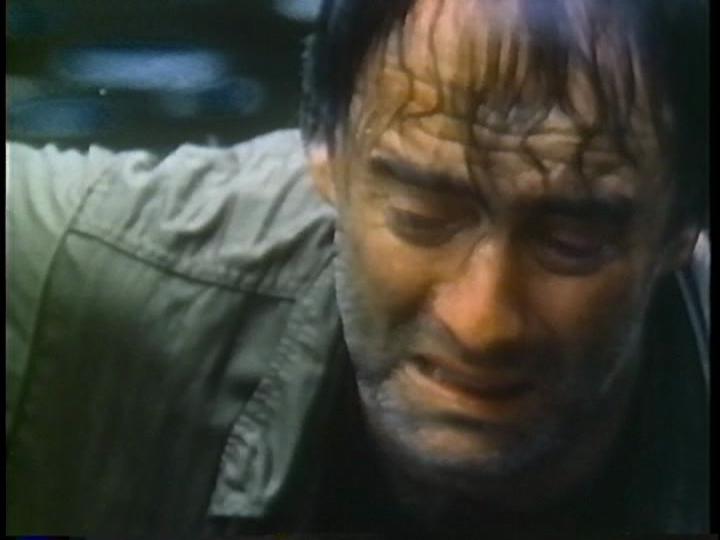
Nabonga (1944)

Grade: D-


It's been a while since we first watched Nabonga, but we'd imagine that some minutes in, we turned to each other with a quizzical look: "What the...Haven't we seen this one before?"

And in fact Nabonga has a lot in common with The White Gorilla, that godawful piece of Crash trash that made our worst list a few entries back. Both involve primates (obviously), stock footage of African wildlife (hardly a surprise), Corrigan himself (in a gorilla suit, natch)...

...and white women worshipped and/or feared by credulous, stereotyped natives. Yep, that's a delightful panino of racism served up from Nabonga's grill, though it could be worse.


Of the two, Nabonga is clearly the better film (not that that's saying much). There's a pleasant edge to its MacGuffin -- a tale of stolen riches, a plane crash, and a crooked father (Herbert Rawlinson) willing to kill to protect himself, his daughter Doreen, and his ill-gotten gains (in whatever order). He may be a murderer and a fiduciary traitor, but at least he loves his kid, right?

You've probably already guessed most of the rest, like the noble explorer Ray Gorman (Buster Crabbe) who goes in search of a mysterious "house with wings" that fell from the sky, or the native Tobo (Prince Modupe) who bravely escorts him, despite his trepidations about the "white witch" living in the jungle.

(Poor Tobo: you behaved with honor and courage, but -- while facing your fears is always a good move -- in this case, sadly, you'll regret that decision.)

Naturally, there's also a cunning rival (Barton MacLane), a morally ambiguous femme fatale (Fifi D'Orsay) -- who wears Mexican peasant blouses, for some reason, and flowers that look like dollar signs --

-- and of course Doreen (Julie London), who's all growed up now and has swapped out her paternal protector for something a bit more...hirsute.

And if you've guessed that it's love at first sight for her and Buster, the answer is a resounding "Yes!"...

...uh, more or less, anyway.

All well and good, but did we really need 60+ minutes to chew on this meager plot before we get to anything resembling real action? Gorilla suits, smiling ladies, and fake crocodile fights aren't remotely enough to sustain Nabonga, which doesn't come close to fulfilling the promise of its initial hook. Some conflict between Gorman and Doreen's father would have given some teeth to proceedings, but as things stand, Nabonga's only real selling point is that it's not The White Gorilla.


Midnight Phantom (1935)

Grade: F


As anyone who's ever watched Adam-12 can tell you, it's hard being a police chief (Jim Farley). You've got to be tough but fair, keep your integrity integrated and your wits about you, and hold the men around you to the highest ethical standards while living up to them yourself.


Oh, and occasionally you have to show off your nipples. There's that, too. (It's a union thing.)

"OK, I've had all I can take -- cover 'em up, Chief."
It's even harder, though, when you know you've got a lot of people who want to kill you -- and Midnight Phantom spends a good three-quarters of its running time making damn sure we know just how many people want to kill Chief Sullivan.

Some highlights from this long list include his own men, tired of getting one too many dressings-down. Several of them make not-so-veiled threats against him -- a serious thing in a tough town where "I'll get you!" isn't an invitation to carpool.

Or there's the sad case of his secretary Kathleen (Barbara Bedford), an attractive woman in the early stages of spinsterhood, who quietly harbors a flame of passion for her middle-aged boss.

Her formidable mother (Mary Foy), mistaking propinquity for iniquity, then proceeds to rain down holy hellfire on the poor chief's head.
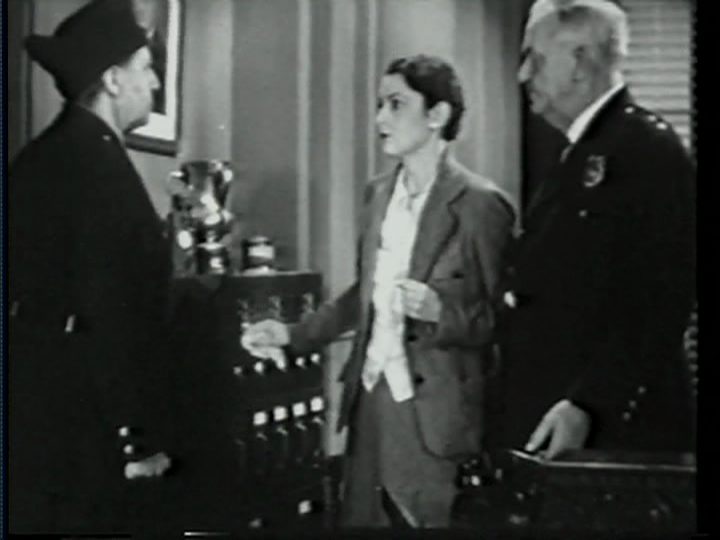
We can't find it at the moment, but one site described Foy as "spectacularly butch" or something along those lines, and that's about right. One part Nona Gaprindashvili and one part Lawrence Dane, she's the sort of woman who says "You'll pay for that!" and leaves you no doubt that it will be so.

And then there's Lieut. Dan Burke (Lloyd Hughes), who's passionately in love with the chief's daughter, Diana (Claudia Dell). The chief even gives his blessing to their marriage, so it seems like blue skies for love, right?

Well, not so fast: there is the minor matter of Burke's criminal brother -- whose existence, once revealed, flits across the plot of Midnight Phantom like that bird what got hit by a baseball that one time. Which is to say, he goes splat, and that's his sole function in the film...

...except, of course, that the whole thing hits the newspapers, and gets poor Lt. Burke the Ted Knight treatment from the chief. Motive for murder? Maaaaaybe.

And then there are all the random criminals who get paraded through the screen at one point -- all so that the famed criminologist Professor David Graham (Reginald Denny, looking rather Scanavino-esque) can do the equivalent of a psychic's "cold reading" on them and suss out their particular brand of lawbreaking. Maybe one of them has manslaughter on the mind?

But one person it can't be is Prof. Graham, no way, no how. Nope. He's such a nice man, and so criminological, you know?

Why, he goes to great lengths to make it clear how OK he is with Diana's imminent marriage, even though he's in love with her! And when given an easy opportunity to undermine Lt. Burke, he doesn't take it, but instead supports Diana! Confronted by a wavering beauty who seeks permission to return to the arms of her beloved, he could've said "What are you, nuts?" but instead, he affirms their love. What a guy.


Anyway, with all these potential foes lurking around, you'd expect the Chief to think to himself "I'm dead meat!", and take appropriate precautions. Or maybe the film would bump him off about halfway through, and we'd have an elaborate series of revelations and counterrevelations to unravel. Right?

Well, no: Midnight Phantom just kinda putzes around for 45 minutes and then, like a college student who procrastinates on a paper until 2:00 a.m. the night before it's due, spends the last 12 minutes hurriedly trying to cobble together some sort of denouement.

Consequently, while any consecutive few minutes of the film are reasonable enough, Midnight Phantom is a complete trainwreck on a structural level, because its fundamental design is disastrously misguided. Its thesis statement is untouched until page 18 of 20; its bungee cord of salvation turns out to be a rubber band.

Such is the mark of a failed film. (It also has a stupid name: every time we've gone through the list of films in our backlog, we've looked at the title and said "Midnight Phantom? What was that?")

So if Midnight Phantom is the booby prize, it seems we are the winners. (Sigh.) But hey, at least it's got soul:

(I know, I know, I know...and now, you supply the other 23! See ya.)

Sunday, April 2, 2017

Great Expectations

Two films that, alas, were not all that we hoped they would be.


Day of the Panther (1988)

Grade: C-


Ozploitation -- that's a new one to me, which makes sense given the term's relatively recent coinage (for a 2008 documentary; wisely shortened from the previously tossed around Aussieploitation). Now, in my mind, this should really mean one of two things: either, the shameful peddling of over-the-top and not-actually-all-that-Australian stereotypes -- à la Outback Steakhouse and Crocodile Dundee -- 

I reckon I'd like a platter of shrimp on the barbie, a six pack 
of Foster's, two jars of Vegemite, and a kilo of fresh baby
for my dingo. Ta!

-- or, the shameful peddling of kangaroos, wallabies, potoroos, and their marsupial brethren for, shall we say, unsavory purposes. (Probably an especially bad idea when it comes to koalas, though.) 

Alas, Ozploitation films are simply schlocky genre flicks -- horror, biker, karate, sexploitation -- made in the 70s and 80s in response to Australia's newly minted R-rating. 


OK, that's not bad at all -- with Mad Max and its Gayboy Berserkers and Smegma Crazies counted among the genre's notables, how could a fellow Ozploit like Day of the Panther be anything less than a joyful, campy romp?

Well, despite the impressive variety of fight sequences crammed into its 84 minute run time, along with a fair sprinkling of laughable fashion and period haircuts, Day of the Panther was no Twister's Revenge. 


That is to say, despite its undeniable 80s-ness and low-budget appeal, it just didn't have the joy we've found in the box*'s other modern offerings, be they low-budget, off-the-rails regional fare, or made-for-TV no-holds-barred cheesefests. 

*Just to be clear, mate, by "box" we mean the Drive-In Movie
Classics, and not our normal 250 Horror Collection stalwart.


It's not without its moments, and it certainly doesn't take itself completely seriously -- how could it with those bumbling, why-the-hell-are-they-even-in-this-movie detectives?

It just tries a bit too hard to be a real kung-fu movie. 


Day of the Panther really wants to wow us with its fight scenes; it only succeeds in making each of them go on for so long that we completely lose interest.

Where is that shadow coming from?
Since the plot is already bare-bones, and the protagonist not terribly compelling (a perpetually-bemused mash-up of Roger Federer and Mario Lopez), the boring action simply drags the entire thing down.

Plus, what's the point of being an Ozploitation film if it doesn't really even look like you're in Australia? Sadly, this one was shot in and around Perth (nothing against you Perth, I'm sure you're a lovely city). No fights on the steps of the Sydney Opera House with the Harbour Bridge in the background, or dune buggy chases around Uluru, pursued by dingoes -- just vaguely tropical scenes that could easily be mistaken for somewhere in south Florida (unless you happen to notice the eucalyptus). 


No kangaroos? That's not alright, mate.

That's not to say that all Australian films should trade on stereotyped Oz-ness (crikey, that would get old). But, if you're going for schlock -- and want to peddle your schlock to the international market -- better to use all the tools at your disposal. Eh, at least there was a snake. 

(Just stay out of the drainpipe, Petey!)


The Creeper [aka Rituals] (1977)

Grade: C+


This one had all the trappings of something we were bound to love. A bunch of our favorite films from the 70s (or at least ones we remember fondly) are set in the great outdoors -- Idaho Transfer, They, Beartoo(t)h, Snowbeast -- so a group of middle-aged doctors heading out into the remote wilderness is a very promising start.


And, not just regular wilderness: majestic, Saint-Ongeian, Canadian wilderness.


That they're going to a place called the "Cauldron of the Moon" is gravy on the poutine: now we have two movies set in places "of the Moon" (though sadly, irl it's just Batchawana Bay, Ontario).


Finally, Stephen King gave The Creeper a plug in Danse Macabre, which is usually a fairly reliable source of good horror from the era.


However, The Creeper just never really seemed to click with us. It may have been the terrible print from Mill Creek, which left a lot of scenes either washed out or completely dark -- a bit of a problem when the setting is supposed to be one of the main sources of menace.


The beginning third was intriguing and suitably scenic, with a fair bit of character building and some witty lines (along with a wonderfully unexpected, 30-years ahead-of-its-time, not-at-all-story-impacting reference to a character being gay, as though it were completely ordinary and not at all taboo -- bravo, writers). The middle third started to drag terribly though (still not helped by the bad print), which made the somewhat muddled and confusing ending seem like even more of a let-down.


Why the disappointment? Well, as alluded to earlier, a lot of these great outdoors horror films use the environment as a central -- if not the central -- source of terror. The Creeper started out this way, and it worked rather well; eventually though, it was as if the writers decided that this wasn't enough, and they cooked up an antagonist with a truly far-fetched backstory, and pinned the whole thing on him.


Thus, it becomes another movie about a completely insane, yet somehow devilishly clever and completely omniscient serial killer (much like the worst episodes of Criminal Minds). I think we both had higher ambitions for how this one would end up, and The Creeper simply fell short.


Don't get me wrong, The Creeper is still worth watching -- especially if you can track down a nicer copy than what Mill Creek offers -- if only to catch a nice performance by Hal Holbrook, and to look at some nice forests in Canada. 


Just don't forget your extra set of boots.


Tuesday, February 21, 2017

Are we a pair?

We don't doubt that some of the themes we use for our posts seem a bit contrived. Truth is, with very rare exceptions, we try to review these movies in the order we watch them, so we'll seize upon anything -- no matter how slight -- to link a pair, trio, or quartet of films together for our purposes.

That said, these next two films have so much in common, you'd almost think you'd queued up the same movie twice in a row. It surely can't be a coincidence that Mill Creek paired them on one side of a disc, for both of them:
  • have capital punishment as a central theme;
  • open with an execution, including a radio broadcast that announces it;
  • have a central character consumed by the injustice he believes he's suffered;
  • have a sweet-natured dullard as a prominent secondary character;
  • show a main character getting slashed by a broken bottle;
  • and involve the framing of an innocent man who's ultimately slated for the electric chair unless something can be done.
We're sure there are more parallels to be had -- courtroom scenes! forbidden love! -- but we trust we've made our case.


Anatomy of a Psycho (1961)

Grade: C-


Angry young man Chet (Darrell Howe) is convinced his brother was wrongfully executed (he wasn't), and seeks revenge on those responsible. But -- what a twist! -- his sister (Pamela Lincoln) is in love with the son of the man whose eyewitness testimony put their brother away. What to do?

Something about Anatomy of a Psycho reminded us of Ed Wood's The Violent Years, so we were pleasantly surprised to learn that Wood may have had a hand in the script of this one too (though the connection is speculative). Of course Anatomy of a Psycho is a better film, but it's also less fun, though at least it has a real edge to its social commentary (unlike Wood's laughable subplot in The Violent Years about communist subversion via schoolroom vandalism).

As Chet, Howe certainly paints a reasonable picture of a man so fulminating with rage as to endanger his sanity -- not to mention his chums.

And there's a cruel logic to Chet's random acts of senseless violence, all of which seem targeted at a world that views him with disdain; though Anatomy of a Psycho is ostensibly a film about an unjust execution and the ensuing paroxysms of revenge, there's clearly a class warfare element in the mix as well.

But something about Anatomy of a Psycho never really engaged us. Maybe the protagonist is too unsympathetic, or the supporting cast too interchangeable; maybe the plot is just too predictable, without enough commitment to see its premise through to a more disturbing end; or maybe we should just watch Rebel Without a Cause or The Wild One again, for a reminder of what a good film about angst-filled hoods can be like.


Buried Alive (1939)

Grade: C+


Another site refers to Buried Alive as a "prison melodrama", and that's about right. Unlike Anatomy of a Psycho -- in which characters living on the outside spend much of their time thinking about those inside -- Buried Alive is set behind bars. Though many of its setpieces happen elsewhere, the prison is the nexus of all the film's activity.

Most of the film's major characters aren't prisoners, however, but prison staff -- among them a kindly chaplain, a friendly doctor, a tormented executioner, and an enlightened warden. All are committed to the penal system and want to see it work as a means of rehabilitation, not merely punishment.

For most of the staff, only one thing occupies their mind more than the prison and its workings, and that's Nurse Joan (Beverly Roberts). Nearly every major character turns out to be in love with her, though we struggle to see the charm -- she has one of those "12-year-old boy boasting about his Pokémon" voices that suggest fried dough sold via an unpowered vehicle, if you catch our drift (and unless you're us or Andrew, you probably don't).

Of course, with all those plum specimens of upstanding bachelorhood drooling over her, Nurse Joan insists on falling for the local bad-boy-with-a-heart-of-gold, Johnny (Paul Wilcox), instead. Convicted of some unspecified crime, he's in for a couple years but is a model prisoner due for imminent release.

And does he like her too? Well, you be the judge:

To the film's credit, not one of the heartbroken also-rans try to undermine Joan and Johnny's love: each recognizes when he's been licked, or at least loves Joan too much to want to sabotage her happiness. 

Or maybe they're just offended seeing such a silly hat aboard a female who's only marginally spunky and certainly isn't a reporter -- who knows.

Instead, the drama in Buried Alive comes from a few unfortunate turns of events that -- coupled with the animus of an unscrupulous reporter and the jealous hatred of a sociopathic inmate -- threaten to ruin everything.

The anti-capital punishment, pro-prison reform message in Buried Alive is hard to miss. But as we've noticed in other films with a political subtext (Our Daily Bread comes to mind), it's otherwise quite optimistic about human nature. True, there will always be snakes in the grass --

-- but the film seems confident that, with the aid of courage and a little ingenuity, basic human decency will win out in the end. (Easy to do, and believe, when you're the one writing the script.)


Unfortunately the film's closing minutes are implausible enough (especially on second viewing) to risk squandering all the goodwill it's built up to that point. But Buried Alive is clearly a cut above the likes of Anatomy of a Psycho, and -- even if it takes a few missteps along the way -- its affirming vision of the world feels reasonably well-earned.