Showing posts with label Poe. Show all posts

Tuesday, August 22, 2017

The 24-hour myth

And now, two films where someone goes to the police for help in finding a vanished lover, but gets turned away for lack of evidence -- at least initially. In one, you already know the plot; in the other, we can hardly say a thing without spoiling it.


The Tell-Tale Heart (1960)

Grade: D+


Well, as we're drawing near the end of the Night Screams subset of the 250-pack (only six left!), it's fair enough to have a film that gives us a real-deal, full-throated night scream.

Of course you already know the plot of The Tell-Tale Heart -- and if somehow you don't, then the opening scene's pulsing floorboards and thumping bass drums constitute advance notice (and a literal flash-forward). It even comes with a warning:
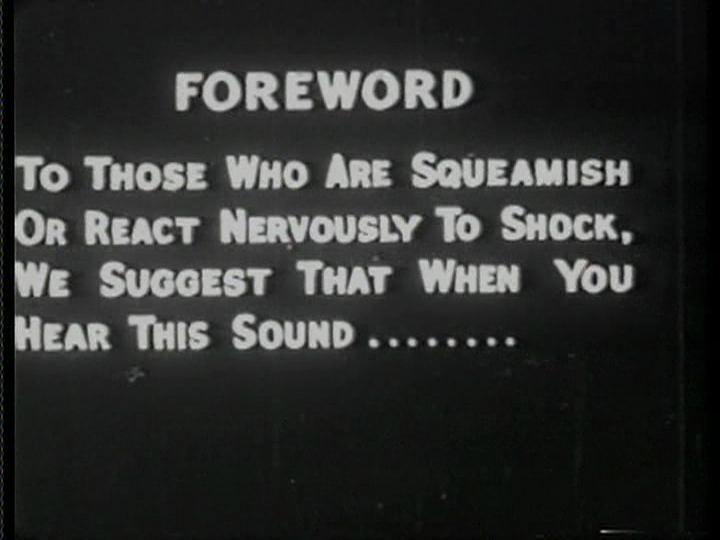
So we have Laurence Payne as Edgar (ha ha), the painfully shy librarian, smitten at first sight by the charms of new neighbor Betty (Adrienne Corri) whom he creepily spies on from his window.

For the inside scoop on Betty, Edgar hits up her landlady (Annette Carell), whose fine-featured face somehow took us by surprise, if only for its unexpected unmatronliness. She looks more like an aristocratic German woman in her mid-thirties, or maybe a teacher at a high-end boarding school, than a working-class property manager.

Anyway, Betty agrees to go out with Edgar, and the ensuing date rivals "Ralph Wiggum walks Lisa Simpson home" for sheer awkwardness.

Still, Betty is the very picture of patience and tolerance -- until Edgar abruptly puts the moves on her at her doorstep. It's pretty gross, and while the idea is clearly to keep Edgar from becoming too sympathetic a character, it also exhausts our ability to care that much about his plight.

On the other hand, he has this great friend, Carl. Everyone likes Carl!

From the moment Edgar starts heaping praise on his friend's head, we know where this is inevitably going, the only mystery being whether the ultimate body count is 1, 2, or 3. The real question is, will getting there be half the fun, or not?

Well, the answer in this case is mostly "not". Though atmospheric and competently made, The Tell-Tale Heart is too obvious for its own good, and too emotionally uninvolving to succeed. The score is particularly heavy-handed, with silly "ba-woomp!" timpani glisses that, in trying to evoke some transfigured version of a heartbeat, end up being just a bit too on the nose.

If we already know what's going to happen, where's the tension in watching Edgar's mind unravel? Is sheer expectation meant to be enough here?

The Tell-Tale Heart does attempt a last-minute Hail Mary to solve its central problem, but as with any other work of fiction that tries the same thing, it just leaves the audience feeling baffled and betrayed. What's left is, as so often the case, a passel of interesting faces, like this overly attached barfly/prostitute --

-- and this blink-and-you'll-miss-it appearance by Frank Thornton, aka Captain Peacock from Are You Being Served?, as a barman:


Wanted: Babysitter (1975)
[aka La Baby Sitter, Scar Tissue, etc.]

Grade: C


It's very difficult to know how to talk about Wanted: Babysitter without completely spoiling it. One thing to say upfront is that this was indeed a color production and is available elsewhere in full color, but -- much like Hannah, Queen of the Vampires -- the Mill Creek copy is in black-and-white for some reason.

Then again, when you're talking about one of the most confusing movies we've seen in recent memory, perhaps the black-and-white isn't such a bad thing -- helping the film to seem unmoored and surreal, rather than just muddled. (It also takes the edge off the score's more saccharine moments.)

There's some real star power aboard in Wanted: Babysitter, like:
  • Maria Schneider, whom you know from that movie (and kudos for her witty remark that she only cooks with olive oil now);
  • Vic Morrow, whom you know because he died in that horrible helicopter accident;
  • and Robert Vaughn, whom you know because his picture is in the dictionary next to the word "glower".
As Michelle, a French sculptor living and working in Rome, Schneider seems likely to be the protagonist. But a lot of the film's initial attention goes to Ann (Sydne Rome), a wounded, vengeful actress whose secrets comprise the movie's two titles (more or less).

Wanted: Babysitter tanked on release, and was given an especially harsh rating by Leonard Maltin, who dismissed it as a "misfired melodrama" with "non-acting" from Schneider. He also criticizes the "miscasting of chubby Italian comedian Renato Pozzetto" as Michelle's boyfriend, which is a fair cop -- his presence is weird and hard to parse, though it's oddly appealing that the guy in her corner is a schlubby albeit determined goofball. Chubby guys with dad bods can be heroes too, after all.

It's quite obvious that the fragmented narrative in Wanted: Babysitter is a deliberate stylistic choice whose consequences, love 'em or hate 'em, are central to the film's structure.

However, the jury's still out when it comes to the movie's persistent failure to establish a clear sense of place -- by which we mean that we often didn't understand where the hell we were, and worse yet, sometimes thought we were in one place before realizing we'd been in another for a good five minutes.

So, is this an intentional move, a question of style...or a sign of directorial incompetence and/or laziness? (Or maybe it's the black-and-white?)

In the midst of all this, we have bunnies, puppies --

-- and a young boy named Boots, which when written out has about the same resonance as "a homeless girl named Dave" (speaking of Britcoms). The child actor playing Boots even gets his very own "introducing John Whittington" moment in the credits, so naturally he doesn't have any other roles to his credit. Maybe he's an assistant manager at a car wash now.

We can tell you that Wanted: Babysitter is a complex, thoughtful movie of the kind that probably rewards multiple viewings. Even watching just the first few minutes over again, we were able to catch numerous details that eluded us -- no doubt intentionally -- on our first pass. It's always nice to watch a film that assumes its viewers are smart, and gives itself permission to imply a great deal more than it says outright. (Think of the brief exchange in Citizen Kane that lays bare the anti-Semitism of his first wife, even though the word "Jew" is never uttered.)

If the movie does have a fatal flaw, though, it probably is somewhere in that combination of Schneider and Pozzetto, especially the former. In situations where Michelle ought to display a sense of urgency and purpose, she instead seems detached and resigned -- so much so that one ends up rolling one's eyes, swearing at the screen, or simply losing one's suspension of disbelief.

Anyway, here's a funny picture of Robert Vaughn in period costume.

And here's a bunny.

Tuesday, July 11, 2017

Skulls sans screams

Yep, both of these films feature a prominent object of the craniomandibular sort -- with and without their accompanying chassis, and fortunately devoid of wearying screams (or Steele).

Fact is, we don't come to learn much of anything about the skulls in question, beyond their simple presence. So alas, Hamlet these movies ain't -- though one of them does feature a Hamlet-esque "play within a play".


Manfish (1956)

Grade: C-

We'll be seeing a fair bit of Creighton Tull Chaney over the next few posts, and -- at least in terms of his bare, middle-aged flesh -- we see the most in Manfish, a film that well may take the cake for the single most deceptive title we've encountered yet.

Now, you're probably imagining some breathless tale of a half-human, half-piscine hybrid. You can see it now, it's either scales from the waist down (too bad it ain't Womanfish, nudge-nudge, know what I mean?) or some fish-mouthed abomination croaking "Please, kill me". Right?

But no, "Manfish" is the name of the boat. YA SRSLY.


Given his age and well-known bad habits, Chaney actually looks pretty good here, in the physique sense -- though in portraying the dull-witted first mate known as Swede, he's still trading on his Lennie persona from Of Mice and Men, nearly two decades later. Oh well, it's a paycheck, and Lon Jr. knows how to play it as well as anyone.

Manfish splices together two of Edgar Allan Poe's stories, "The Gold-Bug" and "The Tell-Tale Heart", and transplants them to the Caribbean to spin its yarn about a treasure hunt, a guilty conscience, and a jacked but thoroughly unlikeable sea captain (John Bromfield) who drives the whole shebang. (It wraps all this in the world's most gratuitous framing story, by the way, but that's soon forgotten.)


Captain Brannigan hunts turtles, which already makes him a bad egg in our book, and really this lying ol' dirty birdy seems to spread misery wherever he goes. He's eking out a living in the Caribbean until he has a confrontation with an aging professor (Victor Jory) and his bored-looking, wonky-eyed consort Alita (Tessa Prendergast) --

-- whereupon he soon develops an acute interest in the professor's sweet ring and his sweet thing.

With this information and the Poe as your guide, if you hazard a guess at the remainder of Manfish's plot you'll probably get it right. Sure, there's tension, betrayal, greed, and angry confrontations galore, but those are essentially condiments, structurally speaking. It's maps, treasure, and post-trangressive psychosis that built this city.

Even so, for the most part Manfish is entertaining enough to watch at least once, and lacks the unpleasant aftertaste of IDGAF cynicism that mars many similar films. The writing and acting are at least serviceable throughout, and the film's underwater sequences are attractively shot...

...though in general it has a habit of letting its wordless outdoor set-pieces -- both above and below the water line -- go on for far too long. Far, far too long. As in, "What the hell is the point of this shit?" too long.

That, and the film's predictability (thanks to its, ahem, Poe-rigins), are the biggest places where Manfish falls down somewhat.

But these aren't lethal flaws in what is otherwise an unexceptional but competent outing. In fact, besides the overlong bits we mentioned above, Manfish is that rare film on this box set that (mostly) didn't make us wish we were watching it for the second time, so that we could reach for the fast-forward button and get it over with faster. Some days, that practically counts as a success in our books.

Add the occasional flashes of warmth or humor that help to liven up proceedings, and though Manfish may be a C-minus film, it's a solid C-minus. You know, the kind that feels like you've accomplished something, even though you'll have to retake the class. Isn't that right, Professor?


Murder at Midnight (1931)

Grade: D

Here's something telling about this film, and it's not a spoiler so don't worry. The title event? Yeah, turns out the clock is set wrong. Take that, Chekhov.

But as you can see there is a gun in Murder at Midnight, which gets used right away as part of an elaborate skit that itself is merely a clue in some rich-people variant of Charades. If that sounds complicated it really isn't, but what's weird is that everyone seems to think it's normal to put on a one-act play, with props and all, just to clue the word "idealize". Once again one is reminded that the rich are, as F. Scott Fitzgerald said, "different from you and me." (But he didn't say it to Hemingway!)

Of our Umbrellahead pair, at least one of us is fond of early talkies and inclined to be charitable toward them. Still, this tale of intrigue and inheritance was too familiar, yet too muddled, for us to enjoy much. The film's chain of murders is probably one link too long to be believable -- and while it may be amusing to watch a highly visible housefly crawling around on an actor's shoulder, it doesn't exactly inspire confidence that this production is a fully-assed affair deserving the benefit of the doubt.

Also, we have to say the trope of the "famous criminologist" is already wearing out its welcome -- understandably so, since he's always going to be the culprit, a red herring, or a Mary Sue. At least Sherlock Holmes was an awkward, grumpy cokehead. And that's not the only familiar trope in Murder at Midnight, not by a long shot (or a long-distance call).

Throw in abundant false leads and a pile of unexplained motivations, and Murder at Midnight starts to feel less like an adventure than an indenture. At least Millie the maid -- played by the troubled, scandal-plagued Alice White -- is kinda cute if you're into that sort of thing, and the butler (Brandon Hurst) is thoroughly buttlesome.

It's fascinating to see what films like these think will pass for "comic relief". In the case of Murder at Midnight, it's a portly plainclothesman assigned to the house (Vernon Dent), who eats a lot of peanuts and drops the shells on the rug.

And...that's pretty much it.

It does inspire a prominent vacuuming scene, though, so if that's your kink go nuts (pun completely unintended!).

It feels mean-spirited to pick on Murder at Midnight, and it's certainly not excruciating to sit through, unlike some others we've seen. Still, even in 1931 the industry knew how to do better than this, and in a murder-mystery there's never an excuse for a script that's foggy in the details. A few funny lines or attractively filmed sequences aren't enough to make Murder at Midnight a truly worthwhile watch.