In the case of these three films, we have not symphonies, but evil schemes that get interrupted -- only to be continued, some time later, by a newcomer's efforts.
(And if that seems like a weak theme -- well, it was either that or "All three films feature sexual assault, attempted or otherwise", and that theme's kind of a downer.)
The Ghost Walks (1934)
Grade: B

After a streak of joyless flicks, it's a treat to watch an unapologetically goofy romp like The Ghost Walks, which -- its inclusion on this "horror" box set aside -- is really a farce with a dollop of mystery and a couple of "spooky" elements.

That said, Mill Creek's print of The Ghost Walks is no treat -- not in the audio domain, at least, as the extremely muffled sound renders much of the dialogue near-incomprehensible. Even after heavy filtering in VLC, there were many lines we simply couldn't make out at all.

We were all set to tell you to watch this copy at Archive.org instead, which has far better sound -- but unfortunately, it turns out that it's missing over three minutes from a key scene early in the film. The edit is non-obvious, but the cut material still has a significant impact on the coherence of the plot, and without it the basic conceit of The Ghost Walks makes significantly less sense.

As for what that conceit is, well...rather than spoil the film with a detailed plot summary, we'll merely say that The Ghost Walks -- like so many before it and since -- revolves around that well-worn device, a dark and stormy night.
This particular DASN opens with bigshot producer Herman Wood and his milquetoast assistant Homer Erskine (played by Richard Carle and Johnny Arthur, respectively). These two New Yorkers are being chauffeured through the storm by a young playwright (John Miljan) who wants Mr. Wood to hear a reading of his new play. But naturally, something goes wrong with the car...

...and, after some kvetching in the rain, the trio end up at a spooky old mansion occupied by a bizarre cast of characters, whose personal dramas and grievances quickly ensnare the visitors.

That said it's the crotchety old Wood and, especially, his neurotic assistant who steal the show throughout. Whether Homer Erskine is meant to be a gay character per se, or simply an effete and cowardly "cream-puff", his stormy relationship with Wood -- getting fired at one moment, sharing a bed the next -- is the core of the film's comedy.
In another film, Erskine's lack of the requisite manly virtues might make him a target of overt ridicule, but here he escapes without major harm or humiliation, and gets the lion's share of the film's zingers as well, e.g.:
"It's a union clock."
"What do you mean?"
"Well, it strikes any old time."
Or:
"Say, I don't like these underground places."
"Well, you may as well get used to it -- you may spend a lot of time in one."
They don't read well in print, but his delivery makes them work.
They don't read well in print, but his delivery makes them work.

However, Wood gets the film's best one-liner when he chokes on a cigar, gets slapped on the back by Erskine, and responds with irritation:
"What's the idea?"
"Why, you were choking terribly!"
(indignantly) "Well, can you do any better?"

Should we read anything beyond the obvious into Erskine's comment -- when offered dinner and a drink by his host -- that he likes "the cocktail part of the program"? Probably not.
But, hard not to raise an eyebrow when another character angrily tells Wood and Erskine that "There's something queer about you both. He winks at you and you wink at me. I don't like it!"

Make time for The Ghost Walks -- but if you can't make out the dialogue, switch to the Archive.org print for the first 17 minutes. Then cut over to Mill Creek from about 15:47 to 19:12, and then go back to Archive.org for the rest.
(Or we think so, at least, since the Mill Creek print runs 64:30 and the Archive.org print clocks in at 63:26. The latter has a longer opening and fewer skips, so that seems to account for the rest of the difference, but we haven't done a scene-for-scene comparison to see what else might be cut from either print.)
The She-Beast (1966)
Grade: C-

Truth be told, we still don't like Barbara Steele. That said, not only does she have very limited screentime in The She-Beast, but in her brief appearance she's used to her best and bitchiest effect, as a snobby newlywed whose husband Philip is a pompous ass of an Englishman (Ian Ogilvy).
For whatever reason, they've opted to take their honeymoon in, all together now:

Of course, the town where they stop for the night turns out to be under an old curse, thanks to an improperly handled witch-killing two centuries prior.

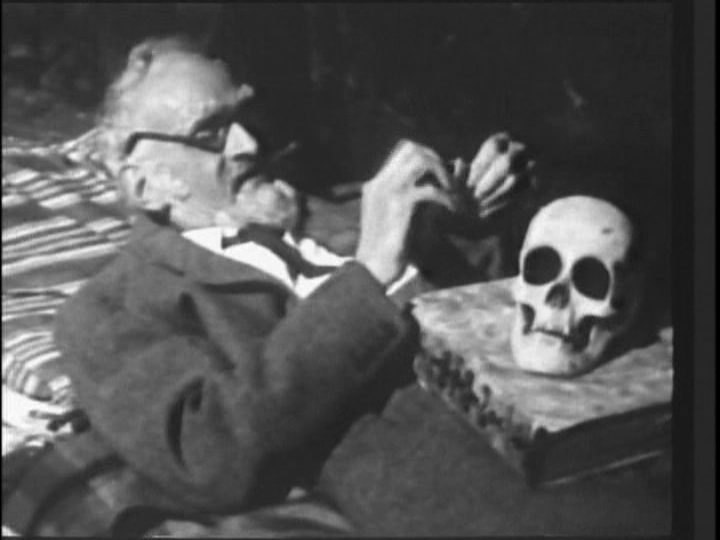
They're helpfully informed of this by none other than Count Van Helsing (John Karlsen), a déclassé Transylvanian nobleman who descends directly from you-know-who. He's more than happy to join them at dinner and order a bottle of Slivovitz on their tab, while boring a thoroughly uninterested Barbara Steele with his family history.
If you know Steele is only onscreen for about 20-30 minutes at the beginning of the film, and another few at the end, you can probably guess how the rest of this one plays out. But one redeeming feature of The She-Beast is its sense of humor, which it uses to constantly poke fun at the absurdities of life behind the Iron Curtain.
These are epitomized by their corrupt and piggish innkeeper, the aptly named Groper (Mel Welles). Early on, Groper gets the living crap beaten out of him by Philip for a Peeping Tom attempt gone disastrously wrong -- which is kind of a nice change from the usual victimization routine.

The thing is, Philip is just kind of a dick in general, and any satisfaction in seeing him pummel Groper into unconsciousness is diminished by his gratingly arrogant, ungrateful behavior toward Van Helsing. Having the protagonist be less than thoroughly likable is a nice twist, but The She-Beast belabors it enough so that Philip's petulant stupidity soon becomes infuriating.

But those irritations -- and a rather gratuitous attempted rape scene -- are alleviated somewhat by a couple interesting twists in the plot, and by the film's lampoons of Romanian life (right at the start of the Ceaușescu period, no less). These give The She-Beast a much-needed infusion of black comedy...

...even if they're not altogether subtle about it.
Curse of the Headless Horseman (1972)
Objective Grade: F
Wavy Gravy Far-Out Grade: C

"It's almost never a good sign when a movie opens with a lengthy voice-over delivering exposition," we wrote recently, and that's no less true of Curse of the Headless Horseman.
Except, maybe, that it's an even worse sign when that VO is saturated in a delay effect that makes the speaker's words nearly incomprehensible. And then, it's paired with an image in which the color process is so clearly misaligned, it's impossible to imagine who could have looked at it and thought, "This is OK, this works, I've done a good job."

For example, feast your eyes on the image above, with bands of red, blue, and yellow appearing in places those colors have no business being, while the bottom of the frame transitions from a weird purple to a colorless gray.
Do you know what the people in that shot are doing? They're eating pizza, that's what.

All told, the first minutes of Curse of the Headless Horseman look as though they were filmed in B&W and then hand-tinted, one primary color at a time, by the lady who so nicely tidied up that fresco of Jesus some years back.
Perhaps it's Mill Creek's fault (hard to see how), but even once things calm down, we get some seriously weird color schemes in this film. In most shots, orange-reds and blues pop out with a brilliant, hyper-real intensity, while other hues are vastly muted by comparison. It's like watching a Tandy Color Computer game come to life.

Or look at the spectrum expressed in this shot. The lead actor is bounded by fields of dark green and purple, while his face looks as orange as an Oompa-Loompa's. What's happening here?

Other sites can give you a play-by-play of the events in Curse of the Headless Horseman; we won't bother. (If you've seen the excellent 1934 film Our Daily Bread, and throw in a couple episodes of Scooby-Doo, you've got the basic idea.) It hovers well past the threshold of incompetence in every way, with no real sense of pacing, thoroughly amateur acting, and a script that makes little sense.

Naturally, all that is also a big part of the film's charm -- though truthfully, despite our indulgent attitude toward it, we often found our attention drooping.

Like The She-Beast, this film has a beast on the loose, a pair of newlyweds as its (ostensible) protagonists...

...and an uncomfortable, extended scene of sexual assault, committed by a man whom another site aptly dubbed "the harmonica rapist", and made worse when he and his victim then become happily coupled: ugh. At least he eventually gets the crap beaten out of him too.

Another common trait with The She-Beast is the incongruous presence of nobility: check out the French "countess" (Ultra Violet) who abruptly shows up mid-film with her Superman lunchbox in tow, only to disappear with little explanation. She's sometimes listed as the star of the film, but Ultra Violet is barely onscreen for five minutes, if that. Billy Curtis's pop-up in Robot Pilot seems inevitable and organic when compared to this celebutante cameo.

Curse of the Headless Horseman is, let's be clear about this, an awful movie. But it's a moderately entertaining form of awful, far more engaging than the likes of Manos: The Hands of Fate, though not as rewarding as (say) Maniac.
If nothing else, its color choices and script decisions are so completely off-the-wall at times that -- despite the distinct lack of foxy in its ladies -- it's worth seeing at least once.