Mention "director William Wilder", and people will think you're referencing the man behind Some Like It Hot, etc., while being weirdly formal about it for some reason. Right?
But no, Billy's real name was...Samuel! Meanwhile, his elder brother was also a director, whose first name was indeed William -- but he went by W. Lee Wilder.
To recap, then: Samuel is Billy, whereas William is W. Lee. And there's no Bimmy, but Mark Dacascos is lurking around here somewhere (holding up a sign saying "Will 'BE-E-E-ER!' for food").
So, it's a case like that of George Waters and Roger Barrett, wherein two closely related artists swap names for some reason (to annoy their biographers, probably).
That said, Roger and Syd have roughly equal claims to fame, while -- as we'll see in this next pair of films from spa-a-a-ace -- one of the Wilder brothers was the dramatically more accomplished of the two. Still, the "other brother" had his charms!
But no, Billy's real name was...Samuel! Meanwhile, his elder brother was also a director, whose first name was indeed William -- but he went by W. Lee Wilder.
To recap, then: Samuel is Billy, whereas William is W. Lee. And there's no Bimmy, but Mark Dacascos is lurking around here somewhere (holding up a sign saying "Will 'BE-E-E-ER!' for food").
So, it's a case like that of George Waters and Roger Barrett, wherein two closely related artists swap names for some reason (to annoy their biographers, probably).
That said, Roger and Syd have roughly equal claims to fame, while -- as we'll see in this next pair of films from spa-a-a-ace -- one of the Wilder brothers was the dramatically more accomplished of the two. Still, the "other brother" had his charms!
Grade: D

It became a dire cliché within a few years, but it's forgivable for a 1954 film to begin with stock footage of a nuclear test. Certainly it was timely, and how else to depict such a thing without CGI (or water tanks and upside-down cameras)?
Still, having your main title come out of the mushroom cloud is probably gilding the lily:

So we have Dr. Doug Martin (Peter Graves), a scientist aboard the unfortunately-named Tarbaby Two, whose job it is to take aerial radiation measurements near the test site. Things are going fine when suddenly, his plane loses control and plummets straight into the ground.

There's no way Dr. Martin could live through a crash like that. When his wife asks if there's any hope, Col. Banks (James Seay) has to tell Mrs. Martin (Barbara Bestar) -- and her unfortunate nose (also Barbara Bestar) -- that there isn't.

But his body is nowhere to be found in the wreckage: what gives? And wait, who's that stumbling up to the guard house?

Yes, it's the man who survives the unsurvivable, revives from the unrevivable, but (to paraphrase one of the greats) "comes back different". A bunch of movies in this box set have already used this trope -- Night of the Blood Beast and The Man with Two Lives come to mind -- but the approach in Killers from Space is a bit more Manchurian Candidate meets Freejack, if you catch our drift.

Either way, as his friend and doctor Major Clift (Shepard Menken) notes, "Your plane was completely demolished, the pilot burned to death -- and you show up, the picture of health!" In fact, the only outward evidence that anything at all has happened to Dr. Martin is a brand-new, yet well-healed surgical scar on his chest.

One nice thing about Killers from Space is that the other characters aren't idiots. They haven't even seen The Twilight Zone, yet only 10 minutes into the film, they're already asking questions like "Did you ever stop to think that perhaps...this Dr. Martin isn't really the Dr. Martin?"
How many times have we seen movies -- or episodes of Star Trek -- where we tore our hair out at characters' contrived obliviousness to such things? Not so with Killers from Space.

Still, Doc Martin seems like himself, knows all the right things to say, and is one of the two key men on this nuclear test project. Couldn't we just reinstate him? What do you think, mysterious googly eyes that just materialized on Venetian blinds for some reason?

The best part of Killers from Space happens over the next 20 minutes or so, as Dr. Martin's behavior becomes more and more erratic, starting with night terrors...

...and ending in acts that could easily be prosecuted as treason, or at least espionage.
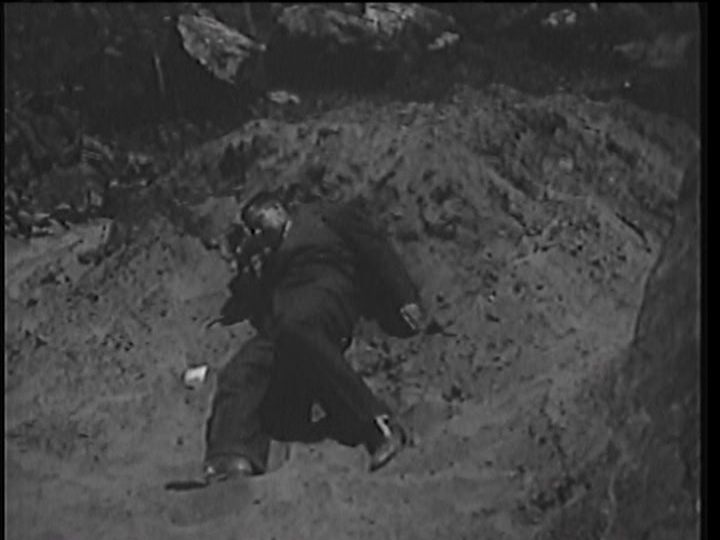
In another film, or a half-hour Twilight Zone episode, Dr. Martin's spiral of self-destruction would take up most of the running time. But we're not even halfway through Killers from Space when Dr. Martin is cornered, captured, given sodium amytal, and asked to recount the events before and after his plane crash.

Now, if you call your movie Killers from Space and don't want to get hunted down by angry filmgoers, sooner or later you're obligated to fulfill the equation. You could throw in meteors, alien microbes, UFOs, whatever you like, even total and obvious nonsense. But it has to be "from spa-a-a-ace".

So, what do F. Lee Wilder and his scriptwriter son Myles have in store for us? Check it:

It's the Marty Feldman family reunion...in spa-a-a-ace!
Well, no, it's actually underground, and (if you haven't guessed it already) this is where things get very silly. At first it's the good kind of silly, because you get things like the above, or this:

Or this:

And heck, if all this amounted to Googly Eyes: The Movie!, then fair enough. By this point the film's already put googlies on a car accident, so doubling down on the proposition would seem reasonable.

But instead, Killers from Space decides to throw its lot in with another, less noble trope of 1950s science-fiction movies...
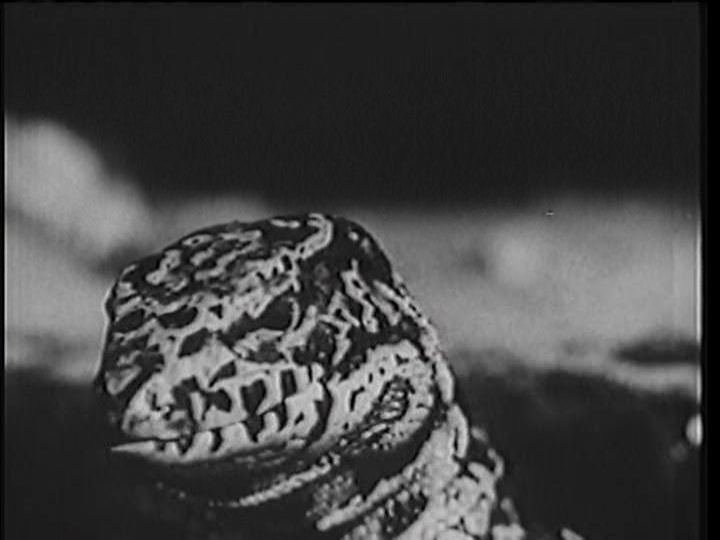
...the "let's use close-up footage of a common animal or insect, and pretend it's a giant beast" one.
We've seen this sort of thing before, of course (sad little mushrooms that we are), but Killers from Space provides the most interminable example we've ever seen. It's hard to believe the core sequence only lasts about 5 minutes -- because those were some long, long minutes.

In many ways the second half of Killers from Space bears an odd resemblance to Teenagers from Outer Space. Just as in Tom Graeff's film, we've got hospitals, giant arthropods, and power stations as keystones in our plot.

But without charismatic leads or a sweet sensibility, there's nothing to sustain Killers from Space once its plot deflates. It's far from the worst, but just doesn't pay off on what could have been an intriguing premise.
By the way, anyone notice that W. Lee Wilder (or his cinematographer) really has a thing for Venetian blinds? They're literally in the last shot of the film, which makes for a nice symmetry with its beginning.

Grade: C-

OK, we complained about the "giant" footage in Killers. But Phantom from Space begins with 20 of the most unpromising minutes we've ever encountered in a film, at least since our Umbrellahead journey began.
Once again, we start out with stock footage and voice-over narration -- the perennial sign of a director whose acquaintance with "show, don't tell" is limited to strip joints -- and then throw in some compasses pirouetting around maps, for kicks.

The MacGuffin, such as it is: an unidentified UFO has streaked across the Pacific Northwest, and is now interfering with radio and TV reception. Send out the mobile units with their detector dishes!

Show their parked cars at bizarre angles for absolutely no discernible reason!

One of the mobile units is flagged down by a distraught woman, Betty Evans, whose aging husband and (ahem) "friend" were just attacked by a mysterious, helmet-wearing man.

Mr. Evans dies, but the friend, Pete, pulls through with merely a bump on the head...and investigators suspect that sketchy extracurriculars are going on between him and Mrs. Evans.
And maybe they are! To the film's credit, it never does rule that one out -- and, if they hadn't been already, there's pretty much no chance they don't start banging after this.

The cops go after Pete aggressively, especially once he claims the occupant of the helmet appeared to have no head. Handed a fish story like that, they feel comfortable writing the whole affair off as "one of those things...pretty girl, older husband, young boarder."

But then new bodies turn up, and new testimonials confirm Pete and Betty's story. Hmmm, could all this have anything to do with the UFO? And what are "Ten-Ring Tips", anyway?
(Answer: it's a Smith & Wesson poster, apparently very collectible nowadays.)

What's the logical next step? Bring in the military and the scientists, so they can speculate at each other in claustrophobic rooms with (once again) lots of Venetian blinds, and offer up lines like "This guy's walking around in a monkey suit...killing people."

All this had us groaning in dismay, and bracing ourselves for yet another mind-numbing cheapo with tons of talky exposition and very little action -- you know, like The Snow Creature (also a W. Lee Wilder joint).

But then something happened that was totally unexpected: Phantom from Space became...engaging. Not good, exactly, but taut enough to hold our interest and keep us from guessing exactly where the narrative was going next.

And the dialogue had a few crisp moments, like the moment when scientist Dr. Wyatt (Rudolph Anders) introduces sexy scientist Barbara Randall (Noreen Nash) to Lt. Bowers (Harry Landers). Noting Bowers's Tex Avery-like response, Dr. Wyatt adds a quick and pointed addendum:
"I don't believe you have met my assistant, Barbara Randall...(pause)...it's Mrs. Randall, Lieutenant!"

And that's the end of that: no subplot, no sexual tension, no convenient killing of Mr. Randall by the monster. Who knows if Bowers had a chance if things were different, but they're not, and that's kind of refreshing.
On the other hand, Major Andrews (James Seay again!) certainly doesn't have a chance if -- as IMDb's "Goofs" page suspects -- he unleashed a silent tide of flatulence on-camera. That would explain why, in the middle of an innocuous scene, Noreen Nash suddenly shoots him a series of very dirty looks. James Seay, disappointer of women and their noses.

Unfortunately most of Phantom's intriguing threads turn out to be little more than shaggy-dog stories...

...like the rhythmic, coded tapping of a pair of scissors, which had us guessing: is it the atomic number of an element? A known mathematical series? A mangled version of the intro to "YYZ" by Rush?

Alas, the film never bothers to tell us -- which adds an element of realism, we suppose, but also makes for a less satisfying story.
Still, at least we get some more weird-ass camera angles.


