Showing posts with label I'm going to tell them all about you. Show all posts

Monday, January 11, 2021

Put our service to the test

Though neither of these films is a Mill Creek joint, we initially took an interest in them because of their connection to the Horror Collection 250-pack. One features an actress we first met in the earliest days of our site, while the other is ostensibly a sequel to one of our favorite movies on the box.

However, we didn't foresee that they'd share something else: protagonists who find themselves in the crosshairs of that most terrifying of locations --

--that most bone-chilling of phrases --

-- that limitless vein of potential awkwardnesses and unwanted socializations:

"You can stay in our guest room."


    The Three Weird Sisters (1948)

    Grade: C+

    Ah, Nova Pilbeam. Even if your name weren't so unusual, we'd certainly remember you from your star turn in Counterblast, not to mention your strong resemblance to a former colleague of ours (at least in that colleague's younger days: you wouldn't recognize 'em now).


    And speaking of younger days, it's not clear whether this or Counterblast was Pilbeam's last film role -- though she did make one BBC appearance in 1951 before packing it in for good -- but after a successful career as a child actress, and a reasonable career as a young adult, that was that.

    She lived to age 95 -- when we wrote our Counterblast review, she was still alive! -- but was, from all reports, not interested in discussing the past. (Makes sense when your name is "new".)


    Anyway, Ms. Pilbeam is Claire (no relation to Emily) Prentiss, a secretary who accompanies her obstreperous boss Owen Morgan-Vaughan (Raymond Lovell) to a Welsh mining village, Cwmglas, where his (ahem) three weird sisters await his arrival at the family home.

    (Technically they're his weird half-sisters, but that wouldn't have the same ring, now would it?)

    One is blind, one deaf, and one has some combination of bad nerves and severe arthritis, resulting in a strange symbiotic interdependency between the three.


    In the film's opening Cwmglas suffers a catastrophic collapse in which several residents die, and survivors opine on the will of God and the suffering of the proletariat.

    While hard to follow on first viewing, a quick review of Dylan Thomas: The Complete Screenplays (which also told us how to spell "Cwmglas") makes the details clear. The Morgan-Vaughans are the local muckety-mucks who made their fortune via the mines, while their cheapskate refusal to fill up unused mineshafts beneath the village caused, or at least contributed to, the collapse.


    For a while, The Three Weird Sisters is poised on a knife-edge of ambiguity: is Owen just a callous bastard who selfishly wants to wash his hands of all responsibility toward the village? (Given that Owen gets a rock flung at him upon arrival, some of the townspeople clearly hold the affirmative.)


    Or is Cwmglas -- the name of which sounds like a "worst of Reddit" thread in the making -- just a decrepit symbol of the corrupt, hopeless old ways? A decaying relic that's undeserving of life support and overdue for destruction? Merely a vessel for a "spent force", one might say?


    With Dylan Thomas on board, some sophistication (moral and otherwise) is to be expected. Ultimately, though, the lines are drawn by the participants' willingness to sacrifice innocent Claire in the crossfire -- and given that one of the sisters describes her as "that horrible painted young woman", one need not be exceedingly wise to infer who the baddies are.


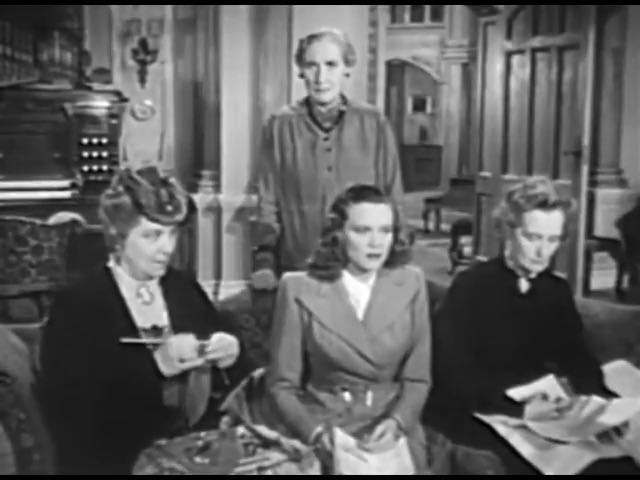
    So what does that leave us? Suspense, atmosphere, intrigue, and barbed dialogue, we suppose, none of which are extraordinary but all of which are at least serviceable. And we get faces, if one likes faces (as we do), ranging from Ms. Pilbeam's ever-popular visage --


    -- to the sisters, especially Gertrude (Nancy Price), whose forbidding countenance somehow intrinsically evokes those stony, mirthless parts of Britain where God's name is perpetually on everyone's lips and yet the old pagan powers feel close at hand.


    Or there's this preacher (Hugh Pryse) in his ridiculous middle-aged makeup:


    And we get amusing vignettes, as when we find the thersitical Mabli (Hugh Griffith) reciting Marxist dogma to, well, dogs:


    Structurally speaking, The Three Weird Sisters is a film-you've-seen-before -- if you understand what we mean -- and offers no great innovation or dramatic uncertainty. So your appreciation of it will likely depend on your affinity for the Welsh coat of paint it's received, and/or your fondness for Dylan Thomas, Welsh terriers, Nova Pilbeam, or handsome older women.

    (No judgment, you do you.)


    Devil Bat's Daughter (1946)

    Grade: D+


    When you expect a film to be a complete piece of crap, it sure is a pleasant surprise when it's not. That's not to say Devil Bat's Daughter even comes close to its predecessor, The Devil Bat, the consensus favorite among Béla Lugosi's Poverty Row efforts (and we agree that it holds up).


    We can't help but be curious why Devil Bat's Daughter was even made. Was a five-year-old film really enough of a success to call for a sequel? That is: if this was a cynical cash-in, what exactly was there to cash in upon in the first place?


    In any event, Devil Bat's Daughter has little to do with the earlier film, though we can't quite call it an "in-name-only" sequel. Instead it runs along similar lines to Shock, with a traumatized young woman, Nina (Rosemary La Planche), guided through recovery by the authoritarian Dr. Clifton Morris (Michael Hale), who may not have her best interests at heart.


    We're not sure whether having a patient living in your home was considered a ridiculous violation of professional boundaries in 1946, though from our vantage point 75 years later, it seems absurd. But living in Dr. Morris's home brings Nina into contact with his saintly wife Ellen (Molly Lamont) and stepson Ted (John James), and guess which one of them falls in love with her?


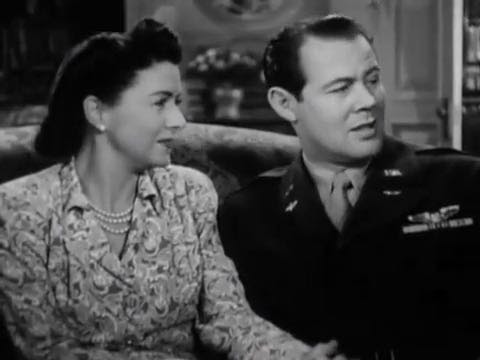
    ...no, this is 1946, try again. Though we will say that Ms. Lamont, who hasn't necessarily lit up our screen in movies like Scared to Death and Jungle Girl, evinces a degree of angular classical beauty in this film --

    -- while, by contrast, Ms. La Planche's past as a Miss America merely underscores how tastes have changed.


    But better either of them than John James, who unfortunately evokes the irritating Jerry Lester -- plus a dash of Mickey Rooney, a sprinkling of Tim Allen, a dusting of John Heard. Those old-young faces are a tough sell.


    If one acknowledges that the major plot points of Devil Bat's Daughter are foreseeable, there are a few things that deviate from the expected path. One of them is the body count, or more accurately, the body-count-to-emotional-consequence ratio, which is unexpectedly brutal. Not a film for dog lovers, this, though we're always glad to see a movie go for the jugular.


    On the other hand, Devil Bat's Daughter commits an absolutely monstrous act of retconning that, under normal circumstances, should be unforgivable. So instead, we'll forgive it by allowing ourselves to pretend that the literal meaning of the revelation -- which would utterly destroy both this movie and the previous one -- is untrue, and that the character who announces it is mistaken. And frankly, the movie still works if you assume that.


    Still, while our initial impulse was to give this one a C-minus, it really needs to be penalized for that misstep. Otherwise, we were shocked to find that we enjoyed Devil Bat's Daughter. It's a predictable and flawed film, but manages to entertain nonetheless -- if you have very low standards, as we seem to these days.


    Tuesday, August 8, 2017

    Back to the Slaughterhouse

    Up next are two* more Tod Slaughter movies from the Night Screams subset of the Mill Creek box set.*

    Plus, as a bonus, we review a feature film* of his that hadn't been seen for decades, until it resurfaced last year.

    (*Well, sort of -- on all counts! -- see below.)


    The Ticket of Leave Man (1937)

    Grade: B-


    Traffic in human depravity though he may, there's something oddly comforting about knowing you're about to watch a Tod Slaughter film. Partly it's the familiarity of seeing the same faces over and over again, until they blend together in a pleasantly delirious haze, wherein names become less important than structural functions.

    So it doesn't matter that Marjorie Taylor is called "May Edwards" in this particular film, because it's just another instantiation of her archetypical role as "the woman Tod Slaughter wants to sleep with, thereby making her very uncomfortable".

    (Someone should start a Tumblr called "Tod Slaughter making women very uncomfortable.")

    This film (The Ticket of Leave Man) and the next (The Face at the Window) blend together even more than most, since they both involve a lot of the same plot points. There's a mysterious criminal named for a dangerous animal, who hides in plain sight by masquerading as an affluent and upstanding citizen. There's a beautiful woman whose charms attract the unwanted attention of said murderer.

    And there's an honest young man (John Edwards) employed at a bank -- and in love with said young woman -- who runs afoul of the law when he's falsely accused of one or more heinous crimes.

    In this case, the honest young man even gets thrown in prison, though he's paroled before too terribly long. This makes him the titular "ticket of leave man", a phrase totally unfamiliar to us before this film.

    To help us differentiate it from other Slaughter films, The Ticket of Leave Man has some striking secondary characters, like this creepy, cigar-smoking child-man...

    ...or this unambiguously anti-Semitic caricature:

    We're hardly the sort to grasp at straws in the name of self-righteousness, but it's not as if there's a scintilla of doubt when it comes to Frank Cochran's portrayal of counterfeiter Melter Moss, or what stereotype it's meant to evoke. Given that he only had three IMDb credits -- one of them for the role of "Ho Tang", we kid you not -- we're guessing Cochran may have been mainly a stage actor, who apparently specialized in ethnoculturally insensitive roles.

    The Ticket of Leave Man is a close cousin to It's Never Too Late to Mend, and probably a notch better than that preachier effort. And we get Slaughter with and without mustache, which is always a plus. But we're docking a few points for Melter Moss: OK, we don't know from 1930s Britain, but we want they should do better than that, no?


    The Face at the Window (1939)

    Grade: C-

    So, when we pulled out Disc 46 of our 250-movie box set to watch The Face at the Window, we were greeted by this:

    And this:

    Yes, it seems that instead of giving us Disc 46 of the Horror Collection, Mill Creek accidentally gave us Disc 46 of the Western Legends Movie Pack. Oh, well.

    Fortunately, all four films on Disc 46 are available for viewing on YouTube and other sites -- which means that, for our next few posts, the screenshots you see won't be from the Mill Creek box. Unfortunately our downloaded source for The Face at the Window is by far the worst of the four, yielding blurry, artifacted results like this:

    It was still watchable (barely), but the poor video quality probably detracted from our enjoyment of The Face at the Window -- though, don't get us wrong, we're grateful to the uploader nonetheless. 

    Another demerit is the supernatural element in this tale, first hinted at in the opening text crawl:

    Then, later, we get a bunch of flasks and beakers, and you know what that means. That's right: science.

    Somehow, the inclusion of lycanthropy (sort of) and galvanism dampens the fun -- perhaps because the necessary pseudo-scientific handwaving undermines the classical purity, if you will, of Slaughter's Grand Guignol act.

    Or then again, maybe it's that the protagonists too often act like blithering idiots, repeatedly contriving to make the stupidest possible choice in order to serve the needs of the plot? That made it hard to care much about their fates.

    But hey, at least we have another entry for our Tumblr.


    King of the Underworld (1952)

    Grade: C+


    This "movie" is actually an edited compilation of the first three episodes of a British TV series, Inspector Morley Investigates -- aka Inspector Morley (Late of Scotland Yard) Investigates, depending on whom you ask.

    However, Inspector Morley was never actually broadcast in Britain: though a full run of 13 episodes was wrapped, the producers were apparently unable to sell the show to the BBC.

    Instead, they sold it to the American market -- where it was apparently broadcast for at least one run -- but also took six of the episodes they'd filmed and combined them into two features, King of the Underworld and Murder at Scotland Yard, which were shown in the U.K. (Confused yet?)

    The latter feature, and the majority of the episodes, remain lost as of this writing -- but may yet lurk in someone's vault or collection.

    You can find more information about the series, including the three other surviving episodes, here. In any event it was a very pleasant surprise when King of the Underworld was unexpectedly shown last year on a British TV station, and we're very grateful to the colleague who was kind enough to provide us with a DVD of the broadcast.

    Slaughter plays Terence Reilly, an irrepressibly evil criminal mastermind, and it's nice to see that age hasn't robbed him of his panache or physical presence. Though Inspector Morley solves a fresh case in each episode, some aspect of the crime will inevitably reveal Reilly's sinister fingerprints.

    And unlike Slaughter's other characters, Reilly doesn't generally let his wang overrule his brain -- making him far more dangerous.

    Opposing Reilly's schemes are Inspector John Morley (Patrick Barr), naturally, as well as his crackerjack assistant Eileen Trotter (Tucker McGuire). Quick-witted and sharp-tongued, Eileen bears no small resemblance to Harriet Sansom Harris (best known for her recurring role on Frasier as Machiavellian agent Bebe Glazer).


    In actuality, King of the Underworld doesn't "read" as a feature film at all. The edits (and voiceover narration) that combine the three episodes aren't crude, but certainly aren't seamless, and even contemporary audiences unaware of the film's origins could hardly have been fooled. Still, Slaughter's presence -- he was in every episode of Inspector Morley -- provides enough continuity to forge a reasonably plausible Holmes vs. Moriarty storyline.

    That said, the quality of the writing isn't great, and leans too heavily on a handful of gimmicks -- especially disguises -- whose plausibility stretches thin with reuse. Also, Morley himself isn't really as clever as he ought to be, sometimes letting slip information that can only harm him or his colleagues: after Eileen successfully tricks Reilly, why on earth would the Inspector then reveal her identity to him? What purpose does it serve, except perhaps to gloat?

    We've seen the other, later episodes of Inspector Morley Investigates that survive, and we're sorry to say that in those, Eileen is woefully underused and dumbed-down. Here, though, she's a real firecracker. Independent-minded, and (ahem) oddly sexy, she's arguably a better foil to Slaughter than Morley himself. Certainly, she's almost as responsible for solving their cases as Morley is.

    So naturally, the writers ensure that Eileen eventually gets into deep trouble and has to be rescued. Così fan tutte.

    Tod Slaughter fans will be this film's main audience, but Tucker McGuire's fun portrayal means there are two good reasons to seek out King of the Underworld. Otherwise it's largely a standard affair and a period piece -- but as fresh documentation of a great actor's career, it's like rediscovering a home movie you'd forgotten about.

    Monday, July 31, 2017

    Bucking the critics

    For the following two films, critical consensus -- at least in the form of IMDb ratings and comments -- seems to go one way. As you'll see from these reviews, we go another.


    The Shadow of Silk Lennox (1935)

    Grade: D+

    The Shadow of Silk Lennox is the fifth film with Lon Chaney Jr. in this box set, though not quite the last (since Bride of the Gorilla will show up in the final subset, 50 Sci-Fi Classics).

    Naturally Chaney is our title character, a deceptively genial gangster whose moniker comes from his corny catchphrase: whenever anyone asks after him, the reply is that things are "smooth as silk". Uh-huh. Owner of several nightclubs, he's also the mastermind behind the heists and hold-up jobs plaguing the city of Wherever-This-Is.

    Most of the action takes place in and around the clubs, though, where two young lovebirds (Dean Benton and Marie Burton) twitter away on stage. Once offstage, they inevitably get mixed up in Lennox's tangled web.

    Soon enough, you've got murder, deception, and the obligatory racist caricature.

    IMDb's reviewer base seems to have decided The Shadow of Silk Lennox is uncommonly poor, but we didn't much mind it. Maybe we haven't seen enough 1930s gangster films (not that we feel compelled to go much deeper than we already have), but while a weaker effort than some, it's hardly a disaster -- just a by-the-numbers affair, plus one or two twists we frankly didn't see coming until they were almost on top of us.

    It also amused us to see either (a) what passed for nightclub entertainment in the 1930s, or (b) what the makers of this film thought would pass for nightclub entertainment in the 1930s: not sure which. While you can't hear the music in the screenshot, the faces speak volumes!


    The Crooked Circle (1932)

    Grade: F

    You know, we sort of enjoyed ZaSu Pitts in Strangers of the Evening. Her screentime was limited to a light sprinkling, yielding a film with just the right amount of her forlorn persona: that is, enough to add a quirky twist to proceedings, but not so as to wear out its welcome.

    But with a much larger role in The Crooked Circle, Pitts's mournful presence soon becomes a plague. It's hard to imagine an audience to whom her constant handwringing and cries of "Oh!" were a laff riot; for us, they were infuriating.

    Same goes for her catchphrase, "Something always happens to somebody!" Sure, we've seen films in which a repeated line becomes a kind of leitmotif that gets funnier as it recurs in more and more unlikely contexts -- but here, it was an irritating contrivance.

    (Maybe she should swap with Silk Lennox? Come to think of it, a catchphrase transplant would improve both films.)

    And contrived is the word that defines The Crooked Circle, a movie that really seems to have no idea what it's doing or why. "Good old fashioned fun!" says a typical review on IMDb, but that wasn't our experience, to put it politely: this film is torture, awkward and interminable, like watching a bad improv company's attempt at creating an hour-long comic mystery on the fly.

    The pacing is trash, the direction and editing are awful, and as K. quite rightly noted, the actors often seem to have no idea what their lines mean. Characters come and go with little explanation, transitions are botched, and cutaways serve to confuse the narrative without intensifying it.

    Oddly enough the plot itself -- concerning a clash between a society of amateur detectives and the titular criminal cabal -- isn't so bad, or at least makes a kind of sense, with a decent-if-foreseeable twist near the end. But the script lacks formal rhythm, and whatever energy it picks up is soon squandered: a clever sequence in which hero Brand Osborne (Ben Lyon) gets outfoxed is immediately followed by a scene in which the consequences of that outfoxing are instantly undone. Way to keep the tension, bro.

    Some faint specks of light (we can't quite call them bright spots) emerge in The Crooked Circle. Of the two lines of dialogue that graduate to the level of vaguely amusing, one is Pitts's deadpan definition of a myth as "a female moth", and the other comes in a policeman's description of his hard-bitten criminal foes:

    "They wasn't born, they was quarried."


    Another faint speck is Irene Purcell, underutilized but still appealing as Thelma, Osborne's cipher of a girlfriend. Her short-lived career seems to be fondly remembered by a few film buffs, and it's a shame this turkey was her last role.

    None of this is enough to salvage this car crash of a movie -- and we haven't even talked about the tired spooky-old-house and famous-criminologist tropes in which it traffics. (On the latter tip, that's C. Henry Gordon above as Yoganda, the "Indian" sleuth whose name inevitably gets misheard as an African country.)

    All the more bizarre, then, that The Crooked Circle holds a unique honor: if IMDb is telling the truth, it was the first feature film ever broadcast on television. What an inauspicious start for the new medium!