Showing posts with label faithful assistant. Show all posts

Tuesday, August 22, 2017

The 24-hour myth

And now, two films where someone goes to the police for help in finding a vanished lover, but gets turned away for lack of evidence -- at least initially. In one, you already know the plot; in the other, we can hardly say a thing without spoiling it.


The Tell-Tale Heart (1960)

Grade: D+


Well, as we're drawing near the end of the Night Screams subset of the 250-pack (only six left!), it's fair enough to have a film that gives us a real-deal, full-throated night scream.

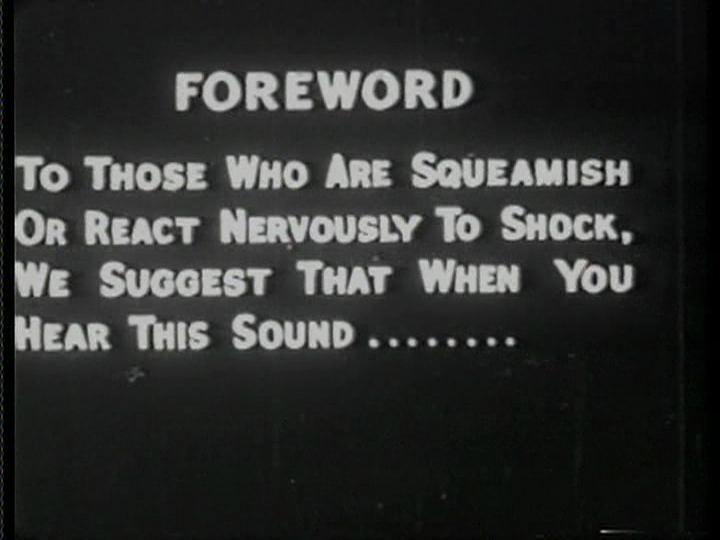
Of course you already know the plot of The Tell-Tale Heart -- and if somehow you don't, then the opening scene's pulsing floorboards and thumping bass drums constitute advance notice (and a literal flash-forward). It even comes with a warning:
So we have Laurence Payne as Edgar (ha ha), the painfully shy librarian, smitten at first sight by the charms of new neighbor Betty (Adrienne Corri) whom he creepily spies on from his window.

For the inside scoop on Betty, Edgar hits up her landlady (Annette Carell), whose fine-featured face somehow took us by surprise, if only for its unexpected unmatronliness. She looks more like an aristocratic German woman in her mid-thirties, or maybe a teacher at a high-end boarding school, than a working-class property manager.

Anyway, Betty agrees to go out with Edgar, and the ensuing date rivals "Ralph Wiggum walks Lisa Simpson home" for sheer awkwardness.

Still, Betty is the very picture of patience and tolerance -- until Edgar abruptly puts the moves on her at her doorstep. It's pretty gross, and while the idea is clearly to keep Edgar from becoming too sympathetic a character, it also exhausts our ability to care that much about his plight.

On the other hand, he has this great friend, Carl. Everyone likes Carl!

From the moment Edgar starts heaping praise on his friend's head, we know where this is inevitably going, the only mystery being whether the ultimate body count is 1, 2, or 3. The real question is, will getting there be half the fun, or not?

Well, the answer in this case is mostly "not". Though atmospheric and competently made, The Tell-Tale Heart is too obvious for its own good, and too emotionally uninvolving to succeed. The score is particularly heavy-handed, with silly "ba-woomp!" timpani glisses that, in trying to evoke some transfigured version of a heartbeat, end up being just a bit too on the nose.

If we already know what's going to happen, where's the tension in watching Edgar's mind unravel? Is sheer expectation meant to be enough here?

The Tell-Tale Heart does attempt a last-minute Hail Mary to solve its central problem, but as with any other work of fiction that tries the same thing, it just leaves the audience feeling baffled and betrayed. What's left is, as so often the case, a passel of interesting faces, like this overly attached barfly/prostitute --

-- and this blink-and-you'll-miss-it appearance by Frank Thornton, aka Captain Peacock from Are You Being Served?, as a barman:


Wanted: Babysitter (1975)
[aka La Baby Sitter, Scar Tissue, etc.]

Grade: C


It's very difficult to know how to talk about Wanted: Babysitter without completely spoiling it. One thing to say upfront is that this was indeed a color production and is available elsewhere in full color, but -- much like Hannah, Queen of the Vampires -- the Mill Creek copy is in black-and-white for some reason.

Then again, when you're talking about one of the most confusing movies we've seen in recent memory, perhaps the black-and-white isn't such a bad thing -- helping the film to seem unmoored and surreal, rather than just muddled. (It also takes the edge off the score's more saccharine moments.)

There's some real star power aboard in Wanted: Babysitter, like:
  • Maria Schneider, whom you know from that movie (and kudos for her witty remark that she only cooks with olive oil now);
  • Vic Morrow, whom you know because he died in that horrible helicopter accident;
  • and Robert Vaughn, whom you know because his picture is in the dictionary next to the word "glower".
As Michelle, a French sculptor living and working in Rome, Schneider seems likely to be the protagonist. But a lot of the film's initial attention goes to Ann (Sydne Rome), a wounded, vengeful actress whose secrets comprise the movie's two titles (more or less).

Wanted: Babysitter tanked on release, and was given an especially harsh rating by Leonard Maltin, who dismissed it as a "misfired melodrama" with "non-acting" from Schneider. He also criticizes the "miscasting of chubby Italian comedian Renato Pozzetto" as Michelle's boyfriend, which is a fair cop -- his presence is weird and hard to parse, though it's oddly appealing that the guy in her corner is a schlubby albeit determined goofball. Chubby guys with dad bods can be heroes too, after all.
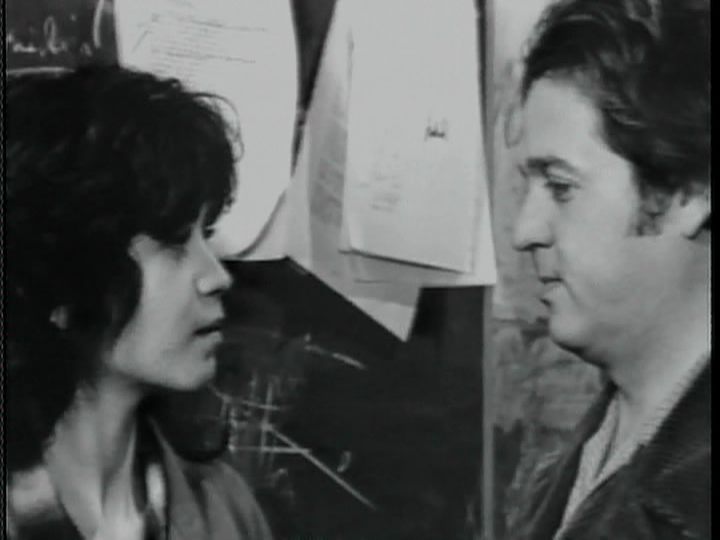
It's quite obvious that the fragmented narrative in Wanted: Babysitter is a deliberate stylistic choice whose consequences, love 'em or hate 'em, are central to the film's structure.

However, the jury's still out when it comes to the movie's persistent failure to establish a clear sense of place -- by which we mean that we often didn't understand where the hell we were, and worse yet, sometimes thought we were in one place before realizing we'd been in another for a good five minutes.

So, is this an intentional move, a question of style...or a sign of directorial incompetence and/or laziness? (Or maybe it's the black-and-white?)

In the midst of all this, we have bunnies, puppies --

-- and a young boy named Boots, which when written out has about the same resonance as "a homeless girl named Dave" (speaking of Britcoms). The child actor playing Boots even gets his very own "introducing John Whittington" moment in the credits, so naturally he doesn't have any other roles to his credit. Maybe he's an assistant manager at a car wash now.

We can tell you that Wanted: Babysitter is a complex, thoughtful movie of the kind that probably rewards multiple viewings. Even watching just the first few minutes over again, we were able to catch numerous details that eluded us -- no doubt intentionally -- on our first pass. It's always nice to watch a film that assumes its viewers are smart, and gives itself permission to imply a great deal more than it says outright. (Think of the brief exchange in Citizen Kane that lays bare the anti-Semitism of his first wife, even though the word "Jew" is never uttered.)

If the movie does have a fatal flaw, though, it probably is somewhere in that combination of Schneider and Pozzetto, especially the former. In situations where Michelle ought to display a sense of urgency and purpose, she instead seems detached and resigned -- so much so that one ends up rolling one's eyes, swearing at the screen, or simply losing one's suspension of disbelief.

Anyway, here's a funny picture of Robert Vaughn in period costume.

And here's a bunny.

Tuesday, August 8, 2017

Back to the Slaughterhouse

Up next are two* more Tod Slaughter movies from the Night Screams subset of the Mill Creek box set.*

Plus, as a bonus, we review a feature film* of his that hadn't been seen for decades, until it resurfaced last year.

(*Well, sort of -- on all counts! -- see below.)


The Ticket of Leave Man (1937)

Grade: B-


Traffic in human depravity though he may, there's something oddly comforting about knowing you're about to watch a Tod Slaughter film. Partly it's the familiarity of seeing the same faces over and over again, until they blend together in a pleasantly delirious haze, wherein names become less important than structural functions.

So it doesn't matter that Marjorie Taylor is called "May Edwards" in this particular film, because it's just another instantiation of her archetypical role as "the woman Tod Slaughter wants to sleep with, thereby making her very uncomfortable".

(Someone should start a Tumblr called "Tod Slaughter making women very uncomfortable.")

This film (The Ticket of Leave Man) and the next (The Face at the Window) blend together even more than most, since they both involve a lot of the same plot points. There's a mysterious criminal named for a dangerous animal, who hides in plain sight by masquerading as an affluent and upstanding citizen. There's a beautiful woman whose charms attract the unwanted attention of said murderer.

And there's an honest young man (John Edwards) employed at a bank -- and in love with said young woman -- who runs afoul of the law when he's falsely accused of one or more heinous crimes.

In this case, the honest young man even gets thrown in prison, though he's paroled before too terribly long. This makes him the titular "ticket of leave man", a phrase totally unfamiliar to us before this film.

To help us differentiate it from other Slaughter films, The Ticket of Leave Man has some striking secondary characters, like this creepy, cigar-smoking child-man...

...or this unambiguously anti-Semitic caricature:

We're hardly the sort to grasp at straws in the name of self-righteousness, but it's not as if there's a scintilla of doubt when it comes to Frank Cochran's portrayal of counterfeiter Melter Moss, or what stereotype it's meant to evoke. Given that he only had three IMDb credits -- one of them for the role of "Ho Tang", we kid you not -- we're guessing Cochran may have been mainly a stage actor, who apparently specialized in ethnoculturally insensitive roles.

The Ticket of Leave Man is a close cousin to It's Never Too Late to Mend, and probably a notch better than that preachier effort. And we get Slaughter with and without mustache, which is always a plus. But we're docking a few points for Melter Moss: OK, we don't know from 1930s Britain, but we want they should do better than that, no?


The Face at the Window (1939)

Grade: C-

So, when we pulled out Disc 46 of our 250-movie box set to watch The Face at the Window, we were greeted by this:

And this:

Yes, it seems that instead of giving us Disc 46 of the Horror Collection, Mill Creek accidentally gave us Disc 46 of the Western Legends Movie Pack. Oh, well.

Fortunately, all four films on Disc 46 are available for viewing on YouTube and other sites -- which means that, for our next few posts, the screenshots you see won't be from the Mill Creek box. Unfortunately our downloaded source for The Face at the Window is by far the worst of the four, yielding blurry, artifacted results like this:

It was still watchable (barely), but the poor video quality probably detracted from our enjoyment of The Face at the Window -- though, don't get us wrong, we're grateful to the uploader nonetheless. 

Another demerit is the supernatural element in this tale, first hinted at in the opening text crawl:

Then, later, we get a bunch of flasks and beakers, and you know what that means. That's right: science.

Somehow, the inclusion of lycanthropy (sort of) and galvanism dampens the fun -- perhaps because the necessary pseudo-scientific handwaving undermines the classical purity, if you will, of Slaughter's Grand Guignol act.

Or then again, maybe it's that the protagonists too often act like blithering idiots, repeatedly contriving to make the stupidest possible choice in order to serve the needs of the plot? That made it hard to care much about their fates.

But hey, at least we have another entry for our Tumblr.


King of the Underworld (1952)

Grade: C+


This "movie" is actually an edited compilation of the first three episodes of a British TV series, Inspector Morley Investigates -- aka Inspector Morley (Late of Scotland Yard) Investigates, depending on whom you ask.

However, Inspector Morley was never actually broadcast in Britain: though a full run of 13 episodes was wrapped, the producers were apparently unable to sell the show to the BBC.

Instead, they sold it to the American market -- where it was apparently broadcast for at least one run -- but also took six of the episodes they'd filmed and combined them into two features, King of the Underworld and Murder at Scotland Yard, which were shown in the U.K. (Confused yet?)

The latter feature, and the majority of the episodes, remain lost as of this writing -- but may yet lurk in someone's vault or collection.

You can find more information about the series, including the three other surviving episodes, here. In any event it was a very pleasant surprise when King of the Underworld was unexpectedly shown last year on a British TV station, and we're very grateful to the colleague who was kind enough to provide us with a DVD of the broadcast.

Slaughter plays Terence Reilly, an irrepressibly evil criminal mastermind, and it's nice to see that age hasn't robbed him of his panache or physical presence. Though Inspector Morley solves a fresh case in each episode, some aspect of the crime will inevitably reveal Reilly's sinister fingerprints.

And unlike Slaughter's other characters, Reilly doesn't generally let his wang overrule his brain -- making him far more dangerous.

Opposing Reilly's schemes are Inspector John Morley (Patrick Barr), naturally, as well as his crackerjack assistant Eileen Trotter (Tucker McGuire). Quick-witted and sharp-tongued, Eileen bears no small resemblance to Harriet Sansom Harris (best known for her recurring role on Frasier as Machiavellian agent Bebe Glazer).


In actuality, King of the Underworld doesn't "read" as a feature film at all. The edits (and voiceover narration) that combine the three episodes aren't crude, but certainly aren't seamless, and even contemporary audiences unaware of the film's origins could hardly have been fooled. Still, Slaughter's presence -- he was in every episode of Inspector Morley -- provides enough continuity to forge a reasonably plausible Holmes vs. Moriarty storyline.

That said, the quality of the writing isn't great, and leans too heavily on a handful of gimmicks -- especially disguises -- whose plausibility stretches thin with reuse. Also, Morley himself isn't really as clever as he ought to be, sometimes letting slip information that can only harm him or his colleagues: after Eileen successfully tricks Reilly, why on earth would the Inspector then reveal her identity to him? What purpose does it serve, except perhaps to gloat?

We've seen the other, later episodes of Inspector Morley Investigates that survive, and we're sorry to say that in those, Eileen is woefully underused and dumbed-down. Here, though, she's a real firecracker. Independent-minded, and (ahem) oddly sexy, she's arguably a better foil to Slaughter than Morley himself. Certainly, she's almost as responsible for solving their cases as Morley is.

So naturally, the writers ensure that Eileen eventually gets into deep trouble and has to be rescued. Così fan tutte.

Tod Slaughter fans will be this film's main audience, but Tucker McGuire's fun portrayal means there are two good reasons to seek out King of the Underworld. Otherwise it's largely a standard affair and a period piece -- but as fresh documentation of a great actor's career, it's like rediscovering a home movie you'd forgotten about.

Sunday, February 5, 2017

Slaughterhouse Four

One of the pleasures of this project -- which, after all, revolves around that mammoth Mill Creek 250-movie "horror" box set, in case you've forgotten -- is discovering actors and actresses whom we might never have otherwise encountered, but who stick with us long after we finish watching their film(s). From the all-American charisma of Don Sullivan, to the proto-Cuddy charms of Evelyn Brent, to the road-trip-worthy humor of Paul Bentzen, all have earned a place in our hearts.

To this pantheon of greats (or at least memorables), we must now add another -- and if you've noticed the title of this entry, or just read our previous one, you'll already know who's stepping to the fore. We've seen four of his films so far, and unlike our usual habit, we're going to review all of them at once, en bloc:


Crimes at the Dark House (1940)

Grade: B+


The Crimes of Stephen Hawke (1936)

Grade: B


Maria Marten, or Murder in the Red Barn (1936)

Grade: C+


Never Too Late [aka It's Never Too Late to Mend] (1937)

Grade: B-


Has anyone ever made evil seem more fun than Tod Slaughter? When it comes to his characters' immortal souls, he seizes -- and palpably enjoys -- any and all opportunities to add a blot to the old escutcheon. Whether he's breaking the spines of small children, murdering pregnant women, consigning prisoners to pointless torture, or simply committing more humdrum crimes like fraud, forgery, and fornication, he simply can't conceal his glee at repeatedly and persistently doing the wrong thing.

What's more, unlike so many modern-day villains (fictional or real), Slaughter expresses no remorse or contrition whatsoever when he's finally caught and cornered (and he always is). If anything he seems relieved to finally be able to unleash the full power of his unhinged malevolence, without having to hide it under a thin veneer of English gentility.

One funny irony is that, in the four films under consideration, the most sympathetic character of the bunch is the serial killer Stephen Hawke. True, the man is a ruthless moneylender and unrepentant murderer, but at least he genuinely loves his daughter -- his adopted daughter, no less (Marjorie Taylor, who looks like she could be Jenny Toomey's grandmother or something).

Otherwise Slaughter's characters are completely devoid of conscience or scruple. For them, crimes against property (theft, mail tampering, perjury) or person (drugging, rape, murder) are all means to the same end: the thrill of power, the pleasure of deception, and the exultation of the ill-gotten gain.

And all of them elicit the same mirthful cackle, the same undisguised pleasure -- as one commenter on another site notes, "He bounces when he walks" -- and, if there's a mustache available, you can bet it's in for a twiddling.

Of course, there are downsides to playing what, in truth, is essentially the same character over and over again -- though it's a damn good character, and he was absolutely born to play it. But Slaughter's films inevitably blur together in one's mind, so that it becomes hard to recall which particular act of villainy took place in which film.
It also doesn't help that many of the same actors and actresses are recycled from film to film. Eric Portman, the "gypsy" in Maria Marten, is subsequently the daughter's love interest in Crimes of Stephen Hawke; meanwhile, D.J. Williams shows up as someone's father in three of these four films.

And Marjorie Taylor, who played Slaughter's daughter in Hawke, becomes the object of his amorous intentions in Never Too Late to Mend. (Ew.)


Adding to the confusion, Slaughter -- or his scriptwriter -- certainly has no qualms about reusing lines wholesale from film to film, e.g.:

Maria Marten: "Didn't I make you a promise, Maria? I promised to make you a bride. Don't be afraid, Maria. You shall be a bride...a bride of Death!"

Crimes at the Dark House: "So you wanted to be a bride, my dear Jessica, did you? So you shall be: a bride of Death!"

That said, the net effect is a bit like Homer's constant repetition of stereotyped formulae in the Iliad and Odyssey. (A similar phenomenon can be observed in any music venue with "Blues" in its name.)

In other words, somehow it's not really a problem. In much the same way that "clunk-clunk" and "The guest star did it" characterize the Law & Order franchise and its descendants, the self-similarity of Slaughter's films ultimately becomes part of our expectations -- as it no doubt did for audiences of his stage productions, who happily (and consensually) booed and hissed at his entrances.

Still, we're able to differentiate these films enough to know that Crimes at the Dark House, which was the first Slaughter film we saw, is also the best. Its tale of impersonation, impregnation, and conflagration offers the most complex and rewarding plot, and the secondary characters here are more fully developed than the comparatively two-dimensional figures of the other films: even minor roles get memorable moments.

Slaughter is at his most diabolical here: if we're not mistaken, this film has the highest body count of the four. Certainly its grim intentions are evident from the start, when it opens in Australia with a character getting a spike to the brain courtesy of good ol' Tod.

Crimes at the Dark House also features a scene of (very strongly) implied rape that, though not graphic in the slightest, is genuinely difficult to watch -- far more so than in a film like, say, Werewolf Woman. There's no deus ex machina or anything, just bad things happening to nice people.

Meanwhile Maria Marten is the weediest of the bunch -- though in fairness, the copy supplied to Mill Creek is missing nearly 10 minutes. If anything, though, the film's pacing is too slack, with the final act really sagging in a way that we didn't see in the other films.


Its running time is further padded by a theatrical introduction that seems intended to remind viewers of Slaughter's prominence on the stage. Complete with village musicians and a pompous MC, it's a strange conceit that hardly seems necessary. 

Even stranger is the frame around Crimes of Stephen Hawke, which begins with a short, in-studio performance by an English musical comedy duo, "Flotsam and Jetsam". If there's a purpose behind their inclusion, it completely escaped us.

Slaughter is then introduced as himself. Looking rather dapper (and conspicuously bereft of 'stache), he steps up to the mic.

After some brief remarks, the actual film begins, and this framing device is completely forgotten -- until the very end, when we cut back to the studio and Slaughter tiptoes out while his interviewer snoozes! It seems weirdly disrespectful to the great actor, almost as though Crimes of Stephen Hawke is trying to distance itself from its own existence.

Fortunately, the meat of the film is unharmed by its strange packaging, and Hawke makes up for its tepid introduction by, in its opening sequence, having Slaughter straight-up murder a little kid. Hays Code be damned, that's the stuff!

Finally there's Never Too Late, aka It's Never Too Late to Mend, based on a book that allegedly sparked major prison reform in England. As in Maria Marten, Slaughter plays a dastardly squire who fraudulently brings the wrath of the law upon a dashing young rogue -- in this case, Tom Robinson (Jack Livesey).

However, the love interest here isn't Robinson, but George Fielding (Ian Colin), an impecunious lad who's about to leave for Australia, in hopes of earning enough money to marry the girl of his dreams. The Squire tries to get rid of Fielding by framing him, but Robinson takes the fall willingly for his friend -- though if he'd known the hell that awaited him in prison, he might have had second thoughts.

Never Too Late wraps up its multiple plot threads a bit hastily, and its closing standoff isn't nearly as gratifying as the marvelously unhinged end of Crimes of Stephen Hawke (from which it cribs a few lines of dialogue). Still, it's entertaining throughout, and its cynical depiction of the lazy, venal English prison administrators is, unfortunately, as timely as ever.

It's a shame that this wonderful actor's work isn't better known, as it's such good fun to watch him stalk, caper, giggle, and bounce through his diabolical roles. We're very pleased to have two more Slaughter movies awaiting us in the box set (The Ticket of Leave Man and The Face at the Window), and are looking forward to seeking out his other available films and TV appearances as well -- not that there's all that much of it, as several of his films are lost.

We can only hope that some of that lost work -- we're curious about Darby and Joan -- reemerges from the shadows. (Heh-heh-heh...)


Next up: the third edition of the Umbrellahead Awards!