And whatever adjectives may be apropos in this case, the following two films surely feature a face we'll not soon forget. Nor shall we forget the time or place, for the films themselves are quite singular as well, albeit in two very different ways.
The Sadist (1963)
Grade: B+

Nowadays, making a movie about a deranged serial killer is pretty straightforward. Hell, there are multiple TV programs exclusively devoted to the topic, and shows like Criminal Minds bring a steady diet of torture-porn to eager audiences. Every week they offer a fresh take on man's inhumanity to man, and a new contribution to our extensive vocabulary dedicated to the agonies of -- and violent trespasses upon -- the human body.

But back in 1963, a film about this subject was a very different proposition. Even as the boundaries of the possible in art began to seem very shaky indeed (or downright arbitrary), there was still a prevailing sense that certain things should not be shown -- that some basic sanctum of human decency and dignity should be preserved, at least within the sphere of public life (of which film is a part).

Now, given that Nanking, Auschwitz, Katyn, and Hiroshima were within recent memory, that notion -- we suppose the right word would be "decorum", though that's too limiting -- might seem like an obscene indulgence. And that's not to mention the endless array of pre-modern atrocities any historian with a strong stomach could reel off -- and which, taken collectively, put paid to any idea that there's ever been a time when human beings weren't doing terrible things to each other.

But a real sea change in public discourse hadn't quite happened yet in 1963. The worst televised horrors of the Vietnam War were still a ways off, the communitarian (and socially normative) spirit of the 1950s was still the dominant voice in the United States, feminine hygiene products still resembled medieval chastity devices...in short, many envelopes were just about to be really pushed.

Or as Philip Larkin once wrote,
Sexual intercourse began
In nineteen sixty-three
(which was rather late for me) –
Between the end of the "Chatterley" ban
And The Beatles' first LP.

And that tension -- between what is and what will be, between what can and can't be shown, between a normative present and a rudderless future -- is probably a big part of why The Sadist is so unexpectedly effective. Sure, on paper it's a thinly veiled cash-in on the Charles Starkweather/Caril Ann Fugate murder spree, with Arch Hall Jr. as "Charlie Tibbs" and Marilyn Manning as the pointedly non-underage "Judy Bradshaw".

And it's hard to imagine it cost much to make; the plot allows 90% of the film to be set in the same place, the cast barely numbers half-a-dozen and features no "name" actors, and the budget demands for costumes, special effects, and the like were -- one assumes -- minimal.

But though The Sadist is hardly perfect, it's not the cynical, half-assed exploitation film one might expect; instead, we get an uncommonly tense and well-crafted little film that easily overcomes its few missteps. Central to this achievement is Arch Hall Jr., whose performance is something we don't often see in these films: genuinely and unexpectedly frightening.

Much like the real Starkweather, his Charlie Tibbs is a bizarre combination of boyish preening and damaged Neanderthal coarseness, with dull, hateful eyes glaring out from beneath a beetle brow and carefully coiffed pompadour. Nothing good can come of a face like that, you'd think, and you'd be right. He veers between detached, giggling sociopathy and sudden fits of rage -- the latter usually prompted by his sense that the other characters look down at him or think he's stupid.
And to be fair, he's usually correct. The other characters underestimate his intelligence and pay a price for it, for Tibbs is crafty indeed.

But not too crafty, for The Sadist is mercifully free of a common trope. Too many serial killers in film and TV are made out to be omniscient, omnipotent geniuses, capable of meticulous, watertight planning and able to foresee every move their prey might make. Not Tibbs; he's dangerously sharp, and his insecurity and paranoia give him a realistic ability to sniff out trickery -- but he still has limitations (both mental and physical, though the latter disappears and reappears at random) and blind spots.

We can't however, say that we much enjoyed watching The Sadist -- the subject matter is too deeply and unremittingly unpleasant for that -- nor do we have any real urge to watch it again. It's the cinematic equivalent of a certain type of short story where, in essence, one thing happens, and the drive towards that thing is the fabric of the story. And in The Sadist, that one thing is the systematic psychological torture of a group of people.
As such it's a complete success, and has all the elements of a good dramatic arc, but there's no layering, no cinematic polyphony, no secondary narrative: in other words, there's nothing here that would reward repeat viewing. It's a highly effective and straightforward film with a short half-life, and there's nothing wrong with that.
But seen from the present day, The Sadist looks like the harbinger of things to come. And while we admire its unflinching approach to the subject matter, it's one step down a path that's since been well-traveled indeed -- and we're not sure walking that road has been good for us, or anyone.

Eegah (1962)
Objective Grade: D-
Tasty Shaving Cream Bonus: B+
... and then, there's Eegah.

("The name written in blood!")
Primitive love-starved caveman encounters modern culture; a bizarre mixture of hijinks, ho-hum, and holy cow, wtf? ensues.

Many folks on the bad movie circuit will know this one from its treatment on MST3K, or else for keeping company with The Beast of Yucca Flats and From Justin to Kelly on IMDB's Bottom 100. It was P. who organized our back-to-back Arch-a-thon, and K, not knowing what was coming, fully expected that he of the Cro-Magnon face would be the titular cave dweller.
Instead, we're treated to a handsome-ish young Richard Kiel, in the days before he rose to (relative) stardom in the James Bond franchise as the steel-mawed villain Jaws.

What, then, for Hall? In a complete reversal of his role in The Sadist, Arch plays the clean-cut, gee-whiz, wow-zee-wow-wow* teenager Tom Nelson, a gas station attendant with a swell dune buggy and sweet electric guitar -- both of which receive more than their fair share of screen time.
*actual quote

Unfortunately for Hall, the only thing flatter than his generic smart alecky lines is the crooning he foists upon us during the film's musical breaks (complete with phantom back-up singers!) The action (as it were) screeches to a warbly halt as we're treated to songs about "Vickie" ...

("Vickie! Oh-oo-whoa Vickie! / I'm so alooone...")
... and "Valerie" ...

("If I had a thousand paintings / in a marble gallery / every single picture / would be of" ... you know who!)
... but not, conspicuously, about his girlfriend Roxy Miller (Marilyn Manning). Frankly, we don't blame him -- thanks to some very unflattering hairdos, Manning could easily be mistaken for the mother of Judy Bradshaw, the gum-smacking14 18 year old she goes on to play a year later in The Sadist.

Eegah's not so picky about his ladies though, which leads to one of the more bizarre hostage situations we've yet encountered. There's a master's thesis worth of material in what goes on in that cave among Eegah, Roxy, Roxy's wounded pith-helmeted father, his shaving kit, a bubbling sulfurous cauldron, and the corpses of Eegah's dead relatives. Trying to explain all the nuances here wouldn't do the film any justice -- it's one of those times where you've just gotta experience it for yourself.

(He even shows her his etchings!)
It's notable that our supposed hero, he-of-the-face, is entirely absent from all that wacky cave action. Instead, Arch Hall Jr.'s father could think of nothing better for Tom to do during the middle 1/3 than wander ineffectually around the surrounding desert landscape. (Oh, did we forget to mention that it was Arch Hall Sr. who directed this ... thing ... and played Roxy's dad? Ah, the pungent smell of nepotism!)

Despite this being essentially a vehicle for the younger Hall and his musical career (as it were), Richard Kiel ends up stealing the show with his youthful Schwarzenegger visage, ludicrous false beard, and community theater animal skin costume. However, credit for our favorite moment in the film goes to the random chef who, in the midst of Eegah's rampage, casually offers up a forkful of meat as through the caveman were just one more bored buffet patron.

("Wait, don't tell me...rare, right?")
Despite this and other chunks of meaty goodness, Eegah is still, at its heart, a bad, bad movie. Bad dialogue, bad lighting, and lots of pointless scenes of driving, singing, swimming, hiking, and otherwise not getting back to the real action. Plus, don't forget about the stock footage!

(Hump?)
But unlike The Sadist, which is far and away the better of the two films, this movie is much more amenable to repeat viewing, if only to catch all those little wtf moments that might have gone unnoticed the first time around. While we've probably had more than our fill of the scrunched up, scowl-faced, punchably pompadoured "hero" and his off-key serenades, we'd be more than eegah to pay a visit to our new favorite gentle giant and his fabulous facial hair.

(Seriously?)

Eegah (1962)
Objective Grade: D-
Tasty Shaving Cream Bonus: B+
... and then, there's Eegah.

("The name written in blood!")
Primitive love-starved caveman encounters modern culture; a bizarre mixture of hijinks, ho-hum, and holy cow, wtf? ensues.

Many folks on the bad movie circuit will know this one from its treatment on MST3K, or else for keeping company with The Beast of Yucca Flats and From Justin to Kelly on IMDB's Bottom 100. It was P. who organized our back-to-back Arch-a-thon, and K, not knowing what was coming, fully expected that he of the Cro-Magnon face would be the titular cave dweller.
Instead, we're treated to a handsome-ish young Richard Kiel, in the days before he rose to (relative) stardom in the James Bond franchise as the steel-mawed villain Jaws.

What, then, for Hall? In a complete reversal of his role in The Sadist, Arch plays the clean-cut, gee-whiz, wow-zee-wow-wow* teenager Tom Nelson, a gas station attendant with a swell dune buggy and sweet electric guitar -- both of which receive more than their fair share of screen time.
*actual quote

Unfortunately for Hall, the only thing flatter than his generic smart alecky lines is the crooning he foists upon us during the film's musical breaks (complete with phantom back-up singers!) The action (as it were) screeches to a warbly halt as we're treated to songs about "Vickie" ...

("Vickie! Oh-oo-whoa Vickie! / I'm so alooone...")
... and "Valerie" ...

("If I had a thousand paintings / in a marble gallery / every single picture / would be of" ... you know who!)
... but not, conspicuously, about his girlfriend Roxy Miller (Marilyn Manning). Frankly, we don't blame him -- thanks to some very unflattering hairdos, Manning could easily be mistaken for the mother of Judy Bradshaw, the gum-smacking

Eegah's not so picky about his ladies though, which leads to one of the more bizarre hostage situations we've yet encountered. There's a master's thesis worth of material in what goes on in that cave among Eegah, Roxy, Roxy's wounded pith-helmeted father, his shaving kit, a bubbling sulfurous cauldron, and the corpses of Eegah's dead relatives. Trying to explain all the nuances here wouldn't do the film any justice -- it's one of those times where you've just gotta experience it for yourself.

(He even shows her his etchings!)
It's notable that our supposed hero, he-of-the-face, is entirely absent from all that wacky cave action. Instead, Arch Hall Jr.'s father could think of nothing better for Tom to do during the middle 1/3 than wander ineffectually around the surrounding desert landscape. (Oh, did we forget to mention that it was Arch Hall Sr. who directed this ... thing ... and played Roxy's dad? Ah, the pungent smell of nepotism!)

Despite this being essentially a vehicle for the younger Hall and his musical career (as it were), Richard Kiel ends up stealing the show with his youthful Schwarzenegger visage, ludicrous false beard, and community theater animal skin costume. However, credit for our favorite moment in the film goes to the random chef who, in the midst of Eegah's rampage, casually offers up a forkful of meat as through the caveman were just one more bored buffet patron.

("Wait, don't tell me...rare, right?")
Despite this and other chunks of meaty goodness, Eegah is still, at its heart, a bad, bad movie. Bad dialogue, bad lighting, and lots of pointless scenes of driving, singing, swimming, hiking, and otherwise not getting back to the real action. Plus, don't forget about the stock footage!
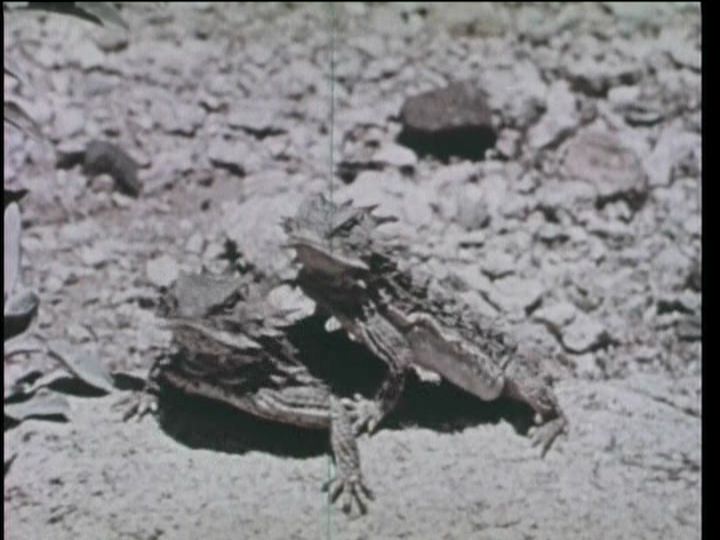
(Hump?)
But unlike The Sadist, which is far and away the better of the two films, this movie is much more amenable to repeat viewing, if only to catch all those little wtf moments that might have gone unnoticed the first time around. While we've probably had more than our fill of the scrunched up, scowl-faced, punchably pompadoured "hero" and his off-key serenades, we'd be more than eegah to pay a visit to our new favorite gentle giant and his fabulous facial hair.

(Seriously?)


