Showing posts with label fortunetellers. Show all posts

Friday, April 7, 2017

The Old Scold and the Sea

In these two aquatic tales, our protagonist has found the object of his desire and the feeling's mutual, but both are hounded by some sex-negative femme d'un certain âge who -- contrary to the original connotations of the phrase -- believes il faut qu'on bloque le coq.


Night Tide (1961)

Grade: C-
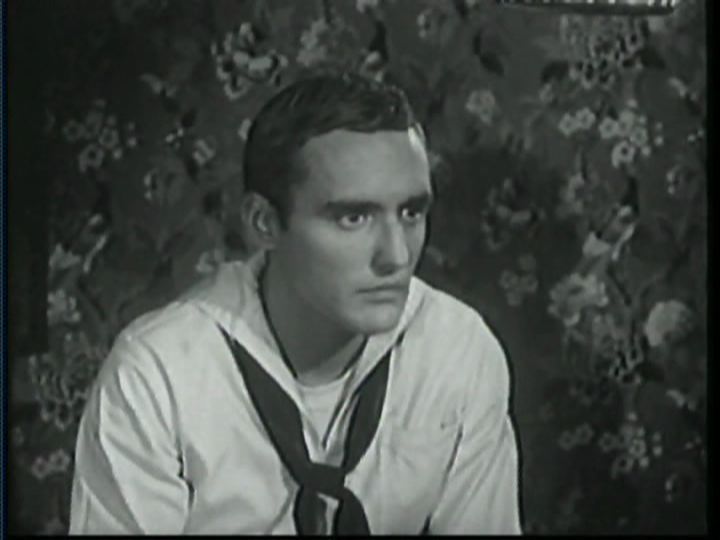

Dennis Hopper: a good actor, sure. A great actor? Maybe. But what he isn't is right for the part of Johnny, the ingenuous sailor smitten with mysterious carnie Mora (Linda Lawson), who may or may not be the mermaid she impersonates for a living.

Johnny insistently presses his attentions on Mora, who's standoffish at first but eventually caves and joins him for an awkward oceanside meal, complete with unexpected gull-stroking.

Soon enough the couple are lounging on the beach, with hugs, kisses, implied sex, and a bit of ass-gazing to boot.

But rumors of trouble persistently swirl around Mora, and local girl Ellen (Luana Anders) is only too happy to pass those rumors along, seeing as how she too wants to get some of that sweet Hopper ass.

Funny to see Anders, so sexy in Dementia-13, play mousy here, and quite convincingly too: whatever sensuality Ellen has is latent and implicitly mired in subservience.

Night Tide has good bones, but Hopper hits all the wrong notes, sorry to say. Instead of wide-eyed and open-hearted, he just seems confused and vaguely distracted -- like a stoner, or a recent TBI patient.

Or if he's trying for brooding and obsessed, that intensity isn't exactly apparent in his body language or line reading, so maybe the guy just needed better direction and more time to hone his acting chops. And if Hopper's Johnny is just meant to be yet another emotionally stunted child of WWII and the Fifties...well, who cares?

In the plus column, Night Tide is equipped with attractive scenery, evocative set-pieces, a decent script, and a plot which isn't altogether predictable. With one or two exceptions, it never embarrasses itself in the many ways such films often do.

But if it's trying to be one of those understated, haunting films whose imagery and characters stick with you for years afterward -- like, say, a Carnival of Souls -- well, that just didn't happen for Night Tide. In a way, it's a good reminder that plausible ingredients don't always yield a compelling result; not every record with Fender Rhodes and funky drums was a winner, after all, nor does every dish with truffle oil, crème fraîche, and chipotle win its chef a James Beard award.

But if blame for Night Tide's non-classic status has to be assigned, it must go squarely on Dennis Hopper's shoulders. His manly, massageable, yet curiously expressionless shoulders.


She Gods of Shark Reef (1958)

Grade: D-


For its first few minutes, She Gods of Shark Reef conjures some real interest. The opening set-piece -- which features, among other things, an impressive-looking assassin who clutches his blade between his teeth as he swims toward his target -- is taut and intriguing, though a bit hard to make out.


Alas, these things don't often last in the land of Mill Creek box sets, and soon a bit of voiceover narration -- that dreaded saboteur of all things action -- escorts us to the small Pacific island where the remainder of She Gods of Shark Reef is to take place. True, we still have POC adroitly transporting blades in the water: 


But Corman et al. decided this Shark needed a WASP injection, provided in the form of recently shipwrecked brothers Chris and Lee Johnston (Bill Cord and Don Durant, respectively). No points for guessing that the blond is the good one!


This idyllic Pacific island -- which definitely isn't Hawaii, how dare you even think that? -- is populated exclusively by moderately attractive, intermittently Polynesian women of marriageable age. When they're not making a living as pearl divers for "The Island Company", they sing, dance, do crafts...


...and practice religious ceremonies involving various combinations of gods, sharks, human sacrifice, and underwater statuary.


If all this sounds like paradise, you haven't reckoned with the presence of Queen Pua (Jeanne Gerson), a hatchet-faced woman who makes some effort to accommodate the unexpected visitors, but whose dedication to the blockage of cockage is nonpareil.

Why, in the midst of all this swarth, she's also as white as baking soda is -- as far as we could tell -- left unexplained.


Does one of the natives (Lisa Montell) fall in love with the "good" brother? Of course she does!


Does Queen Pua do her best to raise a red flag against the indecent writhing of hips and commingling of fluids? Of course she does!


Is there pearl thievery, breaking of taboos, and other trouble in paradise? And is the fattest character the target of humor and/or comic violence? You'd better believe it!

Do these and other events lead to mounting tension, and ultimately violence, between the brothers? Of course they do!


And did we care? Eh, not really. Have a shark.

Sunday, February 5, 2017

Slaughterhouse Four

One of the pleasures of this project -- which, after all, revolves around that mammoth Mill Creek 250-movie "horror" box set, in case you've forgotten -- is discovering actors and actresses whom we might never have otherwise encountered, but who stick with us long after we finish watching their film(s). From the all-American charisma of Don Sullivan, to the proto-Cuddy charms of Evelyn Brent, to the road-trip-worthy humor of Paul Bentzen, all have earned a place in our hearts.

To this pantheon of greats (or at least memorables), we must now add another -- and if you've noticed the title of this entry, or just read our previous one, you'll already know who's stepping to the fore. We've seen four of his films so far, and unlike our usual habit, we're going to review all of them at once, en bloc:


Crimes at the Dark House (1940)

Grade: B+


The Crimes of Stephen Hawke (1936)

Grade: B


Maria Marten, or Murder in the Red Barn (1936)

Grade: C+


Never Too Late [aka It's Never Too Late to Mend] (1937)

Grade: B-


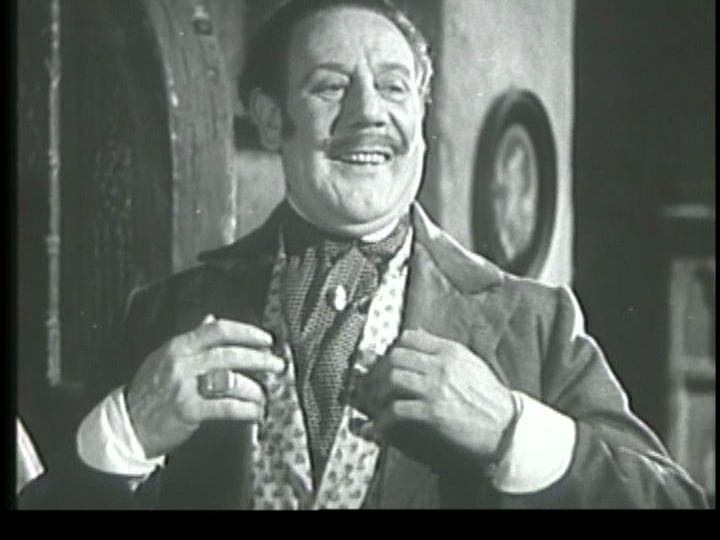
Has anyone ever made evil seem more fun than Tod Slaughter? When it comes to his characters' immortal souls, he seizes -- and palpably enjoys -- any and all opportunities to add a blot to the old escutcheon. Whether he's breaking the spines of small children, murdering pregnant women, consigning prisoners to pointless torture, or simply committing more humdrum crimes like fraud, forgery, and fornication, he simply can't conceal his glee at repeatedly and persistently doing the wrong thing.

What's more, unlike so many modern-day villains (fictional or real), Slaughter expresses no remorse or contrition whatsoever when he's finally caught and cornered (and he always is). If anything he seems relieved to finally be able to unleash the full power of his unhinged malevolence, without having to hide it under a thin veneer of English gentility.

One funny irony is that, in the four films under consideration, the most sympathetic character of the bunch is the serial killer Stephen Hawke. True, the man is a ruthless moneylender and unrepentant murderer, but at least he genuinely loves his daughter -- his adopted daughter, no less (Marjorie Taylor, who looks like she could be Jenny Toomey's grandmother or something).

Otherwise Slaughter's characters are completely devoid of conscience or scruple. For them, crimes against property (theft, mail tampering, perjury) or person (drugging, rape, murder) are all means to the same end: the thrill of power, the pleasure of deception, and the exultation of the ill-gotten gain.

And all of them elicit the same mirthful cackle, the same undisguised pleasure -- as one commenter on another site notes, "He bounces when he walks" -- and, if there's a mustache available, you can bet it's in for a twiddling.

Of course, there are downsides to playing what, in truth, is essentially the same character over and over again -- though it's a damn good character, and he was absolutely born to play it. But Slaughter's films inevitably blur together in one's mind, so that it becomes hard to recall which particular act of villainy took place in which film.
It also doesn't help that many of the same actors and actresses are recycled from film to film. Eric Portman, the "gypsy" in Maria Marten, is subsequently the daughter's love interest in Crimes of Stephen Hawke; meanwhile, D.J. Williams shows up as someone's father in three of these four films.

And Marjorie Taylor, who played Slaughter's daughter in Hawke, becomes the object of his amorous intentions in Never Too Late to Mend. (Ew.)


Adding to the confusion, Slaughter -- or his scriptwriter -- certainly has no qualms about reusing lines wholesale from film to film, e.g.:

Maria Marten: "Didn't I make you a promise, Maria? I promised to make you a bride. Don't be afraid, Maria. You shall be a bride...a bride of Death!"

Crimes at the Dark House: "So you wanted to be a bride, my dear Jessica, did you? So you shall be: a bride of Death!"

That said, the net effect is a bit like Homer's constant repetition of stereotyped formulae in the Iliad and Odyssey. (A similar phenomenon can be observed in any music venue with "Blues" in its name.)

In other words, somehow it's not really a problem. In much the same way that "clunk-clunk" and "The guest star did it" characterize the Law & Order franchise and its descendants, the self-similarity of Slaughter's films ultimately becomes part of our expectations -- as it no doubt did for audiences of his stage productions, who happily (and consensually) booed and hissed at his entrances.

Still, we're able to differentiate these films enough to know that Crimes at the Dark House, which was the first Slaughter film we saw, is also the best. Its tale of impersonation, impregnation, and conflagration offers the most complex and rewarding plot, and the secondary characters here are more fully developed than the comparatively two-dimensional figures of the other films: even minor roles get memorable moments.

Slaughter is at his most diabolical here: if we're not mistaken, this film has the highest body count of the four. Certainly its grim intentions are evident from the start, when it opens in Australia with a character getting a spike to the brain courtesy of good ol' Tod.

Crimes at the Dark House also features a scene of (very strongly) implied rape that, though not graphic in the slightest, is genuinely difficult to watch -- far more so than in a film like, say, Werewolf Woman. There's no deus ex machina or anything, just bad things happening to nice people.

Meanwhile Maria Marten is the weediest of the bunch -- though in fairness, the copy supplied to Mill Creek is missing nearly 10 minutes. If anything, though, the film's pacing is too slack, with the final act really sagging in a way that we didn't see in the other films.


Its running time is further padded by a theatrical introduction that seems intended to remind viewers of Slaughter's prominence on the stage. Complete with village musicians and a pompous MC, it's a strange conceit that hardly seems necessary. 

Even stranger is the frame around Crimes of Stephen Hawke, which begins with a short, in-studio performance by an English musical comedy duo, "Flotsam and Jetsam". If there's a purpose behind their inclusion, it completely escaped us.

Slaughter is then introduced as himself. Looking rather dapper (and conspicuously bereft of 'stache), he steps up to the mic.

After some brief remarks, the actual film begins, and this framing device is completely forgotten -- until the very end, when we cut back to the studio and Slaughter tiptoes out while his interviewer snoozes! It seems weirdly disrespectful to the great actor, almost as though Crimes of Stephen Hawke is trying to distance itself from its own existence.

Fortunately, the meat of the film is unharmed by its strange packaging, and Hawke makes up for its tepid introduction by, in its opening sequence, having Slaughter straight-up murder a little kid. Hays Code be damned, that's the stuff!

Finally there's Never Too Late, aka It's Never Too Late to Mend, based on a book that allegedly sparked major prison reform in England. As in Maria Marten, Slaughter plays a dastardly squire who fraudulently brings the wrath of the law upon a dashing young rogue -- in this case, Tom Robinson (Jack Livesey).

However, the love interest here isn't Robinson, but George Fielding (Ian Colin), an impecunious lad who's about to leave for Australia, in hopes of earning enough money to marry the girl of his dreams. The Squire tries to get rid of Fielding by framing him, but Robinson takes the fall willingly for his friend -- though if he'd known the hell that awaited him in prison, he might have had second thoughts.

Never Too Late wraps up its multiple plot threads a bit hastily, and its closing standoff isn't nearly as gratifying as the marvelously unhinged end of Crimes of Stephen Hawke (from which it cribs a few lines of dialogue). Still, it's entertaining throughout, and its cynical depiction of the lazy, venal English prison administrators is, unfortunately, as timely as ever.

It's a shame that this wonderful actor's work isn't better known, as it's such good fun to watch him stalk, caper, giggle, and bounce through his diabolical roles. We're very pleased to have two more Slaughter movies awaiting us in the box set (The Ticket of Leave Man and The Face at the Window), and are looking forward to seeking out his other available films and TV appearances as well -- not that there's all that much of it, as several of his films are lost.

We can only hope that some of that lost work -- we're curious about Darby and Joan -- reemerges from the shadows. (Heh-heh-heh...)


Next up: the third edition of the Umbrellahead Awards!

Monday, January 2, 2017

Breath, advocate, food cake

If you're confused by this post's theme, then go to hell -- since that's where all three of these films can be found, at least in the genitive case.


Devil's Partner (1958/1961)

Grade: C-


For a film that opens with an old man sacrificing a goat and selling his soul to Satan, there's something awfully coy about Devil's Partner. For example, why does he draw a hexagon, rather than the usual pentagram? Why is the term of the agreement two years?

And why does the Devil apparently sign under the name "Jezzer Hora"? Is that his MC name or something?

It's never really clear what either party is getting out of this arrangement. In his new guise as "Nick Richards", Jenson's actions seem haphazard and self-serving, and it's hard to see how managing a gas station in Furnace Flats, NM (pop. 1505) will serve an infernal agenda. He doesn't work to corrupt anyone's soul or cause widespread mayhem; he just wants to win a pretty girl's heart, keep people from sniffing around his origins, and make devilish references to his true nature.


From all appearances, the scriptwriters simply couldn't decide whether the Richards character should be the Devil in Jenson's newly rejuvenated body, or just a mean old man who uses his second lease on life to try to screw his neighbor's daughter. He clearly has some demonic powers, but -- like a cat hoarder's interactions with the outside world -- they mostly seem to revolve around animal control.

At one point he says outright "Well, I'm really the Devil," but none of his other actions corroborate that. And if Jenson/Richards is merely an aide to Asmodeus, this still seems like a pretty terrible business arrangement for the Evil One.

Without a coherent plot, Devil's Partner is left to depend on the charisma of its lead -- which, in truth, is considerable: Ed Nelson has a brooding, smirking intensity that makes it easy to believe he'd both attract and unsettle the residents of Furnace Flats.

But a movie needs more than charisma and a handful of effective set-pieces to succeed, and ultimately Devil's Partner is undone by its reluctance to commit to a clear vision of its own plot. One can only guess that the screenwriters were afraid of alienating Bible Belt audiences by explicitly using Satan as a protagonist, and so hedged their bets, substituting hexagons for pentagrams and "Jezzer Hora" for "Beelzy Bubba".

If you're willing to sacrifice goats in your film, though, why settle for half-measures?


The Devil's Daughter [aka Pocomania] (1939)

Grade: C-

If it's a "SACK" attraction, you know it must be good, right?

But sadly, The Devil's Daughter really isn't a good film. Stiffly acted and scripted, and saddled with a hackneyed plot about love triangles, sibling rivalry, and obeah, it's a movie whose theatrical merits wouldn't pass muster at a regional summer stock production. To give it a free pass for these things, simply because it has an all-black cast, would strike us as condescending at best.

That said, The Devil's Daughter has multiple saving graces -- namely that it's short (clocking in at well under an hour), entertaining, and full of engaging imagery and sounds.

(These things are hardly a given: soon enough in the Umbrellahead Review, we'll see an example of an early African-American film with none of those redeeming qualities.)

It's by no means an unpleasant film to watch, and the corny performances are, if anything, a source of amusement.

The one actor who comes off well here is Hamtree Harrington, an experienced vaudevillian who serves as the film's comic relief. He's broad, but relatively polished, and it's interesting to see how a character of this type is portrayed in a film intended for black audiences.


It also doesn't hurt that his love interest, Elvira (Willa Mae Lane), is kinda foxy -- certainly more so than the two female leads, anyway. (The male leads aren't any great shakes either.)

Ms. Lane also acquits herself well in the acting department, but doesn't appear to have had any other roles; too bad.


The Devil's Daughter is no masterpiece, but it's no Chloe, Love is Calling You either. With appropriately modest expectations, it's worth experiencing both as a time capsule and as 50 minutes of light entertainment. Believe us, it could be much worse -- and it'll help you remember "obeah" during those tight Boggle matches.


The Devil's Messenger (1961)

Grade: D


At this stage of his career, it's hard not to feel faintly embarrassed for Lon Chaney, Jr., no matter what role he's in. Still, playing the Lord of the Underworld would seem a perfect fit for the veteran actor -- but turns out to be an unexpected bit of miscasting.

With Rolodex in hand and smiles aplenty, LCJ's Satan is neither saturnine nor diabolical. Instead, he comes off more like a kindly uncle, or at worst, like the washed-up alcoholic who holds court daily at your local bar, telling tall tales of his past, ever-genial but clearly beyond redemption.

...and hey, that's pretty much what he was. Zing!


Anyway, Chaney's role in The Devil's Messenger is simply to provide a framing story for three episodes of a Swedish TV series, 13 Demon Street, a horror anthology that seems to have basically been Der Tvilight Zøn in all but name. It's a recycle job, in other words, like Alien Zone and other "movies" we've seen through the years.

And the frame is pretty horrific in its stupidity, revolving around a young suicide named "Satanya" (no, we're not kidding) who delivers cursed objects to unsuspecting Earthlings, somehow justifying the set's title. Even by our steadily lowering standards, it's stupid and half-assed. 

Fortunately 13 Demon Street seems to have been a serviceable if uninspired affair, and the three featured stories are no worse than a third-rate episode of Rod Serling's brainchild.

The first, involving a brutish photographer with a guilty conscience, is probably the least rewarding of the bunch, since the plot is utterly predictable and the protagonist impossible to care about.

The second segment, telling the tale of a scientist who falls in love with a woman preserved in glacial ice, is actually dumber. But at least we were distracted by trying to figure out who the lead actor reminded us of, beyond a vague hint of Abe Vigoda. (Maybe it was just the Pakistani guy that P. went to college with?)

It was no strain to "place" the protagonist of the next story, though, given his striking resemblance to René Auberjonois (of Benson and Deep Space Nine fame) -- maybe with a dash of Bashar al-Assad thrown in there too.

This third and final tale was by far the best, depicting the inexorable meeting of a man haunted by a recurring dream and a fortuneteller who serenely conveys the will of fate. Predictable, but capably acted and directed, its plot and story arc wouldn't have been at all out of place on TZ, though the last five minutes dragged a bit.

Unfortunately, this segment is also the only one that gets shoehorned back into the framing story, squandering whatever goodwill it had earned. It turns out that our protagonist is also Satanya's ex-boyfriend, and so when he dies...yeah, it's stupid.

Never fear, though, as the Lord of the Files [sic!] comes through with a last-minute turn to the bizarre: Satanya's next mission is to deliver a formula that will allow humanity to build a 500-megaton nuclear weapon! I see we're ramping things up a bit, Mr. Lucifer -- that's 10 times larger than the biggest detonation in history. 

Gratuitously super-sized nukes aside, The Devil's Messenger has no real attraction beyond the unexpected competency of its third act. The audio quality of Mill Creek's print is quite horrific, by the way, with the kind of distortion that sounds more like a bad connection than an overmodulated signal.

Oh, and at one point, this happened:

Admittedly, it was only for a split second, but still: way to go, Mill Creek Quality Control! (That's a phrase right up there with "The Lance Armstrong Sportsmanship Award" and "The Buddy Rich School of Diplomacy".)

If you're trapped in ice for thousands of years with nothing else to do, you can watch The Devil's Messenger, I suppose. Just don't blame us if, thanks to propinquity, you end up getting a crush on the glacier girl. And hey, you could do worse: we hear she's a real doll.