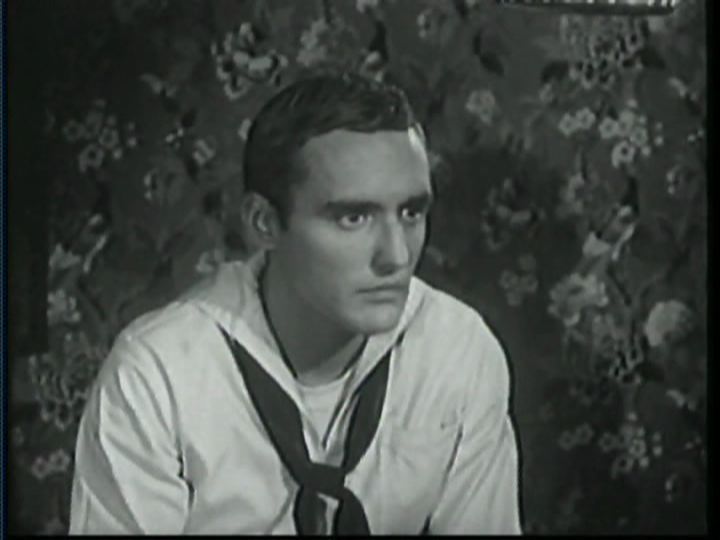
The customer says: "We'd like a table outdoors, some heterosexual banter as an appetizer, and then at least one ethnic stereotype as our entrée." And do these two films deliver!
Grade: D

If your old man is famous and you're in the same line of work, it's not an easy hand to play: just ask the Bach kids, Miloslav Mečíř Jr., or any number of other examples. Lon Chaney Jr. seemed to want to pick up where his chameleonic dad left off, and that's fine -- his prerogative.
But front-load a film to this extent (as seen in the above screenshot), and not only are you putting a lot of pressure on the son, you're already funneling the viewer into too narrow a causeway: instead of responding to the movie's events as they unfold, we're responding to our expectations of Chaney's double casting.
(Also, "Butch Curtain"? What is that, something Charles Nelson Reilly's interior decorator picked out for him?)

Anyway, we've got a huge ruby, owned by the father (John Ince) of Edith (Sheila Terry), the woman sitting with Chaney-as-Jack-Wilson in the screenshot above. Wilson's on the trail of Johnny Fly (Manuel López), nogoodnik criminal --
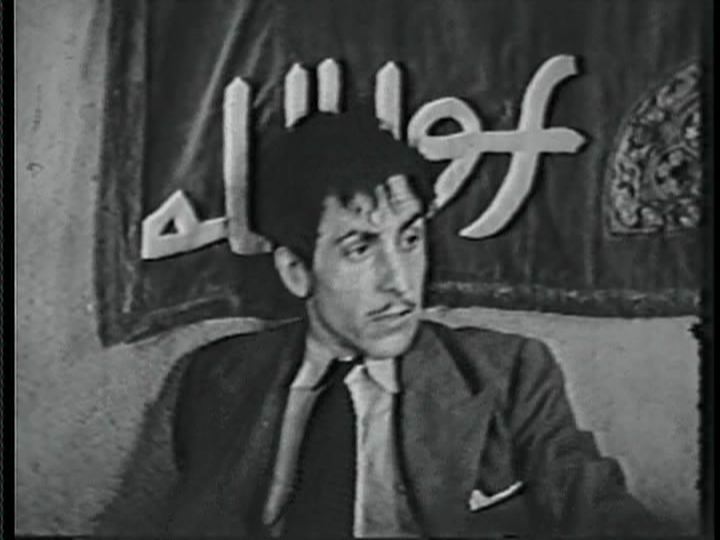
-- and virtuosic lasso-tosser:

As we soon discover, Fly's favorite hangout is Butch Curtain's bar. He may be a dim-witted thug with a wonky eye (shades of Manfish!), but he's a sure shot with darts and knives.

His bar is also a magnet for attractive birds of one sort --

-- or another:

(P. thinks this uncredited extra shows strong indicators of foxiness, K. disagrees. Either way it'd be interesting to find out who she was: anybody know?)
So isn't it a wild coincidence that Jack looks a lot like Butch, and can even talk like him? And wouldn't it be the funniest thing if that turned out to play a role in the plot? To invoke a double positive, "Yeah, yeah."
Along the way to the inevitable, we get policeman Wu Ting (Philip Ahn), whose clan presumably ain't nuthing ta f' wit. He speaks normally at the start of the movie, but lays it on thick when he goes undercover:
"Me velly solly. Excuse, please. Oh, me just want a dlink. You can do, please? Whiskey, please. You bossy man here? Maybe you do me hon-ah, have dlink with me."
The 1930s: not the greatest time to be an Asian actor.

There's a reason A Scream in the Night apparently sat on the shelf for almost a decade before it was released. Even with a plot this simple, some details are fumbled: ultimately Wilson-as-Curtain gets his cover blown, thanks to Fly's combative girlfriend Mora (Zarah Tazil), but how exactly it happened we have no idea.

Anyway, Chaney is passable here, but not enough to carry the film. Sorry, Lon. Now could we get the number of that foxy extra?

[aka Drums of Africa]
Grade: D-

OK, so let's get this out of the way upfront: Jungle Man -- called Drums of Africa on our copy, but as we understand it that's an anomaly -- is basically a marginally better version of The White Gorilla. That means it has:
- copious use of stock footage of animals
- characters who don't really interact with the above-mentioned animals
- events recounted through flashback for no particular reason
- repurposed footage from a silent film (not 100% sure about this one, but we think so)
- racist depictions of African natives and Africa itself
- pompous lectures about the jungle and its dangers
So if we found The White Gorilla so terrible that we dubbed one of the worst movies we've ever seen -- after all, we regularly quote "As I watched..." as a kind of metonym for a particular type of bad movie-making -- then how the heck does Jungle Man scrape a D-minus? Well, here's one reason:

That's right, no Crash Corrigan. His "ass-faced voyeurism" (cruel phrase, but fair) is instead replaced here by Buster Crabbe, who's easier on the eyes and a far more charismatic screen presence.
Of course, if you like boot-fa-chays, the movie has some of those too.

You see, we're meant to think this woman will want to marry that guy --

-- but, well, see what happens when she meets this guy:

That's one thing that's refreshing about Jungle Man, actually: from the moment she meets Crabbe as Dr. Robert Hammond, Betty is thoroughly and more-or-less unrepentantly smitten. It's so obvious that when she embraces her fiancé Bruce (Weldon Heyburn) as he's about to leave on an expedition to the mythical City of the Dead, he pauses and looks at her dubiously:
Bruce: You do want me to come back, don't you?
Betty: Oh, of course! W-why shouldn't I?
Bruce: I don't know, I -- I've just had the strangest feeling ever since we've been here.
Betty: Silly.
In the midst of this we cut away to Crabbe and Bruce's pal Andy (Robert Carson), who shoot each other a look, and boy, do their facial expressions tell a story:

So you see, Jungle Man isn't completely stupid. It's got a couple of marginally amusing one-liners -- "But I'm from Missouri, you'll have to show me" is one, if that gives you the idea of the league we're talking about -- and also has at least one other great cutaway, in which Betty's father William (Paul Scott) and his brother Jim the priest (Charles Middleton) have this exchange after Betty announces her intent to join Hammond on a trip to a dangerous village:
Jim: Oh, William, you must stop her!
William: Stop her? You don't know Betty. I didn't want to come to Africa! But I'm here!
Jim: Perhaps it's just as well I turned to this -- I never did understand women.
And the reaction shot:

We surely don't want to give the impression that Jungle Man's few moments of liveliness outweigh the crushing contrivance of its storytelling, though. It's hard to find the right word for the way a movie like this makes us feel, but unconvincing is the closest we've found, though that hardly does it justice. It's not the performers' fault -- they're fine -- but the production itself that feels awkward and cynical and heavy-handed, like it's always playing to the dumbest people in the cheapest seats.
For instance, let's take the sound effects. That "constant jungle chatter" in certain scenes is some sort of squeaky bird call, made by rubbing two dry cylinders together, that sounds like a misaligned fan belt or malfunctioning air conditioner. It's not pleasant. Or there's the lion's roar that sounds like a Superball being rubbed against an oil drum: couldn't they do better in 1941?

Then there are the historical inaccuracies, anachronisms, or whatever you care to call them. First of all, the tiger --

-- which they hang a lampshade on by explaining how Jim "picked him up in one of the Malay states". OK, fine, whatever you say. Clearly they had a tiger available and needed an excuse to use him, and after all he's the only animal that actually interacts with any of the cast:

Oh, and the tiger's name is Satan, which gives us the odd spectacle of hearing a priest say "Thank you, Satan" after the cat defends him from an attacker. Yup.
Meanwhile, this is the famed City of the Dead, in darkest Africa:

Or here's another angle:

If you looked at these shots and said "wat" to yourself like that old lady in the meme, you're exactly right: this is Angkor Wat, in that well-known African country, Cambodia. Yup again.

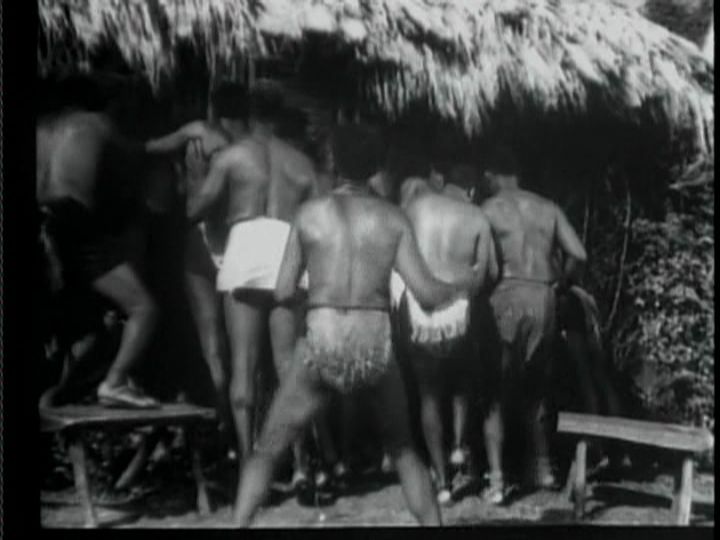
Really, the African-ness of this movie is solely a product of stock footage, costume design...and hiring a bunch of black actors to demean themselves by shouting "Booga booga booga" and waving spears in the air. ("They're just like children," opines Jim the priest, in an aggression none too micro.)
If at this point you're foolish enough to watch Jungle Man -- and you can't say you haven't been warned -- then, as the kids say these days, you do you. Just don't watch The White Gorilla, for the love of Vlad, unless you really want to dive into despair and question your life choices.