For our first post of the New Year, we leave the calm waters of Mill Creek and turn our attention to
Grit 'n Perseverance, a set of 2 DVD-Rs published in 2011 by Smooth Motion Pictures and/or SG Entertainment, aka Seedsman Group.
We looked at this "4 Movie Marathon" before
when we covered our beloved Beartooh [sic], but held off on covering the other three films until we got our discs resurfaced. The flea market stall where we bought
Grit 'n Perseverance had a few other copies, but all of them had the same scratching/pitting as ours: a bad batch, we guess?
It's sort of bracing to look online and see that no one else has reviewed this set, or even discussed it. Search for "grit n perseverance", and this blog is one of the few results; add "4 Movie Marathon" and you've got almost nothing but us and Amazon, with no reviews on the latter.
So, here we are, documenting away. And grab a cup of tea, because this is a long one:
Bloody Che Contra (1969)
[aka El "Che" Guevara]
Grade: C-
It never ceases to amaze how unimaginative and self-oriented some people can be. Take
the Amazon reviewer who smugly notes that his copy of
Bloody Che Contra "just began and ended without any credits at all. Guess they were really proud of their work."
Well, no, Mr. Slow Loris: "they" didn't do that at all. Two seconds' research will reveal that Bloody Che Contra is a foreign release title for a 1969 film originally titled El "Che" Guevara, directed by Paolo Heusch -- the man behind the mildly amusing Werewolf in a Girls' Dormitory and the excruciating The Day the Sky Exploded.
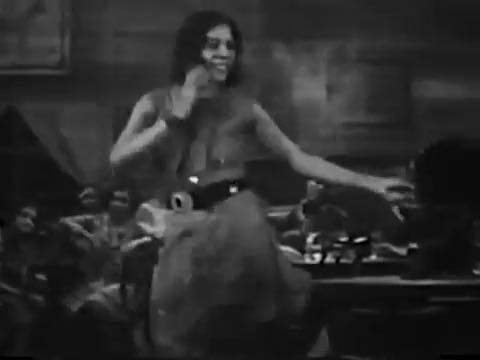
Now, look at that screenshot above, with its Video Toaster-looking font and still shot of a scene from the film. And notice how Bloody Che Contra begins abruptly, with no preamble, as though we were entering mid-scene. Doesn't it occur to you -- how can it not occur to you -- that we're dealing with a hacked-down version of the film, retitled to make it seem more lurid and/or less potentially pro-Guevara?
And can you savvy that those things probably weren't done by the original filmmakers, but by someone downstream trying to make a buck? Hold the phone!
One can't help but notice that, if you've got a bug up your ass about historical accuracy (which this film admittedly lacks), there's a certain irony in not bothering to make sure your own snarky allegations are justified.
But don't worry, bud, you're in good company. Just check the comments on any YouTube upload of this film -- most of them enraged that someone had the audacity to make a film about Che Guevara without a flashing logo onscreen every second that says "CHE IS BAD AND COMMUNISM IS BAD GO TEAM USA".
Not that we're pro-Ernesto -- or anti-Ernesto, for that matter. The venom of his detractors, and the hagiography of his admirers, are more than enough to inspire a rousing chorus of "A plague o' both your houses" on principle alone.
We're not particularly informed and knew only the basic outlines of Guevara's story, though the period depicted in Bloody Che Contra -- his last days and execution in Bolivia -- was the part we knew best. After all, everyone remembers the endings.
You can find a Spanish-language copy of the original
El "Che" Guevara on YouTube (
here and
here). It reveals that the opening was a lengthy panorama of nature and country scenes, with voiceover narration from Guevara's diary, followed by the opening credits.
Meanwhile, the closing credits add a bit of voiceover, followed by a reprise of a revolutionary song (probably titled "El Guerrillero", we're guessing) heard earlier, when Che was captured and hauled into town.
So: yes, Mr. Slow Loris, there were opening and closing credits: about six minutes' worth, by our count. Now, they don't add much, and frankly, even if the YouTube copy didn't sound like complete ass, we couldn't parse the voiceover in Spanish well enough to make sense of it (we caught a phrase here and there -- "mas fatigoso" was one -- and can probably infer the rest).
But they were there.
We'll also note that Bloody Che Contra awkwardly overdubs the scene of Che's capture with standard-issue Andean flute and guitar music, probably because the political content of the song was deemed too inflammatory or leftist.
They did a pretty crappy job of it, though, since the very beginning and ending of "El Guerrillero" are still present -- kind of like the remnants of "We Are Not Alone Here In Space" from Cosmos: War of the Planets.
So how's the film? Eh, about what you'd expect -- though at least it's not trashy in the way a film made 10-15 years later might have been.
At first, it does a decent job of keeping its loyalties in check by including a character like Acacio (Lex Monson). He may be fiercely loyal to Che (Francisco Rabal), but he's also exactly the kind of revolutionary who won't stop once his goals are achieved, because destruction and revenge turn him on too much.
Before long, though, the scales drift out of balance. The revolutionaries meet an attractive, naive young girl (Susanna Martinková) and yet no one puts the moves on her --
-- while the Bolivian soldiers who take over a locanda are boorish and forward, though (to be fair) not cartoonishly so. They're just underpaid and tired of losing.
We're not sure if El "Che" Guevara was originally released in Italian or Spanish. IMDb doesn't say, and with a multilingual cast, it's impossible to guess. We can say, though, that the English dub in Bloody Che Contra is quite good -- too good to have been done by the same people that butchered the film.
Is there a full English-language print of El "Che" Guevara out there that has the opening and closing narrations intact? Will someone rescue this (very) early Guevara biopic from its chop-shop hell, and do a nice transfer from original elements, so we can see Bolivian soldiers fling themselves away from miniscule explosions in high definition?
That'd be cause for celebration -- at least in principle.
OK, our Geoguessr is off by 2400 miles for that joke, but c'mon, the film's off by 6000!
Sardinia makes for a surprisingly plausible Bolivia, though. Just don't try the cheese.
Savage Journey (1978/1983)
[aka Brigham]
Objective Grade: D-
Yes, We Do Know How to Waltz Bonus: B+
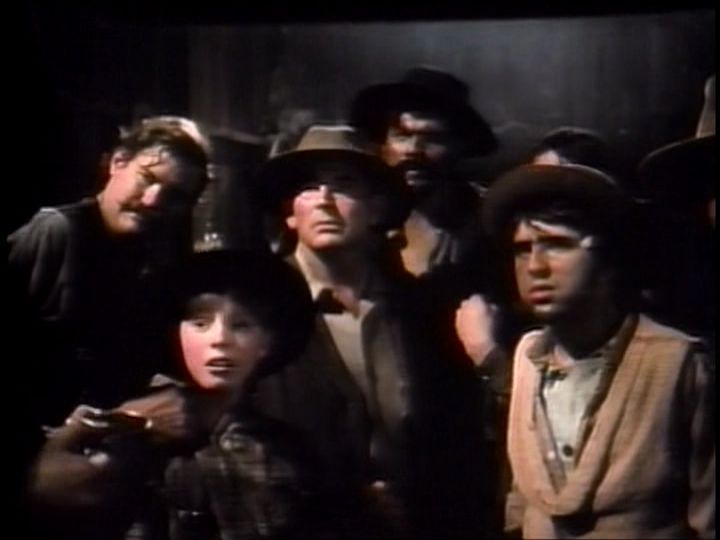
Let's get this out of the way upfront: Savage Journey is definitely, no-doubt-about-it, propaganda. Mormon propaganda.
Originally released as Brigham in 1978, and then re-edited (supposedly for TV) into the version we've got here, it depicts the church's early history from a perspective that goes well beyond "sympathetic".
The good guys -- all Mormons, of course -- are faithful, brave, and infinitely patient despite endless persecution. The villains are cardboard cutouts, burning with a hatred the film makes no effort to explain. And while the
Haun's Mill massacre gets plenty of screen time, don't look to
Savage Journey to offer an accounting for, say, the
Mountain Meadows Massacre: in this movie's world, it's as if it never happened.
Even some LDS commentators think the film goes too far in its rewriting of history -- and chances are, most of us "Gentiles" will reach for some combination of Wikipedia and that one episode of South Park after watching it.
Now, all that said, this movie was a blast to watch. First off, we have the reason we bought this set in the first place:
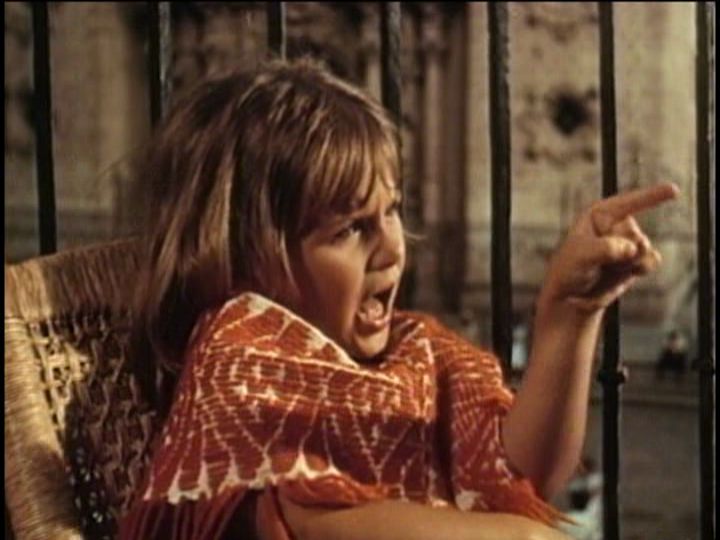
Despite having only a minor role in Savage Journey -- yet again, playing a woman named Claire who's married to a militant atheist! -- the apple-cheeked actress gets top billing on the DVD packaging:
In fact several of her Nightmare co-stars return here -- like Maurice Grandmaison, who had a supporting role in Nightmare, but here takes the lead as Brigham Young himself.
Grandmaison has a credible (if stolid) screen presence, but it's been so long since we've seen Nightmare, we didn't recognize him. (Don't worry -- we'll be seeing Nightmare again soon enough. Sort of.)
However, there was no mistaking this old friend:
Yes, under that amazing wig is none other than Richard Moll as Joseph Smith, founder of Mormonism. He's billed as "Charles Moll", which threw us off the scent for a bit: a brother, maybe?
But no, it's Night Court's Bull, and the protagonist of The Nightmare Never Ends, in what turns out to have been his very first film role. And man, does he seem miscast.
Maybe that's unfair -- not his fault that we've since come to know him as Harry Anderson's goofy bailiff, right? -- but between his height and vaguely diabolic appearance, he seems more like a Dickensian villain than a beloved prophet.
(
One reviewer says he "looks like some creature out of
Star Trek", which is 100% on point though we'd be more specific: in some scenes, he's near-Vulcan in appearance. Or maybe Romulan.)
It's fascinating to try to unpack how the same crew of actors went from a (literally) strait-laced Mormon production to exploitative trash like The Nightmare Never Ends. The common link seems to be Philip Yordan, a peripatetic writer and script doctor who's been described as a "chameleon", and was clearly quite a character (to put it politely).
Yordan was also a producer -- and everything Faith Clift was in, Philip Yordan either wrote, produced, or both (including recycled versions of Brigham and The Nightmare Never Ends). What a coincidence!
Oddly enough, Ms. Clift -- or, if you prefer, Mrs. Yordan -- is fairly nondescript here. She turns in an unobjectionable performance in an unremarkable role, though it pays off in a mind-boggling sequence near the very end of the movie.
A more Cliftian performance is offered by Robin Russell as Maryann Angel, Brigham Young's first wife (
sort of).
Brigham and
Savage Journey are her only two credits on IMDb, and since her line readings are about as stiff as starched Viagra, it's easy to see why.
When Joseph Smith decides to institute polygamy in the church, Maryann is initially resistant. Heck, Brigham is too, telling his friends that "I'd sooner be carried off in a coffin than have to take another wife." (Better order 55 coffins.)
But to hear Savage Journey tell it, not only does she come around to the idea, she even sets up a meeting with a prospective wife for the reluctant Brigham. Heck, she practically pushes him into it!
This ultimately sets up the most hilarious sequence in Savage Journey, which comes late in the film, at a social event where the Mormons dance, fiddle, and host a skeptical delegation from Washington.
In preparation for his impassioned defense of polygamy -- "We hold it's better for a woman to become the third wife of a loving husband than the only wife of a bum who beats her" -- the film sticks Brigham Young on a Lazy Susan and spins him around, splicing in a new wife with each rotation (i.e. every time Young's back is turned to the camera), all to the tune of The Blue Danube.
It really has to be seen to be believed.
There are pleasures to be had in Savage Journey that don't come solely from mockery. One reviewer at IMDb rightly notes that the film "has a good eye for the Jacksonian era it portrays", and the sets, costumes, and other details show ample evidence of that. Thanks to a few big agricultural set-pieces and an appropriately epic soundtrack, the film sometimes doesn't feel as cheap and half-assed as it probably was.
(On the other hand, the gorgeous landscapes are occasionally implausible in some pretty darned obvious ways: Gildersleeve Mountain that ain't.)
As with all propaganda, it's hard not to find yourself carried along by Savage Journey after a while. In particular, the Haun's Mill massacre -- which, let's be clear, was an unequivocal and unjustifiable act of mass murder -- is suspenseful and harrowing to watch.
It was also unexpectedly evocative of a few of the Ringwraith scenes in Fellowship of the Ring...kind of freaky, since The Nightmare Never Ends already made us think of those too.
When we sat down to watch Savage Journey, we nearly got derailed when our DVD-R started to act up a few minutes into the film. Before the Internet we'd have been screwed, but instead we hopped onto YouTube, watched a few minutes there to get past the trouble spot, and then resumed.
Only later did we realize that Savage Journey was also on the Drive-In Movie Classics 50-pack -- which meant (1) we could've just watched that, and (2) we were continuing our Mill Creek project without even realizing it.
(The Mill Creek version is very similar, in case you're curious; the sound is a tad brighter but the colors are slightly washed-out. We haven't done a scene-for-scene comparison, though.)
In fact, with the exception of Beartooth, all the movies on Grit 'n Perseverance are stalwarts of public domain collections and can be viewed on YouTube.
Alas. Next time we're in Salt Lake, maybe.
As a postscript, Faith Clift/Yordan has apparently led an interesting life, which is to be expected when you're married to a guy like Philip Yordan -- or even afterward. In 2011, in the course of going through her late husband's papers, she unearthed Exorcism, a play by Eugene O'Neill that was believed to have been destroyed.
For O'Neill scholars, it was a bombshell of happiness -- the equivalent of having a complete print of London After Midnight show up on their doorstep. So kudos to her for being alert.
And now, Richard Moll, looking smug in a white suit.
Gregorio and His Angel (1970)
[aka Gregorio y su ángel]
Grade: D
Remember watching Nic Cage drink himself to death? And watching Elisabeth Shue watching him do it?
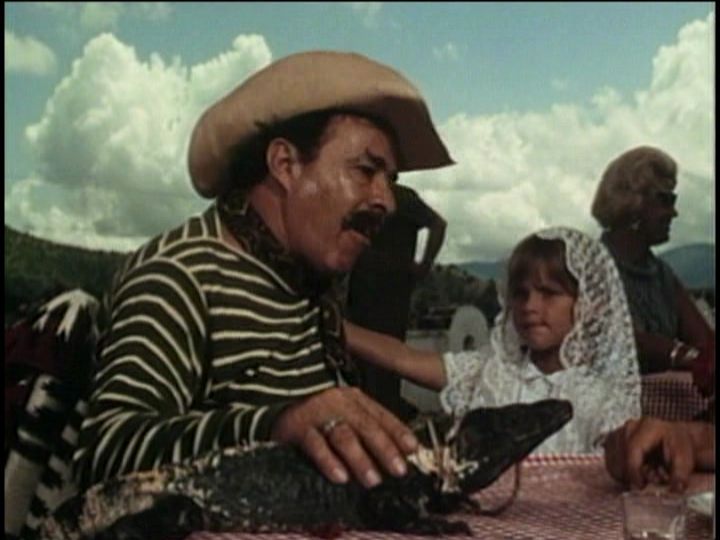
Well, this morality play from Mexico is for you, friends: a sort of Leaving Las Pegas. But instead of Peter Loew and a hooker, we've got Broderick Crawford as Gregorio -- a man who almost literally doesn't go a single scene without drinking something --
-- and a little girl, Ines (Connie Carol), who sticks to him like
glue, and finds him
work while helping him overcome
obstacles. (Thanks,
Wiktionary.)
Now, Gregorio had a job at a Catholic orphanage, where he was very popular with the kids. They even pray for him and his raging alcoholism.
But when an icon mysteriously vanishes from the church, the nuns are so fed up with his drinking that they blame him without hesitation -- or evidence: "It matters not to me whether you've stolen the image or you have broken it," says the Mother Superior. "It is gone -- and it is more than evident that you are at fault."
Ouch! And so Gregorio gets his walking papers.
If you're remotely attentive to the film's heavy-handed cues, you'll intuit a connection between the disappearance of the icon and the appearance of the sweet little girl -- one might call her an angel -- who suddenly shows up and clings to Gregorio despite his protests.
Of course, for every angel there's a devil, and if there's one thing we know about the devil it's that he wears many guises. Sometimes he's a bartender, gleefully pouring Gregorio drink after drink, on the house.
Sometimes he's a Scottish tourist (with an odd resemblance to Muammar Gaddafi), nimbly hopping over a comatose Gregorio before taking him on as a guide -- and, at every opportunity, slipping him a drink.
Or maybe he's a partying clubgoer with a swastika tattoo (!!!), informing Gregorio that the mariachi he's looking for is in another castle. Sorry, Gregorio.
All these devils and more are played by Germán Valdés aka Tin Tan -- a superstar in Mexico who was completely unknown to us, but gets second billing here behind Crawford. And the film isn't coy about his infernal identity.
He's in almost every scene, leering and simpering like a cartoon character -- which makes sense, since Tin Tan was the Spanish-language voice of a bunch of Disney characters.
We've seen a bunch of reviews that refer to
Gregorio and His Angel as a "heartwarming metaphor" (IMDb), a "good film for children to see...and to give anyone who has a problem with drinking" (Amazon), a "charming religious parable" (
The Complete Films of Broderick Crawford), and "a Sunday school staple throughout my childhood" (
this reviewer).
This, friends, is hard to feature, because Gregorio and His Angel is completely bonkers (as if you couldn't already tell from the devil with the swastika tattoo). Despite the film's feelgood message and inevitable happy ending, the sheer amount of alcohol consumption -- and the random feints at sexuality and Nazism -- pretty much disqualify it from any Sunday school we've ever known.
At times it's downright reminiscent of a Wes Anderson movie, which makes sense since we're firmly in the realm of "magical realism".
It even has a completely unexpected musical number near the end, when an entire busload of passengers sings a song to Gregorio in Spanish, about (we presume) the perils of alcoholism.
This might sound fun and whimsical, but Gregorio and His Angel is so tone-deaf, repetitive, and scattershot that actually watching it borders on torture. The middle third of the film repeatedly fails to advance the narrative in any way, as Gregorio keeps drinking, Tin Tan keeps leering, and Ines keeps working miracles for a man who shows no particular evidence of deserving it.
(One of those miracles, presumably, is doing something about the ungodly smell that must be clinging to Gregorio after endless days of wearing the same outfit.)
Worst of all is when Gregorio is sidetracked by a wild goose chase, taking a package-delivery job for the Devil that defies all plausibility. (He barely remembers to ask who he's supposed to meet, or where he's supposed to go.)
It brings the film to a screeching halt, and is obviously introduced for the sole purpose of getting him out of the way for a while, but that could've been handled much more organically.
Speaking of tone-deafness: not to paint Mexican cinema with a broad brush here, but
Gregorio's incessant, cloying use of the Mozart K545 Piano Sonata in C Major can't help but remind us of
a certain other movie and "Jingle Bells". It's clearly meant as a leitmotif, but it makes for an oppressive and incongruous soundtrack.
As with Santa Claus, the sheer oddity of Gregorio and His Angel isn't nearly enough to redeem its flaws, but the film does benefit from its two leads. OK, Connie Carol's repeated cries of "Gregorio! Gregorio!" may remind us of the worst parts of a Gamera movie, but she doesn't mug or bat her eyelashes, and her performance as Ines could have been far more sickeningly sweet than it is.
And Broderick Crawford may be slumming it here, but he's still a serious and experienced actor who wisely understands that Gregorio -- who, like most alcoholics, is deeply depressed at heart -- is a part best underplayed. His interactions with Ines and the film's other children seem natural and sincere, even when the kids' own line readings are anything but.
But we won't be showing Gregorio and His Angel to an audience of kids anytime soon -- both to maintain our own personal liberty, and because we don't want to have to start checking their milk for tequila.
So that's
Grit 'n Perseverance! No question what film we liked best (that'd be
Beartooth) or which one was hardest to get through (lookin' at you,
Gregorio). It'd be interesting to try to figure out the algorithm that put these four films together; we can do it in pairs:
- Rocky Mountains (Beartooth and Savage Journey)
- Retellings of historical events, including extrajudicial executions (Bloody Che Contra and Savage Journey)
- Spanish-speaking countries (Bloody Che Contra and Gregorio and His Angel)
- Christian narratives (Savage Journey and Gregorio and His Angel)
- An old man loyally accompanied by a young female that isn't exactly human (Beartooth and Gregorio and His Angel)
- Protagonists who become ill with respiratory disorders while holed up in the mountains (Beartooth and Bloody Che Contra)
Trying to come up with something for all four, not so much. And if we lean on the set's title, well, Gregorio doesn't so much grit or persevere as "drink until the last possible moment", so that's out. We suppose they all are kind of Western-y in a way.
We know of eight "4 Movie Marathon" sets put out by Seedsman Group, with contents that range from wholesome to unsavory. Six are catalogued
here, while
Grit 'n Perseverance is the seventh, and a set called
Good Guys vs. Bad Guys is the eighth.
Oddly, the spine of our copy of Grit 'n Perseverance lists Shalimar and Scott of the Antarctic instead of Savage Journey and Gregorio and His Angel -- as well as misspelling the name of the set itself. Guess someone fell asleep at their copy of Illustrator.
Shalimar and
Scott are on a set called
Classic Adventures, but the review
here makes the transfers they used sound like a crime against humanity, or at least cinema.
Will we someday seek out those films, from whatever source? We'll see!