Showing posts with label coneboobs. Show all posts

Tuesday, February 13, 2018

Can I do it until I need glasses?

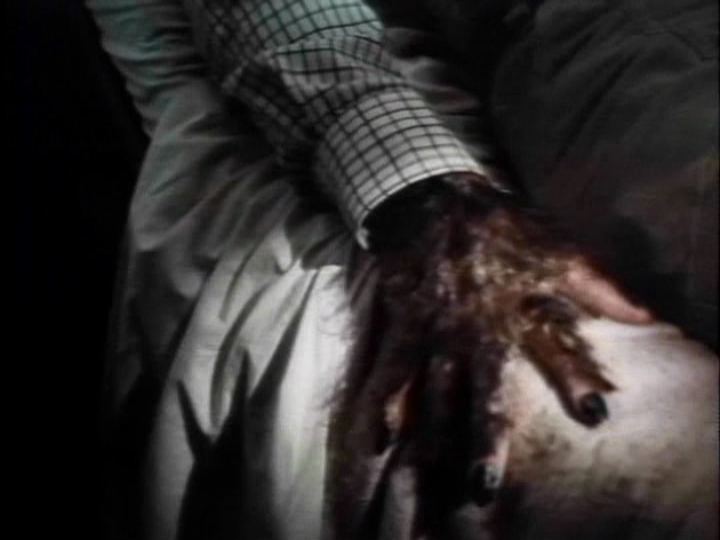
And now, a pair of films where the growing hirsuteness of a character's hands -- and the rest of their body, too -- is a major plot point:


Moon of the Wolf (1972)

Grade: C


Doesn't take long to figure out this one was made for TV -- and if the lack of graphic violence wasn't enough to clue us in, we certainly knew once it started fading to black at regular intervals.

Even so, this slight but amiable look at lycanthropy avoids most of the usual TV-movie traps. It's not too bland, not too pat, and occasionally even has a crisp edge to its dialogue or set pieces.

Moon of the Wolf leans heavily -- maybe too much so -- on atmospheric (i.e. muggy) shots of rural Louisiana, where it was filmed. Then again if the crew had to put up with that miserable-looking weather, more power to them for documenting what they went through. Friends of ours were victims of extortion by that state's infamously corrupt justice system, so we have no urge to visit that neck of the woods to begin with, and Moon of the Wolf did nothing to make a road trip seem more appealing.

Of course the thing about Moon of the Wolf is that the number of whodunit possibilities is really quite small -- two, by our count. It's the kind of movie where you pretty much know the identity of the werewolf from the start, but then you wonder if you aren't being tricked: maybe the whole scene (and it's a good one) with the sulfur and asafetida was a red herring, and it's really that other person.


Sadly, though, the filmmakers chose to go with the less interesting option. On top of that, if you speak French -- or are familiar with certain middling 1970s prog-folk bands -- then the film's suspense takes a hit, since the phrase that le Grandpa Joe keeps mournfully repeating in his sickbed (and other characters mangle as "lou-kah-rouk") is easy enough to break down.


Also, "AWARD"! That's right up there with a giant can that just says "FOOD" on it, or "POISON/SLEEPING TABLETS" for that matter. But after all, this is on the wall of a doctor who gets this gem of a line:

Sheriff: "How come you didn't tell me [she] was pregnant?"
Doctor: "I knew she was pregnant...I was third in my class."

If he'd gone on to recite his SAT scores, we wouldn't have been a bit surprised.


Having seen Moon of the Wolf -- which we actually watched after Queen of the Amazons and before Kong Island, but who's counting -- we've also furthered our progress in the Drive-In Movie Classics box set we plan to take on after the 250-pack. Why? Because it's on that too!

(At least it's not Shock or Snowbeast, which made their way onto both of those box sets plus the Chilling Classics set as well. Bo Svenson and Vincent Price, thrice? Seems Mill Creek likes 'em tall.)

Oh, and these dogs are dead now. Poor dogs; we hope you caught the squirrel at least once, each.


Bride of the Gorilla (1951)

Grade: D

We had to be a bit coy in our review of Moon of the Wolf to avoid spoiling the identity of the werewolf, but there's no doubt here: Raymond Burr is a gorilla.


Or he's a man who becomes a gorilla. Or a man who thinks he becomes a gorilla, à la Nicolas Cage in the wonderful Vampire's Kiss. Whatever, he'll take anything that isn't yet another fat joke or Perry Mason reference.

Burr plays Barney Chavez, a plantation foreman in Brazil who -- as Homer Simpson once observed -- dares to live out the (South) American dream by killing his boss (Paul Cavanagh), marrying his wife, and taking his stuff. In the business, we call that "the triple".

Chavez's perfidy is quietly observed by Al-Long (Gisela Werbisek), a loyal old servant with a witchy side. This gets us curses, dangerous plants -- and Werbisek's astonishingly strong resemblance to Geoffrey Palmer in drag.

(Sorry, old girl, but it had to be said. Please don't curse us.)

In 1951, Burr's star was ascending about as quickly as Lon Chaney Jr.'s was falling, though their respective highs and lows were still five or six years away. Here, the affable old fellow plays a police commissioner who feels pretty sure that Chavez did the deed, but doesn't have quite enough evidence to arrest him.


Chaney's Brazilian cop speaks perfect English, upon which Bride of the Gorilla hangs a lampshade by having him give the following hilarious speech about halfway through:

"I sometimes regret that I went to university, and then returned to this jungle with its superstitions. It only served to confuse me...How could I help being confused? My native mind is filled with these superstitions. My legal mind was developed through books, written by people without emotion."

Coming from a different actor -- say Raul Julia, or Klaus Kinski -- it might almost be plausible, but from Chaney's lips, these lines play like ground beef dropped onto a concrete floor.

The most interesting thing about Bride of the Gorilla is that it somehow feels about five years ahead of its time. Hard to pin down exactly why that is, but we were surprised to remind ourselves that it came out as early as 1951.

It also has a few loopy moments, like when the genteel Dr. Viet (Tom Conway) wants to warn Chavez's coneboobiferous wife Dina about his deterioration. (Dina is played by Barbara Payton, and boy, her life is a cautionary tale if one there ever was.)

Servant girl Larina (Carol Varga) opens the door for Dr. Viet and is hanging around, eavesdropping. But when he asks to speak with Dina alone, she abruptly gets an "Oh, what the fuck!" look on her face, smashes an object on the ground, apologizes -- and leaves, never to be seen again.

Now, we know Larina and Barney had a thing before he threw her over for Dina -- but why would a private conversation between Dina and Dr. Viet make her explode with rage? If anything she might hope that Viet, whose attraction to Dina is obvious (and unrequited), would somehow drive a wedge between them. Oh, well.

Anyway, that's Bride of the Gorilla: yet another "jungle" movie, it's not so goofy as to leave us embarrassed for anyone involved, but not compelling enough to graduate beyond the doldrums. Still, we've certainly seen worse, and Burr has a sort of smoldering, dark-eyed presence that makes him a pretty plausible antihero (even if the only "heroic" thing he does is making time to be nice to goats).

So, welcome to the jungle, Raymond -- but somehow we suspect you've been here before.


Friday, April 7, 2017

The Old Scold and the Sea

In these two aquatic tales, our protagonist has found the object of his desire and the feeling's mutual, but both are hounded by some sex-negative femme d'un certain âge who -- contrary to the original connotations of the phrase -- believes il faut qu'on bloque le coq.


Night Tide (1961)

Grade: C-


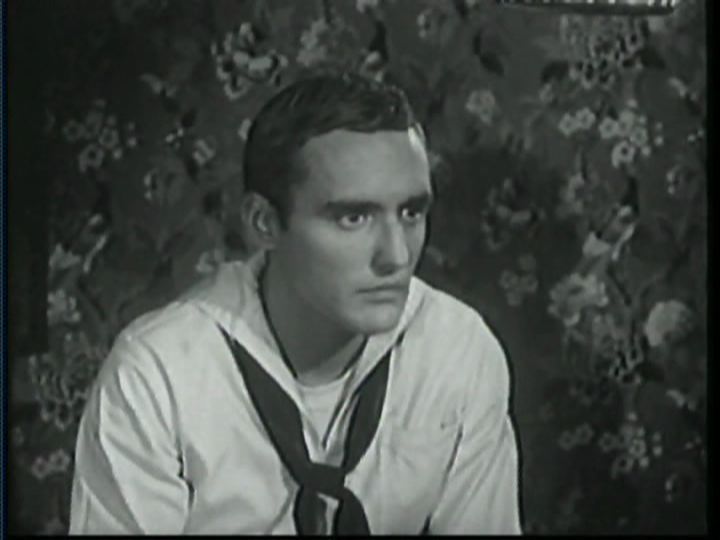
Dennis Hopper: a good actor, sure. A great actor? Maybe. But what he isn't is right for the part of Johnny, the ingenuous sailor smitten with mysterious carnie Mora (Linda Lawson), who may or may not be the mermaid she impersonates for a living.

Johnny insistently presses his attentions on Mora, who's standoffish at first but eventually caves and joins him for an awkward oceanside meal, complete with unexpected gull-stroking.

Soon enough the couple are lounging on the beach, with hugs, kisses, implied sex, and a bit of ass-gazing to boot.

But rumors of trouble persistently swirl around Mora, and local girl Ellen (Luana Anders) is only too happy to pass those rumors along, seeing as how she too wants to get some of that sweet Hopper ass.

Funny to see Anders, so sexy in Dementia-13, play mousy here, and quite convincingly too: whatever sensuality Ellen has is latent and implicitly mired in subservience.

Night Tide has good bones, but Hopper hits all the wrong notes, sorry to say. Instead of wide-eyed and open-hearted, he just seems confused and vaguely distracted -- like a stoner, or a recent TBI patient.

Or if he's trying for brooding and obsessed, that intensity isn't exactly apparent in his body language or line reading, so maybe the guy just needed better direction and more time to hone his acting chops. And if Hopper's Johnny is just meant to be yet another emotionally stunted child of WWII and the Fifties...well, who cares?

In the plus column, Night Tide is equipped with attractive scenery, evocative set-pieces, a decent script, and a plot which isn't altogether predictable. With one or two exceptions, it never embarrasses itself in the many ways such films often do.

But if it's trying to be one of those understated, haunting films whose imagery and characters stick with you for years afterward -- like, say, a Carnival of Souls -- well, that just didn't happen for Night Tide. In a way, it's a good reminder that plausible ingredients don't always yield a compelling result; not every record with Fender Rhodes and funky drums was a winner, after all, nor does every dish with truffle oil, crème fraîche, and chipotle win its chef a James Beard award.

But if blame for Night Tide's non-classic status has to be assigned, it must go squarely on Dennis Hopper's shoulders. His manly, massageable, yet curiously expressionless shoulders.


She Gods of Shark Reef (1958)

Grade: D-


For its first few minutes, She Gods of Shark Reef conjures some real interest. The opening set-piece -- which features, among other things, an impressive-looking assassin who clutches his blade between his teeth as he swims toward his target -- is taut and intriguing, though a bit hard to make out.


Alas, these things don't often last in the land of Mill Creek box sets, and soon a bit of voiceover narration -- that dreaded saboteur of all things action -- escorts us to the small Pacific island where the remainder of She Gods of Shark Reef is to take place. True, we still have POC adroitly transporting blades in the water: 


But Corman et al. decided this Shark needed a WASP injection, provided in the form of recently shipwrecked brothers Chris and Lee Johnston (Bill Cord and Don Durant, respectively). No points for guessing that the blond is the good one!


This idyllic Pacific island -- which definitely isn't Hawaii, how dare you even think that? -- is populated exclusively by moderately attractive, intermittently Polynesian women of marriageable age. When they're not making a living as pearl divers for "The Island Company", they sing, dance, do crafts...


...and practice religious ceremonies involving various combinations of gods, sharks, human sacrifice, and underwater statuary.


If all this sounds like paradise, you haven't reckoned with the presence of Queen Pua (Jeanne Gerson), a hatchet-faced woman who makes some effort to accommodate the unexpected visitors, but whose dedication to the blockage of cockage is nonpareil.

Why, in the midst of all this swarth, she's also as white as baking soda is -- as far as we could tell -- left unexplained.


Does one of the natives (Lisa Montell) fall in love with the "good" brother? Of course she does!


Does Queen Pua do her best to raise a red flag against the indecent writhing of hips and commingling of fluids? Of course she does!


Is there pearl thievery, breaking of taboos, and other trouble in paradise? And is the fattest character the target of humor and/or comic violence? You'd better believe it!

Do these and other events lead to mounting tension, and ultimately violence, between the brothers? Of course they do!


And did we care? Eh, not really. Have a shark.

Sunday, December 27, 2015

Getting out of the Woods

The first step to getting caught up with our enormous backlog is to get through the Woods. The Ed Woods, that is.

And fortunately -- as the old riddle says -- once you've walked halfway in, you're already getting out. Ergo:


Trick Shooting with Kenne Duncan (1953)


Grade: N/A

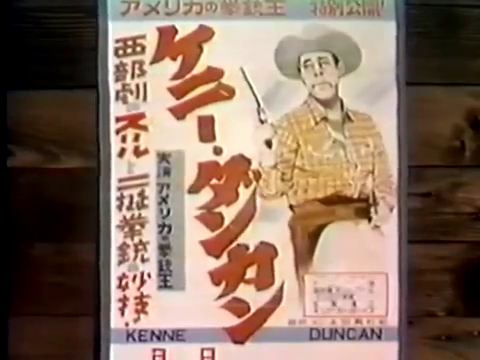
This is...pretty much what it says on the package, i.e. 9 minutes of trick shots by the perennially tired-looking Duncan, aka Dr. Acula from Night of the Ghouls, who clearly knew his way around a rifle.


There's nothing particularly Woody about the production, though the incongruous background music -- and an odd Japanese interlude -- add a hint of that freezer-burned flavor we associate with Ed's work. But maybe that's just the 1950s, which were weird enough on their own.


Otherwise, what's to say? It's, uh, trick shooting. With Kenne Duncan.


The Sun Was Setting (1951)


Grade: D-

Pointless tearjerker about a terminally ill woman who wants to go clubbing and, after 13+ minutes of conversational platitudes, almost does.

Other than serving as an interesting footnote to Wood's biography, the existence of this unreleased short contributes nothing to the world.


The Violent Years (1956)


Grade: C-

Now this is more like it. Scripted by Wood and directed by other, more capable hands, this trashy exploitation romp could be summed up as "poor little rich girl turns bad, thanks to parental neglect".


Or as the protagonist's mother says, the blame is all theirs for giving her "a new dress, instead of a caress". Ah, millinery, that well-known path to juvenile delinquency.


And as you might expect from Akdov Telmig, it's got long stretches devoted to hand-wringing, soul-searching, stern lectures, and other forms of "socially conscious" moralizing.


All this, no doubt, to justify all the sex and violence on display -- right? Well, neither nudity or blood is on the menu, nor anything else particularly graphic...


...but then again, can you name another movie with a 4-on-1 gang rape scene where all the perps are women? (No, that one episode of Law & Order doesn't count.) Well, OK, they don't actually show it, but there's zero doubt as to what that cutaway is, er, cutting away from.


One peak of absurdity comes thanks to the delinquent girls' liaison to the underworld -- the type of woman who wears high heels and tight belts while lounging around on the couch, and who serves as one part fence, one part criminal mastermind, one part Madame Blavatsky, one part cream of tartar.


She assigns them the task of trashing the local high school. Why, you might wonder -- what profit is to be had? Maybe an insurance payout?

No, instead we learn that "a certain organization" is behind the operation and, if "a few flags get destroyed in the process", they'd be more than pleased: "Let's just say it's part of a well-organized foreign plan."

Yes, friends, it's those damned Commies behind juvenile delinquency. Who knew?


Anyway, it's talky and not terribly titillating, and despite running under an hour it manages to include a montage of itself near the end of the film. But it's entertaining enough to watch once, and then watch again at double speed for the sake of getting a review done.