Showing posts with label blindness. Show all posts

Sunday, July 25, 2021

Unilateral disarmament: the pros and cons

(A cheap and obvious pun, but it had to be made.)

In a slight departure from strict chronology, The Umbrellahead Review once again turns its attention to films found on some versions of Mill Creek's box sets, but not others. In this case, we're looking at the Nightmare Worlds release -- specifically the version included as part of our 250-pack box set -- which omits two movies we had to seek out from other sources.

One of these films was cut before we got our box set; one seems to have been added afterward. One was removed in favor of The Disappearance of Flight 412, that shaggy-dog story of a TV movie; the other replaced The Return of Dr. Mabuse, that unmemorable slice of early-1960s German murk.

Both films are superior to their respective swapmates -- if that's not a word, it should be -- and one of them is about to get the first grade of its kind on The Umbrellahead Review.


    The War Game (1965)

    Grade: A


    The simplest way to describe The War Game would be "sobering". We downloaded our copy -- split, it seems, into two individually-digitized reels -- from Archive.org. Normally when we watch movies we don't talk much, but we might chat or complain a little.

    But by the time we got halfway through the first reel of The War Game, not a peep was to be heard hereabouts.


    Produced, written, and directed by Peter Watkins, The War Game was filmed in preparation for a 1965 showing on the BBC, but after seeing its depiction of the effects of nuclear war on Britain, the bigwigs at the Beeb deemed it too traumatizing for broadcast. Subsequently it was shown at film festivals, ultimately winning the Academy Award for Best Documentary Feature in 1967.


    But The War Game didn't reach British television until 1985, airing just before the 40th anniversary of the Hiroshima bombing in 1945 -- and nearly a year after the premiere of Threads, which did indeed traumatize millions of British people, adults and children alike.

    Along with 1983's Testament and The Day After -- both of which did their parts to traumatize American families -- Threads is the most obvious point of comparison for The War Game. All these films were made for TV, and all of them offer a relentlessly downbeat vision of life after atomic war.


    One crucial difference is that The War Game is not narrative fiction, but a documentary of sorts. It makes little attempt to tell the stories of specific people, but instead assembles a collage of scripted and unscripted interviews, recitations of quotes by prominent British public figures (most of them hopelessly fatuous, naive, or jingoistic), and enactments of what one might expect to be "typical" scenes in post-apocalyptic England.

    You know, looters getting shot, injuries without doctors to treat them, utter and total loss of hope, that sort of thing.


    The War Game is far less graphic than Threads, but in some ways is even more effective as a result. Watkins does a masterful job of weaving together individual heartbreak with collective destruction, not by creating characters for us to follow, but through the synecdoche of letting each person's words, facial expressions, and movements inevitably imply the whole.


    If you retain any affection for the inhabitants of Great Britain and their ways -- and, please, don't let's conflate the British people with any misdeeds done in their name or the name of Empire -- then it's profoundly disturbing to see the total breakdown of those ways, sometimes referred to as "society". (You know, that thing Maggie said didn't exist.) 


    We know that The Day After had a profoundly sobering effect (there's that word again) on Ronald Reagan, who wrote in his diary that it was "very effective and left me greatly depressed...My own reaction was one of our having to do all we can to have a deterrent and to see there is never a nuclear war."

    Guess it takes Hollywood to reach Hollywood -- but The Day After also reached a massive percentage of the American public. The War Game was denied that opportunity, reaching only a handful of cinematic elites until its time had passed.

    Impossible to say now what effect it would have had since -- in this timeline at least -- we miraculously made it through the remainder of the 20th century, and the first two decades of the 21st, without turning ourselves into glass souvenirs for curious aliens.


    Anyone who's seen "The City on the Edge of Forever" knows better than to meddle with the past. So, who knows: had The War Game been shown, maybe it would have inspired a huge British anti-war movement that would, in turn, have inspired a countermovement that led to catastrophe. Push a pendulum, get hit in the face.


    Better then to forfeit one's moment in the sun -- and an Academy Award sure as hell ain't bad -- than to reap "Two Suns in the Sunset". Nonetheless The War Game is more available than ever and, sadly, just as relevant as ever.

    It retains its power to leave an audience in stunned silence -- and if that audience is unlikely to want to watch it again, that would seem to be a measure of its success.


    The Severed Arm (1973)

    Grade: C

    After The War Game, the gore and goofiness of The Severed Arm come as a relief. True, it has ambitions of being something more than a standard-issue slasher/revenge film; in some details, it does elevate itself above that mean.

    But when you come down to it, The Severed Arm is one of those movies whose relationship to the consumer is mainly defined by the one-to-one correspondence between its title and its contents: it does what it says on the can. For those who like freshly amputated upper extremities, it's not going out on a limb (ahem) to say, this is the sort of thing they'll like. It delivers.


    Here's a really weird trope that we see a lot in films and TV: the idea that, in the face of a potentially lethal event -- poison gas, radiation, starvation -- you can precisely calculate the amount of time left. If you're able to finish a task or find salvation when you're below that number, you're golden; if not, you're inevitably dead meat.


    Now, sometimes this kind of exactitude makes narrative sense, like in a scuba diving movie. But if you're wondering how and why an amputatable gets amputated in The Severed Arm, the main reason is that six bros get together, something goes terribly wrong...


    ...and before long, "Some of us...maybe all of us...can't make it through tomorrow" if they don't get to sawin'. (Chop chop.)


    One might quote Dave Chappelle's sage observation -- "You were in on the heist, you just didn't like your cut" -- but, naturally, that holds little sway with the hack-ee. So when the other five bros begin losing limbs left and right...


    ...well, really more like left or right...


    ...the question doesn't really seem like "Whodunit?" so much as "Whatcha gonna do when they [in the 'third-person singular of unspecified gender' sense] come for you?"

    Hard to say more without spoilers galore, though the presence of Deborah Wiley as Teddy -- daughter to don't-mind-'im-'e's-'armless -- complicates matters beyond the routine.

    Is she a possible love interest with a disarming smile? Just an indignant and/or concerned family member? Something else? Only time will tell.


    One of us recalls reading some pretty negative comments about The Severed Arm that implied it was in the same league as Manos or Eegah. Consequently, as we watched (hi, Ray!), the film defied expectations simply by being of ordinary quality.

    That doesn't mean it was especially well-acted or well-written, mind you -- the script even invokes the old cliché about how the calls are coming from inside your house! -- but it never got worse than passable.


    Of course it helps that, instead of our usual PD fare, we were watching a gorgeous widescreen transfer from Vinegar Syndrome, with intense colors and a beautifully crisp image. Between that, Phillan Bishop's moody analog synth score, and the lavish supply of marvelous 1970s aesthetics, the film is a feast for the senses.


    By the way, some people who own DVDs of The Severed Arm have wondered if it ends prematurely. It's possible that sketchy releases truncate the credits to obfuscate copyright, but Vinegar Syndrome's release makes it very clear that the film's rather abrupt ending is intentional, and the final freeze-frame doesn't change during the credit roll.

    If you see a still shot with two happy people, and one with a blank expression, you've seen the end.

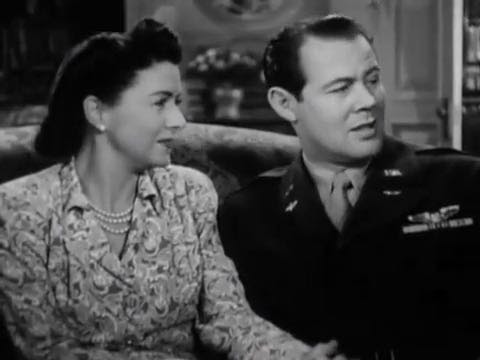
    (But the screenshot below isn't it -- just a chance to show off some cardigans and fancy prints.)


    Monday, January 11, 2021

    Put our service to the test

    Though neither of these films is a Mill Creek joint, we initially took an interest in them because of their connection to the Horror Collection 250-pack. One features an actress we first met in the earliest days of our site, while the other is ostensibly a sequel to one of our favorite movies on the box.

    However, we didn't foresee that they'd share something else: protagonists who find themselves in the crosshairs of that most terrifying of locations --

    --that most bone-chilling of phrases --

    -- that limitless vein of potential awkwardnesses and unwanted socializations:

    "You can stay in our guest room."


      The Three Weird Sisters (1948)

      Grade: C+

      Ah, Nova Pilbeam. Even if your name weren't so unusual, we'd certainly remember you from your star turn in Counterblast, not to mention your strong resemblance to a former colleague of ours (at least in that colleague's younger days: you wouldn't recognize 'em now).


      And speaking of younger days, it's not clear whether this or Counterblast was Pilbeam's last film role -- though she did make one BBC appearance in 1951 before packing it in for good -- but after a successful career as a child actress, and a reasonable career as a young adult, that was that.

      She lived to age 95 -- when we wrote our Counterblast review, she was still alive! -- but was, from all reports, not interested in discussing the past. (Makes sense when your name is "new".)


      Anyway, Ms. Pilbeam is Claire (no relation to Emily) Prentiss, a secretary who accompanies her obstreperous boss Owen Morgan-Vaughan (Raymond Lovell) to a Welsh mining village, Cwmglas, where his (ahem) three weird sisters await his arrival at the family home.

      (Technically they're his weird half-sisters, but that wouldn't have the same ring, now would it?)

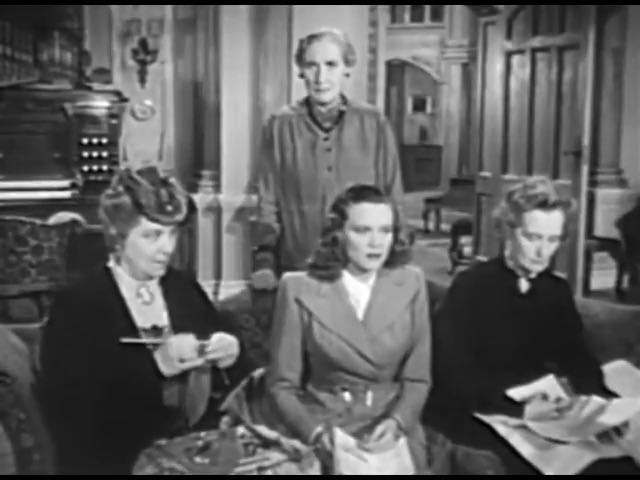
      One is blind, one deaf, and one has some combination of bad nerves and severe arthritis, resulting in a strange symbiotic interdependency between the three.


      In the film's opening Cwmglas suffers a catastrophic collapse in which several residents die, and survivors opine on the will of God and the suffering of the proletariat.

      While hard to follow on first viewing, a quick review of Dylan Thomas: The Complete Screenplays (which also told us how to spell "Cwmglas") makes the details clear. The Morgan-Vaughans are the local muckety-mucks who made their fortune via the mines, while their cheapskate refusal to fill up unused mineshafts beneath the village caused, or at least contributed to, the collapse.


      For a while, The Three Weird Sisters is poised on a knife-edge of ambiguity: is Owen just a callous bastard who selfishly wants to wash his hands of all responsibility toward the village? (Given that Owen gets a rock flung at him upon arrival, some of the townspeople clearly hold the affirmative.)


      Or is Cwmglas -- the name of which sounds like a "worst of Reddit" thread in the making -- just a decrepit symbol of the corrupt, hopeless old ways? A decaying relic that's undeserving of life support and overdue for destruction? Merely a vessel for a "spent force", one might say?


      With Dylan Thomas on board, some sophistication (moral and otherwise) is to be expected. Ultimately, though, the lines are drawn by the participants' willingness to sacrifice innocent Claire in the crossfire -- and given that one of the sisters describes her as "that horrible painted young woman", one need not be exceedingly wise to infer who the baddies are.


      So what does that leave us? Suspense, atmosphere, intrigue, and barbed dialogue, we suppose, none of which are extraordinary but all of which are at least serviceable. And we get faces, if one likes faces (as we do), ranging from Ms. Pilbeam's ever-popular visage --


      -- to the sisters, especially Gertrude (Nancy Price), whose forbidding countenance somehow intrinsically evokes those stony, mirthless parts of Britain where God's name is perpetually on everyone's lips and yet the old pagan powers feel close at hand.


      Or there's this preacher (Hugh Pryse) in his ridiculous middle-aged makeup:


      And we get amusing vignettes, as when we find the thersitical Mabli (Hugh Griffith) reciting Marxist dogma to, well, dogs:


      Structurally speaking, The Three Weird Sisters is a film-you've-seen-before -- if you understand what we mean -- and offers no great innovation or dramatic uncertainty. So your appreciation of it will likely depend on your affinity for the Welsh coat of paint it's received, and/or your fondness for Dylan Thomas, Welsh terriers, Nova Pilbeam, or handsome older women.

      (No judgment, you do you.)


      Devil Bat's Daughter (1946)

      Grade: D+


      When you expect a film to be a complete piece of crap, it sure is a pleasant surprise when it's not. That's not to say Devil Bat's Daughter even comes close to its predecessor, The Devil Bat, the consensus favorite among Béla Lugosi's Poverty Row efforts (and we agree that it holds up).


      We can't help but be curious why Devil Bat's Daughter was even made. Was a five-year-old film really enough of a success to call for a sequel? That is: if this was a cynical cash-in, what exactly was there to cash in upon in the first place?


      In any event, Devil Bat's Daughter has little to do with the earlier film, though we can't quite call it an "in-name-only" sequel. Instead it runs along similar lines to Shock, with a traumatized young woman, Nina (Rosemary La Planche), guided through recovery by the authoritarian Dr. Clifton Morris (Michael Hale), who may not have her best interests at heart.


      We're not sure whether having a patient living in your home was considered a ridiculous violation of professional boundaries in 1946, though from our vantage point 75 years later, it seems absurd. But living in Dr. Morris's home brings Nina into contact with his saintly wife Ellen (Molly Lamont) and stepson Ted (John James), and guess which one of them falls in love with her?


      ...no, this is 1946, try again. Though we will say that Ms. Lamont, who hasn't necessarily lit up our screen in movies like Scared to Death and Jungle Girl, evinces a degree of angular classical beauty in this film --


      -- while, by contrast, Ms. La Planche's past as a Miss America merely underscores how tastes have changed.


      But better either of them than John James, who unfortunately evokes the irritating Jerry Lester -- plus a dash of Mickey Rooney, a sprinkling of Tim Allen, a dusting of John Heard. Those old-young faces are a tough sell.


      If one acknowledges that the major plot points of Devil Bat's Daughter are foreseeable, there are a few things that deviate from the expected path. One of them is the body count, or more accurately, the body-count-to-emotional-consequence ratio, which is unexpectedly brutal. Not a film for dog lovers, this, though we're always glad to see a movie go for the jugular.


      On the other hand, Devil Bat's Daughter commits an absolutely monstrous act of retconning that, under normal circumstances, should be unforgivable. So instead, we'll forgive it by allowing ourselves to pretend that the literal meaning of the revelation -- which would utterly destroy both this movie and the previous one -- is untrue, and that the character who announces it is mistaken. And frankly, the movie still works if you assume that.


      Still, while our initial impulse was to give this one a C-minus, it really needs to be penalized for that misstep. Otherwise, we were shocked to find that we enjoyed Devil Bat's Daughter. It's a predictable and flawed film, but manages to entertain nonetheless -- if you have very low standards, as we seem to these days.


      Wednesday, May 31, 2017

      Kaj nun por io tute malsama

      Nu, Kapitano, kion vi faras en hororo filmo?


      Incubus (1965)
      [Inkubo]

      Grade: C


      Continuing our detour from the Mill Creek box, we watched the Shat -- not to be confused with the Schach -- in Incubus, a film that manages to be infamous on multiple fronts. To wit: it was believed lost for many years, and the only surviving print has burned-in French subtitles. It allegedly carries a "curse" that, shortly after the film's completion, yielded two suicides (one of them a murder-suicide) among the cast members.

      And -- oh yeah -- it's completely in Esper-fuckin'-anto. (That would be an example of an infix, for all you budding linguists out there.) Thus the burned-in subtitles, which are obscured by an ugly but necessary black box for the English-language subs.

      Another site describes Incubus as "some kind of hybrid of an Ingmar Bergman film with Manos: The Hands of Fate", which is pretty much spot on -- though, at least plot-wise, you could probably throw in a dash of Night Tide too. It tells a moody tale of a succubus who drowns sinful men at the behest of an evil cult...


      ...until she meets a man who's not so easily corrupted. (Three guesses who.)

      The movie's deliberate pace and philosophizing dialogue are certainly reminiscent of Bergman, as is the positively gorgeous cinematography by Conrad Hall (of Butch Cassidy and the Sundance Kid and American Beauty fame). For many of the films we watch, we find ourselves struggling to find a decent screenshot; Incubus presents us instead with an embarrassment of riches, with almost every frame akin to a well-composed photograph.

      It's true that, by using Esperanto, the events in Incubus become weirdly unmoored from any specific time, place, or culture: we literally have no idea when or where these events are meant to be happening. It's disorienting, and certainly contributes to the film's unsettled atmosphere. 

      It's also true that, even to a non-speaker of Esperanto, the dialogue in this film is painfully stilted both in its delivery and its pronunciation: most of the actors -- who allegedly learned their lines phonetically, and on short notice -- are clearly uncomfortable with the language, and their line readings suffer as a result.

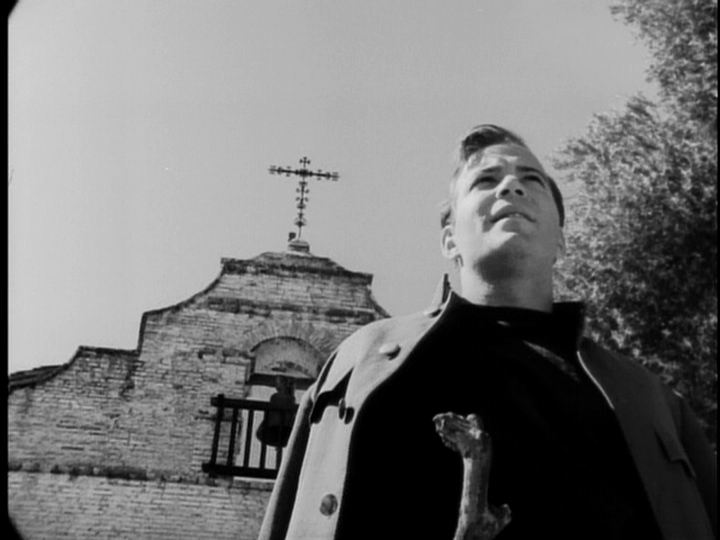
      The interesting exception is Shatner, who (at least in the early going) is noticeably more fluent than his colleagues. We've read that he speaks Esperanto with a pronounced French-Canadian accent, but better that than a Southern California accent, n'est-ce pas? (Dude?)


      Shatner's hammy behavior in the wake of Star Trek has made it easy to overlook that he's always been a committed, disciplined actor. Whatever his personal shortcomings, his fame is at least partly the product of dues paid through years of hard work, by being damn good at his job and giving it everything he's got.

      In the case of Incubus, he does what he can to make the best of a difficult situation; while he can't singlehandedly elevate the film, he's certainly not a liability -- and almost had us believing he could carry this off.


      We also took notice of Milos Milos as the titular incubus. Shame he was the perp in that murder-suicide we mentioned above, as there's real menace in his leering, demonic performance -- and while some of it is attributable to good direction and cinematography, this Serb clearly had screen presence.

      But ultimately it's hard to see Incubus as anything more than a beautifully filmed miscalculation. Pretentious and portentous, it nonetheless manages to conjure an atmosphere of real foreboding -- but neither its muddled narrative nor the stiff cast supply the foundation needed for Incubus's atmosphere to amount to more than just ambience. It has the visual flair and tortured quality of a Bergman film, sure, but not the intelligence or finely crafted performances characteristic of Ingmar's work.

      All in all, certainly worth seeing (especially in the most literal sense), but not a good film. Sorry, Cap'n.


      As a side note, Incubus is just about the last movie in our massive review backlog that, when we began chipping away at it with our most recent Ed Wood entry, dated back to August 2014. Since kicking into high gear in October of last year, we've been covering films that we initially watched between December 2014 and December 2015. With over 50 films in the backlog it seemed insurmountable when we first started, but here we are, out of the woods.

      For a variety of reasons we didn't watch many movies for most of 2016, though Incubus was one of the few; others -- at least the ones potentially relevant to this blog -- include:
      • Jungle Moon Men, one of the more offensively terrible films we've ever seen from a mainstream studio;
      • The Howling and King Kong, two films far too famous to need our two cents on 'em;
      • Chandu the Magician, an amusing but threadbare romp with Béla, and One Million Years B.C., a less enjoyable (and bone-stupid) romp with Raquel.
      We won't be doing formal reviews for any of these, but funny story about The Howling. We had DVR'd what we thought was The Haunting of Julia, and let that recording sit for over a year before sitting down to watch it. The first minute or so didn't get taped, so we didn't see the opening titles and were thoroughly confused for about 20 minutes until we figured out what had happened. In retrospect we're glad we got the chance to see this landmark werewolf film, even if purely by accident.

      In our next entry we'll cover the only two Mill Creek box films we watched in 2016. Once that's done, we'll be fully caught up, and from that point forward, everything you read from us will be hot off our cinematic presses and fresh in our minds -- which will, in turn, spare us the experience of having to watch the likes of Frankenstein 80, A Face in the Fog, and Midnight Phantom twice.

      September 2018 will also mark the approximate 10-year anniversary of this project, with the anniversary of our first blog post coming two months after that; with roughly 70 films between us and the end of the 250-pack, perhaps it's not inconceivable (hi, Wally!) that we'll finish it up in time for the site's one-decade mark? We'll see!