A few years back, the Sci-Fi Channel (
Siffy, if you prefer) expanded their usual New Year's Eve
Twilight Zone marathon to include every single episode from the original 1959-1964 series, aired chronologically. We thought, what the heck?

So, allowing for breaks during some of the episodes we'd seen before, we proceeded to take in the entire run. It took
days, and we had to endure some tedious stretches (season 4's hour-long runtimes were a mistake), but now we can say it's DONE -- we watched 'em all.

And of course it wasn't
just about being completists, though making our way through discrete sets of things is, well, kind of our thing. Now, years later, we can fondly reminisce about the time we rang in the new year (and then some) lounging in our pajamas, staying up through the wee hours to catch one kinda mediocre episode after another (they can't all be Lois Nettleton in "The Midnight Sun").

It was in the same spirit that we approached the the next five movies featuring Gamera -- a giant fire-breathing turtle who spins through the air like a massive self-propelled Catherine wheel and spends way too much time hanging around with small children.

Our beloved Mill Creek 250 Horror Collection has movies #1 (
Gammera [sic] t
he Invincible), #4 (
Destroy All Planets) and #5 (
Attack of the Monsters); we figured why not track down #2 (
War of the Monsters) and #3 (
Return of the Giant Monsters) and complete the series?

Turns out #2 is on Mill Creek's Strange Tales pack of 20 movies, all of which also appear on the 250 pack,
except for
War of the Monsters. Huh; oh well, internet to the rescue. To our knowledge, #3 never appeared on
any Mill Creek offerings, so it was off to the internet again.

We hadn't planned to binge all five, but with a free evening ahead of us and no obligations the next morning, it somehow seemed like the right thing to do. Thus, in the span of 16 hours or so (we broke for sleep -- what can we say, we're not as young as we once were), we did just that.

Admittedly it in no way approaches the scale of our
Twilight Zone viewing session; and of course, there are plenty more Gamera movies that we'd need to watch in order to call ourselves completists (and that probably won't happen). But we can now turn to one another and say "remember when we subjected ourselves to
that?" And, as a gift to our future selves, we're now spared the experience of pulling out the next disc and sighing "oh boy, another Gamera movie."

Gammera the Invincible [aka Gamera, The Giant Monster] (1965)
Grade: D+

And so it begins.
Mill Creek's copy of this first foray into Gamera-land is apparently a re-edit of the original Japanese release (
Gamera, the Giant Monster), with extra scenes added for the "benefit" of American audiences, and a superfluous
m for good measure -- good job, guys.

Clearly it isn't good enough for Gamera to simply emerge from the Arctic ice, wreak some havoc on a scientific team, and fly off in the direction of Tokyo. What Americans desire above all else are a bunch of generals, pundits, scientists, and senators to bark, argue, insult one another, and hold Very Important Meetings to discuss at length the mere
possibility of the existence of a giant, fire-spurting flying turtle.
 'Cause little children have a way with G-A-M-M-E-R-A
Once that talky (and often shouty) diversion is dispensed with (and really, the scenes aren't all that bad; they just don't seem necessary), it's back to the meat of the Japanese original. Poor little Toshio; he just wants to hang out with his pet red-eared slider, but his dad and sister are having none of it.

When the
über-chelonian lands at the family lighthouse, one has the inkling that this budding turtle whisperer might play some pivotal role in the proceedings.

And indeed, it's not the last we hear of the wee lad, who seems to be the only one championing the giant reptile. Even with his travels dictated by his long-suffering family -- not to mention a scientist channeling Reba McEntire's Colonel Sanders --

-- Toshio always manages to pop up his cherubic little face precisely where Gamera is doing his best knock-stuff-down act.

It's the typical monster movie cycle: the beast destroys; the scientists and/or military come up with an improbable plan; the beast thwarts the plan and goes on destroying; somebody comes up with an even more improbable plan; and so on and so forth. (Sure keeps the scale model builders in business.)

Eventually all the world governments manage to come together for one final, desperate push, and we're left cheering Gamera as he's launched into space, never to return . . .

War of the Monsters [aka Gamera vs. Barugon] (1966)
Grade: C
. . . until six months later, when a meteor hits his rocket and Gamera spins lazily back down to Earth.

Oops! Within the first five minutes, Gamera flattens a hydroelectric plant and busts open a dam, then blithely flies off to his lair, or wherever it is giant turtles like to chill out.

Then the movie takes a bit of a left turn, as we don't see Gamera again until the 52 minute mark. Instead, we're dropped into a plot by a cadre of Bad Guys (and one not-so-bad guy) to retrieve a giant opal from a remote Pacific island cave.

Turns out monster eggs look a whole lot like valuable gemstones, and after an unintended stint under a conveniently positioned heat lamp --
 Aren't all ship cabins equipped with those?
-- out hatches Barugon.

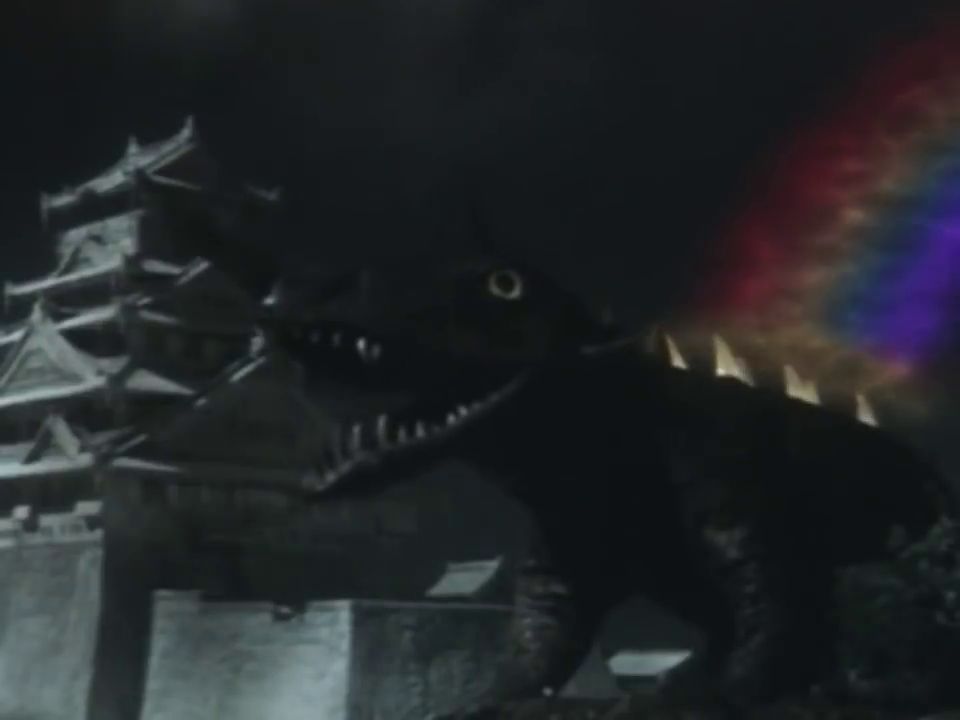
With a colorful array of rainbow death rays shooting from his back -- not to mention the long, stiff tongue shooting gouts of freezing liquid -- Barugon is certainly one of the more
Mazovian monsters we've come across.

Gamera, perhaps annoyed that there's another game in town, drops in to investigate.

As the monsters rumble and the scientists and military (ineffectually) plot, the baddest of the Bad Guys is still determined to retrieve his "opal," dropping bodies along the way and just generally making a nuisance of himself.

More fighting, more rainbows, more thwarted military plans, and eventually Gamera prevails and everyone's happy. Hooray!
 War of the Monsters
 is a bit of a black sheep within the Gamera film family -- all sorts of close-range death, human-on-human violence, evil plots, greed, theft, scorpion stings, knife fights, quicksand, the works.

No "friend of children" narrative here. And what it lacks in youthful frivolity it more than makes up for with gleeful carnage, destruction, and beat-downs.

But really, who misses the kiddos when we've got festive monsters and mustachioed scientists with comically oversized cordless phones?

Return of the Giant Monsters [aka Gamera vs. Gyaos] (1967)
Grade: C-
After
War of the Monster's tale of murder, intrigue, treasure hunters, and exotic islanders, it's time for a movie about . . . road construction!

That's right, a handsome foreman and his work crew are trying to get a new highway built, and the local yokels are brandishing signs and blocking their way.

Riveting stuff. At least it's a bit more complex than innocent peasants vs. big bad government, as the villagers are protesting mainly as a tactic to get more money for their land.

And they would've gotten away with it too, if it weren't for those meddling monsters! You see, there's an active volcano nearby, and in that volcano lives Gyaos -- a pterodactyl-looking thing so badass that at one point it
cuts off its own toe to escape from Gamera's clutches.
 Is toe jam good on rice?
Gyaos accomplishes this feat of self-amputation with the ol' laser-shooting-from-the-(adorably-triangle-shaped)-mouth trick.

It's a formidable weapon, and one used to comic effect when Gyaos manages to slice a car so cleanly in two that its occupants just keep driving along in half a vehicle.

A plane gets bisected as well -- the consequences of which are rather more grim to consider.

Luckily there's a kid doing a bit of meddling too -- that would be young villager Eiichi, who was first on scene at Gyaos' emergence and keeps feeding the scientists reasonably plausible ideas on how to destroy the creature.

Most usefully, Eiichi manages to endear himself to Gamera so completely that's he's ultimately able to summon the giant turtle back from his lair for the coup de grâce.

Overall, it's the same basic format as the last Gamera film -- the new monster destroys stuff, scientists try (and fail) to thwart it, Gamera swoops in at various points to help. and a murky subplot ties it all together.

We're realizing how
reluctant a hero this Gamera has turned out to be. Like a kind-hearted introvert who's endeared himself to a much more active (and trouble-prone) crowd, he simply doesn't have the heart to say "no" when he's called out of his cozy home to join the monster party.

As the responsible one of the group, he spends all night taking care of everyone and making sure the entire place doesn't get (too) trashed.

Maybe he even has a little fun in spite of himself. But, as soon as his perceived obligation is fulfilled, he gets the heck out of there and heads for safety and comfort of his underwater lair.

Destroy All Planets [aka Gamera vs. Viras] (1968)
Grade: D-
We took a break before #4 to get some sleep; we're committed to this project, but not (for the most part) gluttons for punishment. A night's rest left us bright-eyed and bushy-tailed, ready to tackle the last two movies of our mini marathon.

It's clear from the first scene that
Destroy All Planets takes a much different tack than the previous three. The title gives it away -- this is
space, and Gamera has moved beyond mere terrestrial threats to help defend Earth against alien invaders.

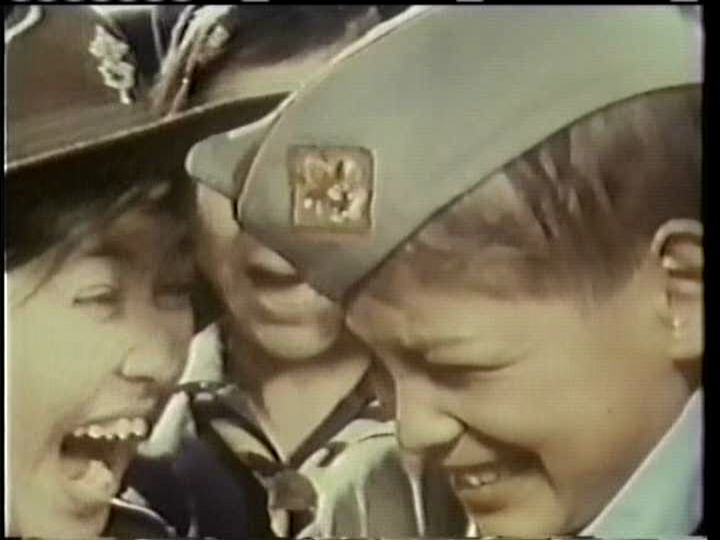
But, after a relatively quick battle in which Gamera (kinda) prevails, we're brought back down to earth to a most wholesome scene: a joint US-Japan seaside scout camp, complete with a kumbaya song circle and everyone kitted out in full uniform.
 Moonrise Kingdom, eat your heart out.
Soon we're introduced to the real stars of the film: Masao and his American friend Jim, who are clearly the resident mischief-makers in the troop.

The lads cleverly sabotage a research submarine (yellow, of course) to play a prank on their scoutmasters; this leads to their own underwater adventure and close encounter with Gamera, who manages to find trouble of his own.

It seems those aliens are back, and they mean business.

All this in just the first 15 minutes -- not a bad start! Then . . . as we watched . . . we were suddenly hit with . . .

A clip show! And not one of those fake ones the Golden Girls did where the flashbacks were new; this was solid
twenty minutes of material grabbed straight from the three movies we had just plowed through and were hoping to put (far, far) behind us. They even stuck black and white scenes from #1 among all the later color stuff!

Sure, the stock footage fit the context of aliens doing their "research" into Gamera and his habits and abilities (as THEY watched . . . ), which does figure into the plot. And maybe we could pretend that the filmmakers
didn't do it to save money, and simply wanted to introduce the younger audience to Gamera's prior exploits, seeing as those other films were more PG, as compared to
Destroy All Planet's kid-friendly G-ness.
 No A rating, thank you.
Well, maybe except for the head slicin' . . .

. . . or Gamera impalin'. . .

. . . but heck, they did the same thing to Ursula, so who are we to judge what counts as kid-friendly violence?

Stock footage aside, this Gamera outing wasn't so terrible.The set designers and prop masters clearly had an absolute blast -- both the interior and exterior of the alien ship are chock full of stripes, patterns, shapes, flashing lights, and general space-age awesomeness.

There's mind control, puzzle solving, questionable food, and a few twists and turns to keep things interesting. And Viras, who only assumes his true form at the very end, is certainly fun to look at and a worthy adversary for Gamera.

Ultimately though, it's a movie about kids, for kids; a fun enough romp, but only if you're in a gee whiz kind of mood.
Attack of the Monsters [aka Gamera vs. Guiron] (1969)
Grade: D

"Oh boy, another Gamera movie." -- Everyone at this point, including us.
Hey everyone, have you seen
Santa Claus Conquers the Martians? Yes? Good. Now, how about we do this:
For Earth kids Billy and Betty, substitute Akio and Tom (again with the American friend!)

They're out playing, find a spaceship, and you can guess the rest.

This time don't fly to Mars, but head to undiscovered planet Terra. It orbits directly opposite Earth, you see, which meant the Earthlings couldn't.

Instead of the bumbling Martian henchmen, trade up to Barbella and Florbella -- two spacesuit-clad bombshells with special plans for their young captives.

Crazy space sets, rocket ships, freaked-out parents, fighting among the villains, and an extra helping of golly gee kiddo action -- don't change a thing, you're doing great.

And finally, instead of dear old Santy Claus, have our hero Gamera swing in to save the day.

THERE.
DONE.

OK, fine,
Attack of the Monsters deserves a
teeny bit more credit. It isn't simply a clone of
SCCTM (thank goodness) -- there are the monsters, of course, and not just two, but three! There's our pal Gamera to start, then Space Gyaos -- as you might imagine, it's simply Gyaos from #3, just painted a different color.
 Totally not the same thing.
Finally the most formidable foe: knife-faced, shuriken-wielding Guiron -- who, as another blogger pointed out, is a dead ringer for the San Jose Sharks mascot, S J Sharkie.

With talk of cannibalism and an unsentimental euthanization, things are also a bit darker here than in Santy land.

But overall, the look and feel are just about the same. Bad effects, bad dialogue, too many kids, not enough teeth.
 Or too many teeth. You get the picture.
And that, ladies and gentlemen and assorted canines, concludes our Gamerathon. Thank freakin' goodness.