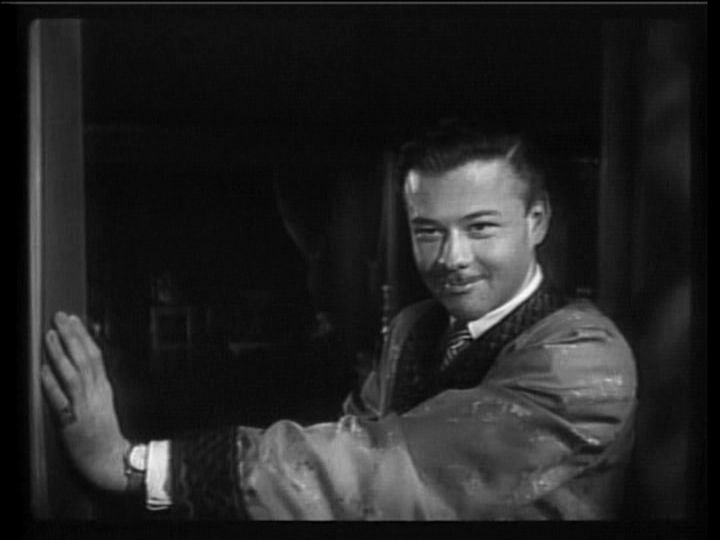
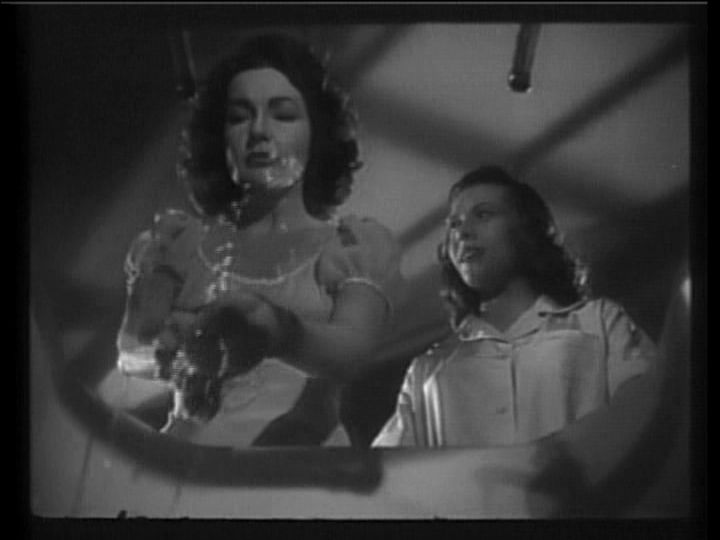
The Peter Hurkos Story (1960)
Grade: D

We couldn't help but be offended by The Peter Hurkos Story, for much the same reason we were mildly irritated by The Night America Trembled. And that, to remind our loyal readers once again, is because it's bullshit.

From all reports Hurkos was a typical "psychic" con artist, using an array of manipulative tricks to prey on people's hopes and fears. So while this film -- really a two-part episode of One Step Beyond, sponsored by Alcoa and edited together (rather badly) into a single 51-minute feature -- is, in terms of pure craftsmanship, a reasonably well-made example of TV entertainment...

...we can't quite will ourselves to believe anything in the narrative, because Hurkos himself trafficked so unrepentantly in lies.
Was he really a member of the Dutch Resistance? Did a fellow Resistance member, believing Hurkos to be a traitor, really try to smother him in his sickbed -- only to stop when Hurkos read his thoughts? Is there any truth at all to the story, or is it just another fiction from a master manipulator and serial liar? And why on earth did Alcoa sponsor such a cavalcade of cynical crap?

At the end, the real Hurkos even pops up to offer the following proclamation:
"So long as I live, I offer myself for any test, any study, under any conditions that scientists may impose."
Yeah...about that. (And here's a bit more.)
The Embalmer [aka Il mostro di Venezia] (1965)
Grade: D+

The Embalmer's original Italian title translates, shockingly enough, as "the monster of Venice". And just like it says on the box, a depraved killer is roaming the streets (or really scuba-diving the canals) of Venice, drowning young women before adding them to his collection.

How does he ward off the stink and keep them NM+/NIB, or at least NM-? Well, that's where the English-language title comes in, natch.
But formaldehyde fiddlings can't thwart a reporter's houndlike ability to sniff a good story from a mile away -- and naturally our spunky colleague (Luigi Martocci) rapidly outpaces the police in his efforts to crack the case.

The nexus for all this activity is a sketchy hotel that -- conveniently enough -- is hosting a gaggle of schoolgirls and their chaperone (Maureen Brown). That's, uh, some spectacularly ill-timed tourism.

The Embalmer is one of those films that plays better in memory than in actuality. Before rewatching it to write this review, we had some recollection of it as a middling effort, a bit like (say) Phantom of Soho: murky, meandering, but at least competent in the basics.

But truth be told, it's not really very good at all. The biggest problem is the film's presentation of its own plot, which simply falls down at the task of giving us important information in a way we can understand and retain. That's something crucial in a murder-mystery, even in one with pretensions toward being a horror film.

It'd be easy to blame the dubbing for the fact that (for example) we had no idea who the killer was until we went back and reviewed several key scenes in the movie. Oh, we saw his face, but we didn't recognize him at all, or remember him from earlier in the film.
But we'll hazard a guess that the issue is just as present in the Italian original: whatever the language, if a character doesn't get the necessary screen time or have the needed presence, the issue remains the same.

The real blame probably lies with the film's director and editor. Especially on second viewing, The Embalmer is just loaded with padding that masquerades as suspenseful buildup, and characters who serve no structural purpose in the film, however interesting their faces might be...

...or however amusing it might be to see the Italian Elvis pop out of a coffin.

And even now that we understand the killer's identity, the movie's third act is ultimately a dismal affair. Despite a few memorable images and set-pieces, the inevitably violent conclusion offers no real catharsis, but simply a downbeat shrug of indifference.
However we were hardly indifferent to the actress who played Grace (pictured on the left below), who stood out from the dreary surroundings like a sequined suit in a pile of black velvet.

Her screen time is sadly limited and her name remains unknown to us (thanks, IMDb). But we couldn't help but take note of this fetching young woman, who clearly possessed a certain nous ne savons quoi...

...or maybe we savons exactly quoi it was, now that we think about it, and clearly the cinematographer knew it too. Tanto meglio.
The Atomic Brain [aka Monstrosity] (1964)
Grade: D-

It's almost never a good sign when a movie opens with a lengthy voice-over delivering exposition that ought to be shown, not told -- and that's just one of several ways in which The Atomic Brain is a sub-mediocre mess. In offering up the tale of a rich old woman (Marjorie Eaton) who teams up with a mad scientist (Frank Gerstle) in pursuit of renewed youth, The Atomic Brain succeeds only in being tacky and half-assed without mustering any real charm.

It's not as if it's a secret why old Mrs. March has placed an ad for a new servant-girl (applications must include your bust, waist, and hip measurements!). Nor is it a surprise what sort of treatment -- in either sense of the word -- the three naïve young women who answer the ad are soon to be in for.

But The Atomic Brain plods forward, undaunted, trailing that half-baked collection of vignettes, clichés, and confrontations it hopes to pass off as a plot.

We were particularly amused by Judy Bamber's attempt at an English accent, yielding a strange hybrid of Texas and New Zealand (plus a dash of South Africa). She's apparently the sexpot of the bunch, and when she swings her hips as she walks -- or just bounces on her bed -- her bodily motions are accompanied in the soundtrack by what we can only describe as "sexy xylophone".
Now that's a word-pair (let alone a concept) that, outside of a particularly hard-fought game of Scrabble, really has no right to exist.

Anyway, the body count is high, the body beautiful count is low, and the door for a sequel is left open in a rather hamfisted manner.
But who would really care to watch The Atomic Brain 2, or Monstrositwo for that matter? It's hard enough to imagine an audience for this film which, though not the very bottom of the barrel, still offers no real rewards for even the most tolerant viewer.
(Unless you really like cats. It's got some of that, at least.)