It's been over a decade since we started making our way through the 250 (ish) films in the Mill Creek Horror Collection. At long last, we've arrived at the tail end of the box, with just two movies left -- two! -- that neither of us have ever seen before.
And what do they have in common, besides aliens and space and other science fiction tropes? There are a few options, like blowing up heavenly bodies (happens in both), teleportation (ditto), or ripping off established science fiction classics (that's a hat trick).
But we'll choose this: in both films, press conferences are held in which the very fate of the earth is called into question.
And what do they have in common, besides aliens and space and other science fiction tropes? There are a few options, like blowing up heavenly bodies (happens in both), teleportation (ditto), or ripping off established science fiction classics (that's a hat trick).
But we'll choose this: in both films, press conferences are held in which the very fate of the earth is called into question.
Grade: D

These last two films in 50 Sci-Fi Classics really do bring us full circle, as Warning from Space amply demonstrates. Even if we didn't have the literal (and adorable) "star men" seen above, its Japanese origins and style would certainly remind us of the Super Giant films we watched near the very outset of our 250-pack quest.

Once again the Mill Creek compilers show discernment by pairing Warning from Space on the same disc with They Came from Beyond Space. Perhaps we should have reviewed them together, as they really do share a lot of themes -- like having scientists as protagonists, and showing them in the field.

Or aliens who, in need of a spokesperson, choose to inhabit a human female body.

Or societies that conceive of themselves in terms of politeness and fair play, and that are left curiously defenseless against those who transgress those norms.

Or weird stuff that pops up from a pond, while the soundtrack uses a grating electronic tone to make sure we catch on to its "alienness".

Anyway, Warning from Space is basically Japan's version of When Worlds Collide with a dash of The Day The Earth Stood Still. There's a whole lot of looking through telescopes and firing off rockets --

-- interspersed with philosophical arguments, cultural activities, and the occasional dance number.

By deciding to make Japan their point of contact, did the aliens inadvertently guarantee that the rest of the world would drag their feet? There's a whiff of that in the film -- an aggrieved undertone of "Why aren't they taking us seriously? Why are they refusing our requests for help?" --

-- to which the events of 1931-1945 might be a plausible answer. (Just saying.)

Warning from Space might rate a notch or two higher if it weren't for the cavalier way it handles a crucial plot thread near the end. It cheapens the narrative, and would have been so easy to fix! And we can't blame the dubbing, since it's apparently quite faithful.

The fun is also dampened by scenes near the end that show various animals in distress. The intention is to evoke our compassion by reminding us of how they too would suffer in the oppressive heat, but can we trust that none were harmed in the making of this film? Probably not.

On the other hand, that alien chick has one hell of a serve. Naomi Osaka, watch out!

[aka War of the Planets, aka Anno zero - Guerra nello spazio]
Objective Grade: F
Plus WTF Withal: D

Cosmos: War of the Planets isn't quite the last film on the box set: that honor goes to Destroy All Planets, a Gamera film we already reviewed. But it's on the last side of the last disc, at least.
And boy, did Mill Creek pick a doozy to finish things up -- because War of the Planets is one bizarre, scattershot, fever dream of a movie.

There was always going to be some background weirdness since War of the Planets has the same director (Alfonso Brescia), and much of the same cast, as a film we've already seen, War of the Robots.
Heck, it's even got Aldo Canti as an unexpectedly friendly alien who joins the starship's crew late in the film -- playing almost the exact same role he did in Robots.

But War of the Planets is much, much weirder than either Robots or the other Brescia film we've seen, Star Odyssey. Those films at least made some attempt to present a coherent narrative (despite the swapped reel in Star Odyssey), but War of the Planets is just completely and utterly out-to-lunch from the start.
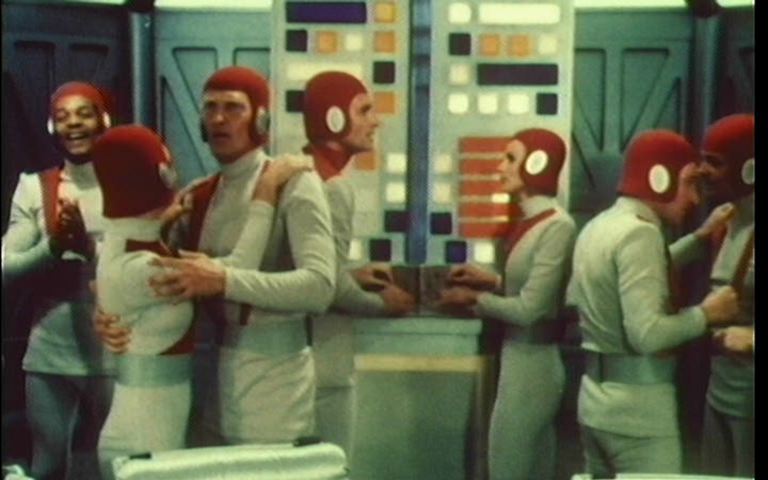
It's never a good sign when you can barely understand the film's opening scene, in which the crew seems to be on a collision course with debris from a stellar explosion. Their computer refuses to route around it, confounding the crew and leaving them headed for certain doom --

-- only to discover that the object hurtling toward them was, as the ship's computer tells us in an announcement whose beginning is obscured by the crew's cheers, merely "a refraction of a cosmic explosion occurring 10 million years ago."
And that's why it didn't steer clear: the object wasn't even there. Guess Compy knows best, eh, folks?
In the original Italian version of War of the Planets, the title sequence (which follows the scene above) had a song all its own. Its refrain:
We are not alone here in space
Because here in space we have brothers
It's as hilarious as it sounds, but given the singer's thick accent -- and habit of switching between English and Italian -- it's understandable that "We Are Not Alone Here In Space" was pulled for the foreign dub (though a fragment of it pops up at around 8:45, who knows why?).
Instead, we get an extended sequence of avant-garde electronic patter, which accompanies long shots of asteroids, starfields, spaceports, and some amazing attempts at Anglicizing the names of the Italian crew.

Next, the film's protagonist, Captain Fred Hamilton (John Richardson), walks up to one of his co-workers, greets him, and clocks him for no discernible reason.
When Captain Hamilton is called on the carpet for his fisticuffs, and arguments ensue about "a bunch of notes from an electronic hunk of metal" vs. "the greatest brain ever made by man", we know we're dealing with one of those man vs. machine movies. And contrary to some other reviewers, we wouldn't describe this as a hidden subtext of War of the Planets, because it's about as subtle as a sledgehammer.

Does a guy nearly get himself killed while doing a space-walking operation? And does the Captain need to fly to his rescue, after the computer's automated assistance isn't nearly fast enough? It's all the fault of those damn machines, machines, we built them to serve us.

Or does a couple engage in some sort of strange, alienated cybersex through a glass ball that looks kind of like the Death Star?
"How long?"
"Whatever."
(flips switch)
"Violent, or gentle?"
"You decide."
(flips switch)
Yep, it's the machines, machines, they're gonna be our bed.

Don't worry, some of us still know how to get it on properly. We don't even have to go to Tangie Town.

And some of us are named "Oko" and have overdubbed Asian accents -- who knows if that was in the original -- despite strong evidence that we don't hail from that neck of the woods.

The person who put together the soundtrack for War of the Robots really likes the Bach Toccata and Fugue in D minor. Eventually he caves in and just uses a recording of the Bach directly -- an excerpt at 23 minutes, and a long chunk around 51 minutes -- but it's present from the very first shot of the film, when the oscillations of a star are accompanied by a rapid-fire version of the Toccata's opening riff.
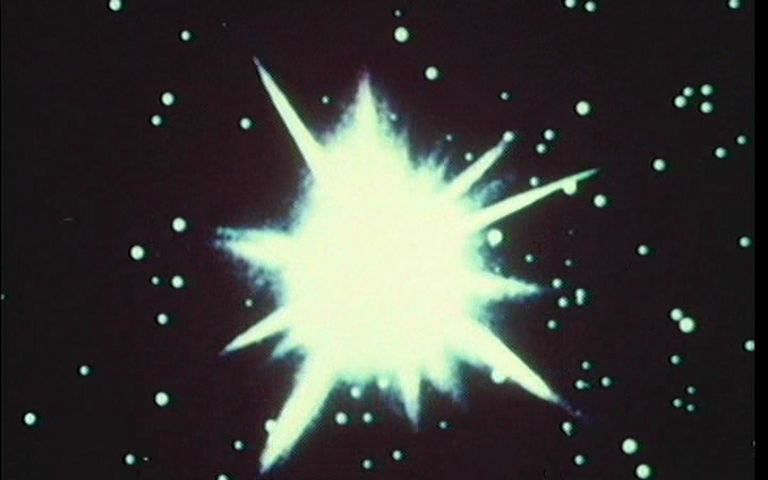
At other times, it's sped up even further and used as a sound effect for computer alerts and big banks of blinkenlights. And when we're not hearing the Toccata, we're hearing Switched-On-style synth tunes inspired by Bach (but without any of his chops).

The captain may hate computers, but his superiors happily take their orders from the supercomputer Wiz. When a mysterious interstellar signal disrupts communications on Earth, Wiz somehow knows that "behind this strange signal there's an alien intelligence that knows all", and "orders [them] to find the emission source and destroy it".
(Perhaps the wise Wiz could also have noted that the signal is just the freakin' Toccata lick sped up by a factor of 20. Haven't you ever played Dark Castle, Wiz?)

And guess who gets the job? OK, a mysterious woman has to persuade the Captain, though we get no backstory or explanation of why this Dr. Jane Frazier has such a sway on his judgment. Her appearance is so brief as to almost be a cameo, while the actress is uncredited and unknown to us.
It's yet another example of the seat-of-your-pants style of scriptwriting -- and direction, and editing -- that War of the Robots seems to favor. No narrative conventions needed, just full speed ahead at all times.

Soon enough, the captain and his crew get to the mysterious planet from which the emissions are coming. From there, things play out like a cross between War of the Robots and pretty much any episode of Star Trek where Kirk et al. encounter a "primitive" people. There's always someone pulling the strings, and if it's not a disembodied intelligence with godlike powers, it's usually a computer.

Meanwhile his bosses back on Earth are being hounded by "newspapermen" (though they're certainly not all men).

This prompts one of the only intentionally funny exchanges in the entire film. After the brass offer a reassuring explanation for recent events -- "I'm sorry for the headlines you had in mind, but Earth is not in any danger!" --

-- the reporters scramble away to the nearest phones, with one man specifically shouting "Earth is in danger!" to his editor. The two military men look at each other and deadpan:
Miller: Didn't buy it.
Armstrong: Nope.

The occasional chuckle aside, War of the Planets is a gigantic mess. It manages to both drag and rush, with botched transitions and sequences that go on too long. Characters talk over each other for no reason; scenes are interrupted mid-sentence; the action shifts from place to place, seemingly at random, leaving us uncertain as to what's going on or what's happened to whom. Seldom have we ever spent as much time glancing at each other and silently mouthing "WTF?"
In other words, both the editing and direction are atrocious. (And the prop department kinda phoned it in too.)

How much of the incoherence comes from the dubbing process is unclear, though seeing the Italian original would be the gold standard here. On a technical level the English dub is mostly decent (especially since some of the actors were speaking English anyway!), though we do get one or two gloriously ridiculous moments when a character takes a long, unnatural pause mid-sentence.
And the cinematography is fine -- nice, even -- though maybe we're just responding to the pretty colors and flashing lights, since we haven't hit the Pink Floyd show at the planetarium and we're jonesing.

As a side note, what on earth is this crucifix doing in a random explosion sequence? If there's a hidden Christian message in this film, it's buried pretty deep.

War of the Planets completely loses its marbles toward the end, when it veers wildly from ripping off 2001: A Space Odyssey to ripping off who-knows-what-they-were-trying-for (Planet of the Vampires gets brought up a lot in other reviews, but we haven't seen it).
But at least War of the Planets sticks by its core message: that humans shouldn't allow themselves to be too dependent on computers, lest we become weak, vulnerable, and alienated from our own humanity. Or something like that.
Fortunately, there's absolutely nothing timely or relevant about that message, right? Sounds totally irrational to us.

Don't you agree, Aldo Canti? You're everyone's favorite alien.

Next up, the Umbrellahead Awards for 50 Sci-Fi Classics!