These two films have a huge plot point in common, but revealing it would be a spoiler of colossal proportions.
So instead, we'll note another resemblance: both movies explicitly invoke and subvert stereotypes -- though one does so a hell of a lot more effectively than the other.
Oh, Bob Dishy. Is there any name that flows off the tongue so nicely? Seriously, just try saying it right now, aloud to yourself: Bob Dishy.

A rose by any other name might smell as sweet, but Bob's moniker communicates so much in such a short time -- a model of efficiency. It connotes handsomeness à la Keeping Up Appearances's famous vicar, yet retains the down-to-earth-ness that comes with "No, not Robert, thank you, just Bob."
The improbability of his last name, why, it hints at the origin of the Semitic good looks that led him to later play a rabbi on one of Dick Wolf's endless shows about law and/or order.

And if you've only seen Bob in his mature years, you might not know that he was, as a younger man, rather good-looking. Sort of a poor man's Robert Redford, if you like, with a dash of Bob Geldof.
However, unlike the haughty likes of Redford, he's not too good-looking -- just good-looking enough. A dish, but not a high-priced entrée you can't afford. A modestly hot guy, to get you through the hard times, you know the kind. Not a throb, just Bob.

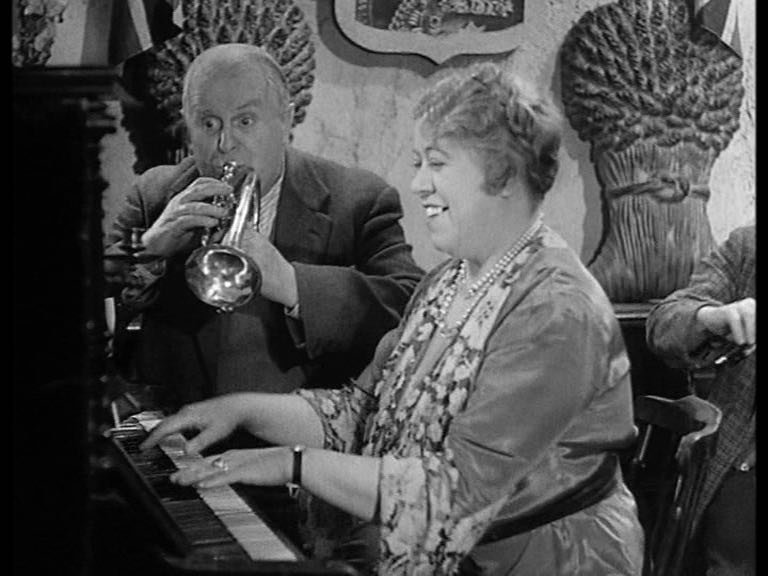
So Bob Dishy -- can I call you Bob, Mr. Dishy? -- has the lead role, you see, in this film, I Wonder Who's Killing Her Now?. How promising that it opens with an animated sequence involving gendered eyes and shoes! How intriguing that it has Angelo Rossitto, and Pat Morita "as Heshy Yamamoto": a seal of approval twice over!

And how unusual that the opening scenes show him at the grand piano, playing Chopin -- of all things! -- and quite well at that.

Except his character, Jordan Oliver, is no concert pianist, and isn't even playing. Instead, he's engaged in a bizarre pantomime while a little person -- yep, Angelo Rossitto -- is supposedly the one really playing. On a toy piano.
And now we begin to detect the first hint that I Wonder Who's Killing Her Now? will not, as we might hope, be a tale of knives into unsuspecting backs; of sweaty foreheads lit by streetlights coming through windows at night; of soft, panicked men running futilely from the pitiless, implacable hand of justice.
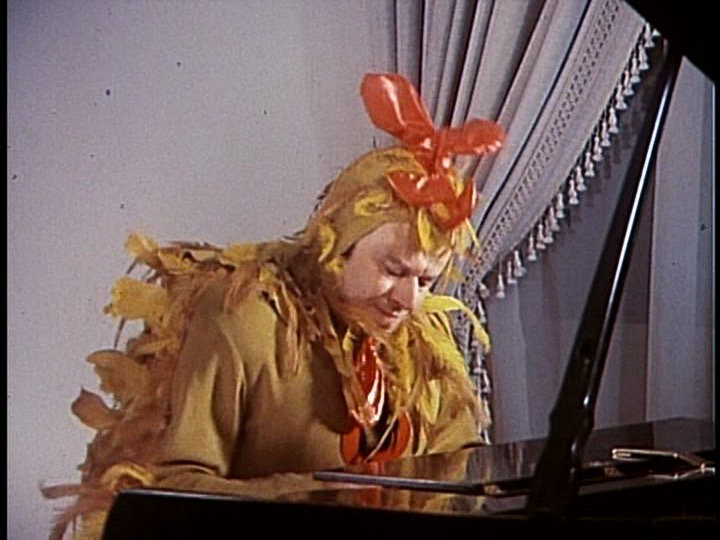
No, I Wonder Who's Killing Her Now? is a comedy. Or more correctly: an attempt at comedy. Or even more correctly: a really, really shitty attempt at comedy.
Take, for example, the last line of the first scene. Jordan tells his tiny pianist: "Come in through the doggie door! And watch out for the doggie doo!"
We are, one imagines, meant to laugh at this. But there is nothing to inspire laughter in the line's content, context, or delivery. Whose Line Is It Anyway? regularly improvises better material. For this, people bought a ticket?

So Peter Sellers was originally supposed to be the lead in this thing. Certainly, he would have had no trouble playing an incorrigible rogue who, faced with financial ruin, decides to kill his estranged wife for the insurance payout. (This is the plot of I Wonder Who's Killing Her Now?, more or less. But mostly less.)
But, Sellers became uninsurable after his heart attack. So they got Bob Dishy instead.
Do you remember that comedian who went to see Phantom of the Opera, and got Robert Guillaume instead of an ill Michael Crawford? Do you remember how he compared it to going to a Madonna concert, and having Tina Yothers come out on stage instead? The Umbrellahead Review remembers.

But how could we blame Bob Dishy for this? Say his name aloud and you'll find that you can't either. You'll see.
He tries gamely, throwing in bad accents and impressions (like Robin Williams on a bad day), strange tics and facial expressions (like Jim Carrey on a bad day), and himself through a window (like your local dive bar most days). None of this hits the mark, but is it really his fault?

No, the real problem is that the material is horrific. We've seen a few reviews claiming I Wonder Who's Killing Her Now? as a fine example of zany Woody Allen-esque comedy. Such a claim kicks Woody Allen in the shins, which he might well deserve, but not for this.
I Wonder Who's Killing Her Now? thinks having an art dealer walk on his knees is automatically funny. Because we mistook him for a little person, you see: silly us.

Or a Chinese restaurant with a Mexican waiter. Har-de-har-har, how incongruous.

Or a Japanese doctor (no points for guessing the actor) who "lost his contact rens". Yes.

Or a turban-wearing "Indian" conductor in bronzeface who waves a flute instead of a baton, buys lip gloss in bulk at garage sales, and says things like "Ahd you see-di-ous?"

Or an incompetent hit man who wears two different shoes.

Or an elderly barmaid draped in cobwebs, who plays a record of a loud party to deceive patrons into thinking the bar is lively.

Or "Dr. Binay's Fat Farm", run by a walking, talking Béla Lugosi impression -- Jack DeLeon in whiteface -- who transplants old women's brains into young bodies, and whips his cross-dressing assistant.

Or a cross-dressing spy who acts out the Monty Python lumberjack sketch, but as a bricklayer.

I Wonder Who's Killing Her Now? believes these things are zany, absurdist humor. It thinks it has a memorable cast of characters that get up to endearing shenanigans. It imagines reviews that say things like "Uproarious!" and "A laugh riot!"

It is, in short, a giant, relentless schmear of tiresome schtick, crude stereotypes, and recycled gags. It's humor, as written by a committee of people who aren't funny. It's a parade of Z-listers and Catskills has-beens who, even in their prime, only got laughs from drunk yentas and alter kakers.
It has maybe one gag that hits the mark, and that one's not even in English ("Come si dice dove in italiano?" "Dove!"). It rips off Wile E. Coyote, for God's sake, and yet it still botches the punchline.

I Wonder Who's Killing Her Now? is, in short -- let's be clear about this -- a worthless piece of shit of a movie. It makes you want to see the people who wrote and directed it punished. Or at least made to shine Mel Brooks's shoes and clean his bathtub, daily, in perpetuity.
But at least it's got Bob Dishy.


If Savage Weekend is basically a slasher film -- and it is -- it's also the kind of movie that benefits from multiple viewings. That's not because its plot is especially complicated, but because it takes a while to understand the relationship between its characters. In the order we meet them, there's:
- Marie (Marilyn Hamlin), an aloof divorcée with a young son.

- Shirley (Caitlin O'Heaney), her hot-to-trot sister, and
- Nicky (Christopher Allport), Shirley's gay best friend, who's very out.

- Greg (Jeff Pomerantz), Marie's ex-husband, recently hospitalized after losing his job in a political scandal, with a massive chip on his shoulder about everyone and everything.

- Robert (Jim Doerr), Marie's new boyfriend, a middle-aged stockbroker whose kindness may be a liability.

- and Jay (Devin Goldenberg), a friend of Robert's, who just split with his wife and seeks fresh furrows in which to plant his seed. He's also a boatwright, and Robert bought a boat that needs wrighting.

Minus Greg (who has the kid this weekend), the remaining five pile into a station wagon and head for a rural getaway -- upstate New York in both reality and fiction, though all the banjos on the soundtrack subtly encourage us to assume it's somewhere south of the Mason-Dixon line. Either way it's redneck country.

Along the way -- in a sequence guaranteed to come up in any review of this film -- Nicky deliberately provokes a bar fight with the local yokels, only to hand them their asses: "I wasn't brought up in the South Bronx for nothin'," he notes.

Playing against stereotypes is a recurring theme throughout Savage Weekend. Are the locals conspiring against our city slickers? It sure seems like something is brewing when the local Marlboro Man archetype, Mac Macauley (David Gale), has an exchange with one of his employees:
Employee: "Me and Ryan's got plans for that bunch."
Mac: "You ain't gonna do nothing 'til you hear from me."
Employee: "Hell we ain't."
Mac: (strikes employee in stomach) "You watch your mouth with me, you hear?"

Is Mac the incarnation of the land itself, a Deliverance-like force seeking to punish urban trespassers foolish enough to disrespect his place and his people?
For disrespect they do, talking smack about dimwitted Otis Crump (William Sanderson, later of Newhart) within his earshot, despite Mac's warning that Otis is more dangerous than he appears: "Now there's a weird one."
Otis sure spends a lot of time looking through binoculars and disapproving. What's his deal, we wonder?

Well, Mac describes Otis's revenge on a cousin he fancied, but who fancied the local lads more. When Otis found her at "that tavern they got down there on Route 22" -- aka Oasis, the very place Nicky had his bar fight (continuity!) -- mayhem and maiming ensued:
Mac: "'Whore! Whore!' he kept yellin', and branded an H right in the middle of her chest."
Robert: "Why an H?"
Mac: "For 'whore'. Otis ain't none too bright. Clear forgot the word began with a W."
Robert: (cracks up laughing)

Another recurring theme in Savage Weekend: the interaction between metal and flesh. Brands branding? Fishhooks penetrating feet? Saws cutting through limbs? Nails pounded through a bat? One character intentionally grabbing barbed wire while he watches two others have sex? It's got all these and more!

There are subtle touches to Savage Weekend that are not just easy to miss, but just about impossible not to miss on first viewing. For example, when we first meet Nicky he acts and sounds like a fairly ordinary straight man, yet in every other subsequent scene he's as out as a broken streetlight.
Now, he's helping to care for his best friend's nephew, so it makes perfect sense that he'd keep things under wraps. If anything he butches it up à la Charles Nelson Reilly, saying things like "C'mon, bustah, let's get it into geah!" and "C'mon, tiger, let's finish up".
But only in retrospect does this become clear: we don't know Nicky yet, so how can we appreciate the significance of his restraint?

In another scene, Jay and Shirley -- who have already had coitus al fresco once on the trip -- head off into the weeds for another assignation, whereupon Jay rips off Shirley's top and makes the following proposition to his bare-breasted companion:
"Listen, why don't we do somethin', uh...filthy? I mean something really...dirty and revolting?"

Then in their next scene together, they have this exchange:
Shirley: "I'm doing my nails."
Jay: "C'mon, you know you loved it."
Shirley: "Leave me alone."
Jay: "What'd I do? C'mon, tell me what I did!"
Shirley: "You're a real pig! I'm not surprised your wife left you."
Jay: "What's the matter with you all of a sudden?"
Shirley: "I'm surprised she stuck with you for three years. I'll tell you what's the matter. When you came to me in the woods, I thought, wow. Here's a man with some ima-a-agination. Later I realized you were just a silly jerk who gets all his ideas from girlie magazines." (storms off)
Jay: "Is that so?"

Let's analyze this: Jay proposes a sexual act he describes as "filthy" and "dirty". He does so spontaneously, while outdoors, and therefore without any...supplemental resources. And afterward, Shirley is repulsed by him, either because things didn't go well or because she can't believe what she did.
To paraphrase John Davidson on Hollywood Squares, "It must be...some part of the body. I wonder where it could be?"

Finally, there's the connection between the film's ending and its beginning. Start the movie over, and you immediately realize what was done and what's being said, or implied -- but watching it straight through, we lacked the context to make sense of it.
Does it reflect badly on us that this clever finesse went over our heads? Maybe, but it also underscores the chief flaw in Savage Weekend: the editing. It's competent, but a better editor might have ensured that certain key elements of plot and characterization were emphasized.
Or that we understood who the hell all the characters were.

Then again, speaking of editing, it's always possible something is missing from Mill Creek's copy, which runs about 86 minutes vs. IMDb's listed running time of 88 minutes. The sex all seems to be present -- just about every female character bares her breasts at some point, including a cow that very nearly becomes a prop in a sex scene. (No, we're not joking.)

However, one or two of the more violent sequences seem like they could be cut short. And who knows, the saga of Jay and Shirley might be clarified in an unedited copy. (There's a Blu-Ray out there, maybe we'll see it sometime.)
On the other hand Mill Creek's copy adds something, namely a whole lot of boom mic thanks to incorrectly matted shots. No way the makers of Savage Weekend intended these to be seen, as it's too pervasive.

Savage Weekend doesn't quite live up to its ambitions, and probably crosses the line from "leaving some things implied" to "not bothering to fill in important details". Its denouement isn't really satisfying, and it squanders its best character, Nicky, by not giving us enough to understand his psyche. Is he in love with Shirley? Attracted to Jay? Vice versa? Both?
We're left to wonder, and his long campy dance sequence with Shirley does nothing to clarify matters.

Still, Savage Weekend also crosses the line from "routine genre exercise" to "distinctive film well worth seeing". It has enough psychological insight to give bite to its observations, and avoids the trap of giving us warmed-over Deliverance or, especially, Straw Dogs (perhaps the film's real ancestor).

If ultimately the locals are hardly less opaque than the city slickers in their motivations, at least the soundtrack attempts to do right by them:
You can't blame upstate folks from getting crazy in the mind
You buy some land, you scratch the earth 'til midnight, moonlight makes you blind
You miss one payment on the farm, you watch the bank foreclose
You sell it to some city guy who needs help to blow his nose
An upstate man got ain't much for his time in this life
Little pride, little property, sometimes a little wife
To keep that little, he fights a lot of temptation and strife
And the pride's more important to him than life
A bit on the nose -- especially since we hear it twice -- but it ensures we get the point.