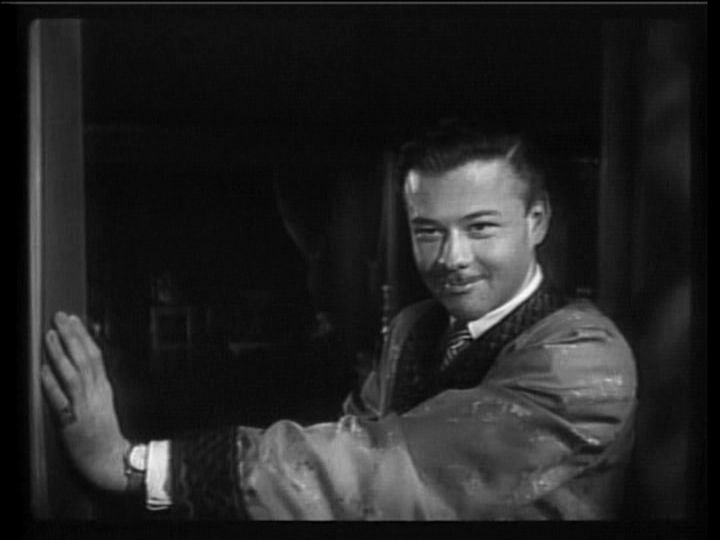
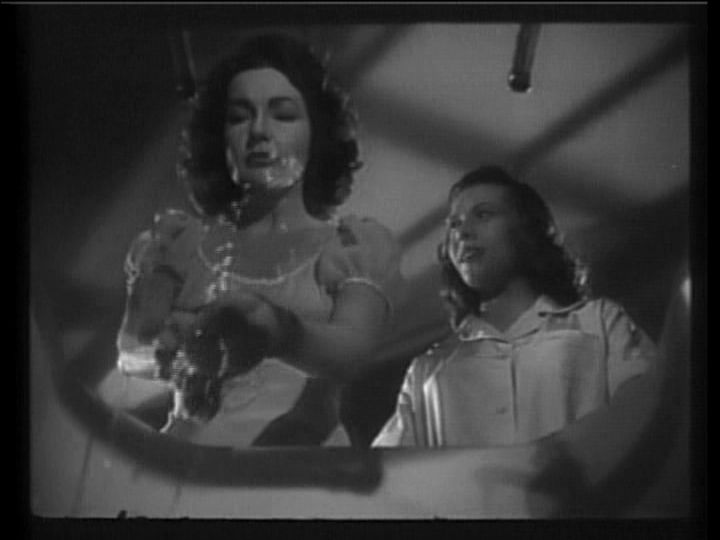
Though neither of these films is a Mill Creek joint, we initially took an interest in them because of their connection to the Horror Collection 250-pack. One features an actress we first met in the earliest days of our site, while the other is ostensibly a sequel to one of our favorite movies on the box.
However, we didn't foresee that they'd share something else: protagonists who find themselves in the crosshairs of that most terrifying of locations --
--that most bone-chilling of phrases --
-- that limitless vein of potential awkwardnesses and unwanted socializations:
"You can stay in our guest room."
Grade: C+
Ah, Nova Pilbeam. Even if your name weren't so unusual, we'd certainly remember you from your star turn in Counterblast, not to mention your strong resemblance to a former colleague of ours (at least in that colleague's younger days: you wouldn't recognize 'em now).

And speaking of younger days, it's not clear whether this or Counterblast was Pilbeam's last film role -- though she did make one BBC appearance in 1951 before packing it in for good -- but after a successful career as a child actress, and a reasonable career as a young adult, that was that.
She lived to age 95 -- when we wrote our Counterblast review, she was still alive! -- but was, from all reports, not interested in discussing the past. (Makes sense when your name is "new".)

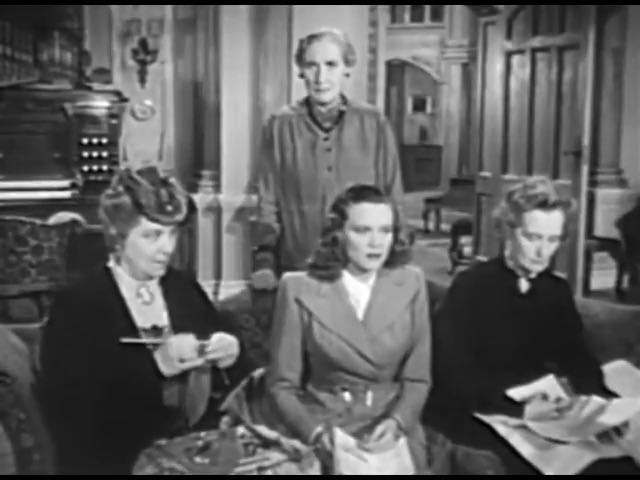
Anyway, Ms. Pilbeam is Claire (no relation to Emily) Prentiss, a secretary who accompanies her obstreperous boss Owen Morgan-Vaughan (Raymond Lovell) to a Welsh mining village, Cwmglas, where his (ahem) three weird sisters await his arrival at the family home.
(Technically they're his weird half-sisters, but that wouldn't have the same ring, now would it?)
One is blind, one deaf, and one has some combination of bad nerves and severe arthritis, resulting in a strange symbiotic interdependency between the three.

In the film's opening Cwmglas suffers a catastrophic collapse in which several residents die, and survivors opine on the will of God and the suffering of the proletariat.
While hard to follow on first viewing, a quick review of Dylan Thomas: The Complete Screenplays (which also told us how to spell "Cwmglas") makes the details clear. The Morgan-Vaughans are the local muckety-mucks who made their fortune via the mines, while their cheapskate refusal to fill up unused mineshafts beneath the village caused, or at least contributed to, the collapse.

For a while, The Three Weird Sisters is poised on a knife-edge of ambiguity: is Owen just a callous bastard who selfishly wants to wash his hands of all responsibility toward the village? (Given that Owen gets a rock flung at him upon arrival, some of the townspeople clearly hold the affirmative.)

Or is Cwmglas -- the name of which sounds like a "worst of Reddit" thread in the making -- just a decrepit symbol of the corrupt, hopeless old ways? A decaying relic that's undeserving of life support and overdue for destruction? Merely a vessel for a "spent force", one might say?

With Dylan Thomas on board, some sophistication (moral and otherwise) is to be expected. Ultimately, though, the lines are drawn by the participants' willingness to sacrifice innocent Claire in the crossfire -- and given that one of the sisters describes her as "that horrible painted young woman", one need not be exceedingly wise to infer who the baddies are.

So what does that leave us? Suspense, atmosphere, intrigue, and barbed dialogue, we suppose, none of which are extraordinary but all of which are at least serviceable. And we get faces, if one likes faces (as we do), ranging from Ms. Pilbeam's ever-popular visage --

-- to the sisters, especially Gertrude (Nancy Price), whose forbidding countenance somehow intrinsically evokes those stony, mirthless parts of Britain where God's name is perpetually on everyone's lips and yet the old pagan powers feel close at hand.

Or there's this preacher (Hugh Pryse) in his ridiculous middle-aged makeup:

And we get amusing vignettes, as when we find the thersitical Mabli (Hugh Griffith) reciting Marxist dogma to, well, dogs:

Structurally speaking, The Three Weird Sisters is a film-you've-seen-before -- if you understand what we mean -- and offers no great innovation or dramatic uncertainty. So your appreciation of it will likely depend on your affinity for the Welsh coat of paint it's received, and/or your fondness for Dylan Thomas, Welsh terriers, Nova Pilbeam, or handsome older women.
(No judgment, you do you.)
Grade: D+

When you expect a film to be a complete piece of crap, it sure is a pleasant surprise when it's not. That's not to say Devil Bat's Daughter even comes close to its predecessor, The Devil Bat, the consensus favorite among Béla Lugosi's Poverty Row efforts (and we agree that it holds up).
We can't help but be curious why Devil Bat's Daughter was even made. Was a five-year-old film really enough of a success to call for a sequel? That is: if this was a cynical cash-in, what exactly was there to cash in upon in the first place?

In any event, Devil Bat's Daughter has little to do with the earlier film, though we can't quite call it an "in-name-only" sequel. Instead it runs along similar lines to Shock, with a traumatized young woman, Nina (Rosemary La Planche), guided through recovery by the authoritarian Dr. Clifton Morris (Michael Hale), who may not have her best interests at heart.

We're not sure whether having a patient living in your home was considered a ridiculous violation of professional boundaries in 1946, though from our vantage point 75 years later, it seems absurd. But living in Dr. Morris's home brings Nina into contact with his saintly wife Ellen (Molly Lamont) and stepson Ted (John James), and guess which one of them falls in love with her?

...no, this is 1946, try again. Though we will say that Ms. Lamont, who hasn't necessarily lit up our screen in movies like Scared to Death and Jungle Girl, evinces a degree of angular classical beauty in this film --
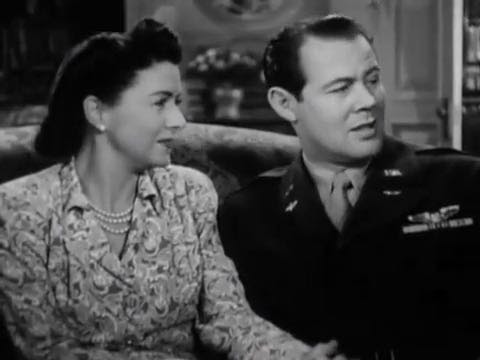
-- while, by contrast, Ms. La Planche's past as a Miss America merely underscores how tastes have changed.

But better either of them than John James, who unfortunately evokes the irritating Jerry Lester -- plus a dash of Mickey Rooney, a sprinkling of Tim Allen, a dusting of John Heard. Those old-young faces are a tough sell.

If one acknowledges that the major plot points of Devil Bat's Daughter are foreseeable, there are a few things that deviate from the expected path. One of them is the body count, or more accurately, the body-count-to-emotional-consequence ratio, which is unexpectedly brutal. Not a film for dog lovers, this, though we're always glad to see a movie go for the jugular.

On the other hand, Devil Bat's Daughter commits an absolutely monstrous act of retconning that, under normal circumstances, should be unforgivable. So instead, we'll forgive it by allowing ourselves to pretend that the literal meaning of the revelation -- which would utterly destroy both this movie and the previous one -- is untrue, and that the character who announces it is mistaken. And frankly, the movie still works if you assume that.

Still, while our initial impulse was to give this one a C-minus, it really needs to be penalized for that misstep. Otherwise, we were shocked to find that we enjoyed Devil Bat's Daughter. It's a predictable and flawed film, but manages to entertain nonetheless -- if you have very low standards, as we seem to these days.