Showing posts with label vampires. Show all posts

Sunday, October 8, 2023

Polish my Helmut – or, more Cushing for the pushing

Violence -- sexual or otherwise -- has long been cinema's favorite excuse for bare breasts. And these films supply all of the above, plus other pendulous globes! 


Mad Dog (1977) 
[aka Beast with a Gun, etc.]

Grade: C

Oh, Helmut Berger. A cautionary tale of wasted talent, or an example of someone who got the most out of what was predestined to be a limited shelf life? A charismatic chameleon and a born star, or a passaround boy who lucked into the infatuated gaze of fawning directors?

Well, probably the former (in each case). Berger exudes magnetism and danger, like the proverbial caged tiger, and you can't fake that with clever cinematography. He must have been part of what made Visconti's The Damned so striking, though the present writer mostly remembers the Night of the Long Knives scenes.

Such a shame when bad things happen to...people.


Clearly the makers of Mad Dog -- aka Beast with a Gun, The Human Beast, Mad Dog Killer, or La belva col mitra if you want the original Italian -- knew Berger was their star attraction. So they give him just the kind of role in which he shines, as Nanni Vitali, an absolutely ruthless, sexually voracious criminal who escapes from prison and is hell-bent on revenge.

No doubt they had Berger at "ruthless", his forte.


And they give him plenty of screen time, including a protracted shot of his bare backside if you're into that sort of thing, and pretty much all the best lines. More than once it borders on camp, intentionally or not, as when a detective (seemingly) meets his end in a fiery crash:

"That was a nice sight! A well-done dick."

You don't say, Helmut Berger! You don't say.


That detective, one Commissioner Santini (Richard Harrison), has one thing going for him: dude is absolutely jacked. Unlike a lot of policeman protagonists, you get the feeling that this cop could literally overpower the villain. He's got muscles and brains, so what's not to like?

Well, as opposed to (for example) Dirty Harry, Santini is too much of a straight hero to get the good lines. I suppose you could count his Smash Mouth moment about 12 minutes in -- "Vitali's like a mad dog!" -- but that only works on a meta, presentist level.


Actually a bunch of Santini's dialogue hits very strangely in 2023, in that he'll be saying something fairly routine but finishes off with something that sounds like a low-karma Reddit post. See, for example, when he excoriates Vitali for his cowardice:

"You're a filthy hyena. And you have the courage of one. You're only brave as long as you've got that gun, so you can terrorize helpless females."


Oh, hey, I got a work call and have to go home early but it was great meeting you!

Or how about when he, uh, excoriates Vitali for his cowardice again?

"You're a coward. You think you're a genius but you're just a common killer. There's a whole race of people like you, Vitali!"

That's...that sure is a thing you just said, that was said, by you.

On the other hand, we cracked up when a perfectly reasonable request from his Kim Clijsters-looking hostage, Carla (Marina Giordana), got this nasty reply from Vitali:

"I'm thirsty."
"So have a drink, twat!"

Once again, the bad guy gets all the good lines.

Of course this also betrays the fundamentally mean-spirited attitude of Mad Dog. Sure, modern viewers aren't likely to be bothered by its violence -- a bit of which was trimmed out of the Mill Creek print, though the only significant cut we identified actually improves the movie.

(The guy was face-down in a puddle and looked dead as a doornail, so bringing him back to have him cry out in agony? Not a good idea.)

But the "sexy man rapes woman, kills mate to demonstrate alpha status, and may have induced Stockholm Syndrome with his mighty phallus" angle of the film is uncomfortable. Arguably Mad Dog tries to have its cake and eat it too, though we can't communicate how without spoilers, but it's clear the film wants us to think she was ambivalent.

A subtler and more provocative moment comes in the homoerotic subtext between Vitali and the young criminal he picks up (Alberto Squillante). The way Helmut Berger looks at this Bimbo -- no, really, the character's name is Bimbo -- is tough to pass off as merely a kind of paternal affection.

Perhaps Berger put a bit of his authentic self into the role, since it's hard to imagine "Act like you want to bang the delinquent someday" was in the script.


It's also refreshing that Vitali isn't a Criminal Minds-style genius or master karateka, but someone who gets by strictly on his looks, ruthlessness, and cunning. He fumbles an attempted hit on a witness, keeps getting cornered like a rat, and even fails to perform in one fight scene, when a botched swing has him missing the victim entirely: "Bruno! Punch him!" he shouts.

Playing it off was cheaper than a reshoot, I guess.

Oh, and the print looks good enough, but very occasionally something gets cropped to comic effect, like this entrance:


Anyway, Mad Dog has multiple plot holes -- the one at the beginning, involving an unloaded gun, is comically obvious -- and a nasty streak. Even with lines like "I'll be in town...making hamburger out of the motherfucker!", is Helmut Berger enough to carry this one?

It depends on what you want from your hour-and-a-half of entertainment. It was probably bracing in 1977, but hard to predict people's reaction now. Maybe it's got a bit of the "too much of this, not enough of that" syndrome.

Quentin Tarantino seems to like it, prominently featuring the film in Jackie Brown. As for whatever Berger thought, he seems to have given it his all. Or makes us think he did.


Count Dracula and His Vampire Bride (1973)
[aka The Satanic Rites of Dracula]

Grade: D

Count Dracula and His Vampire Bride relies upon the premise that a bunch of high-ranking British muckety-mucks are in a secret society engaging in unspeakable, depraved acts with vulnerable persons. I mean, how gullible did Jimmy Carreras think we are, to toss a vile notion like that at us?


This wasn't quite Christopher Lee's last appearance as Dracula -- there's a horror comedy (shudder) yet to come -- but it's his last with Hammer. To be honest, the only other time we've seen Lee don the cape was in Jess Franco's Dracula (which we're not reviewing, as we'd have nothing interesting to say), so we don't have lots of context for his work as the Count.

This time around, his charisma is undiminished, his accent silly, and he just doesn't get all that much to do.


Meanwhile Peter Cushing is Professor Lorrimer Van Helsing -- one of the many fictional descendants of that fearless vampire hunter, who take to the job like an orphaned beaver that instinctively builds dams. (And they do!)

No marginal old man, Van Helsing holds his own and plays his part -- despite repeatedly engaging in the vice of announcing what you're about to do instead of just doing it. And he even shows off some pendulous globes!


So why is Drac back? Just to frolic with mid-tier extras whose agents convince them going topless will help their careers?


No, he wants to kill everybody with a new strain of bubonic plague that kills "within seconds". Septicemic plague can take less than a day (once symptoms present), but the modern vampire is in a hurry!


If anything Count Dracula and His Vampire Bride seems to think that evil for its own sake is enough of a motivator. Van Helsing tells us it can be "more addictive and more potent than heroin, I assure you, and the end result is just as fatal". Paging Dinky Hocker.

And we get a speech from one Professor Kelsey to that effect -- someone who was apparently "awarded the Nobel Prize for science and humanity" (er, sure), yet now has thrown his lot in with the infernal:

"Evil rules, you know. It really does. Evil and violence are the only two measures that really hold any power."

As we get older, and see more things happen, the temptation to reply "Well...you're not wrong!" grows stronger.

In any event Dracula has two persecutors, as he's also harried (indirectly) by Inspector Murray (Michael Coles), a specialist from Scotland Yard.

Inspector Murray also has the hots for Van Helsing's granddaughter Jessica (Joanna Lumley), for whom we do not have the hots.


Coles has one of those creepy old-young faces (like Brian Jones of the Rolling Stones), a big part of which is the way his haircut inspires cognitive dissonance (also like Brian Jones of the Rolling Stones).

(Not to mention the guy mentioned in red above: seriously, how could the world not twig Jimmy "Jim'll Fix It" Savile as a creep? That weird-haired burly man-child gave us the jibblies the first time we saw him.)


On the other hand, Coles is very good at projecting that "boxer who just took a hard hit to the end but is going to keep on fighting" thing, which is a lot more convincing than the usual impervious action-hero crap.

...speaking of which, Van Helsing (the elder and handsomer one) gets shot in the head, yet they don't bother to explain his immediate recovery or why he's not dead. Would one line about "Somehow, it ricocheted off my skull" really go amiss?


Count Dracula and His Vampire Bride is pretty phoned-in, more so as it goes on. The first 30 minutes or so are moderately entertaining but before long, the plot and pacing are in danger of falling below "Sega CD FMV game" standards. It relies too heavily on people doing stupid things, and needed more pulchritude to keep its audience too titillated to notice its flaws.

(Our understanding is that we're not missing any significant footage vs. the original release under the Satanic Rites of Dracula title, but we could be wrong. Correct us if we are, since a "Well, actually" comment would at least indicate that someone's reading!)

But is it watchable? Sure, it's watchable: what movie with T and/or A isn't, one might ask? (Some entries hence, you'll get an answer to that, courtesy of Ed Wood.)

And some of those action scenes get pretty funny at 4x speed, which is how you play them back if you're reviewing a movie a couple years after you first watched it. As one does.


Obviously, we haven't been able to post much lately. That happens sometimes -- but far be it from us to allow 2023 to pass without an entry.

Perhaps this will mark a renaissance at the Umbrellahead Review, as we catch up on our backlog and start going steady again? We look forward to that day!

Wednesday, November 23, 2016

Unanswered questions

We seem to have a habit lately of posting right before major holidays, so why not continue the pattern?

Unfortunately none of these four films have any particular relevance to Thanksgiving -- no turkeys, no cranberry sauce, not even a flagrantly stuffed bra -- but they do share a common thread: all of them end by breaking the fourth wall, with a question left unanswered.


The Night America Trembled (1957)

Grade: C-


Edward R. Murrow, his cue cards, and his trusty cigarette can't fix the core issue that plagues The Night America Trembled -- which is, of course, that it's based on bullshit: Orson Welles's War of the Worlds broadcast in 1939 did not, in fact, inspire mass panic and disorder. A handful of foolish people got foolish, maybe, but we're talking numbers in the teens, not thousands.

(Now Ecuador, that's a different story.)

Still, however the urban legend got started, it's been a persistent little cuss. In 1975, The Night America Trembled was evidently remade as the TV movie The Night That Panicked America, showing that two decades of "progress" hadn't dampened Hollywood's willingness to found their productions on falsehoods (or offer up old wine in new bottles).


Meanwhile, that "fake radio news broadcast that got everybody scared" has continued to pop up, unchallenged, in otherwise-clever films like The Adventures of Buckaroo Banzai, though one hopes (no doubt in vain) that the Snopes era will put an end to the Welles-Wells panic myth.


Anyway, the whole thing is about what you'd expect from a 1950s TV movie: men, microphones, modest amounts of mayhem.

And -- perhaps surprisingly -- a makeout session from soon-to-be-married teenyboppers, in an era when Lucy and Ricky were still sleeping in separate beds.

For most viewers, half the fun of The Night America Trembled will be spotting future stars like Ed Asner and Warren Beatty in small supporting roles. For us, as always, it was trying to get unflattering screenshots of the principals.


The print that Mill Creek used is reasonably clear, but a faint overlay of some ghostly image is perceptible throughout. Double exposure? Interference during the transfer? Recycled videotape? Who knows -- we can't capture it in screenshots, but whenever the camera moves it's quite visible. 

Either way, at least The Night America Trembled is pleasantly short, clocking in at well under an hour. As for the unanswered question, it's found in Murrow's closing words to us, the audience:

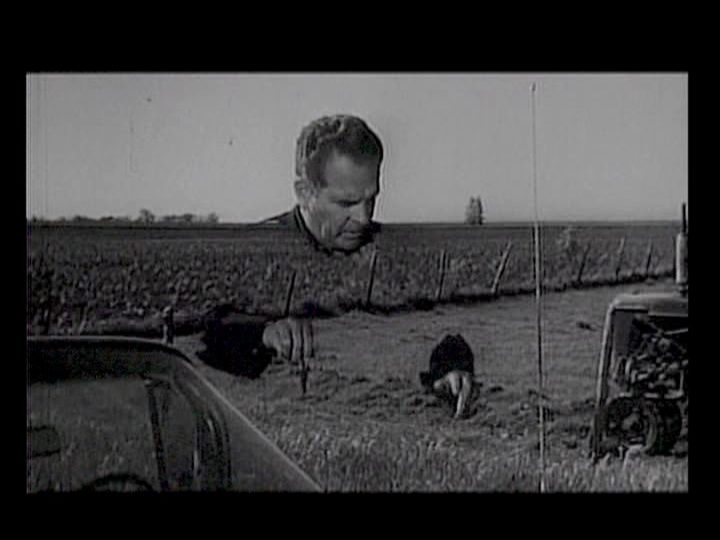
"Twenty years ago, the concept of an alien race was novel to us, hence alarming. Today, we realize that Mars is very near -- closer, perhaps, in time than we imagined. There is every reason to believe that long before the Martians come to us, we will go to them. I wonder if we'll panic them as they did us, on The Night America Trembled?"

Indeed, Eddie, my boy. Indeed.


The Amazing Transparent Man (1960)

Grade: B-


In making our way through the Mill Creek 250-pack, we've certainly seen some terrible prints, and overall The Amazing Transparent Man is far from the worst. But its first few minutes are surely among the most flagrantly damaged we've seen -- not in the "scratched and spliced print" sense, but in the "something went seriously wrong with this transfer" sense.

Dark areas of the image are filled with analog and digital artifacts, the picture itself has a sandblasted, wrecked quality, and the net result bears an unfortunate resemblance to late 1990s streaming video protocols.


All told, we'd imagine most non-completists took one look at the opening and bailed. And that's a shame, since what we have here is a tightly-constructed, punchy little B-picture that amply demonstrates that you don't need an hour of runtime to tell a complete story.

With a title like The Amazing Transparent Man, it's hardly a spoiler to give the basic outlines of the plot: master safecracker Joey Faust (Douglas Kennedy) gets sprung from prison by bad girl Laura Matson (Marguerite Chapman), who spirits him away to a safe house in the boonies.


Now, Laura didn't just do this out of the goodness of her heart. She's in league with Maj. Paul Krenner (James Griffith), a treasonous criminal mastermind who wants Faust to steal nuclear material to further his clever schemes.

And how is Joey supposed to do that, given that (a) the material is under armed guard and (b) as a wanted fugitive, he'll be instantly recognized by just about anyone who sees him?


Enter Dr. Peter Ulof (Ivan Triesault), an "eminent nu-cu-lar scientist" (but not a balloonist) with piercing blue eyes, a Holocaust-haunted past, and -- oh yeah -- the ability to make small animals invisible, via exposure to just the right sort of radiation. (You know, the fancy kind.)

And who's to be the guinea pig for the first human trial?

You can probably guess most of the rest (hint: Dr. Ulof isn't helping Maj. Krenner of his own free will). But what sets The Amazing Transparent Man apart isn't the novelty of its plot, but the quick pace and strong momentum that it sustains throughout its 57 minutes.

Between the tight time constraints and tight budget, there really isn't room to screw around, and the movie's brisk professionalism -- light on exposition, heavy on schemes and counterschemes -- is refreshing.

The characters in The Amazing Transparent Man also spend a surprising amount of time assaulting one another, with nearly every member of the cast receiving at least one nasty blow to the head.

Small wonder, then, that they're constantly brandishing guns -- that is, when they're not angrily telling each other to "lay off the giggle water": if drinking alcohol is incompatible with their schemes, why do they have so much of it around?

Of course, any "invisible man" film lives or dies by the effectiveness of its special effects, and for a low-budget movie, The Amazing Transparent Man delivers quite well on that front -- especially the scenes where Faust partially reappears, which manage to be both vaguely comic and kinda cool.


But the film certainly isn't flawless. There are minor stupidities in the exposition, but those are to be expected; more damaging, though, is the miscasting of James Griffith, whose stage presence is evocative of, say, Don Knotts, rather than the saturnine, dangerous menace the role ought to have.


Still, it's worth sticking with The Amazing Transparent Man, if only to reach the final scene, in which Dr. Ulof delivers a peroration upon the dangers of powerful technology falling into enemy hands -- "It's a serious problem" -- only to interrupt himself and, unexpectedly, turn to the audience:

"What would you do?" he asks -- and the film fades to black and ends just like that.

(And personally? I'd check the shipping forecast.)


Twister's Revenge (1986)

Objective Grade: who cares
All Aboard for Fun Time Grade: A-

So Twister's Revenge -- which has naught whatsoever to do with tornadoes, in case you're wondering -- brings the following to the table:
  • Twister, a sentient monster truck that talks;
  • Dave, a wisecracking cowboy hero (Dean West);
  • and Sherry, a brilliant, wealthy, sexy damsel in distress (Meredith Orr).
(Well, she starts out as a damsel, but becomes a married woman about 17 minutes in.)

Sounds like a murderer's row of leads, right? But in this wonderfully stupid, sprawlingly ridiculous Bill Rebane feature, none of those elements gets the spotlight.

Instead, the center of our attention, and our sympathies, is right here:

Fact is, these three goofballs -- ostensibly the villains -- are really the protagonists of Twister's Revenge. We never really know why, in the face of repeated, humiliating disasters, they're so determined to pull off a heist at the expense of the happy couple. But like Wile E. Coyote, they just keep trying and trying.

Truth be told, the whole movie is like a Looney Tunes cartoon writ large --

-- but one in which it appears that any idea that passed through the makers' heads, no matter how random or outlandish, was kept in. For instance, how about we spend several minutes of screentime on a New Wave group at a dive bar --

-- but have them be fronted by three writhing, dancing girls, including a pointedly plus-size lead?

Sure, why not? And why not have some people bopping in gas masks for no reason? We've got gas masks, might as well use 'em!

Hey, did you say you could get a tank? Then I guess we'll have a tank!

And wait, there's a parade going on? Let's put that in too!

This gloriously half-assed approach to filmmaking -- not worrying whether anything is good or bad, but merely plowing ahead with enthusiasm and conviction, using whatever resources are at hand -- is one of those things not everyone can embrace. And that's fine! We gather that quite a few people find Twister's Revenge an excruciating experience, but not us: we've enjoyed everything we've seen by Rebane so far, and this perhaps most of all.

If any one actor deserves credit for the infectious charm of Twister's Revenge, it's R. Richardson Luka as Bear, a good-natured, rubber-faced lummox who seems devoid of malice, but still agreeably goes along with his friends' plans. There's something intrinsically likeable about him, and surely without Bear the movie wouldn't be remotely as fun.


We took a break from the 250-pack to watch Twister's Revenge on Mill Creek's Drive-In Movie Classics 50-pack. Unfortunately long stretches of Mill Creek's transfer suffer from weird audio dropouts that sound a bit like a CD struggling to track properly. It's not intolerable, and thankfully the sound doesn't drift out of sync, but it's a shame that an otherwise OK transfer is marred by this annoying defect.


As for the film's unanswered question, well, this is a bit of a stretch. But the above woman in the yellow dress -- Bear's main squeeze -- is terror-struck when Twister attacks her home (and outhouse) in an effort to seek revenge for Sherry's abduction.


So naturally, she runs...and runs...and runs, all to the tune of a silent-era-style piano accompaniment (which is sped up, as is the footage, with obvious and perhaps tasteless comic intent). She runs through fields, meadows, parking lots, and even makes a pit stop at Arby's:

And for the movie's very last shot, instead of showing us the happy protagonists, a triumphant Twister, or even Bear, we get this hapless woman sprinting through Wisconsin snow in the dead of winter, still only barely clothed:

That's right -- even though Twister's gotten his titular revenge and everything's been set to rights, she's still running. The poor thing.

And hence, the unanswered question: did she ever stop?

("Some say she's still running to this day," intoned the camp counselor.)


Grave of the Vampire (1972)

Grade: C-

No one is apt to accuse Grave of the Vampire of being an unmemorable film. In fact it's one of the few on this box set that we can truthfully say has had a handful of genuinely disturbing images -- though it wasn't the 7+ onscreen murders (some of them quite brutal), but rather the film's penchant for blood play, that had us twitching in our seats.

And the screenshot above, of blood dripping on an infant's face (in case you hoped it was just cranberry sauce)? That tasty treat, we'll have you know, comes courtesy of Mom, who just wants to feed her sweet baby James as best she can. Mmm, Thanksgiving.

However, memorable imagery can't rescue Grave of the Vampire from an unexpected, disastrous left turn -- whether the result of budgetary limitations, or simply misguided ambitions, we don't know. But after spending nearly half its running time in the late 1930s, the movie suddenly drops a ton of voiceover exposition on us, and teleports forward three decades' time --

-- whereupon little James Eastman is now a strapping full-grown man, played by William Smith, who manages to look remarkably ill-at-ease in nearly every one of his scenes.

Now, if the cause of his discomfort were overtly spelled out -- say, if he were Native American (as he sort of appears to be) in a WASP environment, or clearly marked as working-class at an affluent college -- then we might have an interesting fish-out-of-water subtext going on.

But instead, he just seems incredibly, weirdly uncomfortable with the whole thing, for reasons only known to Mr. Smith and his otherwise-storied career.

Of course, it's always weird to begin with, going to night school...

...but it's doubly weird when you're planning to kill your professor (Michael Pataki). And he's a vampire. And a rapist. And, uh, your dad -- he's that too. That's right, your dad is Professor Rapist Vampire, Ph.D.

For some reason, Eastman doesn't fast-track his patricidal ambitions, but seems content to hover around until a sufficient threshold of murders has been reached. Meanwhile father and son are both attracted to Anne (Lynn Peters, in her last film role), an "instructor in English literature", who to the film's credit is an approximately age-appropriate pairing for both of them (i.e. not a 21-year-old ingenue).

The first and second acts of Grave of the Vampire feel spliced together from two completely different films, but we held out some hope that the third act would, somehow, bring its narrative arc to a convincing conclusion.

No such luck, as the movie's concluding minutes feel just as uncertain and cobbled-together as the rest of it. Characters are brutally murdered, and their friends seem wholly unfazed; the protagonist continues to hang out with his dad for no discernible purpose; and when things finally erupt into overt violence, while we were pleased to see some eye-gouging (always an underutilized resource), there's still no sense of rhyme or reason to any of it.

That said, we'd love to be able to show you the movie's penultimate shot, as it's another memorable (and absurd) image that epitomizes our theme of breaking the fourth wall. But, it'd also be one hell of a spoiler. So, sorry, kids, you'll have to watch this one for yourselves.

We will, however, show you the haunting question that follows that shot, and concludes the film:

Uh, okay. Shades of "Tabled, this motion is" -- or, perhaps more appropriately, "Break me a fucking give."