Have you ever started a school paper or an essay with one of the following?
"Ever since the dawn of time..."
"Throughout human history..."
"From the earliest days of mankind..."
"In the broad sweep of history..."
To a teacher, sentences like these are the equivalent of Comic Sans at a typography convention. They strike at the heart of even the most seasoned educators, filling them with dread, ennui, and the compulsion to question their life choices.
And sadly, we've all done it at least once, and maybe more than once -- kinda makes you want to track down poor old Mrs. Chickenbottom and buy her a beer, doesn't it? -- until a brave red pen intervened and said "No, and never again" to that hoary cliché.
These two films, though, clearly didn't get the memo. Both of them start out with a narrator -- never a good sign -- who portentously sets the stage by talking about events that predate recorded history.
You know, things that happened at the dawn of time. (Sorry, Mrs. Chickenbottom.)
"Ever since the dawn of time..."
"Throughout human history..."
"From the earliest days of mankind..."
"In the broad sweep of history..."
To a teacher, sentences like these are the equivalent of Comic Sans at a typography convention. They strike at the heart of even the most seasoned educators, filling them with dread, ennui, and the compulsion to question their life choices.
And sadly, we've all done it at least once, and maybe more than once -- kinda makes you want to track down poor old Mrs. Chickenbottom and buy her a beer, doesn't it? -- until a brave red pen intervened and said "No, and never again" to that hoary cliché.
These two films, though, clearly didn't get the memo. Both of them start out with a narrator -- never a good sign -- who portentously sets the stage by talking about events that predate recorded history.
You know, things that happened at the dawn of time. (Sorry, Mrs. Chickenbottom.)
Grade: F

Let's just take a moment to consider the opening voiceover in Prehistoric Women:
"Our knowledge of the prehistoric world, before the first historian sat down to write the story of his people, is vague. It’s founded on the research of archeologists. Their studies of people and dwellings which existed in those times. Existed not only in rocky wastelands, but in the warmer climates, in the plush, prehistoric jungles. Not so very long ago, an explorer in a wild, tropic jungle found evidence which told this story. Nobody knows when these events took place -- maybe ten thousand, maybe a hundred thousand years ago. It’s the story of romance when the world was young.”
And now, take a moment to reflect on those broken sentences and that tortured syntax. Someone thought to themselves, Yep, this is a good way to start a movie. This is good writing. People will enjoy this.

With a few exceptions, like these three films, most discs in our Mill Creek 250-pack have been haphazard in their pairings. Follow The Giant Gila Monster with The Fatal Hour? Sure! How about a double-feature of Carnage and Daughter of the Tong? Makes sense!

However the person who put together 50 Sci-Fi Classics seems more on the ball, because Prehistoric Women is paired with The Wild Women of Wongo on Disc 58, Side B, and that's pretty spot-on.
Even though it was almost a decade ago, the grinding, interminable experience of watching Wongo is still plenty fresh in our minds. How could it not be, with all those parrots and, uh, wild women?

Prehistoric Women gave us the same grinding, minutes-are-like-hours feeling we got from Wongo -- but, somehow, it's actually worse. At least Wongo didn't take itself seriously, but Prehistoric Women has loftier ambitions, and that pretty much kills off any chance of enjoyment. It's pure torture.

If it seems like we're trying to avoid actually talking about Prehistoric Women, well, you've got us. Bottom line, it's basically a really, really stupid version of Quest for Fire -- crossed with Wongo, or One Million B.C., or whatever shitty caveman movie you want to invoke that actually has women in it.

Of course, these women have immaculate hair, makeup, and teeth, just like in prehistoric times. After all, they're totally paleo.

And when you have a nearly (or at least temporarily) all-female cast in the 1950s, you know what that means! Good ol' film, substituting violence for the sex it wasn't allowed to show, and inadvertently creating a nation of pervs turned on by the proxy. (No, Mr. Kinsey, I'd rather not borrow your toothbrush, actually.)

The pompous narrator is present throughout Prehistoric Women, since there's no dialogue except for made-up cave speak, which mostly consists of one or two words at a time. You can imagine how quickly that gets old, at least when done as poorly as it is here.

And sakes alive, does this print get bad whenever it's dark out:

Somehow you'd expect Prehistoric Women to be a foreign production, but not only do most of the actors and actresses appear to be American, but many of them actually had substantial careers.
Given that they spend the entire time grunting and pointing, it's hard to imagine this one was much help to their CVs, but a paycheck's a paycheck.

And speaking of paychecks...
[aka Bloodtide]
Grade: C-

To paraphrase April O'Neil, "Oh! James Earl Jones! What are you doing here?"
In the wake of all his Star Wars duties, maybe JEJ just wanted the world to cut him some slack. Sign on the dotted line, and he gets to chill out on a Greek island and pretend he's banging Lydia Cornell, aka the blonde from Too Close for Comfort.

In Blood Tide she's called Barbara, but she could just as easily be Sara Rush on her first European vacation. And how will Henry handle this news: his daughter with an older man? An older, black man? We see a lot of finger-shaking ahead! Pity poor Muriel -- and poor Cosmic Cow, right?
But Blood Tide was actually filmed in June 1980, when Too Close for Comfort wasn't even a thing yet (it didn't debut until November 1980), and Empire Strikes Back was just hitting theaters. So maybe the "paycheck factor" was a priority for Jones, and it almost certainly was for Cornell.

Years and years ago, we here at the Umbrellahead Review were privy to a bit of inside gossip about Mr. Jones -- something that might explain why this illustrious actor has, at times, taken roles that seem beneath him. Let's just say he has more than one thing in common with Sidney Poitier, and respectfully leave it at that. We wouldn't want to anger Darth Vader.

Foolishly, the makers of Blood Tide didn't have Jones do the opening narration, which runs as follows:
"Before the dawn of civilization, in the early light of man's existence, life was an eternal struggle between good and evil. The ancients knew the way to placate the beast that lurked beneath the eternal sea, and within the consciousness of man. Sacrifice. Virgin sacrifice. The practice of that bygone age died with the coming of civilization -- but deep in the heart of man, the primeval urge to give new life to an ancient ritual lingers on."
Maybe JEJ refused to utter the likes of "Before the dawn of civilization", a phrase that comes straight from that high-school essay template. It's still a hell of a lot better than Prehistoric Women, though.

Mercifully, that's the only narration in the whole film. On the other hand, it pretty much spoils the entire plot.
And on the third hand, when a movie starts out with a young girl in a boat, voluntarily being sent toward an unseen menace, it's probably part of the plan for viewers to grok that the business about "virgin sacrifice" and "the beast...beneath the eternal sea" ain't metaphorical.
Neither JEJ nor Cornell are the protagonists of Blood Tide, oddly enough. That honor goes to newlyweds Neil and Sherry Grice (Martin Kove and Mary Louise Weller).
Kove seems to be doing the Val-Kilmer-as-Jim-Morrison thing in this one, and who can blame him? It's a look that gets the strange, even though we meet him right when the strange can no longer be got.
(The usual waiting period is seven years, but we can expedite your application if you demonstrate that you make over $100K per annum.)

They've sailed to this mysterious Greek island in search of Neil's erratic sister Madeline (Deborah Shelton), but have barely set foot there before they're attacked...
...by a flying cat.

Well, OK, the cat was thrown by a bunch of creepy children, proving once again that the question Who Can Kill A Child? doesn't always deserve to be rhetorical.

Ere long they run into the island's αρχηγός, Nereus, played by a grim-faced José Ferrer (yes, the producers sprang for two "name" actors). He speaks Greek once or twice in the film and sounds plausible doing it, but how would we know?

Inevitably Neil and Sherry manage to run afoul of nearly everyone, including Jones's character Frye, a salvage diver whose hobbies include quoting Shakespeare and overreacting.

Frye also likes to verbally abuse Barbara now and then, just to keep things fresh. In a film well-populated with bizarre moments, his lecture on how to properly eat a watermelon is a highlight. (Apparently, you don't need a knife.)

But Frye's soliloquies don't require an audience -- he's perfectly happy to speak to an empty, underwater cave before he blows part of it up. Just see for yourself:

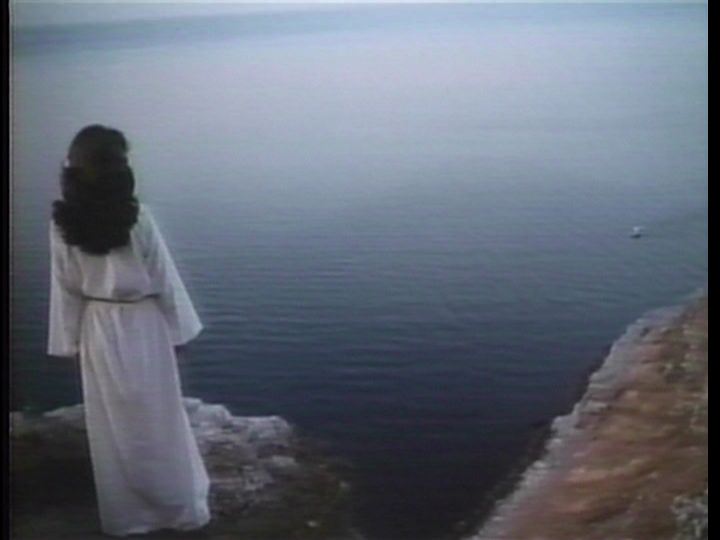
Neil and Sherry quickly track down Madeline, who's staying in a convent and is obsessed with restoring an ancient, multilayered piece of artwork. Madeline is clearly one of those free spirits who drifts in and out of reality, and yearns for some ascetic, pure existence...

...which is why her makeup is always so immaculate, of course. Those Greek nuns really know their mascara and lip gloss.

Deborah Shelton gets the dreaded "introducing" tag here -- often the kiss of death for a young actress's career -- but she actually had over 5 years of TV credits before Blood Tide, and plenty afterwards.

She also made several appearances in Greek films. Despite her Anglo surname, maybe Shelton spoke the language and could serve as a useful liaison to the crew?
Sadly, she doesn't get the chance to speak any Greek here -- though it appears that one of her co-stars is fluent in French. (No translator needed.)

Madeline sure does wear a lot of white, though. I wonder what that could possibly signify?

As in Who Can Kill A Child?, we spent a fair amount of the movie's running time yelling at Neil and Sherry to just get the hell out of Dodge. When the ostensible protagonists seem hell-bent on their own destruction -- and are thoroughly overshadowed by the supporting cast -- it's hard to care much about what happens to them.

Still, Blood Tide was just offbeat enough to hold our interest, even if its climax is abrupt and disappointing. However, the film holds back its weirdest moment for the denouement, when something happens that completely disrupts the narrative -- the kind of thing you'd see in a Channel 101 skit, not a mainstream movie.
Is it a hail-Mary attempt to rescue a troubled story by simply going completely bonkers at the end? Or is it meant to be thought-provoking?

Are we meant to re-evaluate a couple characters? Because that would explain why...
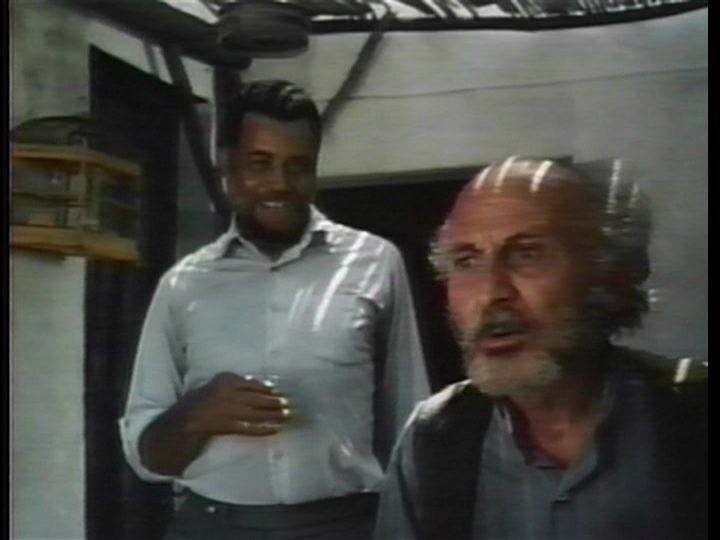
But wait, if that happened, then how could she be...?

...oh, yeah, there is that. Yeah. Think about it.

Or, uh, maybe it's better to forget about it. Here, have a Lydia Cornell leg lift instead.


