Showing posts with label spunky female reporter. Show all posts

Friday, June 2, 2017

Telephone secrets, telephone spies

"Can you hear me? Or am I talking to myself?" - Chris Squire (RIP)

In these two killer films from Poverty Row, the folks availing themselves of Ma Bell's services surely aren't talking via satellite (or Verizon), but can still hear each other just fine.

Little do they know, though, that an eavesdropping third party is listening in close to get the information right.


I Killed That Man (1941)

Grade: C+

Anyone who's seen enough Poverty Row crime flicks has seen the devices of I Killed That Man a dozen times over already, like the spunky female reporter (Joan Woodbury) who just so happens to be dating the A.D.A. (Roger Phillips).


Or the opening sequence that depicts the final moments of a condemned man before his execution...

...until he decides to admit that he is indeed guilty (yay, justice system!), but also had a secret partner in crime -- all revealed in a long speech that, for dramatic effect, saves the identity of his collaborator for last. And what's that? Why, it's a blowgun dart that kills him instantly, just as he's about to name names!

So next we get one of those "Nobody leaves this room!" numbers, which results in a whole lot of nekkid middle-aged men (mostly implied, so no luck if you're into that sort of thing). At least they get it out of the way upfront, vs. the absurd formal contortions we saw in Midnight Phantom.

I Killed That Man also does the "the culprit can't possibly be this guy, so of course it's this guy" bit that a New York Times reviewer skewered so well in A Shot in the Dark. TVTropes calls that sort of thing "hanging a lampshade on it", but for a murder mystery it's not such a wise idea.

Around now, you're probably wondering: "So, why the C+?" Well, it's amazing how much a brisk pace, a couple of clever set-pieces, and some good one-liners can do to salvage even the most familiar plot. And that certainly applies to I Killed That Man, which somehow manages to entertain throughout its 70 minutes.

For instance, when the gentlemen are putting their clothes back on post-inspection, we get this exchange:

Reed: "Never have I been so humiliated."
Lanning: "Felt kinda foolish myself. I guess I'll have to go on a diet."
Reed (bitterly): "So I noticed."

It doesn't really come off in print, but it's a sick burn in execution.


Returning to the subject of this post, we get a bumper crop of telephone-related plot points, including mysterious numbers, ice cream sodas, and a seldom-seen 3-way split-screen shot.

Is I Killed That Man a must-watch? Hardly. But it's one of those films that pops its head above the sea of Poverty Row mediocrity, rewarding the persistent viewer who wades through this stuff in hopes of turning up a hidden gem -- or, in the present context, simply something that's competent and entertaining. And that's exactly what we have here, so let's not press our luck by demanding more than that.


The Invisible Killer (1939)

Grade: D


Mill Creek's print of The Invisible Killer has one of the lousiest and most muffled soundtracks of any film on this boxset -- not to mention a series of nasty cuts and splices near its midpoint. Half the time we struggled to make out what was being said, but that's not necessarily a dealbreaker for us: after all, we liked The Ghost Walks.

What is damn near a dealbreaker, though, is this lady right here, Ms. Sue Walker:

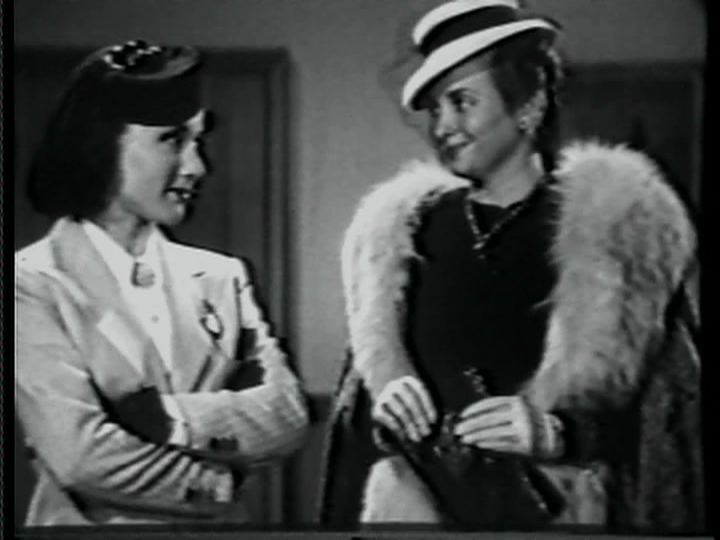
Played by Grace Bradley, she's a relentlessly self-interested, Machiavellian journalist who goes well past "spunky" to the point that we nearly had to introduce a "nasty female reporter" tag. There's nothing wrong with amoral characters, of course, but Walker is so irritating and pointlessly difficult, we found ourselves wishing her love interest Lt. Jerry Brown (Roland Drew) would finally make good on his repeated threat to wring her neck.

It seriously detracts from a movie that isn't so hot to begin with. Maybe it's telling that so many sources seem to misunderstand the plot of The Invisible Killer, from the Mill Creek blurb saying "an eager female reporter...ends up partnering with a homicide detective assigned to the case" (misleading) to the IMDb claim that "a fiendish killer uses sound waves to commit his murders" (flat-out wrong).

What is the means of murder? Well, that would be blabbing.

The first two-thirds of The Invisible Killer drag like hell, in part because of the perennial 1930s "too many indistinguishable white guys in hats" problem. The presence of a secondary female character, attractive socialite Gloria Cunningham (Jean Brooks), does help a bit by allowing us to triangulate the identities of the IWGIH relative to her.

Ms. Cunningham is also the fiancée of the D.A., Richard Sutton (Crane Whitley), who's trying to rein in a wave of gambling-related crime...


...so it's very embarrassing when she's nearly caught up in an investigation: only Ms. Walker's forbearance keeps her from ending up on page one.
Worse yet is the fate of her father (Boyd Irwin), who fights on the side of right and justice, but discovers to his chagrin that he owns multiple properties used as gambling dens -- and once your hands are dirtied, it can be very hard to get clean.

Anyway, you can probably imagine much of the rest, but The Invisible Killer throws some weird curveballs. For example, there's Sutton's valet Worcester (David Oliver), a drunkard who spends his downtime slowly typing broadsides against "The Evils of Alcohol". We spend such a shockingly long time watching Worcester and his two-fingered technique that (we assume) he must be intended to serve as a key component of the film's comic relief -- or, perhaps, as a sardonic commentary on the hypocrisy of reformers.

But his scenes are so cut to ribbons by bad splices, and his typescript so hard to read in this print, that whatever impact the scene is meant to have is replaced instead by ennui and confusion.

Which, now that we think about it, is a pretty good description of what it's like to watch The Invisible Killer -- at least in its Mill Creek iteration.

Wednesday, April 19, 2017

A ____ in the _____

No points for guessing our theme this time around -- but, on the other hand, you'll get quite a few points if you can follow the plots of these two convoluted murder-mysteries on first viewing. (We sure couldn't.)

And what else do they have in common besides the structure of their titles? Well, how about --
  • unusual projectiles,
  • piquant discussions of the human neck,
  • amateur detectives,
  • and truly horrific prints?
Yeah, that's about right.


A Face in the Fog (1936)

Grade: F

"Numb from the neck both ways": that's how spunky female reporter Jean Monroe (June Collyer) describes herself early on in A Face in the Fog. The exact gist of this idiom is obscure to us -- its only appearances on the Internet are an IMDb review of this very film, and a dead link on a message board for ex-Mormons -- but watching A Face in the Fog gave us a feeling that can't be too far removed from, well, whatever it means.

The film's plot seems like standard stuff: a mysterious, hunchbacked fiend is committing murder after murder, all centered on the Alden Theater, where a new production is soon to debut.

Cue our spunky female reporter, who nearly gets offed in the opening scenes (and whose ridiculous cries for help bear a remarkable resemblance to the arcade game King & Balloon, if you can dig that). She seems like our protagonist, but in reality, most of the legwork is done by her spunky male colleague Frank Gordon (Lloyd Hughes) and bumbling photographer Elmer (Al St. John).

Together, they hope to unravel the mystery -- and, apparently, claim a $2000 reward, though as far as we can tell that's never explicitly mentioned in the film. (Whoops!)

Of course, odds are that the reward was mentioned, but got lost in one of the many, many cuts and skips that plague this copy of A Face in the Fog. It's hard to give the film a fair shake when it's represented by a print this damaged. While the sound quality is tolerable, the picture is often blurry and hard to make out, and several key scenes are so badly hacked to bits that we literally had to watch the film three times to fully piece together what was going on -- and there are still several things, like the reward, that remain unclear to us.

But even if the print were intact, we'd probably still be confused by A Face in the Fog. First and foremost, it suffers acutely from a common 1930s affliction: a severe excess of interchangeable white guys in hats. We struggled mightily to differentiate between the many fellows in chapeaus, and eventually resorted to making notes in a text file just to keep track of them all.

Second, A Face in the Fog doesn't make any sense -- a diplomatic way of saying that, basically speaking, it's dumb as hell. For instance, we learn very early on that the Fiend's weapon of choice is a large projectile, and yet "there hasn't been a mark of any kind" on the victims. As Kittka from the Specialists would say, eet's not poss-ee-bull -- and it's not the only law of physics that gets violated by the murder weapon.

And speaking of the victims, as they expire, they take the time to say "His name is..." and then collapse, instead of just blurting out the name of the murderer like any human being would.

Meanwhile, key moments in the plot, including the film's climax, are shaped not by the protagonists, but by minor characters. Halfway through, a man we've never seen before is introduced -- some rando who's yet another guy in a hat, basically -- and he immediately becomes the prime suspect. This is not good storytelling (especially since, let's face it, it's completely obvious whodunit by the halfway point of the film, if not sooner).


With a better and more complete print, A Face in the Fog might be marginally more coherent. But it's not as if that would help with the stupidities of its plot, the inane and repetitive dialogue, the unfunny comic relief, the stiff performance of June Collyer (and her lack of chemistry with Hughes), or any of the film's many other turnoffs.


A Shot in the Dark (1935)

Grade: D


The protagonist of A Shot in the Dark, a college boy named Kenneth Harris, is played by one Charles Starrett. Tell us that was a pseudonym for John de Lancie, Sr., and we'd surely believe you -- so strong is his resemblance to the actor who played perennial irritant Q on Star Trek: TNG.

The movies we watch seldom come to the attention of the major press, but back in 1935, Andre Sennwald at the New York Times wrote a review of A Shot in the Dark that's pretty much on point. To quote one of his choicer lines (with a spoiler redacted):
"A Shot in the Dark," which pictures a trilogy of murders on a rural college campus, telegraphs its punches in a way that...is as good as a confession to us amateur gumshoes. All you must do is single out the kindly ____, who obviously has nothing to do with the case, and then observe how the camera contemplates him for a moody second or two as he stares into the fire or drapes himself in the background with an air of furiously transparent innocence.
Pretty accurate, really, then and now.


To tell the truth, the cues were so obvious that we found ourselves wondering whether we were deliberately being misled. In such a case, one's suspicions turn to other characters, idly and musingly, in hopes that the scriptwriter had a curveball in store.

It's like the difference between being genuinely gullible, and consciously allowing oneself to half-believe a farfetched proposition simply because it would make life more interesting. One is foolishness; the other is a way to sustain a vague thread of hope in the face of disappointment. "Maybe something cool will happen," we tell ourselves, even knowing it probably won't.


But, as Sennwald writes, "There is a lot more to it, routinely told, and the trail leads relentlessly to the man who couldn't possibly have done the deed." Quite so. And if you've already ID'd the culprit in a murder-mystery, what's left to enjoy?

Well, the sound quality of A Shot in the Dark is horrendously muffled, and even with major EQ and other intervention, several lines of dialogue escaped us completely. But at least the picture isn't bad, letting us appreciate a few choice shots -- like this one, where a hanged man's dangling feet cast a macabre shadow:

And even with the damaged soundtrack, there are a few wonderful voices to be had in A Shot in the Dark, like the unexpected basso profundo of Professor Brand (John Davidson) --

-- or the affable growl of Robert McKenzie, evoking the quintessential country sheriff, and a few Sesame Street characters besides.

But the twists and turns in A Shot in the Dark -- and there are a few -- just don't have that feeling of inevitability that can keep a mystery interesting even after you've guessed all the guessables. OK, fine, here's a long-lost love, and a long-lost sibling, and a "You look just like ____!", and an unexpected bit of collateral damage: but who cares? It all feels arbitrary and piled-on, filler for a fundamentally thin plot, a way to keep us hung up for just a bit longer.

Not only do both films have a surfeit of minor characters (mercifully more distinguishable here, at least), but the victims in A Shot in the Dark also suffer from the same folly as those in A Face in the Fog: "It was --", they begin, and before they finish their sentence, it's curtains.

So, a memo to all witnesses everywhere: lead with the name, save the deets for later. The alternative just drags things out and makes everyone miserable, especially those of us who have to watch this stuff.

Monday, February 20, 2017

Passion killer, you're too much

By no means is this next pair of reviews our first foray into the Night Screams (sing it, Neil!) subset of the 250-pack. We've covered six of those films so far, ranging from the Sapphic musings of Kiss Me, Kill Me to the bottomless battles of Killers of the Sea (as opposed to the topless titillations of Devil Monster, with which we sometimes confuse it).

But these two films share another trait besides being part of Night Screams, since they both prominently feature pretty ladies gettin' photographed (and then offed -- not much of a spoiler, that). And yet, both are also dominated by a charismatic male actor whom we found more memorable than any of the XXs on display.


Bloody Pit of Horror (1966)

Grade: D+

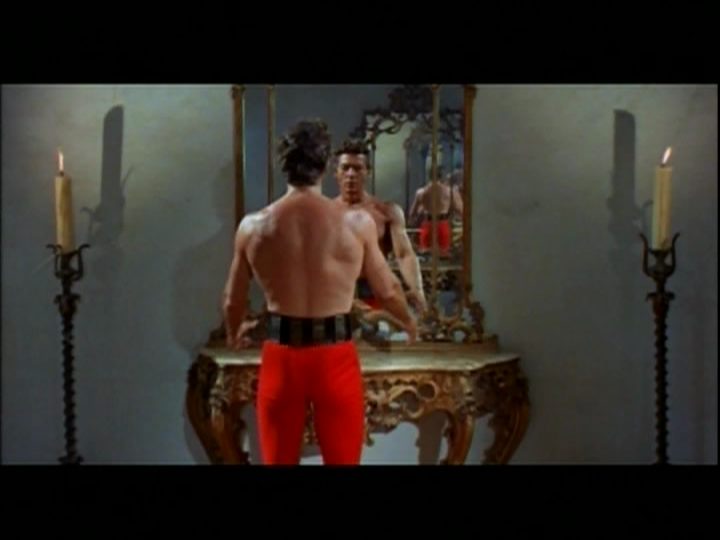
Silly robes aside, there's a solid case to be made that Mickey Hargitay was actually the most attractive member of his family. We've never thought Jayne Mansfield was much of a looker, and Mariska clearly takes after her; meanwhile, though we knew Mickey was jacked, we didn't realize how pretty he was.

Somehow a mental image of one of those circus strongmen with a big mustache crept into the "Mickey Hargitay" filing drawer of our brains, but he's not Karnov- or Zangief-esque at all; if anything he looks and moves more like a dancer. His screen presence is a bit off-kilter, but no less palpable.

However, Mickey Hargitay certainly wasn't the best actor in his family -- his daughter deserves that title (even if these days SVU has reduced her to trotting out rote expressions of pained sympathy and righteous indignation, in whatever sequence is necessary to fill that episode's quota).

He gives Bloody Pit of Horror his best shot, but -- like a washed-up actor doing porn to make money -- his efforts feel out of place and, at times, faintly embarrassing.

And of course, Bloody Pit of Horror basically is porn -- torture porn, to be precise, that's allegedly adapted from the writings of de Sade. Oh, there's a framing story about a group of models and photographers who foolishly blunder upon a haunted castle and ignore numerous warning signs telling them to get the hell out.

With their blasé attitude and loose morals, they ultimately offend Hargitay -- who (now that we think about it) plays a washed-up actor, so there you go -- and thereby seal their fate. Throw in a medieval legend about the "Crimson Executioner", an obsession with bodily purity, and a handful of underlings who all wear striped shirts for some reason, and you've got a movie.

But, to vaguely evoke that famous line from 1984, the torture is the point of Bloody Pit of Horror -- not a means to an end, but an end in itself. And, well, if you're into seeing women tormented to the tune of looping Italian lounge music, then we suppose this here is your jam. It's got skewerings, slashings, burnings, an iron maiden, death by crossbow, and an elaborate setpiece involving a web of wires and the goofiest-looking spider this side of Martha's Orphanage.

As demonstrated by the persistence of shows like SVU and Criminal Minds (not to mention the recent U.S. election), virulent sexual sadism is rather fashionable these days. But while Bloody Pit of Horror is too distasteful to be laughed off, the years have dulled its edge, and -- despite some impressive sets and a fairly attractive cast -- ultimately it left us bored and disinterested.


City of Missing Girls (1941)

Grade: C+


This crisp little effort from Poverty Row manages to be a film about prostitution that never actually uses the word, nor any of its synonyms. But that's clearly the subtext -- here couched in euphemisms about "out-of-town jobs" to which the titular girls are assigned, never to return.


Swooping in to save the day is James Horton, an ambitious young A.D.A. (played by John Archer, whom we recently saw in Bowery at Midnight, and rather reminds us of Robert Sean Leonard in this appearance).

He's flanked by a philosophical old police captain (H.B. Warner) and -- could there be any doubt? -- a young, spunky female reporter, Nora Page (Astrid Allwyn). She's good-naturedly amoral in her search for front-page news, though like all spunky female reporters, she eventually sees the error of her ways.

She's also in for a grim discovery, as her father is an investor in the "Crescent School of Fine Arts" -- a talent agency that's more or less a front for the film's sex trafficking operations. So the deeper she digs, the closer she unwittingly gets to dear old Dad.

(Don't you see? This is what always happens to -- ugh -- career women. Hence why no spunky female reporter's career outlives the runtime of the film she's in, not to mention the conspicuous lack of middle-aged spunky female reporters in these movies.)

One thing that's refreshing about City of Missing Girls is the unexpected civility of the cast. Officers of the law and criminals have actual conversations, and treat each other with a degree of respect, even when hinting at the gravest of threats. And this paradoxically makes the villain King Peterson (Philip Van Zandt) seem more menacing, since like a big dog that doesn't bark, he has no need to boast to prove his power.

If you enjoy the fashionable absurdities of past decades (as opposed to the fashionable inhumanity of the present era), then City of Missing Girls offers a pleasant smorgasbord of preposterous peacockery. We get silly hats (obligatory in any film with a SFR), silly outfits, and silly dances galore.

But the real star is H.B. Warner, who's the kind of old fella we'd all love to have in our corner, and steals every scene he's in. (We suppose that's no surprise coming from a guy famous for his portrayal of Jesus -- which he pulled off the age of fifty-two!)

As Captain McVeigh, he's warm, witty, patient, sharp as a tack -- and astonishingly spry when the moment calls for it.

By our lights, McVeigh is the film's real protagonist. He's the first onscreen and last to leave, and gets most of the best lines:

Horton: "If you were a gangster and you wanted to frame somebody --"
McVeigh: "Yeah, well, I'm not a gangster, and I don't want to frame anybody. I want to go to sleep!"
Horton: "Mac, this is important!"
McVeigh: "All right, I am a gangster, I do want to frame somebody, and I don't want to go to sleep."
Horton: "All right, now who would you get to take a picture like this?"
McVeigh: "A photographer."

At heart City of Missing Girls is a formula piece, with a plot whose twists and turns hardly qualify as such. But it's still an enjoyable one, and if you don't agree, may H.B. Warner haunt you with his Duck Face of Disappointment.