Showing posts with label interesting face. Show all posts

Monday, January 11, 2021

Put our service to the test

Though neither of these films is a Mill Creek joint, we initially took an interest in them because of their connection to the Horror Collection 250-pack. One features an actress we first met in the earliest days of our site, while the other is ostensibly a sequel to one of our favorite movies on the box.

However, we didn't foresee that they'd share something else: protagonists who find themselves in the crosshairs of that most terrifying of locations --

--that most bone-chilling of phrases --

-- that limitless vein of potential awkwardnesses and unwanted socializations:

"You can stay in our guest room."


    The Three Weird Sisters (1948)

    Grade: C+

    Ah, Nova Pilbeam. Even if your name weren't so unusual, we'd certainly remember you from your star turn in Counterblast, not to mention your strong resemblance to a former colleague of ours (at least in that colleague's younger days: you wouldn't recognize 'em now).


    And speaking of younger days, it's not clear whether this or Counterblast was Pilbeam's last film role -- though she did make one BBC appearance in 1951 before packing it in for good -- but after a successful career as a child actress, and a reasonable career as a young adult, that was that.

    She lived to age 95 -- when we wrote our Counterblast review, she was still alive! -- but was, from all reports, not interested in discussing the past. (Makes sense when your name is "new".)


    Anyway, Ms. Pilbeam is Claire (no relation to Emily) Prentiss, a secretary who accompanies her obstreperous boss Owen Morgan-Vaughan (Raymond Lovell) to a Welsh mining village, Cwmglas, where his (ahem) three weird sisters await his arrival at the family home.

    (Technically they're his weird half-sisters, but that wouldn't have the same ring, now would it?)

    One is blind, one deaf, and one has some combination of bad nerves and severe arthritis, resulting in a strange symbiotic interdependency between the three.


    In the film's opening Cwmglas suffers a catastrophic collapse in which several residents die, and survivors opine on the will of God and the suffering of the proletariat.

    While hard to follow on first viewing, a quick review of Dylan Thomas: The Complete Screenplays (which also told us how to spell "Cwmglas") makes the details clear. The Morgan-Vaughans are the local muckety-mucks who made their fortune via the mines, while their cheapskate refusal to fill up unused mineshafts beneath the village caused, or at least contributed to, the collapse.


    For a while, The Three Weird Sisters is poised on a knife-edge of ambiguity: is Owen just a callous bastard who selfishly wants to wash his hands of all responsibility toward the village? (Given that Owen gets a rock flung at him upon arrival, some of the townspeople clearly hold the affirmative.)


    Or is Cwmglas -- the name of which sounds like a "worst of Reddit" thread in the making -- just a decrepit symbol of the corrupt, hopeless old ways? A decaying relic that's undeserving of life support and overdue for destruction? Merely a vessel for a "spent force", one might say?


    With Dylan Thomas on board, some sophistication (moral and otherwise) is to be expected. Ultimately, though, the lines are drawn by the participants' willingness to sacrifice innocent Claire in the crossfire -- and given that one of the sisters describes her as "that horrible painted young woman", one need not be exceedingly wise to infer who the baddies are.


    So what does that leave us? Suspense, atmosphere, intrigue, and barbed dialogue, we suppose, none of which are extraordinary but all of which are at least serviceable. And we get faces, if one likes faces (as we do), ranging from Ms. Pilbeam's ever-popular visage --


    -- to the sisters, especially Gertrude (Nancy Price), whose forbidding countenance somehow intrinsically evokes those stony, mirthless parts of Britain where God's name is perpetually on everyone's lips and yet the old pagan powers feel close at hand.


    Or there's this preacher (Hugh Pryse) in his ridiculous middle-aged makeup:


    And we get amusing vignettes, as when we find the thersitical Mabli (Hugh Griffith) reciting Marxist dogma to, well, dogs:


    Structurally speaking, The Three Weird Sisters is a film-you've-seen-before -- if you understand what we mean -- and offers no great innovation or dramatic uncertainty. So your appreciation of it will likely depend on your affinity for the Welsh coat of paint it's received, and/or your fondness for Dylan Thomas, Welsh terriers, Nova Pilbeam, or handsome older women.

    (No judgment, you do you.)
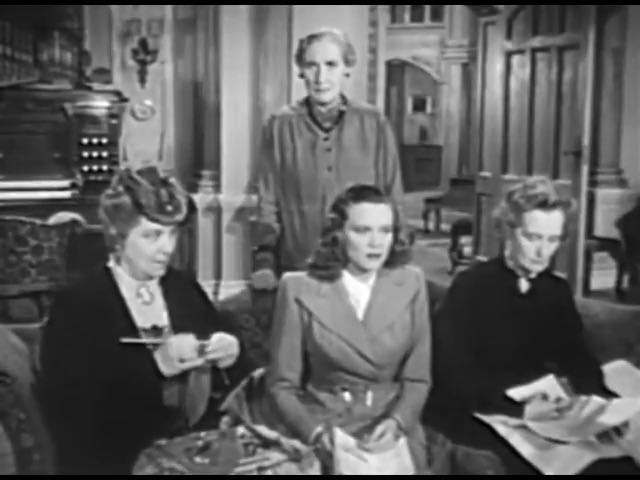


    Devil Bat's Daughter (1946)

    Grade: D+


    When you expect a film to be a complete piece of crap, it sure is a pleasant surprise when it's not. That's not to say Devil Bat's Daughter even comes close to its predecessor, The Devil Bat, the consensus favorite among Béla Lugosi's Poverty Row efforts (and we agree that it holds up).


    We can't help but be curious why Devil Bat's Daughter was even made. Was a five-year-old film really enough of a success to call for a sequel? That is: if this was a cynical cash-in, what exactly was there to cash in upon in the first place?


    In any event, Devil Bat's Daughter has little to do with the earlier film, though we can't quite call it an "in-name-only" sequel. Instead it runs along similar lines to Shock, with a traumatized young woman, Nina (Rosemary La Planche), guided through recovery by the authoritarian Dr. Clifton Morris (Michael Hale), who may not have her best interests at heart.


    We're not sure whether having a patient living in your home was considered a ridiculous violation of professional boundaries in 1946, though from our vantage point 75 years later, it seems absurd. But living in Dr. Morris's home brings Nina into contact with his saintly wife Ellen (Molly Lamont) and stepson Ted (John James), and guess which one of them falls in love with her?


    ...no, this is 1946, try again. Though we will say that Ms. Lamont, who hasn't necessarily lit up our screen in movies like Scared to Death and Jungle Girl, evinces a degree of angular classical beauty in this film --
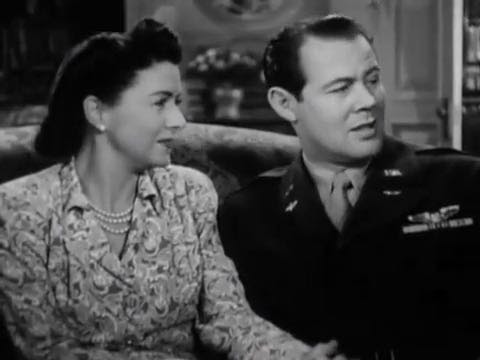

    -- while, by contrast, Ms. La Planche's past as a Miss America merely underscores how tastes have changed.


    But better either of them than John James, who unfortunately evokes the irritating Jerry Lester -- plus a dash of Mickey Rooney, a sprinkling of Tim Allen, a dusting of John Heard. Those old-young faces are a tough sell.


    If one acknowledges that the major plot points of Devil Bat's Daughter are foreseeable, there are a few things that deviate from the expected path. One of them is the body count, or more accurately, the body-count-to-emotional-consequence ratio, which is unexpectedly brutal. Not a film for dog lovers, this, though we're always glad to see a movie go for the jugular.


    On the other hand, Devil Bat's Daughter commits an absolutely monstrous act of retconning that, under normal circumstances, should be unforgivable. So instead, we'll forgive it by allowing ourselves to pretend that the literal meaning of the revelation -- which would utterly destroy both this movie and the previous one -- is untrue, and that the character who announces it is mistaken. And frankly, the movie still works if you assume that.


    Still, while our initial impulse was to give this one a C-minus, it really needs to be penalized for that misstep. Otherwise, we were shocked to find that we enjoyed Devil Bat's Daughter. It's a predictable and flawed film, but manages to entertain nonetheless -- if you have very low standards, as we seem to these days.


    Monday, January 16, 2017

    Warning! Attention! Achtung!

    Before watching the next three films -- all of which, as it happens, revolve around criminal schemes that run afoul of the law -- be warned: each harbors a serious issue that, in the case of one of these films, can damage your television or even your health. (No, we're not kidding.)


    Bowery at Midnight (1942)

    Grade: C+

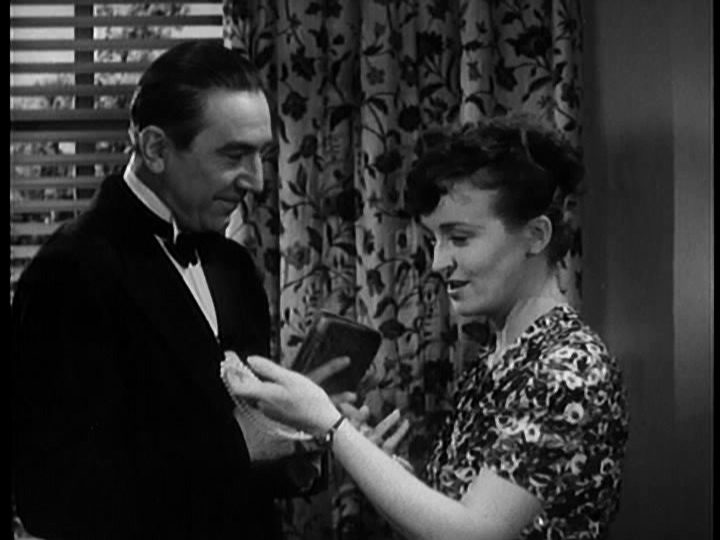
    To see Béla Lugosi onscreen in a starring role is, alas, to know you've already spotted the villain. But for the first few minutes of Bowery at Midnight, Béla puts up a good front as Karl Wagner, the kindly operator of a soup kitchen/flophouse. Wagner doesn't ask a lot of questions, or try to save anyone's soul...

    ...because his is already long gone. Wagner leads a double life, you see, as the mastermind behind a series of particularly brutal robberies -- and his associates have a nasty habit of ending up dead.

    And that goes double if they get the bright idea of talking smack about him while he watches on his secret TV (which, to our great pleasure, Bowery at Midnight makes no attempt whatsoever to explain).

    Did we say Wagner leads a double life? Well, it's really more of a triple life --

    -- for, by day, he's Professor Brenner, noted criminologist and devoted husband. While his criminal associates know that Wagner has a dark side, no one knows that Brenner is Wagner -- and he means to keep it that way.

    Wagner/Brenner makes for a refreshingly evil character, and a part tailor-made for Lugosi. He has no compunction about killing anyone, and we mean anyone, who gets in his way. The movie's body count is impressively high, and as another site notes, it quickly establishes that any character can die at any time -- something that puts us in a completely different headspace, so to speak, from the usual "everything's OK in the end and only the bad guys get it" fare.

    Of course there has to be an infusion of spunk somewhere along the line, right? And Bowery is no exception, though it distributes its moxie more or less evenly between Wagner's assistant Judy (Wanda McKay), a nurse who knows nothing of her boss's dark side --

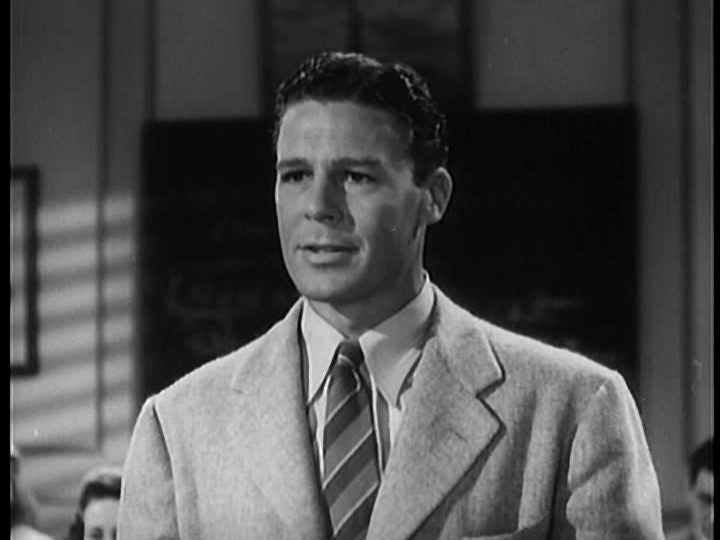
    -- and her wealthy boyfriend Richard (John Archer), who -- quelle coincidence! -- is taking Brenner's criminology class. Annoyed and offended by Judy's long nights in the Bowery, Richard decides to scope things out for himself. This is not one of his better ideas.

    Bowery suffers from a mild case of One Subplot Too Many, though other writers have overlooked one possible motivation for its bizarrely tacked-on zombie theme. Let's put it this way: if zombification is fully reversible, you can off as many people as you want without violating the Hays code.

    Now, a very important warning: at approximately 55:41 into Mill Creek's print of Bowery at Midnight, the viewer is hit out of nowhere with an ear-splittingly loud noise (probably feedback of some kind) in one channel.

    It's far louder than the surrounding audio, sounds like a cross between a siren and a Slinky from hell, and is more than capable of blowing out your speaker if you've got the volume turned up (and who doesn't when trying to make out the dialogue on these Mill Creek DVDs?). If you're listening on headphones, it could certainly cause hearing damage.

    It also made us jump about 10 feet even though we had a vague idea it was coming (thanks to a warning on another site, and we're grateful for the solid), marking the first genuinely scary moment we've had on this box. And when we watched Bowery again for this review, K. spent the entire time cringing in apprehension.

    So how will you know when it's coming, short of watching the counter on your DVD player? Well, watch out for this scene in which Judy is asking one of the flophouse residents to run an errand for her, and hands him some money:

    Right after that, she leaves and walks into the next room, and that's when the noise happens. Turn down your volume in advance! You'll know you're clear when she begins to speak with this man, "Doc" Brooks:

    If all this sounds overwrought, believe us, it's no joke. Consider yourself warned!


    Midnight Shadow (1939)

    Grade: F

    Another Sack film with an all-black cast, Midnight Shadow poses the question: how do you stretch 25 minutes' worth of film into a 50+ minute featurette?

    Why, with "comic relief", of course -- if you can use that term to describe the asinine and joyless antics of the two wannabe detectives who mug their way through this film. We remembered Midnight Shadow as one of the worst films we'd seen on this box, but for the first 15 minutes or so, we found ourselves questioning this assessment: did this silly but inoffensive murder-mystery really deserve that much opprobrium?

    But once Buck Woods and Richard Bates show up onscreen, look out. It's not merely that they're unfunny, or that there's something embarrassing and painful about watching them carry on. They're just flat-out obnoxious, so insultingly stupid that it moves us to anger.

    And it doesn't help that Richard Bates has a creepy, young-old face that makes his role as "Junior" somehow disturbing -- a bit like John Hurt's early scenes in Heaven's Gate, we suppose, but much, much worse. Ostensibly a young man, he certainly doesn't look much younger (if at all) than his onscreen parents.

    So be warned: the presence of these two pretty much tanks any chance for Midnight Shadow to be what it could have been, i.e. a threadbare but mildly entertaining romp whose rough edges and incoherent script are almost forgivable in light of its brevity and circumstances.

    Instead, it's just a big steaming pile of anhedonia. Sorry, Sack.


    Torture Ship (1939)

    Grade: C-


    Let's get the warning out of the way upfront this time: Mill Creek's print of Torture Ship is missing the first 9-10 minutes of the film, give or take. And while you can infer the gist of the missing material pretty quickly -- these people are criminals on a boat, this person's a scientist conducting experiments on them, etc. -- it still has a major impact on the film's coherence and enjoyability.

    It turns out that neither YouTube nor Archive.org can supply the missing beginning to the film, so we digitally "rented" a copy of Sinister Cinema's version, which seems to be the only place to get those opening minutes. The Sinister print is certainly better than Mill Creek's copy, but much as with The Ghost Walks several entries back, it also has some unexpected flaws. Among these are a scene that's been mysteriously replaced by an exact repetition of a later scene (which is confusing as hell), and a couple skips and audio dropouts that aren't present in the Mill Creek version.

    If you choose to watch the Mill Creek version of Torture Ship (from which all of these screenshots are taken), you'll be a bit lost for a while, but you'll still be able to enjoy the film's wealth of interesting faces. And it sure has a lot of them, though there's a clear winner in the bespectacled fellow pictured at the very start of this review, Skelton Knaggs, a man who -- as you can see -- looks exactly like his name.

    Our female protagonist, Joan, is played by Julie Bishop -- who, speaking of fah-chays, looks a bit like the young Arlene Francis (a cutie in her youth, if you didn't know that: certainly worth a Google, no need for a Bing).

    An innocent secretary unwittingly mixed up in a murderous racket, her only lifeline is heroic Lt. Bob Bennett (the ever-redoubtable Lyle Talbot), nephew to the scientist we mentioned a while back. And boy, does she give him bedroom eyes when he saves her bacon.

    And speaking of women of a certain age who work in quartets, the comic relief in Torture Ship is supplied by Ole Olson (Eddie Holden), a stereotyped Swede and spiritual grandfather of Sven Lindström. Cowardly but sweet-natured -- and full of gratuitous transformations of palato-alveolar affricates into palatal approximants, naturally -- he gets the film's best line, or at least its strangest:

    "If a gun was even two feet in front of me, it would run like 'Hail, Columbia'."

    In its Mill Creek-ified form, Torture Ship is a murky and unsatisfying affair; with the opening restored, it's a marginal but reasonably entertaining hour of plots and counterplots, with a little woo-woo science for added spice, and at least one unforgettable face.

    If you're reading this and decide to assemble the best parts of the Mill Creek and Sinister prints into some sort of restoration project, drop us a line with the download link -- we'd love to see your new cut!

    Sunday, December 11, 2016

    CIB

    Some people collect action figures, or video games, or unemployment. But the three films we'll discuss below all feature deviant souls who have chosen, instead, to collect...women.


    The Peter Hurkos Story (1960)

    Grade: D


    We couldn't help but be offended by The Peter Hurkos Story, for much the same reason we were mildly irritated by The Night America Trembled. And that, to remind our loyal readers once again, is because it's bullshit.


    From all reports Hurkos was a typical "psychic" con artist, using an array of manipulative tricks to prey on people's hopes and fears. So while this film -- really a two-part episode of One Step Beyond, sponsored by Alcoa and edited together (rather badly) into a single 51-minute feature -- is, in terms of pure craftsmanship, a reasonably well-made example of TV entertainment...

    ...we can't quite will ourselves to believe anything in the narrative, because Hurkos himself trafficked so unrepentantly in lies.

    Was he really a member of the Dutch Resistance? Did a fellow Resistance member, believing Hurkos to be a traitor, really try to smother him in his sickbed -- only to stop when Hurkos read his thoughts? Is there any truth at all to the story, or is it just another fiction from a master manipulator and serial liar? And why on earth did Alcoa sponsor such a cavalcade of cynical crap? 


    At the end, the real Hurkos even pops up to offer the following proclamation:

    "So long as I live, I offer myself for any test, any study, under any conditions that scientists may impose."


    The Embalmer [aka Il mostro di Venezia] (1965) 

    Grade: D+

    The Embalmer's original Italian title translates, shockingly enough, as "the monster of Venice". And just like it says on the box, a depraved killer is roaming the streets (or really scuba-diving the canals) of Venice, drowning young women before adding them to his collection.


    How does he ward off the stink and keep them NM+/NIB, or at least NM-? Well, that's where the English-language title comes in, natch.

    But formaldehyde fiddlings can't thwart a reporter's houndlike ability to sniff a good story from a mile away -- and naturally our spunky colleague (Luigi Martocci) rapidly outpaces the police in his efforts to crack the case.

    The nexus for all this activity is a sketchy hotel that -- conveniently enough -- is hosting a gaggle of schoolgirls and their chaperone (Maureen Brown). That's, uh, some spectacularly ill-timed tourism.

    The Embalmer is one of those films that plays better in memory than in actuality. Before rewatching it to write this review, we had some recollection of it as a middling effort, a bit like (say) Phantom of Soho: murky, meandering, but at least competent in the basics.

    But truth be told, it's not really very good at all. The biggest problem is the film's presentation of its own plot, which simply falls down at the task of giving us important information in a way we can understand and retain. That's something crucial in a murder-mystery, even in one with pretensions toward being a horror film.


    It'd be easy to blame the dubbing for the fact that (for example) we had no idea who the killer was until we went back and reviewed several key scenes in the movie. Oh, we saw his face, but we didn't recognize him at all, or remember him from earlier in the film.

    But we'll hazard a guess that the issue is just as present in the Italian original: whatever the language, if a character doesn't get the necessary screen time or have the needed presence, the issue remains the same.


    The real blame probably lies with the film's director and editor. Especially on second viewing, The Embalmer is just loaded with padding that masquerades as suspenseful buildup, and characters who serve no structural purpose in the film, however interesting their faces might be...

    ...or however amusing it might be to see the Italian Elvis pop out of a coffin.

    And even now that we understand the killer's identity, the movie's third act is ultimately a dismal affair. Despite a few memorable images and set-pieces, the inevitably violent conclusion offers no real catharsis, but simply a downbeat shrug of indifference.

    However we were hardly indifferent to the actress who played Grace (pictured on the left below), who stood out from the dreary surroundings like a sequined suit in a pile of black velvet.


    Her screen time is sadly limited and her name remains unknown to us (thanks, IMDb). But we couldn't help but take note of this fetching young woman, who clearly possessed a certain nous ne savons quoi...

    ...or maybe we savons exactly quoi it was, now that we think about it, and clearly the cinematographer knew it too. Tanto meglio.


    The Atomic Brain [aka Monstrosity] (1964) 

    Grade: D-


    It's almost never a good sign when a movie opens with a lengthy voice-over delivering exposition that ought to be shown, not told -- and that's just one of several ways in which The Atomic Brain is a sub-mediocre mess. In offering up the tale of a rich old woman (Marjorie Eaton) who teams up with a mad scientist (Frank Gerstle) in pursuit of renewed youth, The Atomic Brain succeeds only in being tacky and half-assed without mustering any real charm.

    It's not as if it's a secret why old Mrs. March has placed an ad for a new servant-girl (applications must include your bust, waist, and hip measurements!). Nor is it a surprise what sort of treatment -- in either sense of the word -- the three naïve young women who answer the ad are soon to be in for.

    But The Atomic Brain plods forward, undaunted, trailing that half-baked collection of vignettes, clichés, and confrontations it hopes to pass off as a plot.


    We were particularly amused by Judy Bamber's attempt at an English accent, yielding a strange hybrid of Texas and New Zealand (plus a dash of South Africa). She's apparently the sexpot of the bunch, and when she swings her hips as she walks -- or just bounces on her bed -- her bodily motions are accompanied in the soundtrack by what we can only describe as "sexy xylophone".

    Now that's a word-pair (let alone a concept) that, outside of a particularly hard-fought game of Scrabble, really has no right to exist.

    Anyway, the body count is high, the body beautiful count is low, and the door for a sequel is left open in a rather hamfisted manner.

    But who would really care to watch The Atomic Brain 2, or Monstrositwo for that matter? It's hard enough to imagine an audience for this film which, though not the very bottom of the barrel, still offers no real rewards for even the most tolerant viewer.

    (Unless you really like cats. It's got some of that, at least.)