Showing posts with label all style no substance. Show all posts

Wednesday, May 31, 2017

Kaj nun por io tute malsama

Nu, Kapitano, kion vi faras en hororo filmo?


Incubus (1965)
[Inkubo]

Grade: C
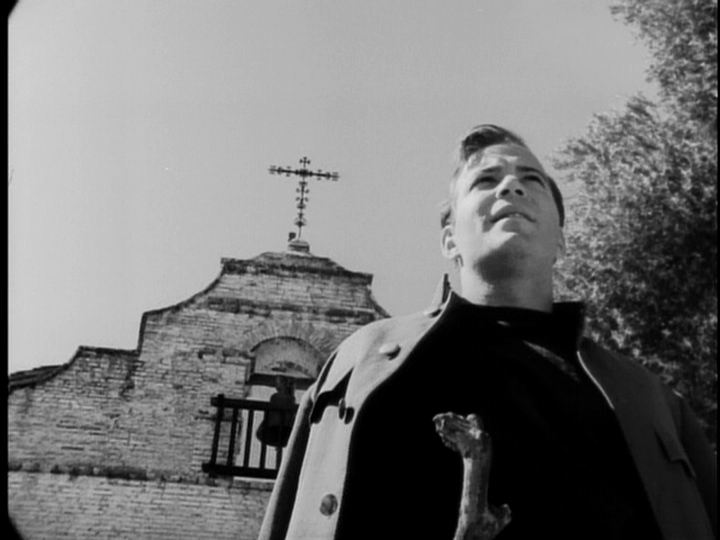


Continuing our detour from the Mill Creek box, we watched the Shat -- not to be confused with the Schach -- in Incubus, a film that manages to be infamous on multiple fronts. To wit: it was believed lost for many years, and the only surviving print has burned-in French subtitles. It allegedly carries a "curse" that, shortly after the film's completion, yielded two suicides (one of them a murder-suicide) among the cast members.

And -- oh yeah -- it's completely in Esper-fuckin'-anto. (That would be an example of an infix, for all you budding linguists out there.) Thus the burned-in subtitles, which are obscured by an ugly but necessary black box for the English-language subs.

Another site describes Incubus as "some kind of hybrid of an Ingmar Bergman film with Manos: The Hands of Fate", which is pretty much spot on -- though, at least plot-wise, you could probably throw in a dash of Night Tide too. It tells a moody tale of a succubus who drowns sinful men at the behest of an evil cult...


...until she meets a man who's not so easily corrupted. (Three guesses who.)

The movie's deliberate pace and philosophizing dialogue are certainly reminiscent of Bergman, as is the positively gorgeous cinematography by Conrad Hall (of Butch Cassidy and the Sundance Kid and American Beauty fame). For many of the films we watch, we find ourselves struggling to find a decent screenshot; Incubus presents us instead with an embarrassment of riches, with almost every frame akin to a well-composed photograph.

It's true that, by using Esperanto, the events in Incubus become weirdly unmoored from any specific time, place, or culture: we literally have no idea when or where these events are meant to be happening. It's disorienting, and certainly contributes to the film's unsettled atmosphere. 

It's also true that, even to a non-speaker of Esperanto, the dialogue in this film is painfully stilted both in its delivery and its pronunciation: most of the actors -- who allegedly learned their lines phonetically, and on short notice -- are clearly uncomfortable with the language, and their line readings suffer as a result.

The interesting exception is Shatner, who (at least in the early going) is noticeably more fluent than his colleagues. We've read that he speaks Esperanto with a pronounced French-Canadian accent, but better that than a Southern California accent, n'est-ce pas? (Dude?)


Shatner's hammy behavior in the wake of Star Trek has made it easy to overlook that he's always been a committed, disciplined actor. Whatever his personal shortcomings, his fame is at least partly the product of dues paid through years of hard work, by being damn good at his job and giving it everything he's got.

In the case of Incubus, he does what he can to make the best of a difficult situation; while he can't singlehandedly elevate the film, he's certainly not a liability -- and almost had us believing he could carry this off.
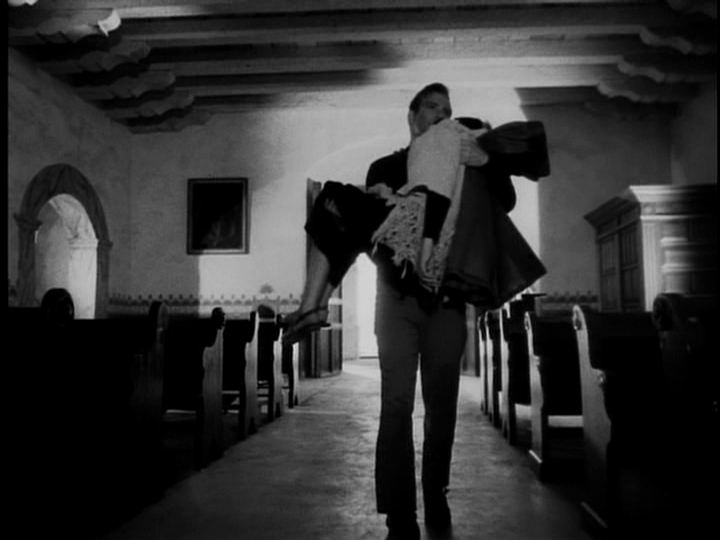

We also took notice of Milos Milos as the titular incubus. Shame he was the perp in that murder-suicide we mentioned above, as there's real menace in his leering, demonic performance -- and while some of it is attributable to good direction and cinematography, this Serb clearly had screen presence.

But ultimately it's hard to see Incubus as anything more than a beautifully filmed miscalculation. Pretentious and portentous, it nonetheless manages to conjure an atmosphere of real foreboding -- but neither its muddled narrative nor the stiff cast supply the foundation needed for Incubus's atmosphere to amount to more than just ambience. It has the visual flair and tortured quality of a Bergman film, sure, but not the intelligence or finely crafted performances characteristic of Ingmar's work.

All in all, certainly worth seeing (especially in the most literal sense), but not a good film. Sorry, Cap'n.


As a side note, Incubus is just about the last movie in our massive review backlog that, when we began chipping away at it with our most recent Ed Wood entry, dated back to August 2014. Since kicking into high gear in October of last year, we've been covering films that we initially watched between December 2014 and December 2015. With over 50 films in the backlog it seemed insurmountable when we first started, but here we are, out of the woods.

For a variety of reasons we didn't watch many movies for most of 2016, though Incubus was one of the few; others -- at least the ones potentially relevant to this blog -- include:
  • Jungle Moon Men, one of the more offensively terrible films we've ever seen from a mainstream studio;
  • The Howling and King Kong, two films far too famous to need our two cents on 'em;
  • Chandu the Magician, an amusing but threadbare romp with Béla, and One Million Years B.C., a less enjoyable (and bone-stupid) romp with Raquel.
We won't be doing formal reviews for any of these, but funny story about The Howling. We had DVR'd what we thought was The Haunting of Julia, and let that recording sit for over a year before sitting down to watch it. The first minute or so didn't get taped, so we didn't see the opening titles and were thoroughly confused for about 20 minutes until we figured out what had happened. In retrospect we're glad we got the chance to see this landmark werewolf film, even if purely by accident.

In our next entry we'll cover the only two Mill Creek box films we watched in 2016. Once that's done, we'll be fully caught up, and from that point forward, everything you read from us will be hot off our cinematic presses and fresh in our minds -- which will, in turn, spare us the experience of having to watch the likes of Frankenstein 80, A Face in the Fog, and Midnight Phantom twice.

September 2018 will also mark the approximate 10-year anniversary of this project, with the anniversary of our first blog post coming two months after that; with roughly 70 films between us and the end of the 250-pack, perhaps it's not inconceivable (hi, Wally!) that we'll finish it up in time for the site's one-decade mark? We'll see!

Tuesday, August 20, 2013

Something's in the water

Fishy, fishy in the brook, Daddy caught you on a hook.


Dementia 13 (1963)

Grade: C+


Written and directed by a young Francis Ford Coppola (and produced by Roger Corman), this dark tale of murder and madness at an Irish castle has a promising first act and plenty of style, but ultimately falls victim to its own lack of substance.


The plot, briefly sketched, is thus: we have Louise Haloran -- played by a fetchingly evil Luana Anders -- a sociopathic golddigger who's married to a member of a rich Irish family. He dies in the opening scene, but since that would effectively disinherit her, she conceals the body and travels to the family's castle, where her husband's brothers and mother live.


Louise's plan seems to be to win the favor of the mother, who's haunted by the memory of her daughter who drowned as a child; there's also a hint that Louise might be planning to drive her mad. However, those plans are abruptly derailed...


Envisioned as a Psycho ripoff to make some easy money for Corman, Dementia 13 certainly shares a few elements with the Hitchcock film, including the ballsy step of (spoiler alert!) killing off its apparent protagonist early in the movie. And killing off Janet Leigh's character, Marion Crane, worked brilliantly for Psycho, but by trying to pull off the same gimmick, Dementia 13 puts itself in a double bind.


On the one hand, Louise Haloran's death doesn't have a fraction of the emotional freight that Marion Crane's murder did in Psycho, since Crane was a fundamentally good person who was trying to make amends for her bad behavior, whereas Louise is a malignant narcissist with no hint of a conscience. On the other hand, Louise is also the most interesting character in the movie by far, and we were looking forward to seeing her toxic manipulations of the other characters play out.


Instead, she gets axed (quite literally), and what's left is little more than 40 minutes of tortured brooding with an occasional murder thrown in.


Still, it's mediocre material in the hands of a brilliant director -- or one who became brilliant, anyway -- so the 75-odd minutes of Dementia 13's runtime don't have the same dreary effect as, say, The Last Man on Earth. But the meaningless plot, the one-note affect, and the relentless lack of Irish accents keep Dementia 13 squarely in the lower tier.


The Phantom from 10,000 Leagues (1955)

Grade: D


If you're jonesing for a monster movie with a smorgasbord of stupid clichés about radioactivity and meaningless nuclear jargon, look no further than The Phantom from 10,000 Leagues. This lousy effort stars Kent Taylor as a scientist who seems to have a knack for anticipating famous monikers, as evidenced by his real name (Ted Stevens) and the pseudonym he adopts early in the movie (Ted Baxter) when he's trying to work incognito.


Several bodies, charred and contaminated with radioactivity, have washed ashore, and Ted's trying to figure out why. His investigation leads him to a local college's marine biology department, where Professor King (Michael Whalen), a brilliant scientist, is conducting mysterious research that involves atoms 'n' stuff. Naturally, said scientist has a beautiful, young, single daughter (Cathy Downs) -- don't they all?


Unfortunately Ted's attempt at going undercover is about as effective as a water barrel (or the middle bush, or the West Midlands). Not only does the government agent assigned to the case quickly figure out who he is, but Ted fails to realize that when you're a prominent researcher within a very narrow field, there's a good chance your peers will recognize you...especially if you put your picture on the cover of your book (which Prof. King owns). Still, no one seems to mind Ted's deception.


Most of what ensues follows the usual schlocky routines. There's mumbo-jumbo about activating hydrogen isotopes and death rays, there's a forced romantic subplot between Ted and the daughter, and there's a monster that's basically just some guy in a silly costume à la Attack of the Giant Leeches. If you can't guess how this ends, right down to the vapid moral epilogue, then you haven't seen many of these movies.


A small saving grace is the professor's secretary, Wanda (Helen Stanton), a sad-eyed, sour-faced Debbie Downer of a woman who's in an amusingly abusive relationship with...well, pretty much everyone in the movie. Almost every word directed toward her is unkind or menacing, and it's not really clear why, but she certainly looks the part of the perennial doormat.


Anyway, there's no reason to watch The Phantom from 10,000 Leagues, unless you have a thing for bullet bras, hilariously futile attempts to shoot day-for-night, and/or men who wear suits when they go boating.


But at least it's not excruciatingly dull, and people get burned up, blown up, and Britney'd.


Friday, August 9, 2013

Not Lebanese, Blanche! (Part 1)

And no chicken legs neither.


Kiss Me Kill Me (1973)

Grade: C+


(protagonist comes on screen)

P.: "So wait, did we agree that we'd hit it?"
K.: "Well, I'd certainly hit it."


(later)

K.: "So basically, they're making the Baba Yaga story into softcore lesbian porn."
P.: "They should make everything into softcore lesbian porn.  The Moosewood Cookbook."
K.: "Isn't it already?"