Showing posts with label death by horse. Show all posts

Saturday, November 24, 2018

The last of their kind

As we continue through the second half of Sci-Fi Classics, and the last 10% of the 250-pack, we reach a fresh milestone: the last gorilla movie, and the last peplum movie, remaining on the box.

So, without further ado, we give you:


    White Pongo (1945)

    Grade: D-


    It always starts the same way. I'm in Africa, airing my grievances, when it walks past my gate, that mysterious gorilla in white.

    "Hello Pongo," I say. 'What are you doing in the Congo?"

    "Attending to certain matters," he replies.

    "Ah," I say. (Well, it's more like "Ahhhhh!!!", but you get the idea.)


    He apprises my lead actress with a keen eye. "That is a well-groomed lead actress," he says.

    "Her name is Maris Wrixon," I say. "Perhaps you would like to come inside?"

    "Very well," he says.

    Pongo walks inside our camp and sits down. We talk urbanely of various issues of the day, like the merits of casting mush-mouthed character actors with nearly unintelligible accents.
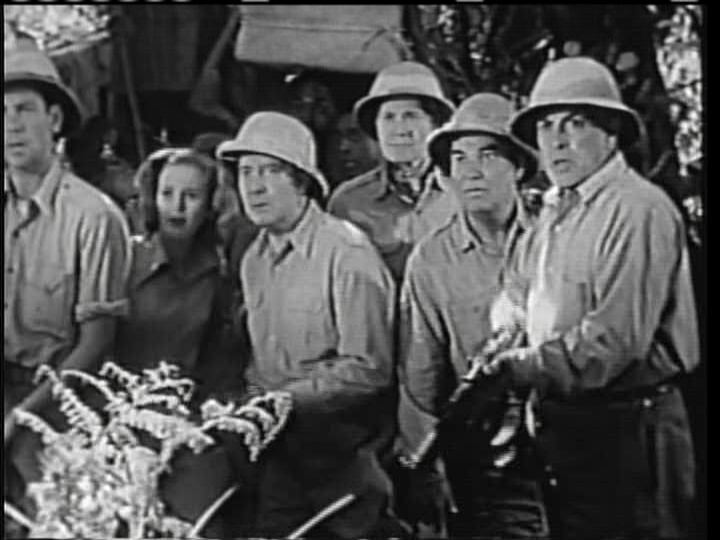
    Presently I say, "Perhaps you would like to see my stock footage? I have a fairly modest amount of it, at least by the typical standards of gorilla pictures."

    "Or how about my collection of photographs related to your genealogy and intelligence?"

    "Or perhaps you'd like to see my pit trap? I have prepared this pit trap especially for your visit, and filled it with your favorite plant matter."

    "Or perhaps you'd enjoy a racist caricature, or a subplot about smuggling? Or both?"

    But Pongo is more interested in the well-groomed lead actress.

    She is taken away, although I get her back after a complicated legal process.


    Giants of Rome (1964)
    [aka I giganti di Roma]

    Grade: C+

    Is this the first peplum we've seen that didn't even vaguely have Hercules as a character? Sure, there are one or two Very Strong Men in Giants of Rome, but it's fundamentally a film about a team -- the kind of movie where you don't even need to look at the IMDb summary to know that it begins with the phrase "An elite group of soldiers..."

    The Druids have developed a secret weapon, and Julius Caesar (Alessandro Sperli) charges Claudius Marcellus (Richard Harrison) with the task of putting together an elite squad (clunk-clunk) to sneak behind enemy lines and destroy it.

    Enter his brooding, Aidan Quinn-like comrade, Castor (Ettore Manni), and you've got the nucleus of the group.
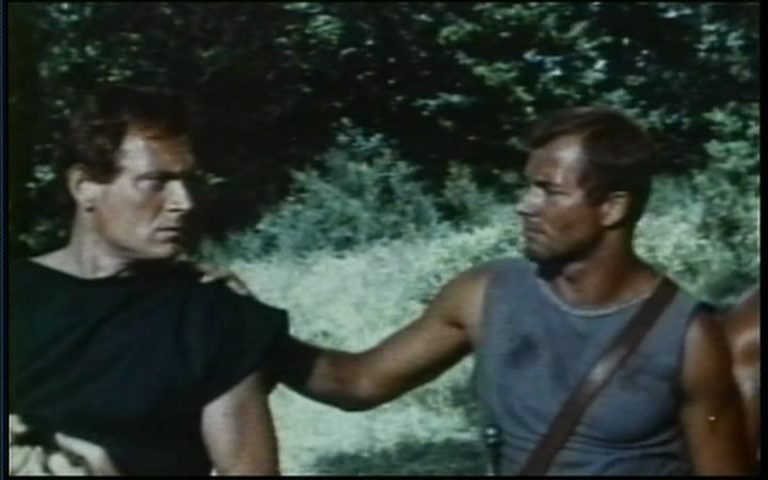
    Add the most distinctive of this multi-talented motley crew, master knife-thrower Verus (Goffredo Unger), who presumably eats his peas with honey.

    There's also the powerful Germanicus (Ralph Hudson), who's basically the warrior in the Gauntlet arcade game come to life. He's the closest thing the film has to a Hercules type, but with his axe and his topknot, Germanicus is more akin to something out of Conan the Barbarian.

    And just like in Hercules Unchained we have a lovable young scamp, Valerian (Alberto Dell'Acqua), who sneaks into the group. We're sure he and his very red shirt will play a small but pivotal role, right?

    Taken together, you've got a veritable Swiss army knife of skills. There's the brave guy, the smart guy, the guy who can throw knives, the guy who can bend bars...

    ...which is certainly helpful for when you'r rescuing prisoners taken by the Gauls...

    ...and the kid who can fit into small spaces. See, we brought him for a reason!

    This whole conceit is a pretty well-worn plot line, as anyone that remembers a handy guy who's an acrobat (and also a gypsy) can attest. But Giants of Rome is refreshingly brutal in its approach, sparing no one from the slings, arrows, axes, crucifixes, and horse-drawn deaths of outrageous fortune -- no matter whether that character was introduced five minutes ago, or has been there from the start.

    Giants of Rome also has the odd habit of saddling the raiding party with characters who don't want to be there and are hostile to their plans. It makes sense in the moment, but in retrospect, why would soldiers from an unsentimental culture like Rome take the risk?

    One of us developed a migraine shortly before we sat down to watch Giants of Rome. An attempt was made to soldier it out (har har), but to no avail: we had to bail out halfway through, watching the remainder the next day.

    And we're glad we did, if only because we got to see the female reproductive system turned into a flaming projectile of death. (No doubt a course of antibiotics will clear that right up.)

    Monday, January 2, 2017

    Breath, advocate, food cake

    If you're confused by this post's theme, then go to hell -- since that's where all three of these films can be found, at least in the genitive case.


    Devil's Partner (1958/1961)

    Grade: C-


    For a film that opens with an old man sacrificing a goat and selling his soul to Satan, there's something awfully coy about Devil's Partner. For example, why does he draw a hexagon, rather than the usual pentagram? Why is the term of the agreement two years?

    And why does the Devil apparently sign under the name "Jezzer Hora"? Is that his MC name or something?

    It's never really clear what either party is getting out of this arrangement. In his new guise as "Nick Richards", Jenson's actions seem haphazard and self-serving, and it's hard to see how managing a gas station in Furnace Flats, NM (pop. 1505) will serve an infernal agenda. He doesn't work to corrupt anyone's soul or cause widespread mayhem; he just wants to win a pretty girl's heart, keep people from sniffing around his origins, and make devilish references to his true nature.


    From all appearances, the scriptwriters simply couldn't decide whether the Richards character should be the Devil in Jenson's newly rejuvenated body, or just a mean old man who uses his second lease on life to try to screw his neighbor's daughter. He clearly has some demonic powers, but -- like a cat hoarder's interactions with the outside world -- they mostly seem to revolve around animal control.

    At one point he says outright "Well, I'm really the Devil," but none of his other actions corroborate that. And if Jenson/Richards is merely an aide to Asmodeus, this still seems like a pretty terrible business arrangement for the Evil One.

    Without a coherent plot, Devil's Partner is left to depend on the charisma of its lead -- which, in truth, is considerable: Ed Nelson has a brooding, smirking intensity that makes it easy to believe he'd both attract and unsettle the residents of Furnace Flats.

    But a movie needs more than charisma and a handful of effective set-pieces to succeed, and ultimately Devil's Partner is undone by its reluctance to commit to a clear vision of its own plot. One can only guess that the screenwriters were afraid of alienating Bible Belt audiences by explicitly using Satan as a protagonist, and so hedged their bets, substituting hexagons for pentagrams and "Jezzer Hora" for "Beelzy Bubba".

    If you're willing to sacrifice goats in your film, though, why settle for half-measures?


    The Devil's Daughter [aka Pocomania] (1939)

    Grade: C-

    If it's a "SACK" attraction, you know it must be good, right?

    But sadly, The Devil's Daughter really isn't a good film. Stiffly acted and scripted, and saddled with a hackneyed plot about love triangles, sibling rivalry, and obeah, it's a movie whose theatrical merits wouldn't pass muster at a regional summer stock production. To give it a free pass for these things, simply because it has an all-black cast, would strike us as condescending at best.

    That said, The Devil's Daughter has multiple saving graces -- namely that it's short (clocking in at well under an hour), entertaining, and full of engaging imagery and sounds.

    (These things are hardly a given: soon enough in the Umbrellahead Review, we'll see an example of an early African-American film with none of those redeeming qualities.)

    It's by no means an unpleasant film to watch, and the corny performances are, if anything, a source of amusement.

    The one actor who comes off well here is Hamtree Harrington, an experienced vaudevillian who serves as the film's comic relief. He's broad, but relatively polished, and it's interesting to see how a character of this type is portrayed in a film intended for black audiences.


    It also doesn't hurt that his love interest, Elvira (Willa Mae Lane), is kinda foxy -- certainly more so than the two female leads, anyway. (The male leads aren't any great shakes either.)

    Ms. Lane also acquits herself well in the acting department, but doesn't appear to have had any other roles; too bad.


    The Devil's Daughter is no masterpiece, but it's no Chloe, Love is Calling You either. With appropriately modest expectations, it's worth experiencing both as a time capsule and as 50 minutes of light entertainment. Believe us, it could be much worse -- and it'll help you remember "obeah" during those tight Boggle matches.


    The Devil's Messenger (1961)

    Grade: D


    At this stage of his career, it's hard not to feel faintly embarrassed for Lon Chaney, Jr., no matter what role he's in. Still, playing the Lord of the Underworld would seem a perfect fit for the veteran actor -- but turns out to be an unexpected bit of miscasting.

    With Rolodex in hand and smiles aplenty, LCJ's Satan is neither saturnine nor diabolical. Instead, he comes off more like a kindly uncle, or at worst, like the washed-up alcoholic who holds court daily at your local bar, telling tall tales of his past, ever-genial but clearly beyond redemption.

    ...and hey, that's pretty much what he was. Zing!


    Anyway, Chaney's role in The Devil's Messenger is simply to provide a framing story for three episodes of a Swedish TV series, 13 Demon Street, a horror anthology that seems to have basically been Der Tvilight Zøn in all but name. It's a recycle job, in other words, like Alien Zone and other "movies" we've seen through the years.

    And the frame is pretty horrific in its stupidity, revolving around a young suicide named "Satanya" (no, we're not kidding) who delivers cursed objects to unsuspecting Earthlings, somehow justifying the set's title. Even by our steadily lowering standards, it's stupid and half-assed. 

    Fortunately 13 Demon Street seems to have been a serviceable if uninspired affair, and the three featured stories are no worse than a third-rate episode of Rod Serling's brainchild.

    The first, involving a brutish photographer with a guilty conscience, is probably the least rewarding of the bunch, since the plot is utterly predictable and the protagonist impossible to care about.

    The second segment, telling the tale of a scientist who falls in love with a woman preserved in glacial ice, is actually dumber. But at least we were distracted by trying to figure out who the lead actor reminded us of, beyond a vague hint of Abe Vigoda. (Maybe it was just the Pakistani guy that P. went to college with?)

    It was no strain to "place" the protagonist of the next story, though, given his striking resemblance to René Auberjonois (of Benson and Deep Space Nine fame) -- maybe with a dash of Bashar al-Assad thrown in there too.

    This third and final tale was by far the best, depicting the inexorable meeting of a man haunted by a recurring dream and a fortuneteller who serenely conveys the will of fate. Predictable, but capably acted and directed, its plot and story arc wouldn't have been at all out of place on TZ, though the last five minutes dragged a bit.

    Unfortunately, this segment is also the only one that gets shoehorned back into the framing story, squandering whatever goodwill it had earned. It turns out that our protagonist is also Satanya's ex-boyfriend, and so when he dies...yeah, it's stupid.

    Never fear, though, as the Lord of the Files [sic!] comes through with a last-minute turn to the bizarre: Satanya's next mission is to deliver a formula that will allow humanity to build a 500-megaton nuclear weapon! I see we're ramping things up a bit, Mr. Lucifer -- that's 10 times larger than the biggest detonation in history. 

    Gratuitously super-sized nukes aside, The Devil's Messenger has no real attraction beyond the unexpected competency of its third act. The audio quality of Mill Creek's print is quite horrific, by the way, with the kind of distortion that sounds more like a bad connection than an overmodulated signal.

    Oh, and at one point, this happened:

    Admittedly, it was only for a split second, but still: way to go, Mill Creek Quality Control! (That's a phrase right up there with "The Lance Armstrong Sportsmanship Award" and "The Buddy Rich School of Diplomacy".)

    If you're trapped in ice for thousands of years with nothing else to do, you can watch The Devil's Messenger, I suppose. Just don't blame us if, thanks to propinquity, you end up getting a crush on the glacier girl. And hey, you could do worse: we hear she's a real doll.


    Sunday, October 30, 2016

    Liquid solutions

    Homer Simpson famously toasted alcohol as "the cause of, and solution to, all of life's problems". And as we ugly bags of mostly water know, you can't have a solution without liquid.

    So while you're bobbing for apples this Halloween weekend, consider these two films in which nearly incompressible fluids play a problem-solving role:


    Terror Creatures from the Grave (1965)

    Grade: D+

    Oh, God, not her again.

    Look, we know Barbara Steele is revered among horror movie buffs, who seem thoroughly captivated by her unusual, vaguely mantis-like features. But it seems like every time she shows up in a film, it inevitably turns out to be a tediously murky effort that takes itself too seriously and doesn't make much sense.


    Sadly, Terror Creatures from the Grave is no real exception. True, it manages to conjure a modestly creepy atmosphere, redolent with imagery of plagues, conspiracies, and spiritualism.

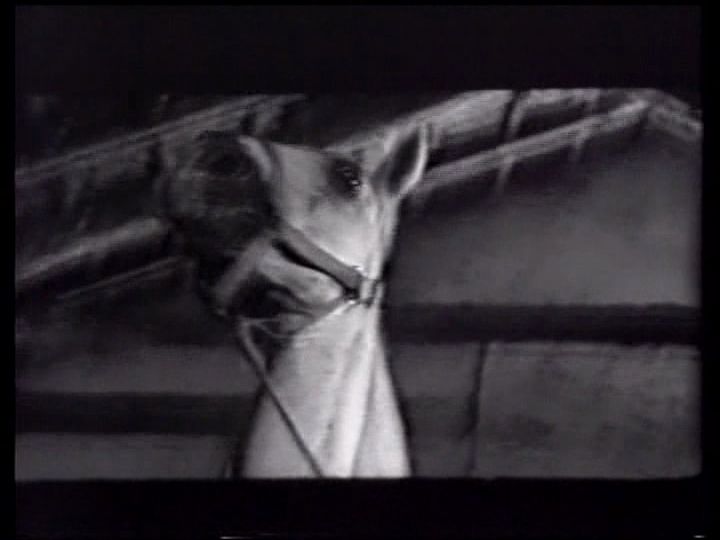
    Plus the movie starts out with death by horse, always a nice touch.

    But Terror Creatures suffers from the same syndrome that torpedoes -- dare we say, "plagues" -- so many similar films. Its symptoms include largely interchangeable supporting characters:

    Long stretches of talky exposition:

    And a protagonist who engages in lengthy voiceover soul-searching, but only figures out the meaning of the movie's biggest clue about 20 minutes after the viewer does.

    In this case, that clue is an (ahem) "ancient lullaby" -- set to modal music that cribs heavily from the "two pretty children" bit in Night of the Hunter -- with the following lyrics:

    Death is approaching
    Approaching for you
    Remember pure water
    Pure water will save you
    The water will save you
    This warning's for you
    Remember, remember, this warning's for you

    Yes, the movie comes with its own walkthrough. It ain't subtle, folks.

    Now, if you're looking for some barenaked ladybugs then, sure, Terror Creatures will hook you up, at least from the upper thigh down.

    And the underutilized maid Louise -- Tilde Till, in her only film credit -- is sort of cute, certainly cuter than the leads (aren't they always?).

    But all the practical effects or insectivorous flesh on display can't hide the fact that, for any but the most dedicated Steele fans, Terror Creatures from the Grave is a slog from which pure water can't save you: that particular salvation can only be given by the end credits.

    Frankly, we're getting to the point where the only positive association we have with the word "Steele" is when it's prefaced by "Hands of".


    The Devil Bat (1940)

    Grade: B+

    Here at the plush offices of The Umbrellahead Review, we sometimes worry. After all, this project of ours inherently means that we have to cover a whole lot of turkeys -- films that have no redeeming value, give us no pleasure, or simply blend into a sea of undifferentiated mediocrity (at best).

    Inevitably, notes of snark, cynicism, or world-weariness creep into our writing. Might we be giving the impression that we've lost our love for second-tier cinema?


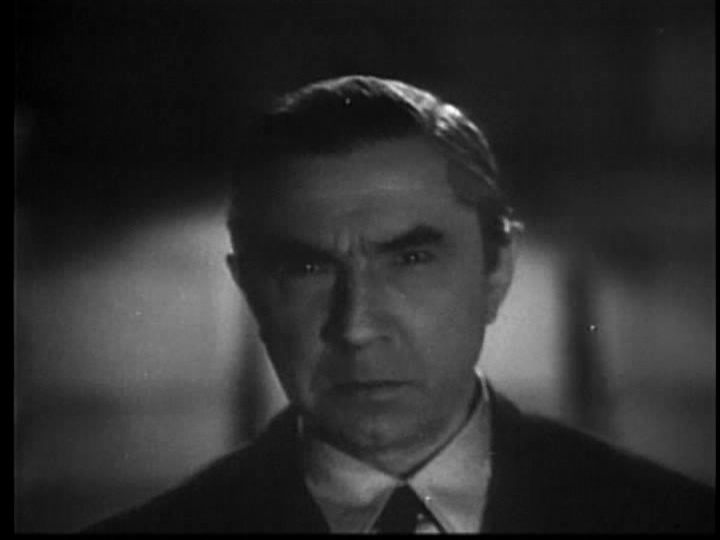
    Well, if there's anyone who can cure those blues, it's Béla Lugosi. Even in the worst stinkers, his inimitable charm, unmistakable presence, and committed intensity always manage to make the experience worthwhile.

    And the great news about The Devil Bat is that it represents Poverty Row at its best: filmmaking on a threadbare budget that nevertheless manages to entertain without insulting the intelligence of its viewers.

    Tightly constructed, well paced, and full of amusing one-liners, The Devil Bat avoids all the usual pitfalls of low-budget filmmaking: the principals aren't idiots, the action actually follows a logical progression, and the criminal mastermind is motivated by a grievance that, whether or not it's justifiable, is certainly understandable.

    (Not to mention that the other characters are kind of dicks about it. Well-meaning dicks, but still dicks.)

    All the film asks in return is that you accept a single premise: that a vengeful (but brilliant) scientist can grow giant bats and train them to kill. With that in place, there are no additional leaps of faith or plausibility required -- everything else flows quite logically from that starting point.

    If there's a major flaw in The Devil Bat, it's more in the vein of a missed opportunity. Before we know much of anything about Lugosi's Dr. Carruthers, he's already telling his bats that they "will strike to kill". In fact the opening text crawl specifically paints him in a sinister light:

    But wouldn't it have been better -- and more tragic -- if instead of being Neutral Evil from the get-go, Dr. Carruthers started out Lawful Neutral, and his decision to seek revenge were a response to his treatment in the movie, rather than a fait accompli?

    The method of dispatch in The Devil Bat is certainly novel. While in Terror Creatures from the Grave good ol' aitch-two-oh was your salvation, here it's aftershave, tinged with "an Oriental fragrance" from Tibet, that spells your doom.

    Once the murders begin, a spunky male reporter -- Dave O'Brien, who famously starred in Reefer Madness -- picks up the scent of a good story and decamps for Heathville.


    Accompanying him is photographer "One-Shot" McGuire (Donald Kerr), whose role as comic relief is mercifully limited to a few minor scenes, none of which overstay their welcome.

    Naturally there's a beautiful young heiress (Suzanne Kaaren) on the scene, whose main suitor is quickly eliminated, leaving our correspondent to horn in on the charms of Ms. Mary Heath.

     
    There's even someone for "One-Shot" -- a pretty French maid (Yolande Mallott) whom he easily persuades to show her knees for the camera. Why she takes a shine to him, one can only wonder.

    Practical effects are seldom a strong point in a Poverty Row production. An uncharitable observer would probably describe the title character in The Devil Bat as a pretty laughable piece of work, and it'd be hard to argue the point.

    Yet somehow it doesn't matter, perhaps because the bats are really a tool, rather than an end in and of themselves. They're not meant to be particularly horrible or terrifying; they're basically just the bat equivalent of a trained falcon.

    And The Devil Bat even "hangs a lampshade on it" by having a subplot in which our hero and his sidekick, unable to snap a decent picture of the bat, decide to fake one instead...and end up getting caught, briefly making them a laughingstock (and royally pissing off Mary to boot).

    Scriptwriter John Thomas Neville knew exactly how to write for Lugosi, giving him grimly funny dialogue that maps perfectly onto Béla's wry sense of humor. The most obvious example is Dr. Carruthers's habit of bidding a somber farewell to all of his intended victims:

    Roy: "Good night, Doctor."
    Dr. Carruthers: (pointedly) "Goodbye, Roy."

    We also enjoyed this exchange when he asks his second victim to sample his (indirectly) lethal aftershave:

    Tommy: "Oh, that feels great! Very soothing!"
    Dr. Carruthers: "I don't think you'll ever use anything else."

    Is The Devil Bat a masterpiece? Not at all, but that's hardly the point. As a showcase for what might be called "mid-period" Lugosi, it could hardly be bettered, giving him center stage without compromising his dignity (hi, The Ape Man) or wasting his talents (hello, Mark of the Vampire).

    And the supporting cast pulls their weight without trying to steal the show: they know who's boss, and rightly so.

    So if you too need a reminder of why you started watching these films in the first place, look no further than The Devil Bat. Karloff may crumble, Cheney may tumble, but our Béla's here to stay.

    Just, uh, don't borrow his toiletries.