Showing posts with label Swedes. Show all posts

Tuesday, July 11, 2017

Skulls sans screams

Yep, both of these films feature a prominent object of the craniomandibular sort -- with and without their accompanying chassis, and fortunately devoid of wearying screams (or Steele).

Fact is, we don't come to learn much of anything about the skulls in question, beyond their simple presence. So alas, Hamlet these movies ain't -- though one of them does feature a Hamlet-esque "play within a play".


Manfish (1956)

Grade: C-

We'll be seeing a fair bit of Creighton Tull Chaney over the next few posts, and -- at least in terms of his bare, middle-aged flesh -- we see the most in Manfish, a film that well may take the cake for the single most deceptive title we've encountered yet.

Now, you're probably imagining some breathless tale of a half-human, half-piscine hybrid. You can see it now, it's either scales from the waist down (too bad it ain't Womanfish, nudge-nudge, know what I mean?) or some fish-mouthed abomination croaking "Please, kill me". Right?

But no, "Manfish" is the name of the boat. YA SRSLY.


Given his age and well-known bad habits, Chaney actually looks pretty good here, in the physique sense -- though in portraying the dull-witted first mate known as Swede, he's still trading on his Lennie persona from Of Mice and Men, nearly two decades later. Oh well, it's a paycheck, and Lon Jr. knows how to play it as well as anyone.

Manfish splices together two of Edgar Allan Poe's stories, "The Gold-Bug" and "The Tell-Tale Heart", and transplants them to the Caribbean to spin its yarn about a treasure hunt, a guilty conscience, and a jacked but thoroughly unlikeable sea captain (John Bromfield) who drives the whole shebang. (It wraps all this in the world's most gratuitous framing story, by the way, but that's soon forgotten.)


Captain Brannigan hunts turtles, which already makes him a bad egg in our book, and really this lying ol' dirty birdy seems to spread misery wherever he goes. He's eking out a living in the Caribbean until he has a confrontation with an aging professor (Victor Jory) and his bored-looking, wonky-eyed consort Alita (Tessa Prendergast) --

-- whereupon he soon develops an acute interest in the professor's sweet ring and his sweet thing.

With this information and the Poe as your guide, if you hazard a guess at the remainder of Manfish's plot you'll probably get it right. Sure, there's tension, betrayal, greed, and angry confrontations galore, but those are essentially condiments, structurally speaking. It's maps, treasure, and post-trangressive psychosis that built this city.

Even so, for the most part Manfish is entertaining enough to watch at least once, and lacks the unpleasant aftertaste of IDGAF cynicism that mars many similar films. The writing and acting are at least serviceable throughout, and the film's underwater sequences are attractively shot...

...though in general it has a habit of letting its wordless outdoor set-pieces -- both above and below the water line -- go on for far too long. Far, far too long. As in, "What the hell is the point of this shit?" too long.

That, and the film's predictability (thanks to its, ahem, Poe-rigins), are the biggest places where Manfish falls down somewhat.

But these aren't lethal flaws in what is otherwise an unexceptional but competent outing. In fact, besides the overlong bits we mentioned above, Manfish is that rare film on this box set that (mostly) didn't make us wish we were watching it for the second time, so that we could reach for the fast-forward button and get it over with faster. Some days, that practically counts as a success in our books.

Add the occasional flashes of warmth or humor that help to liven up proceedings, and though Manfish may be a C-minus film, it's a solid C-minus. You know, the kind that feels like you've accomplished something, even though you'll have to retake the class. Isn't that right, Professor?


Murder at Midnight (1931)

Grade: D

Here's something telling about this film, and it's not a spoiler so don't worry. The title event? Yeah, turns out the clock is set wrong. Take that, Chekhov.

But as you can see there is a gun in Murder at Midnight, which gets used right away as part of an elaborate skit that itself is merely a clue in some rich-people variant of Charades. If that sounds complicated it really isn't, but what's weird is that everyone seems to think it's normal to put on a one-act play, with props and all, just to clue the word "idealize". Once again one is reminded that the rich are, as F. Scott Fitzgerald said, "different from you and me." (But he didn't say it to Hemingway!)

Of our Umbrellahead pair, at least one of us is fond of early talkies and inclined to be charitable toward them. Still, this tale of intrigue and inheritance was too familiar, yet too muddled, for us to enjoy much. The film's chain of murders is probably one link too long to be believable -- and while it may be amusing to watch a highly visible housefly crawling around on an actor's shoulder, it doesn't exactly inspire confidence that this production is a fully-assed affair deserving the benefit of the doubt.

Also, we have to say the trope of the "famous criminologist" is already wearing out its welcome -- understandably so, since he's always going to be the culprit, a red herring, or a Mary Sue. At least Sherlock Holmes was an awkward, grumpy cokehead. And that's not the only familiar trope in Murder at Midnight, not by a long shot (or a long-distance call).

Throw in abundant false leads and a pile of unexplained motivations, and Murder at Midnight starts to feel less like an adventure than an indenture. At least Millie the maid -- played by the troubled, scandal-plagued Alice White -- is kinda cute if you're into that sort of thing, and the butler (Brandon Hurst) is thoroughly buttlesome.

It's fascinating to see what films like these think will pass for "comic relief". In the case of Murder at Midnight, it's a portly plainclothesman assigned to the house (Vernon Dent), who eats a lot of peanuts and drops the shells on the rug.

And...that's pretty much it.

It does inspire a prominent vacuuming scene, though, so if that's your kink go nuts (pun completely unintended!).

It feels mean-spirited to pick on Murder at Midnight, and it's certainly not excruciating to sit through, unlike some others we've seen. Still, even in 1931 the industry knew how to do better than this, and in a murder-mystery there's never an excuse for a script that's foggy in the details. A few funny lines or attractively filmed sequences aren't enough to make Murder at Midnight a truly worthwhile watch.

Friday, July 7, 2017

The (inadvertent) gold diggers of 1932

In 1933, Busby Berkeley and Mervyn LeRoy struck gold at the intersection of economic hardship and showgirl opportunism, beginning with that triumphant -- and ironic -- clarion call: "We're in the money!" When times are tough, marry rich, and figure the rest out later. (If that sounds awfully cynical, it probably is -- but hey, it worked out perfectly for one of our grandmothers.)

But though these two films also use Gold Diggers of 1933's secret-millionaire trope, they don't crow about cash at all, whether at the start or the end. Maybe an extra year of Depression-era desperation made the difference, but in this case, the women lucky enough to end up with Mr. Moneybags just seem glad to have found themselves a nice fella. 


Strangers of the Evening (1932)

Grade: C-


This confusing tale of morgues, mayhem, and mistaken identity took us quite a while to unpack, though by the end we'd finally sussed it all out (more or less).

From the opening sequence -- in which the body of a man who allegedly fell asleep at the wheel is deposited at a morgue -- it's clear something sketchy is afoot...


...and if our intuition didn't tell us that, we certainly know it explicitly once Dr. Chandler the undertaker (Warner Richmond) finishes a phone call with his unsuspecting assistant Tommy (Harold Waldridge), turns to his friends, and triumphantly says "They fell for it."

But even though we understood the basic trajectory of the plot, something in the telling of Strangers of the Evening left us very confused as to its mechanics. OK, it's a story of mistaken identity, but how exactly did the swap happen? Were we supposed to infer that certain key items changed hands, or was it depicted in some non-obvious, veiled way?

Similarly, though it may appear Dr. Raymond Everette (Theodore von Eltz) has murdered the father of his fiancée (Miriam Seegar), there's little doubt that all is not as it seems. You're meant to feel clever at moments like those, but instead we had the nagging feeling that we'd missed something -- something that would bring coherence to events themselves, rather than an explication of the underlying scheme (which would obviously be premature at the sub-10-minute mark).


These issues -- and others, like a medical-experimentation subplot that goes nowhere -- are probably down to subpar direction and scriptwriting, in whatever proportions. A second viewing makes things clearer, of course, but that's hardly the standard...or is it? Perhaps some of these films were meant to be seen more than once, by truant schoolchildren and unemployed workers desperate for distraction.

The main selling point for many prospective viewers of Strangers of the Evening was probably the presence of Zasu Pitts -- pronounced "say-zoo", if you didn't know (and we didn't). She's Sybil, the flaky girlfriend of a befuddled amnesiac (Lucien Littlefield) who wanders through the movie in search of his real identity. Pitts does about what you'd expect, and does it as mournfully as ever.


In several details Strangers of the Evening bears an unexpected resemblance to The Midnight Warning, right down to the "dead body rising from a table" and "let us never speak of this again" tropes that shape a significant chunk of its narrative. Maybe it's instructive to compare the two films, since while Strangers of the Evening throws a lot of seemingly unrelated information at the viewer and gradually reveals the underlying structure, we had an easier time following The Midnight Warning's more parsimonious approach, starting with a firm foundation and then introducing new facts one at a time until the picture was complete.

All this probably gives the impression that we didn't like Strangers of the Evening -- which is literally true, but we didn't dislike it either. It's not stupid or irritating, just poorly made in certain respects. (Plus a few flubbed lines here and there, but that's hardly unusual in films from this period.) And we were able to differentiate between at least some of the white guys in hats, which is a nice change of pace.

One can hardly recommend this film, but it's reasonably watchable and not unpleasant -- putting it miles ahead of, say, The Phantom or The Midnight Phantom.

And hey, that's a nice segue into:


The Phantom Express (1932)

Grade: B


There are too damn many films with words like "phantom" and "midnight" in their names, leaving our heads filled with a muskless miasma of monikers: how to differentiate between The Midnight PhantomThe Midnight Shadow, and The Phantom Shadow?

(OK, that last one is actually a Scooby-Doo villain, but you get the point.)


So -- with one foot already in that river of titles untethered to their filmic content -- it's easy to assume The Phantom Express is yet another interchangeable Poverty Row effort, a poorly-acted Sack special, or any number of other been-there done-thats.


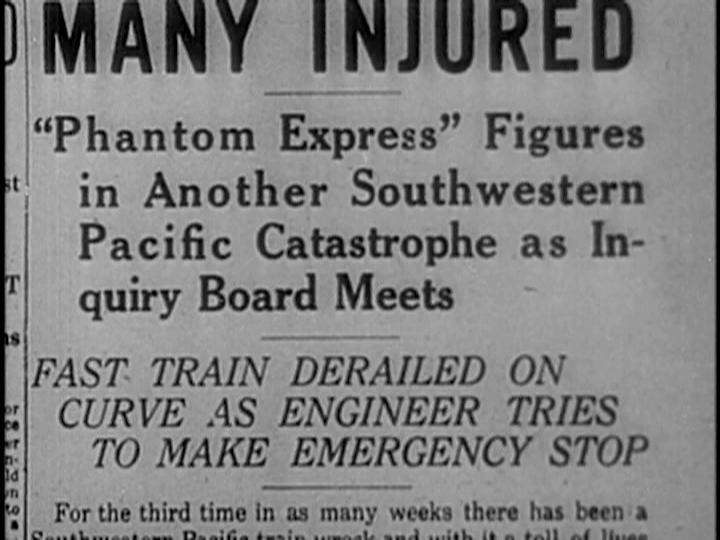
That'd be a shame, though, as we were rather charmed by this modest but engaging little movie. True, the plot itself mostly colors inside the lines, and could be summed up like so: a small railroad, plagued with derailments caused by the phenomenon in the film's title, will soon be sold for pennies on the dollar unless the owner's son can solve the mystery.

In all honesty, that mystery isn't terribly hard to unravel, and we guessed its basic outlines well before the final denouement. That said, The Phantom Express doesn't really depend on a whodunit (or a who-conducted-it) to sustain our interest.

Rather, a combination of elements made The Phantom Express a pleasant surprise. One is the skillful cinematography, yielding set-pieces that, for a film of this vintage and budget, are impressively striking.

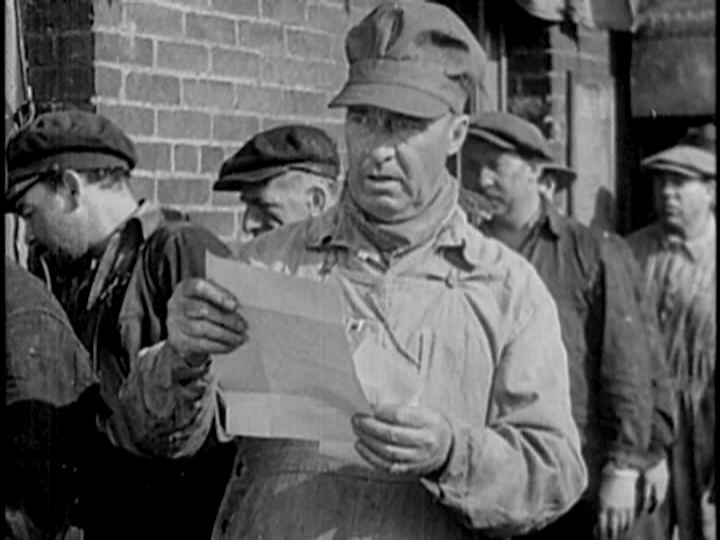
The biggest factor, though, is the film's unexpected decision not to focus myopically on the hero's quest to save his inheritance. Sure, it's predictably fun to see the boyish Bruce Harrington (William Collier Jr.) go undercover, disguising himself as a grease-blackened railroad worker to find out what's really happening -- and, when the opportunity arises, play a prank on the only person around who knows his true identity.

But instead, The Phantom Express devotes a surprising amount of time to the plight of Smokey (J. Farrell MacDonald), the veteran engineer who's dedicated his life to Southwestern Pacific, only to come under fire when a major derailment happens on his watch. Then as now, loyalty and seniority are no guarantee.

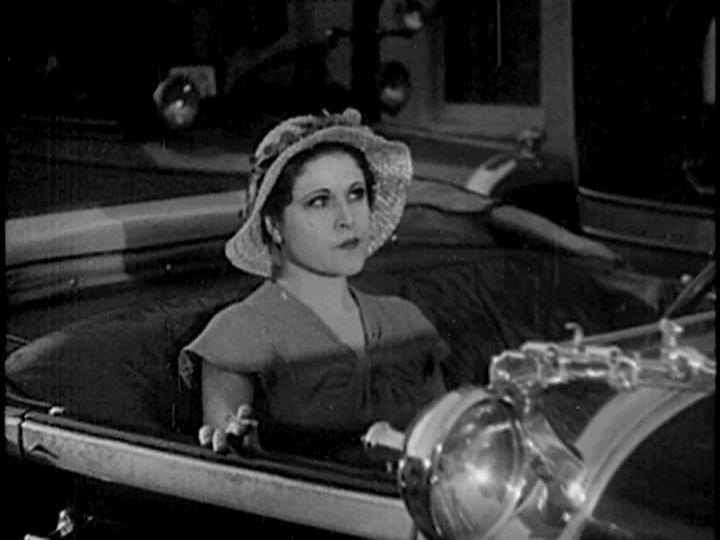
Of course, Smokey's daughter Carolyn (Sally Blane) also turns out to be young Mr. Harrington's love interest (having ditched the heavy-duty RBF you saw a few screenshots ago). Even better for him that he's boarding in their house, for propinquity without iniquity.

Still, The Phantom Express puts Smokey -- and his grief -- front and center for a good portion of its running time. Seldom have we seen a film devote this much care to showing how completely a middle-aged man can be crushed by the loss of his job.

The pathos and intensity here is genuine, and unflinching enough in its depiction that we dreaded -- but half-expected -- the looming prospect of a slow pan and out-of-frame gunshot.

However, a friend in need is a friendly Swede, and none more so than Smokey's irrepressible pal Axel. Played by an actor billed as Axel Axelson (!), with no other credits on IMDb, we have no idea whether we're dealing with a genuine one-shot, or an actor working under a blatant pseudonym for contractual reasons. Either way, Axel's the kind of guy who, if you need him, will show up to help save the day faster than you can say tutenbobels. (Or jazz hands.)


All this means that the closing act of The Phantom Express isn't just a standard boy-solves-crime-and-gets-girl affair, but is as much -- or more so -- about whether Smokey's hopes for redemption will be fulfilled.

Of course, we get the obligatory Scooby Doo action, since these meddling kids still have to solve the crime, unmask the culprit(s), and race against time -- in whatever order. (Bet you thought that "Phantom Shadow" reference was just a one-off!)

But one suspects that, with its frank depiction of a grown man's pain, a film like The Phantom Express may have meant a lot to thousands of aging male moviegoers. With no other socially acceptable way to work through the crushing experience of losing their livelihoods after age 40, at least they could see someone else's grief mirroring their own, while trying to find a way forward in a dark, friendless time.

And sadly, that's still as relevant now as it's ever been.

Thursday, June 8, 2017

No-knock warrants

Continuing with the Night Screams subset of the 250-pack, we bring you two tales of crime, imprisonment, madness, and barging into other people's lodgings without their permission.


The Phantom (1931)

Grade: F

The first couple minutes or so of The Phantom offer us an imminent execution, followed by a daring jail break and a bold leap onto the top of a moving train. It's the kind of set-piece done so well by the Keatons, Lloyds, et al. of the silent era -- which was drawing to a close just as The Phantom was being filmed. All in all, despite frequent camera white-outs from overexposure, the opening does a reasonably good job of snagging the viewer's interest.

Then it all goes to hell, as The Phantom immediately devolves into what may be the most excruciatingly draggy, drawn-out, ponderous movie of its kind that we've yet seen. (And we've seen plenty.)

And if you're already thinking "Hey, it was 1931, cut 'em some slack!", we'll answer with a single letter: M. That's also from 1931, and it's terrific, so there.

In fact we can go back further for our unflattering comparisons, as there's almost nothing in The Phantom that wasn't already done far better in 1926's The Bat -- and most of what's left over was done better in 1934's The Ghost Walks.

Triangulate between the plots of those two films, and you've got a pretty good idea of what to expect from The Phantom: craven maids, escaped mental patients, ominous threats from nicknamed criminals, sympathetic characters operating under false pretenses, and so forth.


But all of that doesn't convey the film's crushing slowness, exhibited by nearly every parameter of its existence. Lines of dialogue are prefaced and followed by lengthy, needless silences. Minor plot developments that could be handled in three seconds instead take 30. Characters react slowly and with a delay, as if they've outsourced their nervous system to the Moon and are working through the signal lag.

Moreover, The Phantom is just plain stupid, to the point of incoherence. Not only could you drive a truck through the holes in the plot, but even the moment-to-moment behavior of the characters doesn't make sense: no matter how young and ambitious you might be, you're probably not going to hold your future father-in-law at gunpoint to advance your career, and probably can't expect to be forgiven if you do.

As others have noted our male lead, Guinn 'Big Boy' Williams, bears a remarkable resemblance to George W. Bush -- though P. was initially reminded more of Patrick Swayze, plus a bit of Andy Roddick, and a dash of a former college friend who's since turned into the worst sort of white libertarian douche.

Meanwhile our female lead, Allene Ray, has a squeaky voice that allegedly kept her from success in talkies Ă  la Singin' in the Rain. While it's not so bad as all that, it was probably no accident but -- rather -- a tactical decision to have the film's other female character, Lucy the maid (the piquantly-named Violet Knights), talk like a helium addict.


About the only hint of a bright spot is William Jackie as Oscar, a Swede-talking, rubber-limbed freakshow who lives at a nearby asylum. In his first appearance he emerges from the floor, unknotting himself like a revived marionette, or a bizarre forerunner of that creepy shadow man from Drakkhen.

Though we weren't too yazzed about his "Yack and Yill" faux-Scandinavianisms, Oscar's rangy weirdness certainly livens things up a bit: hardly cause for celebration -- let alone a festive evening celebration -- but at least there's an umbrella in the mix.

Anyway, The Phantom was miserable, it sucked, it was terrible. But besides that it was fine.

Uh, except it wasn't fine at all, scratch that: it really is awful. You've been...

...warned!

And speaking of warnings:


The Midnight Warning (1932)

Grade: C


Now this is a weird one. For starters we have William "Stage" Boyd, infamous for nearly (though inadvertently) destroying the career of the other William Boyd aka Hopalong Cassidy, thanks to a well-publicized descent into alcoholism -- and a newspaper that accompanied the story of his arrest with Hoppy's picture.

Anyway, by 1935 Boyd was reduced to shouting "Come in, Appollyn!" into a microphone at the behest of the sad, silly serial The Lost City, which we reviewed way back when (in its oh-so-long, Mill Creek-exclusive feature edit).

And then he died.


But The Midnight Warning dates from before all that, and Boyd's performance as Detective Cornish shows that he undoubtedly had presence, at least of the "overbearing gym teacher" sort. And Cornish certainly is overbearing, taking command of the entire situation from the moment his pal Dr. Steven Walcott (Hooper Atchley) mysteriously collapses in a hotel room.

If the hotel staff had their way, Dr. Walcott's collapse would've simply been chalked up to heat and exhaustion. But thanks to Cornish's super-powered binocular glasses and virtuosic lip-reading skills, a slender thread of anomaly begins to unravel a tapestry of conspiracy.

We can't tell you much more about The Midnight Warning's plot (which takes some rather unexpected turns) without spoiling the film. And that'd be a shame, since there's something engaging about its sub-Conan-Doyle stylings -- a comparison not made idly, as it does feel almost as though we're expected to already be familar with the brash Cornish and the more milquetoast Walcott, in a Sherlock-and-Watson sort of way.

Still, though The Midnight Warning moves rather briskly in its fashion and is refreshingly hard to anticipate, there's something subtly "off" about its direction and tone. It's one of those films where, as we watched (!), it took a long time to figure out whether it was good or bad, if that makes sense. Its narrative progression has an odd creakiness and -- for want of a better word -- impulsiveness to it, leaving us unsure whether we're being pulled along confidently or jerked around by half-assery.

Like so many of its contemporaries, it also has a mild case of IWGIHs syndrome, with much of the supporting cast presented in such a way as to offer no meaningful distinction between its members. Seizing on the odd mustache or last name helps a bit -- but still. (And we all know what's made there.)


The truth is probably that The Midnight Warning is a competent genre entry that's very much of its time, with some inspired moments and some pedestrian ones. Perhaps it's got a few unexpected and mildly intriguing quirks, but nothing much more than that. (It's also got some serious jitter in the film-to-video transfer, though mercifully that doesn't go on for too long.)

If it seems weirder than that to us, chances are it's half a product of our own inexperience, and half a consequence of early 1930s filmmaking working out its narrative kinks.

Oh, and by the way, the plot summary at IMDb for this film -- "Guests at a luxury hotel are horrified when they witness a man literally 'disappear into thin air'" -- is total horse pucky. The sleeve to the Mill Creek disc is also in error, but still close enough to the mark as to spoil several key plot points, so don't read it!