Showing posts with label maciste. Show all posts

Sunday, January 7, 2018

Arms and the man

Well, it was nice to have a perfect total of 100 posts for a couple months. But it's high time we came to grips with 50 Sci-Fi Classics -- a set into which we've dipped our toe before, admittedly, with movies like Eegah!, Santa Claus Conquers the Martians, and our beloved Snowbeast. And hey, we like science fiction, right?

Here, though, we're faced with the grim reality that, in the 250-pack version of 50 Sci-Fi Classics, at least 12 of its 49* movies are peplum: swords and sandals, musclemen and imperious queens, the whole works. Watching such a film every so often is one thing, but working our way through a dozen of them is likely to be a chore, especially with Mill Creek's hraka-quality transfers.

*(Yes, 49 movies: after removing 6 films like The Alpha Incident and The Wasp Woman that would otherwise be duplicated elsewhere on the 250-pack -- which is, in itself, laudable -- Mill Creek replaced them instead with four peplum epics, plus Lucifer Complex.)

Still, if we've gotten through endless identical 1930s movies with wisecracking female reporters and unconventional poison delivery systems -- each of them merely an interchangeable (and hat-wearing) part of an infinite whole, an isolated slice of an spunky Mandelbrot set -- then we can handle this.

So, it's time to put some pep(lum) in our step(lum) and begin our Herculean ordeal with these two films, both of which prominently feature a tug-of-war contest with a strong man in the middle.


Atlas in the Land of the Cyclops (1961)
(aka Maciste nella terra dei ciclopi)

Grade: C-

As you can see, fans of hue, tint and shade aren't likely to get their chroma fix from Mill Creek's edition of this Gordon Mitchell vehicle. Almost every color has somehow been eradicated from this print, leaving a palette dominated by the dull reddish-brown you see here. The only major exceptions are the opening titles, which have something vaguely resembling blue --

-- and this, which must have been the greenest dress ever (made of leprechaun sweat and emerald juice, presumably) to cut through the sepia murk:

Fortunately, despite the visual shortcomings of this copy, Atlas in the Land of Cyclops is entertaining and brisk enough to be tolerable, even at 98 minutes. The plot is somewhere between other peplum films we've seen -- say, Fire Monsters Against the Son of Hercules -- and a "Save my baby!" film like The Lion Man, though Maciste/Atlas's relationship with lions...

...is rather more complex.
No, no, it's not that kind of film: the love interest isn't leonine, but instead the more vulpine Queen Capys (Chelo Alonso), a descendant of Circe. Yes, that Circe, the one famously outfoxed by Ulysses -- well, Odysseus, but this is an Italian film.
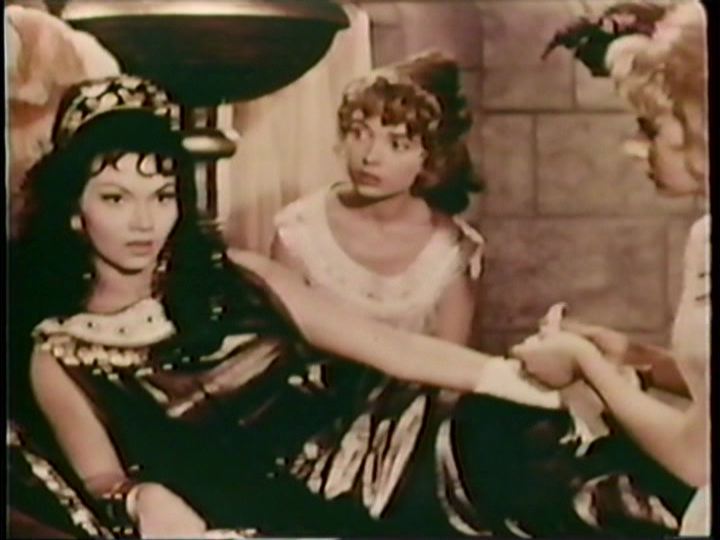

And if you remember who else famously got tricked by Ulysses -- or, hell, if you know the title of this movie -- then you can probably guess who else is sure to show up before the end.

So let's see -- there's a curse, and a plan to sacrifice the first-born son ("and little Fabio"!) of King Agisandro (Germano Longo). No points for guessing who he descends from: come on, turkey!

Naturally Maciste intervenes, and in the process, somehow gets caught up in the most gratuitously racialized tug-of-war we've ever seen. Here's the team on stage left:
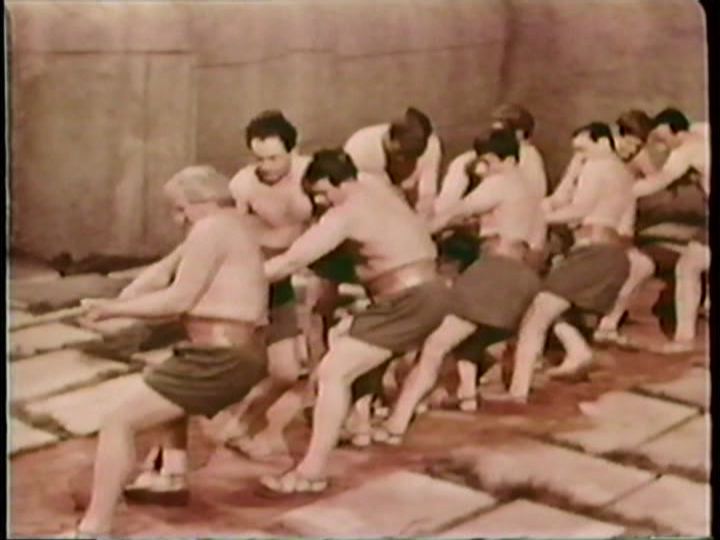
And now, the team on stage right:

Yeah, that's, uh...a thing. And just like in real life, nobody wins this sort of contest -- except the guy with the power who's really pulling the strings.

With the Strom Thurmond Memorial Tug-of-War done and dusted, Maciste captures the eye of the queen, to whom his muscular physique and decidedly non-sycophantic behavior are a major turn-on. But don't take our word for it, ask Capys:

"Ever since you came into my life, you have made me forget everything. Even my duties as a queen -- and my pride as a woman. Everything."

...well, except that whole curse and revenge thing, I've still got that in my Palm Pilot. But the rest? Blank slate, baby.

Soon enough there's a drugged drink -- shades of The Lion Man, yet again -- and a jealous rival:

The rest you can probably guess, so have a silly dance routine and let's move on.


Hercules and the Masked Rider (1963)

Grade: C


Now this was a surprise: not B.C., but very much A.D., and set in 16th-century Spain to boot. Plus Hercules (Sergio Ciani) isn't even the main character. Don't get us wrong, he's definitely in the mix, and here's that tug-of-war we promised you. (This one's even racism-free.)

But the real story is one of intrigue and betrayal, honor lost and regained, and lovers besieged by the slings and arrows of outrageous fortune. Our hero, Don Juan (Mimmo Palmara), is in love with Dona Blanca (José Greci), and they try to elope --

-- but instead he gets exiled from the lands of her father Don Francisco (Renato Navarrini). You see, Dad hopes to marry her off to Don Ramiro Suarez (Arturo Dominici), a perfidious nobleman who might as well have "I AM EVIL" tattooed on his forehead.

So Don Juan falls in with the gypsies -- and once again, if you know the title of the film, you can guess what identity he soon adopts.

Hijinks, gypsy dances, and swordfights ensue, just as you'd expect.

In fact this whole film is largely "just as you'd expect", not that it's necessarily a bad thing. Maybe we were just relieved to get an unexpected respite from sandals and Roman architecture; maybe it's just that we don't know from Zorro -- let alone its ripoffs.

But though Hercules and the Masked Rider is a standard-issue film in every way, we didn't mind it all, and even sort of enjoyed it. Its edge over Atlas in the Land of the Cyclops? Well, it has a drugging, and colors too. (So did Curse of the Headless Horseman, but you get our point.)

So instead of boring you with the details of its subplots -- mostly involving other pairs of young lovers -- let's finish things off with five people in a tree.

Sunday, January 15, 2017

She's still the boss

In many films, the women are pretty while the men are clever. In our next three, it's the opposite: sure, the male leads are hunky and charismatic, but when it comes to cunning leadership, it's the ladies who own the day.


Shock (1946)

Grade: C


On the eve of reuniting with her long-lost husband, a woman (Anabel Shaw) witnesses a psychiatrist (Vincent Price) murder his wife, and is so traumatized that she falls into a catatonic state. And guess who ends up supervising her care?

Though competently made, Shock isn't long on suspense, thrills, or grim noirish atmosphere -- in other words, the things that help make a film like this great. What it does have is Price, genteel and faintly sinister (as always), whose indisputable stage presence and imposing frame help him to easily take command of every scene he's in (as always).

He's well-paired here with Lynn Bari as a scheming nurse who, Lady Macbeth-like, goads him into compounding his sins. She's a fully believable love interest for the brooding psychiatrist, and has enough physical presence of her own to stand up to Price.

Less impressive is Anabel Shaw, whose performance somehow doesn't connect. She reminded us very much of Cathy O'Donnell from The Amazing Mr. X (also starring Lynn Bari!), but while O'Donnell's innate warmth encouraged us to care about her character's travails, Shaw just comes off as overwrought and hapless.


We also might have enjoyed Shock more were it not for the terrible audio quality of Mill Creek's print. Distorted and muffled, it's hard to understand without aggressive EQ, and even after filtering it's still a tough listen.

But we did get a bit of a "shock" ourselves, when this popped up in a montage:

(And yes, no need to Google it if you don't remember -- it was a Tuesday.)


Teenage Zombies (1959)

Grade: D-


Oh, Don Sullivan. We'll always love you for "The Mushroom Song", but your boyish charm isn't enough to elevate Teenage Zombies to respectability. When the film you're in compares unfavorably with freakin' Bloodlust, that's a bad sign.


Fact is, Teenage Zombies is only one or two standard deviations above the likes of Manos: The Hands of Fate. It's not as flagrantly incompetent as Manos, but its hulking manservant -- and long pointless travel shots -- are surely cut from the same cloth.

A few touches, e.g. having a female mad scientist for a change, keep Teenage Zombies from occupying the very bottom of the trash heap. But it lacks the charm of a Giant Gila Monster, without which its dull stretches and atrocious line readings are much harder to forgive -- and boy, is that canned soundtrack overbearing.

But don't worry, Don. Teenage Zombies may have made us sad little mushrooms for a while, but we can still summon laughter -- "ah-wonderful" laughter -- at least where chicken-wire "jail cells" are concerned.


Colossus and the Headhunters (Maciste contro i cacciatori di teste) (1963)

Grade: F


Eh, truth be told, our heart's not much in this famously bad Maciste flick either. The print looks like ass, the production values are half-assed but not endearingly so, and none of the principals command much attention, not even the big guy himself (Kirk Morris).

So what's left? Well, a strong queen, who fights, wears funny hats -- 

-- and naturally falls in love with Maciste, thanks either to his chiseled physique or his ability to walk off serious arrow wounds.

Or maybe it's his uncanny ability to find neatly mowed grasslands through which to lead his party of displaced persons? Who knows.

Anyway, evil brother, imprisoned father, blah blah blah, badly choreographed swordfights, blah blah. Oh, and an interminable dance scene, speaking of bad choreography.

Should we write any more? Let's ask this guy, who's doing Thorgrim-goes-Hawaiian cosplay or something:

Naah, we've done enough. We don't need to log every detail of a movie like this.

Friday, July 8, 2011

When the syringe is falling down, you make the best of what's still around


Since we've already posted four reviews this week, assiduous readers have probably guessed that we're playing catch-up at the moment. And rightly so: the two films in this entry were watched ("mistakes were made") back in March, and all told we've got about nine movies in our backlog. (We're a little more than halfway through the equivalent of the Horror Classics boxset, for those keeping score at home.)

However! Just as a good telemarketer answers your call in the order it was received, so too do Umbrellaheads review movies in the order we watch them (with rare exceptions). It keeps things simple, and honest too. We have to be truthful to our journey, man.

So the coincidence that marks today's entry is no contrivance. These two movies were watched one after the other, and in both of them, a key scene involves a syringe falling off of a laboratory table. With the exception of Behind the Music marathons, how often does that happen?


The Ape (1940)

Grade: D

In this corner, we have Dr. Bernard Adrian (Boris Karloff), an outcast scientist struggling to find a treatment for paralysis so a young woman (Maris Wrixon) might walk again. If only he could find a source for the serum he needs...


("I had a yen to see you get on a leg. Or two. You dig?")

And in this corner we have a crazed ape, caged and tormented by the visiting circus, that escapes and wreaks havoc on the local yokels:


(The bad men put him in a box and now he is a mad ape. Oh, woe.)

Who wins? Well, not the viewer who has to endure the ghastly print used by Mill Creek. It looks good in still shots, but skips so much that the movie loses 3-4 minutes from its original running time. Dialogue gets hacked to bits, major plot points become hard to follow, and we start cracking up. (If you want a DVD with no skips, there's apparently a Karloff double feature that pairs The Ape with the spy movie British Intelligence.)

Who loses? To our surprise, not this guy:


("I did not wed you, so I want to do you. I am SO bad! So, are we on?")

Not only is he a shady businessman, but he carries on a blatant affair (with the woman in the picture above). When his wife gently asks him to stop, he basically tells her to go kill herself. And what happens to him? Nothing! He goes 100% unpunished! It's an interesting twist, though sometimes realism is less satisfying than the tidier option.

Anyway, the movie is watchable despite the scrambled print, but little more than that. The plot teeters between the predictable and the implausible, and a few memorable scenes and images don't really make up the difference. But if you like jerks, this one's for you!


("But you wed me, not her! Do not go yet...can we not eat in our hut, we two? You and me?"
"No way. As far as I see it, you can go eat poo and die."
"But why? Why?"
"Hey, I'm a bad man. It's who I am.")


Maniac (1934)

Objective Grade: D
Gleam-Powered Bonus: A


("When you wish upon a syringe / Soon you'll crave a murder binge...")

Like the Ed Wood films, enough has been written about this movie that we don't need to repeat it here. Plus we don't want to spoil it for anyone who hasn't seen it -- and if you haven't seen it, put it on your very, very short list.


("If you're troubled by the gleam / No behavior's too extreme...")

Sunday, May 17, 2009

Trading in that one-way ticket for a round trip

As these movies prove, it's one thing to go on a journey to a strange land -- but finding your way back can be quite a different matter.


The Lost City (Parts 1 & 2)

Objective grade: D-
Camp value bonus: B-

This feature version of The Lost City (1935) was specifically edited for Mill Creek for inclusion on the Nightmare Worlds box set. They were apparently expecting a typical 70-80 minute serial reduction, and in fact, there were already several existing feature versions around, all of them two hours or less. But thanks to a miscommunication, the film editor instead assembled this 204-minute epic, which includes just about all of the content in the serial's 12 chapters, minus the chapter titles (except for Chapter 1) and recaps.

So what we have here is a very rare bird indeed: not just original editing/authoring work from Mill Creek, which is unusual enough to begin with, but something that literally isn't available anywhere else. Kinda cool. (Note that the division into halves is totally arbitrary; I suspect Mill Creek just needed to be able to count it as two movies for purposes of their "50 movie box".)

As for the film itself, what can we say, really? It's slapdash in every conceivable way; they literally wrote the script as they went along, and the production and acting are thoroughly half-assed. The villain is amazingly, hilariously useless throughout the second half of the movie, quite literally "phoning it in" -- apparently because the actor was thoroughly drunk (he died shortly after filming) and basically got written out of the script.

But the notoriety attached to The Lost City mostly has to do with its racial politics, which really have to be seen to be believed. The simplest way to describe it is that all the black characters are either: (a) seven-foot zombies in Afro wigs; (b) scrambling, subservient, superstitious savages; or, (c) part of a tribe of spider-worshipping white midgets (I kid you not), thanks to a magic serum that transforms the natives from black to white.

Given all this, The Lost City should be approached with caution, but I suspect most people will find it too ludicrous and over-the-top to be genuinely offensive. There are some dull stretches, and at 3 1/2 hours it's probably best watched over two nights (as we did), but if you're not too put off by its treatment of race, it's a genuine camp classic.


Rocky Jones, Space Ranger: Menace From Outer Space

Objective grade: C-
Camp value bonus: C+

Edited together from three episodes of the 1950's Rocky Jones TV show, this good-natured space opera has lots of gee-whiz charm, some decent visual effects, and not much else, really. Invented slang and neologisms abound ("Super-stellar!" is a popular one), as do plenty of inadvertent double-entendres, starting with the trick Rocky uses to defeat his first adversary.

Rocky's various cohorts are mostly stock characters, cardboard cutouts in performances that range from hilarious to grating; as so often happens, the only one who shows a hint of having real acting chops also turns out to be the one who met a scandalous and untimely end. So it goes.


Maciste In Hell (1925)

Grade: B+

We won't say much about this one, except to note that P. had heard good things about this infernal saga, and it lived up to the hype. Maciste all'inferno was allegedly the inspiration for Fellini's directorial career, and you can certainly see why would've blown a young moviegoer's mind; visually, it's quite spectacular, full of eye-popping set pieces and special effects.

The version on this set clocks in at 60-odd minutes long, and was taken from a Grapevine Video release (it even has their logo on a couple of the intertitles). The score, meanwhile, was a loose assembly of classical pieces, including the opening movement of Schubert's "Unfinished", that exactly duplicated the pieces used on The Lost World; since it's generally much more appropriate here, we're guessing that it was probably initially put together for Maciste...but maybe it was just serendipitous coincidence and we're just gettin' all Dark Side and Oz on you, man.

There's apparently an uncut version out there somewhere that's about a half-hour longer, but hasn't been released on commercial DVD, and only circulates between traders. We'll reserve final judgment until we see that version, and/or a copy with a proper musical score.

Sunday, February 22, 2009

Save us, Mister Bigpackage!

These two movies want you to know: in times of trouble or dismay, you can always count on Mister Bigpackage to save your skins.


Fire Monster Vs. The Son Of Hercules

Objective Grade: C-
Camp Value Bonus: B+

Utterly charming sword-and-sandal epic in which our hero Maxus (aka Maciste) brings peace, and/or fire, and/or interbreeding, to tribes of warring cavemen. Careers wildly from solid competence to complete absurdity, with hilarious results.

For instance: in one early scene, our hero faces down a terrific-looking giant animatronic reptile, spearing this titular fire-breather neatly through the eye. Quality work, to be sure. However, in another, later scene, he and his female companion run terrified from another "giant" reptile that abruptly appears -- but this one is obviously a blown-up, poorly-cut shot of a komodo dragon or something.

Other examples abound, the best of which is the sudden, unexpected shot of bright red (and thoroughly modern) underwear, peeking out from beneath a fallen caveman's furs in the midst of a fight scene. In between all this, we get pointless dance numbers, epic battles, bad dubbing, and beautiful scenery. Great fun.


Evil Brain From Outer Space

Grade: F

Disastrous fourth and final entry in the Starman series. Unlike the earlier installments, this one is edited together from three separate short films, and it shows. Completely incoherent, with seemingly interchangeable characters (especially the children), and surprisingly joyless -- you can tell that Ken Utsui wanted out of this role. (And that costume, for that matter: he spends a good deal of his screen time in suit and tie, even for the fight scenes.) A couple of the villains look pretty cool, at least in a Law and Order: Gay Acrobats sort of fashion, but that's about it.

Adding insult to injury, the soundtrack on this version was transferred at much too high a level, and is horribly distorted. Of all the movies we've watched so far, this was one of the hardest to get through. Avoid.