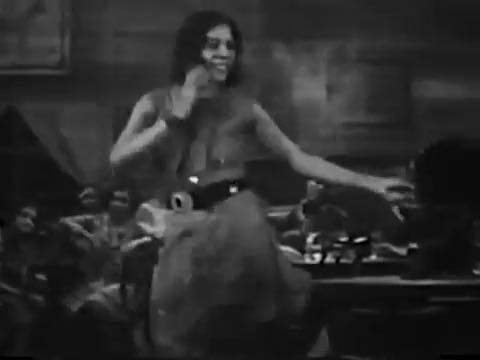
In which two recently released felons hang out with monkeys and try to reckon with a world that seems out to get them.
[aka Sha chu chong wei, aka Exposed to Danger]

Meet Fonda (Hsiao-Fen Lu, credited as Fonda Lin), a woman who is not -- as the strident opening theme and amazing title card font might suggest -- sailing in on a Soviet battleship ready to take a small Taiwanese island by storm.

No, Fonda is arriving fresh from prison after her "breakout" -- though not in the literal sense, in that she presumably served her sentence and was released as a free woman. The full backstory is eventually revealed in flashback, beginning with her arrival in jail and working backwards to flesh out the circumstances that led to her incarceration.

Since she's no longer trapped in Taiwan's penal system (where, if the sets are true to life, the girls bunk together in rough-hewn caves), what's left to break out from?

As quickly becomes clear, the only thing really oppressing Fonda is her self-stigma at being an ex-con, along with a crippling lack of confidence that starts to get rather tired after a while.

I mean, she's young and attractive; the male lead -- who seems genuinely nice -- falls for her instantly; her apartment (for someone with presumably meager funds) is insanely stylish [and comes with its own macaque!]; and she has a mysterious job opportunity handed to her on a sliver platter. Why so glum?

Well, there's the series of cleverly engineered "accidents" that serve to frighten, unsettle, and regularly cause injury to Fonda (along with the occasional unlucky bystander).

There's also the relentless (and seemingly uncalled-for) hostility from Fonda's female coworkers: the shrill, Karen-esque editorial manager (Hsiung-Kuo Li) and the woman-child assistant, Sheena (Fu-Mei Chang, as Lona Chang).

Are these women just cattily jealous of pretty Fonda, or does one of them have more sinister motives? Or, could the culprit be love interest Simon Chang (Alan Tam), or party guy photographer Joe Chan (Tsai Pei Lin, as Jacky Lim)?

Observant viewers (well, even the not-so-observant ones) will cotton on to the "who" fairly early, with the rest of the film unfolding into the "how", along with the all-important "why".

For a movie that seems to want to play it straight -- horror and suspense yes, but with ~*sensitivity*~ to the plight of the heroine -- the whole premise is comically improbable from the get-go.

(As improbable as a lamp made from a frickin' pufferfish.)
There's the odd set-up (unless business owners in Taiwan do regularly hire ex-cons, sight unseen, through the mail -- and that those so hired respond by immediately moving to the area and showing up to work, without so much as a phone call to HR to confirm benefit details).

There's that apartment monkey (who rents out a place with a pet in residence?), and a random knife-wielding woman with no real connection to the plot, who briefly shows up to wreak havoc and get all stabby. Characters do plenty of dumb things, for dumb reasons. And the ending is, well ... a bit beyond belief.

The English dubbing doesn't dispel the unreality either; half the characters shout their lines, and Sheena has this bizarre pseudo-posh English accent that's as slippery and painful as a razor-tipped bar of soap.

The soundtrack, which isn't terrible -- serviceable 80s synth horror, appropriately creepy when called for -- descends into a soppy, faux-pan flute cliche whenever Fonda starts feeling down on herself (which, as mentioned, is often), or interacts in any way with the male lead. It's the same tune, over and over and over again, which translates to an unfortunate earworm that overshadows any of the good audio work.

Then there's the transfer -- in true Mill Creek fashion, the quality is abysmal. Yes, it may be a very dark scene, but horror and suspense depend on being able to see at least *something* going on -- a shadow, a movement, anything -- rather than a blank, murky gloom for solid stretches at a time. One has to believe that the original print was better than this junk, and would have greatly improved the experience.

A final note on the setting, which must be one of Taiwan's outlying islands, as all arrivals (and eventual departures) are made by boat. An interesting locale, though sadly unexplored except for brief seaside vistas and street carnival scenes. Always a nice change to be somewhere other than California, or Italy, or Spain, or England (Sheena's accent be damned).

Overall, a reasonable experience. Not a masterpiece, but enjoyable in its own quirky way.


It's a tale as old as time: an impoverished young man (isn't it always a man?) robs and steals to escape said poverty and to support his girlfriend/wife/love interest. The law gives chase, the young man escapes, and the cycle continues until at least one person ends up dead.

In Country Blue, the young man is Bobby Lee Dixon (Jack Conrad), just out on parole after serving time for sticking up a grocery store (with extra time served for attempting jailbreak). He goes back to work for the man who raised him, the perpetually be-greased garage owner J.J. "Jumpy" Belk (Dub Taylor, of Beartooh fame), whose biological daughter happens to be Bobby's girlfriend Ruthie (Rita George).

After being back in his tiny backwater town for approximately 5 minutes, Bobby feels the itch to escape; but with Ruthie saddled with a husband she doesn't want and no money for a divorce, they're apparently stuck.

"We're both in jail ... I just want to be able to bust us out ... that's all I want to do ... "
Unless...

And the rest of the film unfolds with Bobby and Ruthie's exploits through hill, dale, and jail in the rural South.

We are, of course, expected to root for Bobby as the anti-hero; the problem is that he is so often incredibly stupid. OK, that's not entirely fair; as the very poster boy of disaffected youth, he is often unable to control his anger, frustration, and impulsiveness.

This leads to situations where his success is based not on skill or careful planning, but due entirely to luckiness on his part, or unluckiness on the part of others.

And likewise, when things go wrong, it's not because others were particularly clever, or that the odds were stacked particularly high; Bobby's failures amount almost entirely to a series of unforced errors.

An exception: if there's one thing Bobby Lee Dixon can do well, it's lead a good old-fashioned police chase, no matter what muscle car or rust bucket he's begged, borrowed, or stolen.

As noted by Arneda, the local barkeep-cum-bootlegger who comes first to the rescue, then along for the ride: "I ain't worried Bobby, you drive real good!"

Well, perhaps not always, as poor Arneda will learn to her peril.
So, with a clichéd plot and a petulant churl of a main character, what makes this movie worth watching? The title gives a hint -- this is Country Blue, and the real star is the setting.

Unlike many films that go over the top to drive home the "hickness" of the South, Country Blue does a good job of showing something truer to (what we assume to be) real life in that neck of the woods.

Frayed downtowns with a smattering of cars and old folks parked on benches; cramped, claustrophobic wood-paneled apartments; the occasional stray dog padding through dusty streets; a casual acceptance of lawlessness and violence as a matter of course; tiny one-room roadside churches; poor white and black folks coexisting together in quiet, dignified desperation.

For a film that starts itself off with a long sequence at a grungy, noisy stock car track, it's also particularly rich in natural scenery: as Bobby and Ruthie trundle around the Georgia-Florida borderlands, we're treated to slow strolls through sun-dappled woods; long shots of cars gliding down winding roads with dialog in voiceover; peeper-filled marshes perfect for skivvy dipping and camping out.

Even the so-called action scenes -- car chases and the like -- are full of natural beauty; and Bobby's skill in navigating that particular landscape underscores how much of a country boy he truly is, whether he likes it or not.

In truth, Bobby isn't really a bad 'un; he's never needlessly destructive (except to himself), and seems to be on good terms with his fellow country folk (law enforcement aside).

Were he to get over his terminal fatalism -- not helped by Jumpy, who feels similarly afflicted ("[Ruthie] ain't no misfit like you and me" says Jumpy to his ersatz son) -- he might have a chance of making a decent, though quiet, life for himself.

Will he mend his law-breakin' ways? Don't bank on it.