Showing posts with label blindfolds. Show all posts

Sunday, July 25, 2021

Unilateral disarmament: the pros and cons

(A cheap and obvious pun, but it had to be made.)

In a slight departure from strict chronology, The Umbrellahead Review once again turns its attention to films found on some versions of Mill Creek's box sets, but not others. In this case, we're looking at the Nightmare Worlds release -- specifically the version included as part of our 250-pack box set -- which omits two movies we had to seek out from other sources.

One of these films was cut before we got our box set; one seems to have been added afterward. One was removed in favor of The Disappearance of Flight 412, that shaggy-dog story of a TV movie; the other replaced The Return of Dr. Mabuse, that unmemorable slice of early-1960s German murk.

Both films are superior to their respective swapmates -- if that's not a word, it should be -- and one of them is about to get the first grade of its kind on The Umbrellahead Review.


    The War Game (1965)

    Grade: A


    The simplest way to describe The War Game would be "sobering". We downloaded our copy -- split, it seems, into two individually-digitized reels -- from Archive.org. Normally when we watch movies we don't talk much, but we might chat or complain a little.

    But by the time we got halfway through the first reel of The War Game, not a peep was to be heard hereabouts.


    Produced, written, and directed by Peter Watkins, The War Game was filmed in preparation for a 1965 showing on the BBC, but after seeing its depiction of the effects of nuclear war on Britain, the bigwigs at the Beeb deemed it too traumatizing for broadcast. Subsequently it was shown at film festivals, ultimately winning the Academy Award for Best Documentary Feature in 1967.


    But The War Game didn't reach British television until 1985, airing just before the 40th anniversary of the Hiroshima bombing in 1945 -- and nearly a year after the premiere of Threads, which did indeed traumatize millions of British people, adults and children alike.

    Along with 1983's Testament and The Day After -- both of which did their parts to traumatize American families -- Threads is the most obvious point of comparison for The War Game. All these films were made for TV, and all of them offer a relentlessly downbeat vision of life after atomic war.


    One crucial difference is that The War Game is not narrative fiction, but a documentary of sorts. It makes little attempt to tell the stories of specific people, but instead assembles a collage of scripted and unscripted interviews, recitations of quotes by prominent British public figures (most of them hopelessly fatuous, naive, or jingoistic), and enactments of what one might expect to be "typical" scenes in post-apocalyptic England.

    You know, looters getting shot, injuries without doctors to treat them, utter and total loss of hope, that sort of thing.


    The War Game is far less graphic than Threads, but in some ways is even more effective as a result. Watkins does a masterful job of weaving together individual heartbreak with collective destruction, not by creating characters for us to follow, but through the synecdoche of letting each person's words, facial expressions, and movements inevitably imply the whole.


    If you retain any affection for the inhabitants of Great Britain and their ways -- and, please, don't let's conflate the British people with any misdeeds done in their name or the name of Empire -- then it's profoundly disturbing to see the total breakdown of those ways, sometimes referred to as "society". (You know, that thing Maggie said didn't exist.) 


    We know that The Day After had a profoundly sobering effect (there's that word again) on Ronald Reagan, who wrote in his diary that it was "very effective and left me greatly depressed...My own reaction was one of our having to do all we can to have a deterrent and to see there is never a nuclear war."

    Guess it takes Hollywood to reach Hollywood -- but The Day After also reached a massive percentage of the American public. The War Game was denied that opportunity, reaching only a handful of cinematic elites until its time had passed.

    Impossible to say now what effect it would have had since -- in this timeline at least -- we miraculously made it through the remainder of the 20th century, and the first two decades of the 21st, without turning ourselves into glass souvenirs for curious aliens.


    Anyone who's seen "The City on the Edge of Forever" knows better than to meddle with the past. So, who knows: had The War Game been shown, maybe it would have inspired a huge British anti-war movement that would, in turn, have inspired a countermovement that led to catastrophe. Push a pendulum, get hit in the face.


    Better then to forfeit one's moment in the sun -- and an Academy Award sure as hell ain't bad -- than to reap "Two Suns in the Sunset". Nonetheless The War Game is more available than ever and, sadly, just as relevant as ever.

    It retains its power to leave an audience in stunned silence -- and if that audience is unlikely to want to watch it again, that would seem to be a measure of its success.


    The Severed Arm (1973)

    Grade: C

    After The War Game, the gore and goofiness of The Severed Arm come as a relief. True, it has ambitions of being something more than a standard-issue slasher/revenge film; in some details, it does elevate itself above that mean.

    But when you come down to it, The Severed Arm is one of those movies whose relationship to the consumer is mainly defined by the one-to-one correspondence between its title and its contents: it does what it says on the can. For those who like freshly amputated upper extremities, it's not going out on a limb (ahem) to say, this is the sort of thing they'll like. It delivers.


    Here's a really weird trope that we see a lot in films and TV: the idea that, in the face of a potentially lethal event -- poison gas, radiation, starvation -- you can precisely calculate the amount of time left. If you're able to finish a task or find salvation when you're below that number, you're golden; if not, you're inevitably dead meat.


    Now, sometimes this kind of exactitude makes narrative sense, like in a scuba diving movie. But if you're wondering how and why an amputatable gets amputated in The Severed Arm, the main reason is that six bros get together, something goes terribly wrong...


    ...and before long, "Some of us...maybe all of us...can't make it through tomorrow" if they don't get to sawin'. (Chop chop.)


    One might quote Dave Chappelle's sage observation -- "You were in on the heist, you just didn't like your cut" -- but, naturally, that holds little sway with the hack-ee. So when the other five bros begin losing limbs left and right...


    ...well, really more like left or right...


    ...the question doesn't really seem like "Whodunit?" so much as "Whatcha gonna do when they [in the 'third-person singular of unspecified gender' sense] come for you?"

    Hard to say more without spoilers galore, though the presence of Deborah Wiley as Teddy -- daughter to don't-mind-'im-'e's-'armless -- complicates matters beyond the routine.

    Is she a possible love interest with a disarming smile? Just an indignant and/or concerned family member? Something else? Only time will tell.


    One of us recalls reading some pretty negative comments about The Severed Arm that implied it was in the same league as Manos or Eegah. Consequently, as we watched (hi, Ray!), the film defied expectations simply by being of ordinary quality.

    That doesn't mean it was especially well-acted or well-written, mind you -- the script even invokes the old cliché about how the calls are coming from inside your house! -- but it never got worse than passable.


    Of course it helps that, instead of our usual PD fare, we were watching a gorgeous widescreen transfer from Vinegar Syndrome, with intense colors and a beautifully crisp image. Between that, Phillan Bishop's moody analog synth score, and the lavish supply of marvelous 1970s aesthetics, the film is a feast for the senses.


    By the way, some people who own DVDs of The Severed Arm have wondered if it ends prematurely. It's possible that sketchy releases truncate the credits to obfuscate copyright, but Vinegar Syndrome's release makes it very clear that the film's rather abrupt ending is intentional, and the final freeze-frame doesn't change during the credit roll.

    If you see a still shot with two happy people, and one with a blank expression, you've seen the end.

    (But the screenshot below isn't it -- just a chance to show off some cardigans and fancy prints.)


    Sunday, January 7, 2018

    Arms and the man

    Well, it was nice to have a perfect total of 100 posts for a couple months. But it's high time we came to grips with 50 Sci-Fi Classics -- a set into which we've dipped our toe before, admittedly, with movies like Eegah!, Santa Claus Conquers the Martians, and our beloved Snowbeast. And hey, we like science fiction, right?

    Here, though, we're faced with the grim reality that, in the 250-pack version of 50 Sci-Fi Classics, at least 12 of its 49* movies are peplum: swords and sandals, musclemen and imperious queens, the whole works. Watching such a film every so often is one thing, but working our way through a dozen of them is likely to be a chore, especially with Mill Creek's hraka-quality transfers.

    *(Yes, 49 movies: after removing 6 films like The Alpha Incident and The Wasp Woman that would otherwise be duplicated elsewhere on the 250-pack -- which is, in itself, laudable -- Mill Creek replaced them instead with four peplum epics, plus Lucifer Complex.)

    Still, if we've gotten through endless identical 1930s movies with wisecracking female reporters and unconventional poison delivery systems -- each of them merely an interchangeable (and hat-wearing) part of an infinite whole, an isolated slice of an spunky Mandelbrot set -- then we can handle this.

    So, it's time to put some pep(lum) in our step(lum) and begin our Herculean ordeal with these two films, both of which prominently feature a tug-of-war contest with a strong man in the middle.


    Atlas in the Land of the Cyclops (1961)
    (aka Maciste nella terra dei ciclopi)

    Grade: C-

    As you can see, fans of hue, tint and shade aren't likely to get their chroma fix from Mill Creek's edition of this Gordon Mitchell vehicle. Almost every color has somehow been eradicated from this print, leaving a palette dominated by the dull reddish-brown you see here. The only major exceptions are the opening titles, which have something vaguely resembling blue --

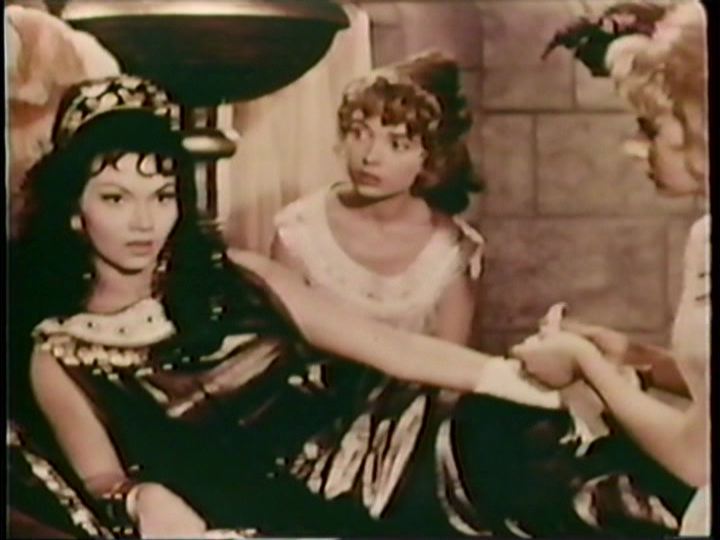
    -- and this, which must have been the greenest dress ever (made of leprechaun sweat and emerald juice, presumably) to cut through the sepia murk:

    Fortunately, despite the visual shortcomings of this copy, Atlas in the Land of Cyclops is entertaining and brisk enough to be tolerable, even at 98 minutes. The plot is somewhere between other peplum films we've seen -- say, Fire Monsters Against the Son of Hercules -- and a "Save my baby!" film like The Lion Man, though Maciste/Atlas's relationship with lions...

    ...is rather more complex.

    No, no, it's not that kind of film: the love interest isn't leonine, but instead the more vulpine Queen Capys (Chelo Alonso), a descendant of Circe. Yes, that Circe, the one famously outfoxed by Ulysses -- well, Odysseus, but this is an Italian film.


    And if you remember who else famously got tricked by Ulysses -- or, hell, if you know the title of this movie -- then you can probably guess who else is sure to show up before the end.

    So let's see -- there's a curse, and a plan to sacrifice the first-born son ("and little Fabio"!) of King Agisandro (Germano Longo). No points for guessing who he descends from: come on, turkey!

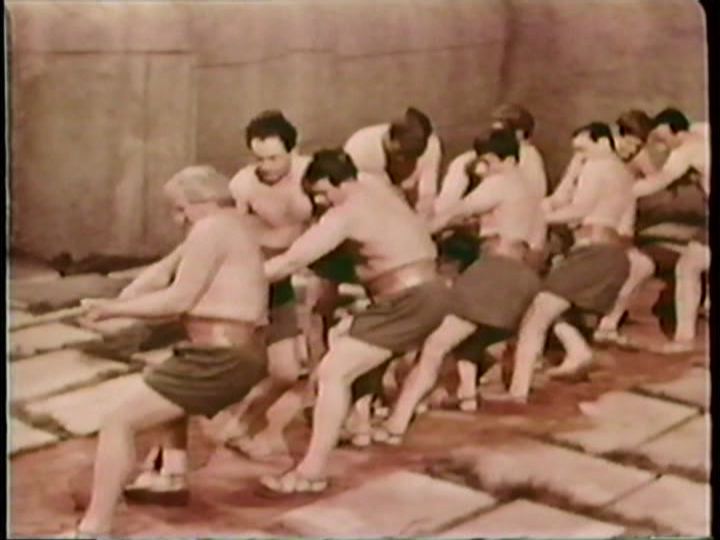
    Naturally Maciste intervenes, and in the process, somehow gets caught up in the most gratuitously racialized tug-of-war we've ever seen. Here's the team on stage left:

    And now, the team on stage right:

    Yeah, that's, uh...a thing. And just like in real life, nobody wins this sort of contest -- except the guy with the power who's really pulling the strings.

    With the Strom Thurmond Memorial Tug-of-War done and dusted, Maciste captures the eye of the queen, to whom his muscular physique and decidedly non-sycophantic behavior are a major turn-on. But don't take our word for it, ask Capys:

    "Ever since you came into my life, you have made me forget everything. Even my duties as a queen -- and my pride as a woman. Everything."

    ...well, except that whole curse and revenge thing, I've still got that in my Palm Pilot. But the rest? Blank slate, baby.

    Soon enough there's a drugged drink -- shades of The Lion Man, yet again -- and a jealous rival:

    The rest you can probably guess, so have a silly dance routine and let's move on.


    Hercules and the Masked Rider (1963)

    Grade: C


    Now this was a surprise: not B.C., but very much A.D., and set in 16th-century Spain to boot. Plus Hercules (Sergio Ciani) isn't even the main character. Don't get us wrong, he's definitely in the mix, and here's that tug-of-war we promised you. (This one's even racism-free.)

    But the real story is one of intrigue and betrayal, honor lost and regained, and lovers besieged by the slings and arrows of outrageous fortune. Our hero, Don Juan (Mimmo Palmara), is in love with Dona Blanca (José Greci), and they try to elope --

    -- but instead he gets exiled from the lands of her father Don Francisco (Renato Navarrini). You see, Dad hopes to marry her off to Don Ramiro Suarez (Arturo Dominici), a perfidious nobleman who might as well have "I AM EVIL" tattooed on his forehead.

    So Don Juan falls in with the gypsies -- and once again, if you know the title of the film, you can guess what identity he soon adopts.

    Hijinks, gypsy dances, and swordfights ensue, just as you'd expect.

    In fact this whole film is largely "just as you'd expect", not that it's necessarily a bad thing. Maybe we were just relieved to get an unexpected respite from sandals and Roman architecture; maybe it's just that we don't know from Zorro -- let alone its ripoffs.

    But though Hercules and the Masked Rider is a standard-issue film in every way, we didn't mind it all, and even sort of enjoyed it. Its edge over Atlas in the Land of the Cyclops? Well, it has a drugging, and colors too. (So did Curse of the Headless Horseman, but you get our point.)

    So instead of boring you with the details of its subplots -- mostly involving other pairs of young lovers -- let's finish things off with five people in a tree.