We're creatures of habit here at the Umbrellahead Review, and two of them are in full effect this Christmas: first, our penchant for posting right before major holidays; and second, our tendency to build up rather large backlogs.
After all, our site's main raison d'être is working through these large Mill Creek (and Mill Creek-esque) box sets, and with the 250 Pack long since under our belt, we're well into Drive-In Movie Classics -- and a few other things besides -- so we have plenty of movies in the queue waiting for reviews.
Even so, we thought we'd offer up something a bit different from our usual fare: namely, a homage of sorts to a form of entertainment whose origins may be humble, yet whose influence on us has been long-lasting.
We mean, of course, the TV movie -- a term that's come to mean something different in the era of the Hallmark Channel, not to mention Syfy and the "Lifetime original", though here we refer to the original concept of a movie made specifically for free over-the-air broadcast.
Neither of us are really old enough to grasp the full arc of the TV-movie phenomenon. At some point, we don't know when, it became vaguely comical: a trashy, defanged version of what one could get in the real cinema, featuring plots "ripped from the headlines" in an effort to make a quick buck. Think, for example, of how -- in the wake of the incident that made it socially acceptable to say "Buttafuoco" -- there were three competing versions of the Amy Fisher story that hit the airwaves. Maybe it was around then that TV movies lost their last traces of dignity.
Yet the TV-movie form seemed to oscillate in and out of respectability, partly because there was a real need for the format. For one, it was a forum to tell stories too modest for the cinema (or paradoxically, too long, as with the miniseries). Where else would such things fit?
From the beginning, the TV movie seemed to be a way of talking about the world as it is: not a medium for purely escapist entertainment on a grand scale, but one perfectly suited for discussing current issues. And the limitations of the form meant that TV movies could focus narrowly on telling a specific kind of story: they needed to sell advertising, not tickets; they were watched by people in the comfort of their homes, not families cringing at the thought of their bored kid throwing a tantrum halfway through Terms of Endearment.
If the plots were sometimes cribbed from recent news stories, with the addition of some fudged events or composite characters...well, Shakespeare did much the same thing, didn't he? It's not for nothing that we use the term "teleplays" for self-contained scripts meant for broadcast; they retain an element of the stage, or community theater.
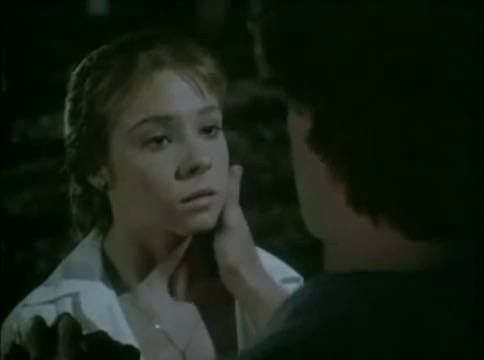
All that said, the first TV movie we'll discuss, I, Desire (1982), doesn't really fit any of the above criteria -- though it does fit perfectly with the sort of material the Umbrellahead Review usually covers. In fact it's cut from the same cloth as a movie like Moon of the Wolf, in that it's a horror film shaped for (and bounded by) the necessities of television.
However I, Desire (aka Desire, the Vampire) is a far grittier, creepier affair. Many big-budget theatrical releases don't come close to conjuring the genuinely disturbing air that hovers over this film -- right from the beginning it radiates a kind of overripe, seedy quality that some directors would give their left arm to capture. (That's some unfortunate foreshadowing there...)
This is thanks in part to the brilliant opening credits, which simply show a series of portrait paintings (almost all of women) while slow harpsichord music plays underneath. Yet all the portraits are in some way a bit off, a tad disturbing, as if the women depicted are somehow in a state of distress, decay, or degradation --
-- while the harpsichord music fades in, mid-phrase, as if one has entered in medias res with a story already underway before we even got there.
From that we go directly into the opening sequence, in which we see:
- a sordid scene on Hollywood Boulevard, with a street preacher using a bullhorn to praise the Lord from his VW Bus, while party people flock hither and yon, and a line of prostitutes ply their wares;
- the slow crawl of a red sedan, driven by the kind of balding, mustachioed man who hires a prostitute in the movies...
- ...which is exactly what he does ("I've got a little personal matter I'd like to discuss with you. Get in!"), while two slow minor chords a third apart give us that well-worn trope of "something bad's a-comin'";
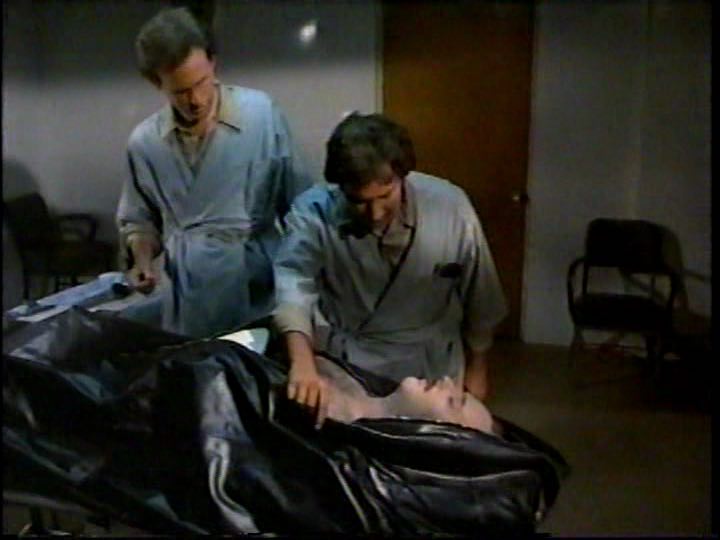
- and the neon of a MOTEL sign, followed not too long afterward by the prim white paint of a CORONER sign, whereupon unzipping a body bag reveals Mr. Mustache, his body drained of blood.
Heavy duty.
And this is about where, back in 1982, P.'s parents promptly (and correctly) decided that this was a bit too much for him to handle, and whisked him off to bed. But the haunting images of that opening sequence stuck with him for decades...
...about 25 years, to be precise, since it was around a quarter-century later that he found someone willing to send him a DVD-R of I, Desire, and a few other things besides.
It's no exaggeration to say that I, Desire was, along with Warriors of the Wasteland, more or less the genesis of The Umbrellahead Review -- in that the impulse to go back and follow up on those forgotten images of yesteryear led us, in 2008, to the Mill Creek box and everything else besides. And that's really the point...
...which leaves us with no particular need to recap a dozen other reviews, or to note the presence of David Naughton (who had recently starred in An American Werewolf in London) or Brad Dourif (charismatic, even handsome, as a fallen priest).
I, Desire isn't a masterpiece, and now and then it flirts with silliness: the overdubbed panther growls get downright goofy. But if we borrow Leonard Maltin's old three-tier scale for rating TV movies, this one would definitely get an Above Average.
It was almost a full decade later, in April 2018, that we watched Long Journey Back (1978) -- another TV movie that stuck with P. all this time.
Or, more accurately, one particular scene stuck with him: as you might expect from a film that dramatizes the Nyack accident of 1972, the sequence in which the train plows into a school bus full of teenagers is harrowing, brutal stuff.
Pretty sure that this was another case where P. was whisked off to bed a bit too late. (It'd be interesting to know how many times Long Journey Back was screened on TV: if P. saw it on the premiere, he'd have been very, very young. More likely, it was a rebroadcast in 1979 or 1980.)

Yet the core of Long Journey Back isn't really the accident, which happens only 6 minutes into the film, but the "journey" (ahem) of teenager Celia as she recuperates from her injuries (amputated leg + brain damage = no fun).
Here we get a double whammy of nostalgia, as Celia is played by none other than Stephanie Zimbalist, whom we know well from her role as Laura Holt in Remington Steele. Not only was that show a fixture of P.'s childhood, but -- once again, decades later! -- the two of us watched the first season together in the early days of Hulu.
(We also know Stephanie Z. from the title role of The Babysitter, a silly-but-entertaining cautionary tale starring William Shatner and Patty Duke. Dunno why we didn't review that campy flick, which we watched back in 2012, but its core message was "she who balls the Shat is probably a nut".)
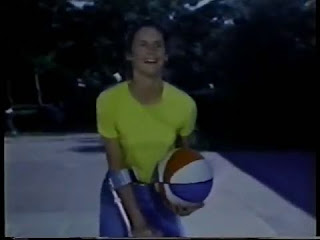
In any event Long Journey Back acquits itself well, and has to be an early example of a (relatively) realistic depiction of recovery from a TBI. And with its judicious use of seafront panoramas and flute solos, it pushes our days-gone-by, '70s nostalgia buttons perfectly. (They even sing freakin' "Day By Day"!)
Above Average once again.

P. can also recall, quite precisely, when he first saw the third of these films, the luridly-titled Sin of Innocence (1986). Thing is, he spent the bulk of his childhood with only broadcast TV to watch, and only a bare handful of fuzzy channels at that -- so when cable TV finally came to the boonies, it was something of a revelation.
Yet, great as it was to be able to watch The Simpsons or MTV or whatever else, his most striking memory is of turning on the Lifetime channel and seeing the very end of a TV movie starring Angie Dickinson, which was immediately followed by Sin of Innocence.
And suddenly he realized: I could sit here all day and do nothing but watch old TV movies. Where once these things were ephemeral, seen once and then gone for good, now they were potentially available at any time. It's a morphine drip, on tap, any time you want it. Dangerous business -- one could drown in a sea of nostalgia and never look back.
The other thing he realized: it's one thing to see Megan Follows play the smart, headstrong, pigtailed Anne of Green Gables; quite another to see her in this, as a smart, headstrong, ponytailed young woman who unexpectedly falls in love with her stepbrother (Dermot Mulroney) -- and vice versa.
You know that "I just want someone to look at me the way that X looks at Y" meme? Yeah, when she gives those bedroom eyes, it hits you like a freight...
...OK, maybe not the best timing on that analogy. But seriously, it's hard to imagine the teenage boy who sees Sin of Innocence and doesn't fall a little bit in love with Megan Follows. (Assuming intelligence and self-possession are your kink, and if they're not, they damn well should be, even at age 16!)
She simply lights up the screen, even in the crappy 360p YouTube capture that was all we had to work with.
The bravery of Sin of Innocence -- gosh, isn't that title the absolute pits? -- is that it doesn't engage in some sort of karmic-retribution routine to keep the stepsiblings of the world from banging (and, spoiler alert, they already are anyway). Instead it just follows the plot to a fairly reasonable, real-world conclusion.
So once again, Above Average, at least if you have a heart.
A very different kind of redhead takes center stage in Stone Pillow (1985). P. didn't see this one back in the day, but certainly remembers the TV Guide hype surrounding Lucille Ball's dramatic turn as a homeless woman.
So when it showed up for free on Amazon Prime we thought, why not?

The usual line on Stone Pillow is that it's impossible to watch Ball's performance and not see wacky old Lucy, mugging for the camera as always. That criticism -- made by Maltin among others -- isn't without a grain of truth, but for the most part we found Ball fairly credible, and never embarrassing, as the homeless Florabelle. Only once or twice did we start feeling like a request for some splainin' was in danger of being made from offscreen.
What sinks Stone Pillow somewhat is Daphne Zuniga, better known as Princess Vespa ("Funny, she doesn't look Druish") from Spaceballs. As the well-meaning nudnik who tries to "save" Florabelle, Zuniga does her best but she's just out of her league here. Her line readings run the gamut from "petulant" to "somewhat more petulant", and her attempts to emote are high-school-drama-club-tier stuff.
Otherwise the film is quintessential TV-movie fare, and inevitably a pleasure to watch thanks to nostalgia for places, faces, styles, and sounds of the past. But honesty requires us to give it an Average.
No such nostalgia attaches to The Failing of Raymond (1971), though our disappointment at this one might not be entirely fair. Somehow we picked up the idea that it was a gritty, angry film about a school shooting and hostage situation -- a bit like Stephen King's novella "Rage", which by the way he should never have disavowed!
So it's not Raymond's fault that it's actually about a mentally ill high school dropout (Dean Stockwell) who fixates on a teacher he blames for his subsequent failures in life (Jane Wyman).

Still, next to four movies that all hit home in varying degrees, The Failing of Raymond feels preachy and toothless -- in other words, the vices that pretty much epitomize the TV movie in its most stereotyped form. Its attempts at social consciousness are pro forma, while its pacing is anything but taut.
Worst of all, the denouement is totally unconvincing. In other words, it's just not very good, and gets a Below Average from us.
The one fun twist -- and the reason that we or anyone else would seek out this movie -- is that it features the 17-year-old Katey Sagal as a spaced-out, hebephrenic teen who holds the key to stopping Raymond's plans.
Her role is minor and relatively brief (and comes courtesy of Dad, aka the director Boris Sagal) -- but it's a trip to see the future Peg Bundy looking like she just got her first retainer.
So here's to the TV movie. Too lowbrow for some, too outdated for others, but there can be a wonderful understatement to the form: small stories in small containers, told in ways that the big screen can't do. For every hyped film like Stone Pillow, there are a dozen others that told a story like a breath on the wind, here one moment, forgotten the next.
And yet they stick with you, somehow.