Showing posts with label jungle. Show all posts

Tuesday, February 13, 2018

Can I do it until I need glasses?

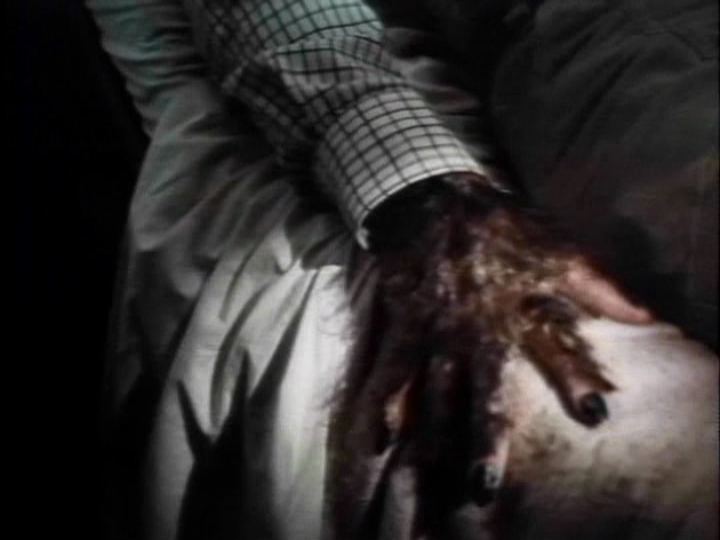
And now, a pair of films where the growing hirsuteness of a character's hands -- and the rest of their body, too -- is a major plot point:


Moon of the Wolf (1972)

Grade: C


Doesn't take long to figure out this one was made for TV -- and if the lack of graphic violence wasn't enough to clue us in, we certainly knew once it started fading to black at regular intervals.

Even so, this slight but amiable look at lycanthropy avoids most of the usual TV-movie traps. It's not too bland, not too pat, and occasionally even has a crisp edge to its dialogue or set pieces.

Moon of the Wolf leans heavily -- maybe too much so -- on atmospheric (i.e. muggy) shots of rural Louisiana, where it was filmed. Then again if the crew had to put up with that miserable-looking weather, more power to them for documenting what they went through. Friends of ours were victims of extortion by that state's infamously corrupt justice system, so we have no urge to visit that neck of the woods to begin with, and Moon of the Wolf did nothing to make a road trip seem more appealing.

Of course the thing about Moon of the Wolf is that the number of whodunit possibilities is really quite small -- two, by our count. It's the kind of movie where you pretty much know the identity of the werewolf from the start, but then you wonder if you aren't being tricked: maybe the whole scene (and it's a good one) with the sulfur and asafetida was a red herring, and it's really that other person.


Sadly, though, the filmmakers chose to go with the less interesting option. On top of that, if you speak French -- or are familiar with certain middling 1970s prog-folk bands -- then the film's suspense takes a hit, since the phrase that le Grandpa Joe keeps mournfully repeating in his sickbed (and other characters mangle as "lou-kah-rouk") is easy enough to break down.


Also, "AWARD"! That's right up there with a giant can that just says "FOOD" on it, or "POISON/SLEEPING TABLETS" for that matter. But after all, this is on the wall of a doctor who gets this gem of a line:

Sheriff: "How come you didn't tell me [she] was pregnant?"
Doctor: "I knew she was pregnant...I was third in my class."

If he'd gone on to recite his SAT scores, we wouldn't have been a bit surprised.


Having seen Moon of the Wolf -- which we actually watched after Queen of the Amazons and before Kong Island, but who's counting -- we've also furthered our progress in the Drive-In Movie Classics box set we plan to take on after the 250-pack. Why? Because it's on that too!

(At least it's not Shock or Snowbeast, which made their way onto both of those box sets plus the Chilling Classics set as well. Bo Svenson and Vincent Price, thrice? Seems Mill Creek likes 'em tall.)

Oh, and these dogs are dead now. Poor dogs; we hope you caught the squirrel at least once, each.


Bride of the Gorilla (1951)

Grade: D

We had to be a bit coy in our review of Moon of the Wolf to avoid spoiling the identity of the werewolf, but there's no doubt here: Raymond Burr is a gorilla.


Or he's a man who becomes a gorilla. Or a man who thinks he becomes a gorilla, à la Nicolas Cage in the wonderful Vampire's Kiss. Whatever, he'll take anything that isn't yet another fat joke or Perry Mason reference.

Burr plays Barney Chavez, a plantation foreman in Brazil who -- as Homer Simpson once observed -- dares to live out the (South) American dream by killing his boss (Paul Cavanagh), marrying his wife, and taking his stuff. In the business, we call that "the triple".

Chavez's perfidy is quietly observed by Al-Long (Gisela Werbisek), a loyal old servant with a witchy side. This gets us curses, dangerous plants -- and Werbisek's astonishingly strong resemblance to Geoffrey Palmer in drag.

(Sorry, old girl, but it had to be said. Please don't curse us.)

In 1951, Burr's star was ascending about as quickly as Lon Chaney Jr.'s was falling, though their respective highs and lows were still five or six years away. Here, the affable old fellow plays a police commissioner who feels pretty sure that Chavez did the deed, but doesn't have quite enough evidence to arrest him.


Chaney's Brazilian cop speaks perfect English, upon which Bride of the Gorilla hangs a lampshade by having him give the following hilarious speech about halfway through:

"I sometimes regret that I went to university, and then returned to this jungle with its superstitions. It only served to confuse me...How could I help being confused? My native mind is filled with these superstitions. My legal mind was developed through books, written by people without emotion."

Coming from a different actor -- say Raul Julia, or Klaus Kinski -- it might almost be plausible, but from Chaney's lips, these lines play like ground beef dropped onto a concrete floor.

The most interesting thing about Bride of the Gorilla is that it somehow feels about five years ahead of its time. Hard to pin down exactly why that is, but we were surprised to remind ourselves that it came out as early as 1951.

It also has a few loopy moments, like when the genteel Dr. Viet (Tom Conway) wants to warn Chavez's coneboobiferous wife Dina about his deterioration. (Dina is played by Barbara Payton, and boy, her life is a cautionary tale if one there ever was.)

Servant girl Larina (Carol Varga) opens the door for Dr. Viet and is hanging around, eavesdropping. But when he asks to speak with Dina alone, she abruptly gets an "Oh, what the fuck!" look on her face, smashes an object on the ground, apologizes -- and leaves, never to be seen again.

Now, we know Larina and Barney had a thing before he threw her over for Dina -- but why would a private conversation between Dina and Dr. Viet make her explode with rage? If anything she might hope that Viet, whose attraction to Dina is obvious (and unrequited), would somehow drive a wedge between them. Oh, well.

Anyway, that's Bride of the Gorilla: yet another "jungle" movie, it's not so goofy as to leave us embarrassed for anyone involved, but not compelling enough to graduate beyond the doldrums. Still, we've certainly seen worse, and Burr has a sort of smoldering, dark-eyed presence that makes him a pretty plausible antihero (even if the only "heroic" thing he does is making time to be nice to goats).

So, welcome to the jungle, Raymond -- but somehow we suspect you've been here before.


Saturday, October 14, 2017

Trisecting the line

The thing about these next three films is, any two of them have a great deal in common:
  • The Lion Man and The Phantom of 42nd Street both involve divorce as a significant plot element;
  • The Phantom of 42nd Street and The Savage Girl both have cab drivers as major characters;
  • and The Lion Man and The Savage Girl are both firmly in that dubious tradition one might call "white people gone native in exotic lands (plus stock footage of the animals with whom they communicate)".
But try as we might, we couldn't come up with something that would bridge all three. Le sigh.


The Lion Man (1936)

Grade: D-


One can only guess how many studios rolled their own version of the Tarzan legend, wherein a noble boy abandoned in a savage land grows up to become a fierce and principled warrior defined by his rapport with animals. The Lion Man at least bases its yarn on another, similar story by Edgar Rice Burroughs, "The Lad and the Lion". It transports the Tarzan archetype to an unnamed and dangerous Arab region, somewhere on the border between French- and British-controlled areas, where Sir Ronald Chatham (Eric Snowden) seeks to negotiate mining rights for tungsten with a local sheik.

Does Chatham bring any colleagues? Does he go with a group of powerful allies or mercenaries? No, he does it more or less alone. But since he just got divorced --

-- he also carts his young son along to the Middle East, for...reasons. (Allegedly the aim is to raise him in the Arab way, but that may just be speculation by his colleagues.)

So it's down the hatch --

-- and off to the land of camels and tents -- 


-- where, sadly, there are no good times to be had with this particular (and murderous) sheik.

Before long peril lurks for the poor lad, and only the brave sacrifice of Sherrifa (Finis Barton) keeps doom at bay -- well, that and shots so blown-out, we assume their pursuers simply couldn't see anything with all the white. (The cinematographer of Cheers struggled with similar issues.)

We wouldn't have much of a story if there weren't a Ben Kenobi-like figure who emerges to harbor and preserve the boy -- in this case, Hassan El Dinh, or as two tribesmen fearfully call him, "The Lion Man! Beyond this point we cannot go!"

The Lion Man tries to dazzle us with sandy set-pieces, a blaring soundtrack of Wagner's greatest hits (especially "The Ride of the Valkyries"), and a female love interest (Kathleen Burke) who -- if you're into that sort of thing -- is certainly easy on the eyes.

However, the lead character (Jon Hall) is irritatingly stupid, while the film's action sequences are horribly choreographed with bad sound.

Worst of all -- save for a very brief bit of footage toward the middle -- there are no lions in the movie! It's in the title of the movie and the book, right? We kept waiting for a pride of wrathful lions to emerge, Valkyrie-like, and descend upon the evil sheik and his followers. But no, we just get this as our penultimate shot:

"Lion man" indeed. Pshaw.


The Phantom of 42nd Street (1945)

Grade: C-


Pity poor Anthony Woolrich (The Devil Bat's Dave O'Brien), a theater critic who just wants to work his usual gig -- and really, really doesn't want to get stuck with the task of investigating the recent death of a prominent actor: "The only murders that interest me are the ones on the stage!"

But that mean old editor of his insists, you see. "Don't you realize you had the jump on an exclusive story!"

At least Tony has Romeo (Frank Jenks), the stalwart cab driver who's more than happy to help in the "moider" investigation. On the other hand, there's the obligatory cop (Jack Mulhall) who warns Tony in no uncertain terms to stay out of the way...which naturally makes him all the more determined to keep digging.

And is there a love interest? Of course there's a love interest (Kay Aldridge)!

K. liked this murder-mystery more than P. did, though neither of us were smitten. It's certainly efficient, clocking in comfortably under an hour. And whoever handled the sound clearly knew what they were doing, as the film almost sounds like a radio drama; O'Brien's resonant voice comes through as though he were speaking directly into a microphone, with rich bass and proximity effect galore.

Maybe they went to the extra expense in hopes of optioning the broadcast rights to radio? It's certainly a wordy script, with very little unremarked upon.

We also found ourselves wishing we'd watched this right after Wanted: Babysitter (or Scar Tissue if you prefer), since both films share a theme of actors wearing silly period costumes.

But the muddled denouement of The Phantom of 42nd Street doesn't live up to the professionalism of its first 45 minutes, denying us the satisfying feeling of inevitability with which a good murder-mystery finishes the job.

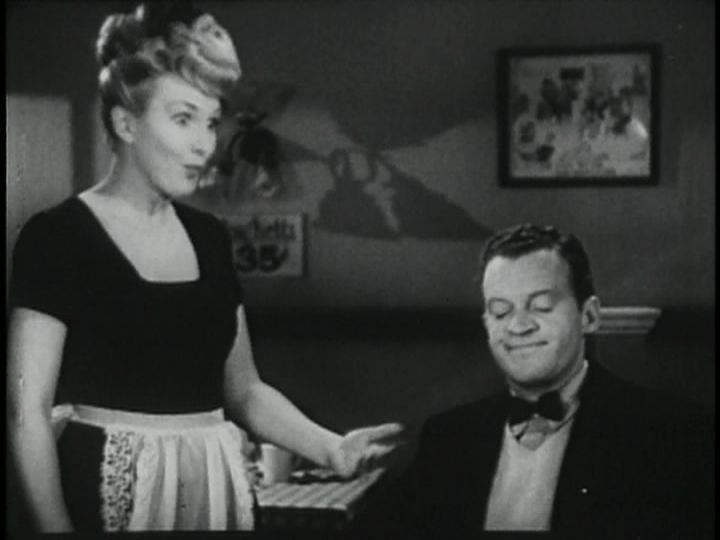
Ah, well: at least we have a batty waitress as comic relief. Who doesn't love that, right?


The Savage Girl (1932)

Grade: D


A couple minutes of exposition got hacked off the front end of Mill Creek's print of The Savage Girl, leaving us a bit uncertain as to why drunken millionaire Amos P. Stitch (Harry Myers) is so intent on hiring intrepid explorer Jim Franklin (Walter Byron) for an expedition in Africa. Tracking down other copies on the Internet reveals that the missing minutes detail Franklin's affinity for wild animals, his policy of non-violence towards them, and his fondness for invidiously comparing them to women:

"One is safer in darkest Africa than in many a speakeasy or nightclub in this city. As a matter of fact, gentlemen, the baby-blue eyes of some of your glorified Follies beauties conceal more hidden dangers than many a savage beast I've met in the bush!"

Can any woman capture the heart of this cynical adventurer? Well, the more pressing problem for Franklin is extracting himself from Stitch's sloppy monologue.

But money talks, and soon enough the pair is preparing to leave for "darkest Africa", with Franklin already having to rein in Stitch's impulse to buy an arsenal. And when the cab driver who drops them off at the shipyards (Ted Adams) laments their departure -- "Jeez, can you imagine that? All my life I've wanted to go to Africa" -- then, with the self-involved spontaneity of the super-rich, Stitch brings him too.

Upon arrival they partner with the seedy Erich Vernuth (Adolph Milar), a lusty and unscrupulous German who warns them of the "jungle goddess" worshipped by the natives, in tribute to whom they torture and sacrifice unwary travelers. And, as we soon discover, that goddess is...

...a feral girl (Rochelle Hudson) with good legs, immaculate makeup, and some sort of leopard-skin outfit. (And she talks to the animals, which makes you wonder how exactly she came by the leopard skin.) Hudson was apparently all of 16 years old when this was filmed, which makes her inevitable romance with the 33-year-old Byron -- more than twice her age! -- seem a bit skeevy.


But Jim Franklin is, all told, a perfect gentleman. No points for guessing that it's Vernuth who has carnal designs on "the girl" (she never gets a name), and no scruples about attempting to force his affections on her. When caught in the act, he offers to "share" her with Franklin: yikes.

Anyway, you can guess most of the rest, complete with demeaning bunga-bunga portrayals from innumerable black extras, stock footage of jungle animals, and that awful squeaking sound effect we heard in Jungle Man. Hudson almost literally spends all of her screen time repeating whatever word Byron just said, with a quizzical expression:

"Talk?"
"Sleep?"
"Stay?"

If she were to bust out with "Brain, brain, what is brain?" it would hardly have surprised us.

When comparing Mill Creek's print of The Savage Girl to the YouTube copy we checked out, there's about an 8-minute difference in running time, which is a lot for a 54/62-minute film. Most of the cuts are tiny edits that might pass unnoticed, but occasionally something significant is lost -- as in the scene where Hudson observes Byron plucking a thorn from an injured monkey's paw, which goes some way toward explaining her affection for him.

There's also a loopy subplot in which Stitch, the chauffeur, and expatriate Harlemite Oscar (Floyd Shackelford) conduct the same experiment the Mythbusters tackled decades later, seeing if an elephant gets spooked by a mouse. (Spoiler: it does.)

But Stitch's diversion isn't enough to keep him from getting homesick. The treatment -- a nice "a-roo-ga" on the car horn, to remind him of the city -- turns out to be a semi-logical plot point, which is sort of cute.

The Savage Girl spares us a tedious backstory for its title character (which is sort of refreshing), and it moves along at a good clip and uses its stock footage with some intelligence (also refreshing). But it's still the same "darkest Africa" storytelling that trades entirely in stereotypes and caricatures -- and even if that doesn't particularly bother you, it has little else to offer beyond jail bait, "How Dry I Am" humor, and Walter Byron repeatedly looking like he'd rather be anywhere else.

Wednesday, July 12, 2017

Racism al fresco

The customer says: "We'd like a table outdoors, some heterosexual banter as an appetizer, and then at least one ethnic stereotype as our entrée." And do these two films deliver!


A Scream in the Night (1935)

Grade: D


If your old man is famous and you're in the same line of work, it's not an easy hand to play: just ask the Bach kids, Miloslav Mečíř Jr., or any number of other examples. Lon Chaney Jr. seemed to want to pick up where his chameleonic dad left off, and that's fine -- his prerogative.

But front-load a film to this extent (as seen in the above screenshot), and not only are you putting a lot of pressure on the son, you're already funneling the viewer into too narrow a causeway: instead of responding to the movie's events as they unfold, we're responding to our expectations of Chaney's double casting.

(Also, "Butch Curtain"? What is that, something Charles Nelson Reilly's interior decorator picked out for him?)

Anyway, we've got a huge ruby, owned by the father (John Ince) of Edith (Sheila Terry), the woman sitting with Chaney-as-Jack-Wilson in the screenshot above. Wilson's on the trail of Johnny Fly (Manuel López), nogoodnik criminal --


-- and virtuosic lasso-tosser:

As we soon discover, Fly's favorite hangout is Butch Curtain's bar. He may be a dim-witted thug with a wonky eye (shades of Manfish!), but he's a sure shot with darts and knives.

His bar is also a magnet for attractive birds of one sort --

-- or another:

(P. thinks this uncredited extra shows strong indicators of foxiness, K. disagrees. Either way it'd be interesting to find out who she was: anybody know?)

So isn't it a wild coincidence that Jack looks a lot like Butch, and can even talk like him? And wouldn't it be the funniest thing if that turned out to play a role in the plot? To invoke a double positive, "Yeah, yeah."

Along the way to the inevitable, we get policeman Wu Ting (Philip Ahn), whose clan presumably ain't nuthing ta f' wit. He speaks normally at the start of the movie, but lays it on thick when he goes undercover:

"Me velly solly. Excuse, please. Oh, me just want a dlink. You can do, please? Whiskey, please. You bossy man here? Maybe you do me hon-ah, have dlink with me."

The 1930s: not the greatest time to be an Asian actor.

There's a reason A Scream in the Night apparently sat on the shelf for almost a decade before it was released. Even with a plot this simple, some details are fumbled: ultimately Wilson-as-Curtain gets his cover blown, thanks to Fly's combative girlfriend Mora (Zarah Tazil), but how exactly it happened we have no idea.

Anyway, Chaney is passable here, but not enough to carry the film. Sorry, Lon. Now could we get the number of that foxy extra?


Jungle Man (1941)
[aka Drums of Africa] 

Grade: D-

OK, so let's get this out of the way upfront: Jungle Man -- called Drums of Africa on our copy, but as we understand it that's an anomaly -- is basically a marginally better version of The White Gorilla. That means it has:
  • copious use of stock footage of animals
  • characters who don't really interact with the above-mentioned animals
  • events recounted through flashback for no particular reason
  • repurposed footage from a silent film (not 100% sure about this one, but we think so)
  • racist depictions of African natives and Africa itself
  • pompous lectures about the jungle and its dangers
So if we found The White Gorilla so terrible that we dubbed one of the worst movies we've ever seen -- after all, we regularly quote "As I watched..." as a kind of metonym for a particular type of bad movie-making -- then how the heck does Jungle Man scrape a D-minus? Well, here's one reason:


That's right, no Crash Corrigan. His "ass-faced voyeurism" (cruel phrase, but fair) is instead replaced here by Buster Crabbe, who's easier on the eyes and a far more charismatic screen presence.

Of course, if you like boot-fa-chays, the movie has some of those too.


You see, we're meant to think this woman will want to marry that guy --

-- but, well, see what happens when she meets this guy:

That's one thing that's refreshing about Jungle Man, actually: from the moment she meets Crabbe as Dr. Robert Hammond, Betty is thoroughly and more-or-less unrepentantly smitten. It's so obvious that when she embraces her fiancé Bruce (Weldon Heyburn) as he's about to leave on an expedition to the mythical City of the Dead, he pauses and looks at her dubiously:

Bruce: You do want me to come back, don't you?
Betty: Oh, of course! W-why shouldn't I?
Bruce: I don't know, I -- I've just had the strangest feeling ever since we've been here.
Betty: Silly.

In the midst of this we cut away to Crabbe and Bruce's pal Andy (Robert Carson), who shoot each other a look, and boy, do their facial expressions tell a story:

So you see, Jungle Man isn't completely stupid. It's got a couple of marginally amusing one-liners -- "But I'm from Missouri, you'll have to show me" is one, if that gives you the idea of the league we're talking about -- and also has at least one other great cutaway, in which Betty's father William (Paul Scott) and his brother Jim the priest (Charles Middleton) have this exchange after Betty announces her intent to join Hammond on a trip to a dangerous village:

Jim: Oh, William, you must stop her!
William: Stop her? You don't know Betty. I didn't want to come to Africa! But I'm here!
Jim: Perhaps it's just as well I turned to this -- I never did understand women.

And the reaction shot:

We surely don't want to give the impression that Jungle Man's few moments of liveliness outweigh the crushing contrivance of its storytelling, though. It's hard to find the right word for the way a movie like this makes us feel, but unconvincing is the closest we've found, though that hardly does it justice. It's not the performers' fault -- they're fine -- but the production itself that feels awkward and cynical and heavy-handed, like it's always playing to the dumbest people in the cheapest seats.

For instance, let's take the sound effects. That "constant jungle chatter" in certain scenes is some sort of squeaky bird call, made by rubbing two dry cylinders together, that sounds like a misaligned fan belt or malfunctioning air conditioner. It's not pleasant. Or there's the lion's roar that sounds like a Superball being rubbed against an oil drum: couldn't they do better in 1941?

Then there are the historical inaccuracies, anachronisms, or whatever you care to call them. First of all, the tiger --

-- which they hang a lampshade on by explaining how Jim "picked him up in one of the Malay states". OK, fine, whatever you say. Clearly they had a tiger available and needed an excuse to use him, and after all he's the only animal that actually interacts with any of the cast:

Oh, and the tiger's name is Satan, which gives us the odd spectacle of hearing a priest say "Thank you, Satan" after the cat defends him from an attacker. Yup.

Meanwhile, this is the famed City of the Dead, in darkest Africa:

Or here's another angle:

If you looked at these shots and said "wat" to yourself like that old lady in the meme, you're exactly right: this is Angkor Wat, in that well-known African country, Cambodia. Yup again.

Really, the African-ness of this movie is solely a product of stock footage, costume design...and hiring a bunch of black actors to demean themselves by shouting "Booga booga booga" and waving spears in the air. ("They're just like children," opines Jim the priest, in an aggression none too micro.)

If at this point you're foolish enough to watch Jungle Man -- and you can't say you haven't been warned -- then, as the kids say these days, you do you. Just don't watch The White Gorilla, for the love of Vlad, unless you really want to dive into despair and question your life choices.