Showing posts with label witchcraft. Show all posts

Tuesday, February 13, 2018

Can I do it until I need glasses?

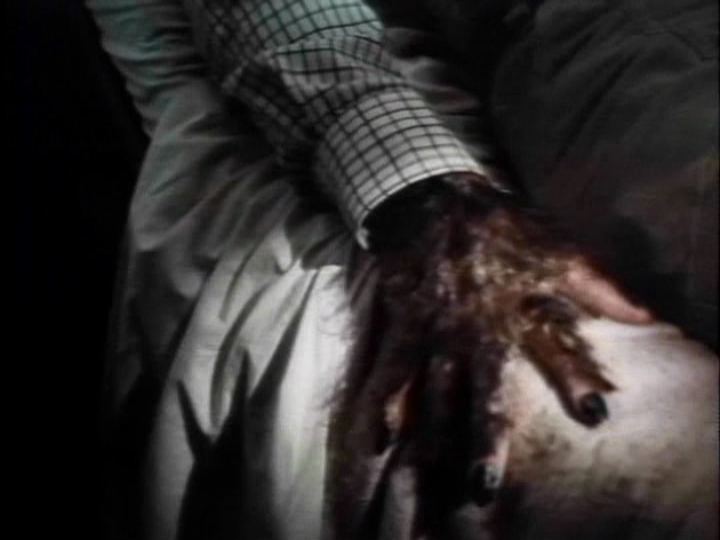
And now, a pair of films where the growing hirsuteness of a character's hands -- and the rest of their body, too -- is a major plot point:


Moon of the Wolf (1972)

Grade: C


Doesn't take long to figure out this one was made for TV -- and if the lack of graphic violence wasn't enough to clue us in, we certainly knew once it started fading to black at regular intervals.

Even so, this slight but amiable look at lycanthropy avoids most of the usual TV-movie traps. It's not too bland, not too pat, and occasionally even has a crisp edge to its dialogue or set pieces.

Moon of the Wolf leans heavily -- maybe too much so -- on atmospheric (i.e. muggy) shots of rural Louisiana, where it was filmed. Then again if the crew had to put up with that miserable-looking weather, more power to them for documenting what they went through. Friends of ours were victims of extortion by that state's infamously corrupt justice system, so we have no urge to visit that neck of the woods to begin with, and Moon of the Wolf did nothing to make a road trip seem more appealing.

Of course the thing about Moon of the Wolf is that the number of whodunit possibilities is really quite small -- two, by our count. It's the kind of movie where you pretty much know the identity of the werewolf from the start, but then you wonder if you aren't being tricked: maybe the whole scene (and it's a good one) with the sulfur and asafetida was a red herring, and it's really that other person.


Sadly, though, the filmmakers chose to go with the less interesting option. On top of that, if you speak French -- or are familiar with certain middling 1970s prog-folk bands -- then the film's suspense takes a hit, since the phrase that le Grandpa Joe keeps mournfully repeating in his sickbed (and other characters mangle as "lou-kah-rouk") is easy enough to break down.


Also, "AWARD"! That's right up there with a giant can that just says "FOOD" on it, or "POISON/SLEEPING TABLETS" for that matter. But after all, this is on the wall of a doctor who gets this gem of a line:

Sheriff: "How come you didn't tell me [she] was pregnant?"
Doctor: "I knew she was pregnant...I was third in my class."

If he'd gone on to recite his SAT scores, we wouldn't have been a bit surprised.


Having seen Moon of the Wolf -- which we actually watched after Queen of the Amazons and before Kong Island, but who's counting -- we've also furthered our progress in the Drive-In Movie Classics box set we plan to take on after the 250-pack. Why? Because it's on that too!

(At least it's not Shock or Snowbeast, which made their way onto both of those box sets plus the Chilling Classics set as well. Bo Svenson and Vincent Price, thrice? Seems Mill Creek likes 'em tall.)

Oh, and these dogs are dead now. Poor dogs; we hope you caught the squirrel at least once, each.


Bride of the Gorilla (1951)

Grade: D

We had to be a bit coy in our review of Moon of the Wolf to avoid spoiling the identity of the werewolf, but there's no doubt here: Raymond Burr is a gorilla.


Or he's a man who becomes a gorilla. Or a man who thinks he becomes a gorilla, à la Nicolas Cage in the wonderful Vampire's Kiss. Whatever, he'll take anything that isn't yet another fat joke or Perry Mason reference.

Burr plays Barney Chavez, a plantation foreman in Brazil who -- as Homer Simpson once observed -- dares to live out the (South) American dream by killing his boss (Paul Cavanagh), marrying his wife, and taking his stuff. In the business, we call that "the triple".

Chavez's perfidy is quietly observed by Al-Long (Gisela Werbisek), a loyal old servant with a witchy side. This gets us curses, dangerous plants -- and Werbisek's astonishingly strong resemblance to Geoffrey Palmer in drag.

(Sorry, old girl, but it had to be said. Please don't curse us.)

In 1951, Burr's star was ascending about as quickly as Lon Chaney Jr.'s was falling, though their respective highs and lows were still five or six years away. Here, the affable old fellow plays a police commissioner who feels pretty sure that Chavez did the deed, but doesn't have quite enough evidence to arrest him.


Chaney's Brazilian cop speaks perfect English, upon which Bride of the Gorilla hangs a lampshade by having him give the following hilarious speech about halfway through:

"I sometimes regret that I went to university, and then returned to this jungle with its superstitions. It only served to confuse me...How could I help being confused? My native mind is filled with these superstitions. My legal mind was developed through books, written by people without emotion."

Coming from a different actor -- say Raul Julia, or Klaus Kinski -- it might almost be plausible, but from Chaney's lips, these lines play like ground beef dropped onto a concrete floor.

The most interesting thing about Bride of the Gorilla is that it somehow feels about five years ahead of its time. Hard to pin down exactly why that is, but we were surprised to remind ourselves that it came out as early as 1951.

It also has a few loopy moments, like when the genteel Dr. Viet (Tom Conway) wants to warn Chavez's coneboobiferous wife Dina about his deterioration. (Dina is played by Barbara Payton, and boy, her life is a cautionary tale if one there ever was.)

Servant girl Larina (Carol Varga) opens the door for Dr. Viet and is hanging around, eavesdropping. But when he asks to speak with Dina alone, she abruptly gets an "Oh, what the fuck!" look on her face, smashes an object on the ground, apologizes -- and leaves, never to be seen again.

Now, we know Larina and Barney had a thing before he threw her over for Dina -- but why would a private conversation between Dina and Dr. Viet make her explode with rage? If anything she might hope that Viet, whose attraction to Dina is obvious (and unrequited), would somehow drive a wedge between them. Oh, well.

Anyway, that's Bride of the Gorilla: yet another "jungle" movie, it's not so goofy as to leave us embarrassed for anyone involved, but not compelling enough to graduate beyond the doldrums. Still, we've certainly seen worse, and Burr has a sort of smoldering, dark-eyed presence that makes him a pretty plausible antihero (even if the only "heroic" thing he does is making time to be nice to goats).

So, welcome to the jungle, Raymond -- but somehow we suspect you've been here before.


Wednesday, May 31, 2017

Kaj nun por io tute malsama

Nu, Kapitano, kion vi faras en hororo filmo?


Incubus (1965)
[Inkubo]

Grade: C


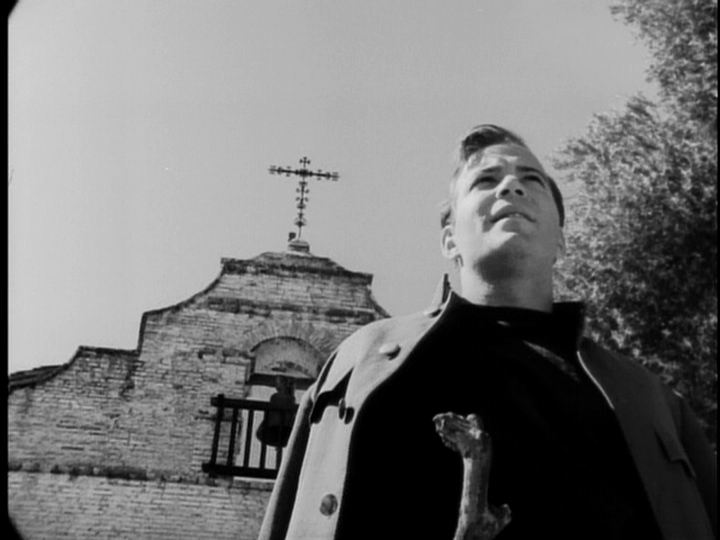
Continuing our detour from the Mill Creek box, we watched the Shat -- not to be confused with the Schach -- in Incubus, a film that manages to be infamous on multiple fronts. To wit: it was believed lost for many years, and the only surviving print has burned-in French subtitles. It allegedly carries a "curse" that, shortly after the film's completion, yielded two suicides (one of them a murder-suicide) among the cast members.

And -- oh yeah -- it's completely in Esper-fuckin'-anto. (That would be an example of an infix, for all you budding linguists out there.) Thus the burned-in subtitles, which are obscured by an ugly but necessary black box for the English-language subs.

Another site describes Incubus as "some kind of hybrid of an Ingmar Bergman film with Manos: The Hands of Fate", which is pretty much spot on -- though, at least plot-wise, you could probably throw in a dash of Night Tide too. It tells a moody tale of a succubus who drowns sinful men at the behest of an evil cult...


...until she meets a man who's not so easily corrupted. (Three guesses who.)

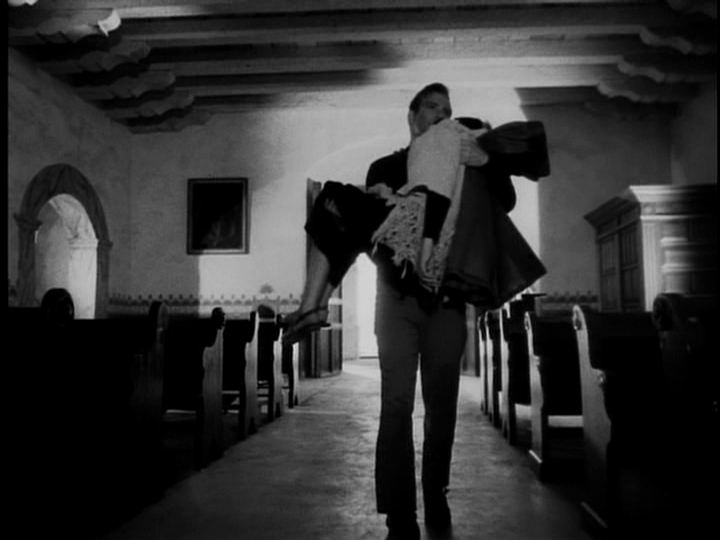
The movie's deliberate pace and philosophizing dialogue are certainly reminiscent of Bergman, as is the positively gorgeous cinematography by Conrad Hall (of Butch Cassidy and the Sundance Kid and American Beauty fame). For many of the films we watch, we find ourselves struggling to find a decent screenshot; Incubus presents us instead with an embarrassment of riches, with almost every frame akin to a well-composed photograph.

It's true that, by using Esperanto, the events in Incubus become weirdly unmoored from any specific time, place, or culture: we literally have no idea when or where these events are meant to be happening. It's disorienting, and certainly contributes to the film's unsettled atmosphere. 

It's also true that, even to a non-speaker of Esperanto, the dialogue in this film is painfully stilted both in its delivery and its pronunciation: most of the actors -- who allegedly learned their lines phonetically, and on short notice -- are clearly uncomfortable with the language, and their line readings suffer as a result.

The interesting exception is Shatner, who (at least in the early going) is noticeably more fluent than his colleagues. We've read that he speaks Esperanto with a pronounced French-Canadian accent, but better that than a Southern California accent, n'est-ce pas? (Dude?)


Shatner's hammy behavior in the wake of Star Trek has made it easy to overlook that he's always been a committed, disciplined actor. Whatever his personal shortcomings, his fame is at least partly the product of dues paid through years of hard work, by being damn good at his job and giving it everything he's got.

In the case of Incubus, he does what he can to make the best of a difficult situation; while he can't singlehandedly elevate the film, he's certainly not a liability -- and almost had us believing he could carry this off.


We also took notice of Milos Milos as the titular incubus. Shame he was the perp in that murder-suicide we mentioned above, as there's real menace in his leering, demonic performance -- and while some of it is attributable to good direction and cinematography, this Serb clearly had screen presence.

But ultimately it's hard to see Incubus as anything more than a beautifully filmed miscalculation. Pretentious and portentous, it nonetheless manages to conjure an atmosphere of real foreboding -- but neither its muddled narrative nor the stiff cast supply the foundation needed for Incubus's atmosphere to amount to more than just ambience. It has the visual flair and tortured quality of a Bergman film, sure, but not the intelligence or finely crafted performances characteristic of Ingmar's work.

All in all, certainly worth seeing (especially in the most literal sense), but not a good film. Sorry, Cap'n.


As a side note, Incubus is just about the last movie in our massive review backlog that, when we began chipping away at it with our most recent Ed Wood entry, dated back to August 2014. Since kicking into high gear in October of last year, we've been covering films that we initially watched between December 2014 and December 2015. With over 50 films in the backlog it seemed insurmountable when we first started, but here we are, out of the woods.

For a variety of reasons we didn't watch many movies for most of 2016, though Incubus was one of the few; others -- at least the ones potentially relevant to this blog -- include:
  • Jungle Moon Men, one of the more offensively terrible films we've ever seen from a mainstream studio;
  • The Howling and King Kong, two films far too famous to need our two cents on 'em;
  • Chandu the Magician, an amusing but threadbare romp with Béla, and One Million Years B.C., a less enjoyable (and bone-stupid) romp with Raquel.
We won't be doing formal reviews for any of these, but funny story about The Howling. We had DVR'd what we thought was The Haunting of Julia, and let that recording sit for over a year before sitting down to watch it. The first minute or so didn't get taped, so we didn't see the opening titles and were thoroughly confused for about 20 minutes until we figured out what had happened. In retrospect we're glad we got the chance to see this landmark werewolf film, even if purely by accident.

In our next entry we'll cover the only two Mill Creek box films we watched in 2016. Once that's done, we'll be fully caught up, and from that point forward, everything you read from us will be hot off our cinematic presses and fresh in our minds -- which will, in turn, spare us the experience of having to watch the likes of Frankenstein 80, A Face in the Fog, and Midnight Phantom twice.

September 2018 will also mark the approximate 10-year anniversary of this project, with the anniversary of our first blog post coming two months after that; with roughly 70 films between us and the end of the 250-pack, perhaps it's not inconceivable (hi, Wally!) that we'll finish it up in time for the site's one-decade mark? We'll see!

Sunday, December 18, 2016

Süssmayr, Cooke, Cerha, and Serly

Sometimes, when someone dies and their life's work goes unfinished as a result, another person steps up to complete the job. Even if they're not quite as skillful as the original auteur, it's important to them that the job gets done.

In the case of these three films, we have not symphonies, but evil schemes that get interrupted -- only to be continued, some time later, by a newcomer's efforts.

(And if that seems like a weak theme -- well, it was either that or "All three films feature sexual assault, attempted or otherwise", and that theme's kind of a downer.)


The Ghost Walks (1934)

Grade: B


After a streak of joyless flicks, it's a treat to watch an unapologetically goofy romp like The Ghost Walks, which -- its inclusion on this "horror" box set aside -- is really a farce with a dollop of mystery and a couple of "spooky" elements.

That said, Mill Creek's print of The Ghost Walks is no treat -- not in the audio domain, at least, as the extremely muffled sound renders much of the dialogue near-incomprehensible. Even after heavy filtering in VLC, there were many lines we simply couldn't make out at all.


We were all set to tell you to watch this copy at Archive.org instead, which has far better sound -- but unfortunately, it turns out that it's missing over three minutes from a key scene early in the film. The edit is non-obvious, but the cut material still has a significant impact on the coherence of the plot, and without it the basic conceit of The Ghost Walks makes significantly less sense.


As for what that conceit is, well...rather than spoil the film with a detailed plot summary, we'll merely say that The Ghost Walks -- like so many before it and since -- revolves around that well-worn device, a dark and stormy night.

This particular DASN opens with bigshot producer Herman Wood and his milquetoast assistant Homer Erskine (played by Richard Carle and Johnny Arthur, respectively). These two New Yorkers are being chauffeured through the storm by a young playwright (John Miljan) who wants Mr. Wood to hear a reading of his new play. But naturally, something goes wrong with the car...


...and, after some kvetching in the rain, the trio end up at a spooky old mansion occupied by a bizarre cast of characters, whose personal dramas and grievances quickly ensnare the visitors.


That said it's the crotchety old Wood and, especially, his neurotic assistant who steal the show throughout. Whether Homer Erskine is meant to be a gay character per se, or simply an effete and cowardly "cream-puff", his stormy relationship with Wood -- getting fired at one moment, sharing a bed the next -- is the core of the film's comedy.

In another film, Erskine's lack of the requisite manly virtues might make him a target of overt ridicule, but here he escapes without major harm or humiliation, and gets the lion's share of the film's zingers as well, e.g.:

"It's a union clock."
"What do you mean?"
"Well, it strikes any old time."

Or:

"Say, I don't like these underground places."
"Well, you may as well get used to it -- you may spend a lot of time in one."

They don't read well in print, but his delivery makes them work.

However, Wood gets the film's best one-liner when he chokes on a cigar, gets slapped on the back by Erskine, and responds with irritation:

"What's the idea?"
"Why, you were choking terribly!"
(indignantly) "Well, can you do any better?"


Should we read anything beyond the obvious into Erskine's comment -- when offered dinner and a drink by his host -- that he likes "the cocktail part of the program"? Probably not.

But, hard not to raise an eyebrow when another character angrily tells Wood and Erskine that "There's something queer about you both. He winks at you and you wink at me. I don't like it!"

Make time for The Ghost Walks -- but if you can't make out the dialogue, switch to the Archive.org print for the first 17 minutes. Then cut over to Mill Creek from about 15:47 to 19:12, and then go back to Archive.org for the rest.

(Or we think so, at least, since the Mill Creek print runs 64:30 and the Archive.org print clocks in at 63:26. The latter has a longer opening and fewer skips, so that seems to account for the rest of the difference, but we haven't done a scene-for-scene comparison to see what else might be cut from either print.)


The She-Beast (1966) 

Grade: C-


Truth be told, we still don't like Barbara Steele. That said, not only does she have very limited screentime in The She-Beast, but in her brief appearance she's used to her best and bitchiest effect, as a snobby newlywed whose husband Philip is a pompous ass of an Englishman (Ian Ogilvy).

For whatever reason, they've opted to take their honeymoon in, all together now:


Of course, the town where they stop for the night turns out to be under an old curse, thanks to an improperly handled witch-killing two centuries prior.

They're helpfully informed of this by none other than Count Van Helsing (John Karlsen), a déclassé Transylvanian nobleman who descends directly from you-know-who. He's more than happy to join them at dinner and order a bottle of Slivovitz on their tab, while boring a thoroughly uninterested Barbara Steele with his family history.

If you know Steele is only onscreen for about 20-30 minutes at the beginning of the film, and another few at the end, you can probably guess how the rest of this one plays out. But one redeeming feature of The She-Beast is its sense of humor, which it uses to constantly poke fun at the absurdities of life behind the Iron Curtain.

These are epitomized by their corrupt and piggish innkeeper, the aptly named Groper (Mel Welles). Early on, Groper gets the living crap beaten out of him by Philip for a Peeping Tom attempt gone disastrously wrong -- which is kind of a nice change from the usual victimization routine.

The thing is, Philip is just kind of a dick in general, and any satisfaction in seeing him pummel Groper into unconsciousness is diminished by his gratingly arrogant, ungrateful behavior toward Van Helsing. Having the protagonist be less than thoroughly likable is a nice twist, but The She-Beast belabors it enough so that Philip's petulant stupidity soon becomes infuriating.

But those irritations -- and a rather gratuitous attempted rape scene -- are alleviated somewhat by a couple interesting twists in the plot, and by the film's lampoons of Romanian life (right at the start of the Ceaușescu period, no less). These give The She-Beast a much-needed infusion of black comedy...

...even if they're not altogether subtle about it.


Curse of the Headless Horseman  (1972) 

Objective Grade: F
Wavy Gravy Far-Out Grade: C

"It's almost never a good sign when a movie opens with a lengthy voice-over delivering exposition," we wrote recently, and that's no less true of Curse of the Headless Horseman.

Except, maybe, that it's an even worse sign when that VO is saturated in a delay effect that makes the speaker's words nearly incomprehensible. And then, it's paired with an image in which the color process is so clearly misaligned, it's impossible to imagine who could have looked at it and thought, "This is OK, this works, I've done a good job."

For example, feast your eyes on the image above, with bands of red, blue, and yellow appearing in places those colors have no business being, while the bottom of the frame transitions from a weird purple to a colorless gray.

Do you know what the people in that shot are doing? They're eating pizza, that's what.

All told, the first minutes of Curse of the Headless Horseman look as though they were filmed in B&W and then hand-tinted, one primary color at a time, by the lady who so nicely tidied up that fresco of Jesus some years back.

Perhaps it's Mill Creek's fault (hard to see how), but even once things calm down, we get some seriously weird color schemes in this film. In most shots, orange-reds and blues pop out with a brilliant, hyper-real intensity, while other hues are vastly muted by comparison. It's like watching a Tandy Color Computer game come to life.

Or look at the spectrum expressed in this shot. The lead actor is bounded by fields of dark green and purple, while his face looks as orange as an Oompa-Loompa's. What's happening here?

Other sites can give you a play-by-play of the events in Curse of the Headless Horseman; we won't bother. (If you've seen the excellent 1934 film Our Daily Bread, and throw in a couple episodes of Scooby-Doo, you've got the basic idea.) It hovers well past the threshold of incompetence in every way, with no real sense of pacing, thoroughly amateur acting, and a script that makes little sense.

Naturally, all that is also a big part of the film's charm -- though truthfully, despite our indulgent attitude toward it, we often found our attention drooping.

Like The She-Beast, this film has a beast on the loose, a pair of newlyweds as its (ostensible) protagonists...

...and an uncomfortable, extended scene of sexual assault, committed by a man whom another site aptly dubbed "the harmonica rapist", and made worse when he and his victim then become happily coupled: ugh. At least he eventually gets the crap beaten out of him too.

Another common trait with The She-Beast is the incongruous presence of nobility: check out the French "countess" (Ultra Violet) who abruptly shows up mid-film with her Superman lunchbox in tow, only to disappear with little explanation. She's sometimes listed as the star of the film, but Ultra Violet is barely onscreen for five minutes, if that. Billy Curtis's pop-up in Robot Pilot seems inevitable and organic when compared to this celebutante cameo.


Curse of the Headless Horseman is, let's be clear about this, an awful movie. But it's a moderately entertaining form of awful, far more engaging than the likes of Manos: The Hands of Fate, though not as rewarding as (say) Maniac.

If nothing else, its color choices and script decisions are so completely off-the-wall at times that -- despite the distinct lack of foxy in its ladies -- it's worth seeing at least once.