Well, we had hoped to finish the 250-movie Horror Classics box -- and the 50-movie subset Sci-Fi Classics -- in time for the 10th anniversary of our first post.
Alas, real life interfered, as it often does, and we've still got a fair handful of films left to watch before we can call the 250-pack done.
Be that as it may, here are two peplum films that share a couple things in common. One is silly trumpets; another is a situation where saying someone's name can lead to interesting outcomes. And if you've ever heard this bizarre field recording from Sudan -- yes, it's real! -- then you know why we might associate those two things in our mind.
But if you don't like that theme, here's another: birds in cages. Satisfied?
Alas, real life interfered, as it often does, and we've still got a fair handful of films left to watch before we can call the 250-pack done.
Be that as it may, here are two peplum films that share a couple things in common. One is silly trumpets; another is a situation where saying someone's name can lead to interesting outcomes. And if you've ever heard this bizarre field recording from Sudan -- yes, it's real! -- then you know why we might associate those two things in our mind.
But if you don't like that theme, here's another: birds in cages. Satisfied?
[aka Ercole contro i tiranni di Babilonia]
Grade: C+
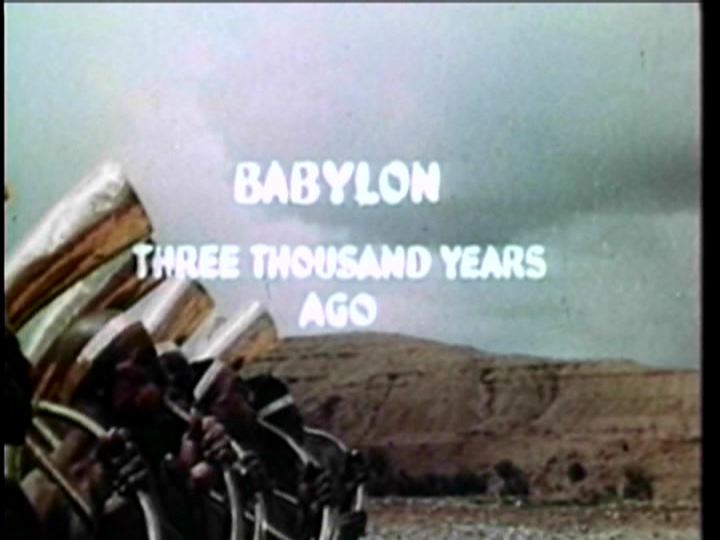
Plot isn't typically a strong point in this genre, but Hercules and the Tyrants of Babylon is built around a tricky, multi-directional power struggle, replete with betrayals and counterbetrayals. At the center of it all are the three siblings who rule Babylon as a triumvirate, including the combative general Salmanassar (Livio Lorenzon):

The crafty statesman Assur (Tullio Altamura):
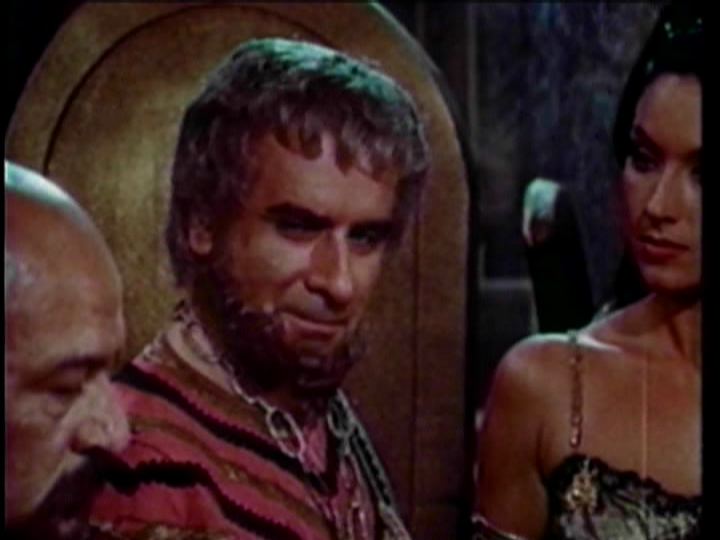
And the treacherous Taneal (Helga Liné):

Taneal first enters the picture to stop the execution of a soldier she's been banging (Diego Pozzetto). IMDb says his name is "Bomar" but it sure sounds like "Bomir", so we'll just call him Boromir, even though he looks nothing like Sean Bean.

Boromir's forces went out to capture Hellene slaves, but were unexpectedly routed. Salmanassar thinks him a coward, and Assur mocks his explanation about "that old myth about the giant who's able to hold off an entire army single-handed? I've heard that before!"
No points for guessing exactly who they mean -- or for anticipating that Taneal takes a personal interest in the prospect of a big, strong man entering the picture.

Hercules (Peter Lupus) also represents a welcome alternative to getting hit on by Malik (Mario Petri), King of Assyria, an unprepossessing fellow who vaguely resembles Dick Van Patten from Eight Is Enough.
Malik shows up to ply the three tyrants with gifts and gold -- and Salmanassar really likes his pressie.

All Malik asks in return is that they give him all the slaves in the city of Babylon. Since Malik might as well be wearing a baseball cap that says "I HAVE A HIDDEN AGENDA", it falls to Taneal to suss out his real plans. Hey, someone has to drink the drugged wine in these things, you want it should go to waste?

It turns out that when the Babylonians sacked Hellas, they unknowingly captured their queen, Esperia (Anna Maria Polani, looking a heck of a lot better here than in Hercules Against the Moon Men). Malik wants to marry her to gain control over her lands, but neither he nor anyone else knows which slave is the Queen -- and the Hellenes ain't talking.

So, they tie them all up and deny them food and water until someone talks. Seems like checkmate, but the Hellene women come up with a clever countermeasure that'd be one heck of a dramatic coup if Spartacus hadn't already done it four years earlier.

Also, Esperia is Hercules's wife. He was away for two years, you see, doing Hercules things. Otherwise he totally would have saved her, and his country, and also he definitely didn't bang other women in the meantime.
I said women, right? Yes, women, that's what I specifically meant.

(He did go clubbing, though -- but don't worry, he only watched.)

Pretty much everyone in Hercules and the Tyrants of Babylon is either Greek, or a villain, to the point where it subverts some typical filmic conventions. For instance, in most movies, if you save someone's life they become a permanent ally, steadfast and true, because they feel a gratitude that transcends all cultural or political boundaries. Not here, though!

One really weird thing about the print used by Mill Creek: a stream of what sounds like Morse code runs quietly but steadily through the entire film. In this thread on Archive.org, one (unnecessarily combative) poster says it's unintentional bleed from time code used in TV broadcasting, which seems plausible.

There's never that much tension in a genre where you always know who wins, and Peter Lupus isn't the most charismatic Hercules we've seen so far. But the layers of intrigue and duplicity in Hercules and the Tyrants of Babylon help keep things interesting -- even though, in a perverse way, they also make it a bit less fun.

Still, it's a well-made film that lacks the tackiness of other pepla we've seen, has some nice set-pieces, and puts a fresh spin on old fan favorites like "drugs in the wine" and "giant wheel for some reason".

[aka Ercole e la regina di Lidia]
Grade: C-

Now this is something else -- not quite the source of the whole genre, but only one step removed from it, with Steve Reeves reprising his role as the big man. It's probably silly to watch Hercules Unchained without having seen the original Hercules from the previous year, but we do silly things around here, like "watch poor-quality transfers of 250 mostly-bad movies".

Filmmaking changed a lot between the end of the 1950s and the beginning of the 1960s, and Hercules Unchained hits us with one of those period conventions early on, when Herc's wife Iole (Sylva Koscina) suddenly bursts into song. It's jarring, overdubbed, and doesn't quite cross the line to "delightfully silly".

For some reason -- no, not that reason --

-- Iole and Hercules bring the man-boy Ulysses (Gabriele Antonini) along on their honeymoon. He seems like the quintessential third wheel, leaving one to wonder why exactly...

...no, not that other reason either. Sheesh.

Hercules soon gets himself mixed up in a Theban power struggle. Yet again it's all thanks to Oedipus (Cesar Fantoni), that perennial ruiner of good clean family fun.
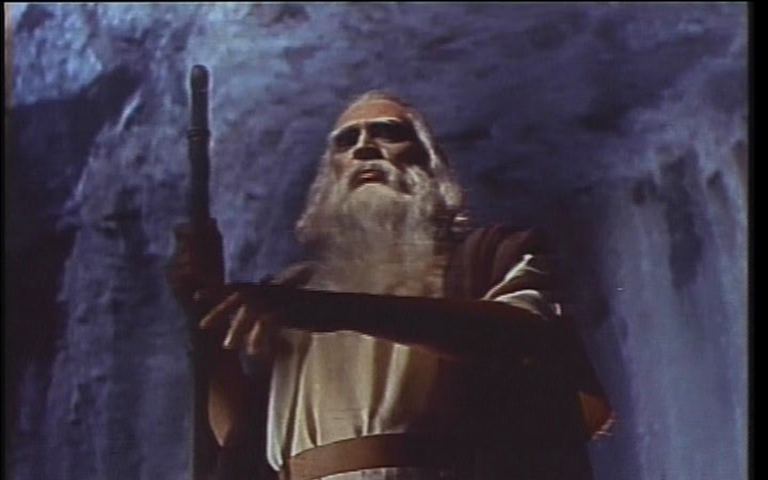
His son Eteocles (Sergio Fantoni) is due to hand off power to his other son Polynices (Mimmo Palmara). It's the same old thing they did last year -- and every year -- but Eteocles don't wanna. But he's gotta. But he don't wanna.

Hercules brokers a deal between the two, leaving Iole behind as a de facto hostage while he runs back and forth between camps. If things go perfectly it seems Thebes will be at peace -- but since Eteocles has borrowed Malik's baseball cap, you can probably guess what he really has in mind.

And, of course, things don't go perfectly, because Hercules drinks from the wrong spring, loses his memory completely, and gets shanghaied by Queen Onfale of Lidia (Sylvia Lopez).

If someone could market this, they'd make money hand over fist, since it's essentially a "get out of jail free" card for adultery: how can you remember you're married if you can't even remember your own name, right?
The artist formerly known as Hercules seems perfectly content with the situation, but Ulysses -- who has a kind of Topher-Grace-meets-David-Faustino thing going on, if you're into that -- insists on being the stone in his shoe.

First, that lovable trickster pretends to be Herc's deaf-mute servant boy, in an attempt at comic relief that's neither amusing nor (in a minor miracle) offensive.

This saves him from execution by the Lidian soldiers, who are no doubt grumpy about their chronic helmet hair: if only they'd invented styling gel in the B.C. era.

To backtrack a bit, Hercules Unchained begins with a stylized, ceremonial scene in which one man is brought in unconscious while another is murdered by soldiers, and leaves it unexplained for a while.

When that scene repeats with different actors later on, it's clear that this is SOP for Queen Onfale, who thus avoids the problem of blocking your ex on social media. So it's Ulysses's job to remind Hercules of his real identity, before he gets thrown over for the next pretty boy...

...and succumbs to an even worse fate than we'd realized.

And Ulysses has to do all this before those dweebs in Thebes kill each other -- or Iole, who's also earned the unwanted attention of a lascivious captain (Ugo Sasso). Aw, jeez.

Once he comes back to himself, Hercules bends some things and throws some statues, and you know how the rest of this goes.

Did you want a silly dance? Hercules Unchained has one of those, though we intend no slight to the dancer, who's popped up on YouTube to describe her experience: here's to you, Mrs. McGrath.

Despite the abundance of pretty boys, the film seems to have a penchant for offbeat-looking women with slightly awkward screen presence. It prominently features them in ensemble shots, like here:

Or here:

Or here, when an earnest-looking girl in a non-speaking role suddenly pops forward for no apparent reason. The composition of the shot makes her look like an equal third in the scene, but she's not!

Speaking of catty comments about women's appearances, if Sylvia Lopez hadn't died of leukemia so soon after the production, we'd probably have some things to say about her over-the-top look in Hercules Unchained.

Instead, let's just say she's not our scene, and leave it at that. As for those who appreciate her and would describe her as "statuesque"? More power to you.

Anyway, Hercules Unchained is fine, it's swell, it's mediocre, watch it or don't. It could rollick more, or maybe less. It has a high body count, but it also has that 1950s feel where everything plays out a bit like a guided tour, or a scripted amusement park ride, and there's never any sense of danger. It's a highly digestible Herculean food product. It brings along old people for no discernible reason, and then expects us to care when they can't keep up.

Oh, here's Ulysses's girl, Penelope. Sing to me of the man, Muse, the man of twists and turns, who settled because he couldn't get Donna or Jackie, or even Kelly.

But she'll be a faithful wife, and a good mom to his son -- which works out well because heck, he's not going to be around to change any diapers!