One of the central tenets of cinephilia is this: edited versions are always inferior.
OK, sometimes they're funny -- Mr. Falcon, a stranger in the Alps, Monday-to-Friday plane, and all that. But anyone who collects films on DVD or Blu-Ray, or seeks out legitimate or illegitimate sources for download, is generally looking out for the longest, most complete, most un-messed-with copy available.
How many films have we seen that were hacked to bits by regional censors, broadcasters, or bad splices in the only surviving copy?
How many have been robbed of their narrative cohesion? Had their dialogue rendered incomprehensible, or their climax neutered?
Had a key plot point or joke ruined?
Or just lost a couple shots that were breathtaking in their eroticism or violence (both at once if you're a sicko)?
The idea that we should be able to see a film as intended and/or issued is such a core value, it almost seems too obvious to point out. For anyone who saw the original, it's easy to resent the jarring collision between our memories and a version that's been screwed around with. (And let's not even get into TV on DVD with syndication edits...shudder.)
Or maybe we simply believe the vision of the film's creators -- scriptwriter, director, editor -- ought to be respected. True, anyone who's seen a few Director's Cuts or Extended Editions knows that the principle of "longer = better" doesn't always apply, and then there's George Lucas, dropping in a CGI Jabba the Hutt where he was never needed.
But the case of Lucas perfectly demonstrates the principle: just give us the theatrical release versions, keep them in print, and you can screw with alternate versions all you want.
Thing is, Abduction turns all that on its head. We watched the version we have on DVD (issued by Digiview Entertainment as part of a double-feature with Embryo). With no knowledge otherwise, we assumed we were getting the whole thing.
In this presentation, the film's thinly veiled retelling of the Patty Hearst story -- via Black Abductor, a pornographic novel written by James Rusk Jr. under the pseudonym Harrison James, which apparently predicted many aspects of Hearst's kidnapping -- seemed more than trenchant.
True, it offered nothing much beyond straight exploitation, and its vague attempts at satire or social commentary -- mainly by framing certain shots in a deliberately absurd manner -- fell short. But Abduction had an edge, captured the Lenin-meets-Manson-meets-Huey Newton vibe well enough, and served its purpose.
Afterward, we discovered Digiview's copy had a shorter running time than what IMDb claims for the film. So we found a version on YouTube (of all places) that was unedited -- or less-edited, it's not clear.
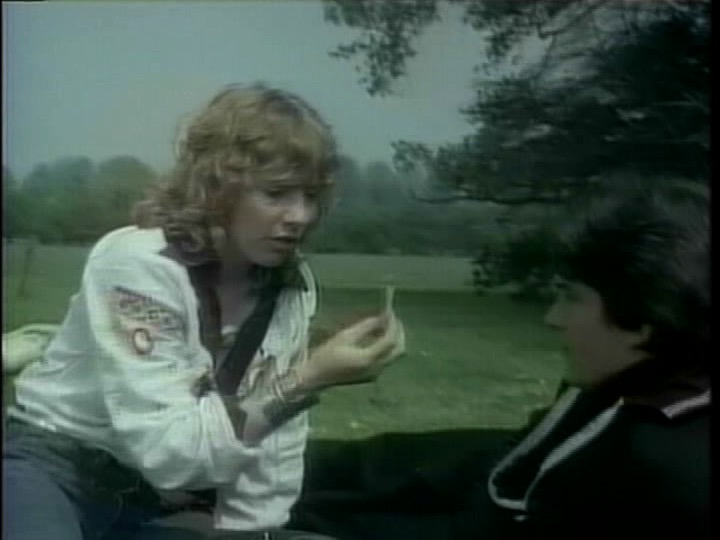
What does it add to the story of Patricia "definitely not Patty Hearst" Prescott (Judith-Marie Bergan), and her abduction and brainwashing by a "definitely not the Symbionese Liberation Army" group of radicals?
Graphic sex scenes, and in particular, scenes of gang rape and coerced sex. (OK, a handful of profanities were also cut from Digiview's copy, as is a sequence involving a bunch of randos who get in the way of the abductors -- probably for profanity as well. But mainly it's the sex.)
So, which is more effective: the cutaway before the event happens, as in a film like Crimes at the Dark House, leaving us to imagine the horrors that await the protagonist? Or getting to see the whole thing, as in the unedited Abduction?
This is an old question. Naturally, different creators have come up with different answers, and different works of art require different approaches.
But in the case of Abduction, we think the rape scenes really hurt the film. They don't add anything but a grotesque, exploitative spectacle that shouldn't arouse anyone -- but probably did.
Their presence collapses what could have been an intriguing spectrum of ambiguities into a single, distasteful reading. And they certainly make it much harder to view the faux-Symbionese radicals led by Dory (David Pendleton) with anything resembling sympathy.
(Not that the SLA deserved much sympathy themselves. There's a reason Donald DeFreeze inspired Stephen King's recurring villain Randall Flagg.)
It's one thing to acknowledge rape as a weapon of war, an instrument of brutality that could contribute to Stockholm Syndrome by breaking the victim down. It's another to imply that it brought about an erotic awakening in the victim -- that she joined forces with her captors because she liked it; that this stuck-up, affluent white woman could only experience her authentic self through sexual violence.
Abduction does more than imply those things, it more or less states them outright. And that doesn't even touch the racial politics of it, as in a well-known two-part phrase that ends with "...you never go back". The source novel was called Black Abductor, after all.
We should note that, in Digiview's copy, we actually do see one of the rape scenes -- sort of: footage of it is reflected in a pair of glasses as her father (Leif Erickson) watches silently, in a darkened room, without saying a word. This is actually more effective, more disturbing, when it's not just a replay of something we've already seen.
(The editors apparently had to loop a short segment of audio to keep it PG-rated, though, and the results are comical if you listen closely.)
A couple minor narrative points are harmed by the editing, including much of the tension in a key scene that -- as an IMDb commenter notes -- anticipates a fakeout sequence in Silence of the Lambs by almost two decades. Instead of cutting between a sex scene and the buildup to a police raid, the edited version just shows the raid.
And we also lose several of the movie's best lines -- including one by Lawrence Tierney, playing an FBI agent but utterly himself as always.
But, yeah, this time the edited version wins. It's hard to imagine all this ugliness wasn't in Black Abductor already, so fair cop to the makers of Abduction for including it.
Once in a while, though, it's a film's missteps or flaws that get edited out -- and in this case, the worst parts of Abduction were the ones to get the censor's axe. It's not just delicate sensibilities that are harmed by the rape scenes; it's the storytelling itself that suffers.