Showing posts with label tales of terror. Show all posts

Thursday, January 14, 2021

Beat them drums

While Mill Creek now sells a 200-movie box called Tales of Terror, they used to sell a completely different 50-pack of the same name. That older Tales of Terror 50-pack was then incorporated, unchanged, into their Horror Collection 250-pack -- aka our ten-year project completed at the end of 2018.

However, as we've previously noted, an even older version of Tales of Terror had a few interesting movies that were later cut from the set, including a Tod Slaughter film we still haven't seen.

So we sat down to watch two of those films, with no other plan in mind, only to discover they had a huge theme in common. To quote Ice-T, poet of our time:

Way down in New Orleans, yeah
I met this old lady...

If you know what follows that incipit, you know what's coming. And -- wouldn't you know it? -- the first of these movies isn't just set in the Pelican State, it is the Pelican State.


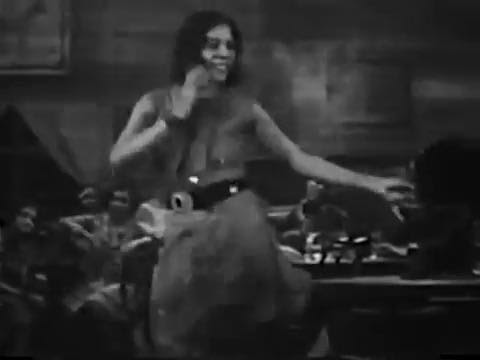
    Drums O' Voodoo (1934)
    [aka Louisiana, aka She Devil] 

    Grade: D-


    Well, when we see the Sack emblem, we know a few things about the film to come: it'll be short, and it won't be very good but will at least be interesting.


    That pretty well sums up Drums O' Voodoo, a morality play in the figurative sense, and just about the literal one as well: it was adapted from a stage work, Louisiana, by one J. Augustus Smith, and with a lead antagonist named "Tom Catt" it's clear the brushstrokes will be broad in this one.


    Smith also plays the preacher Amos Berry, also known as (sigh) Elder Berry. His checkered past becomes leverage for Mr. Catt in the latter's quest to bang nubile niece Myrtle (Edna Barr) --


    -- and since Myrtle's already started jookin' in those jook joints, the danger is clear and present. The power of Christ can't compel Tom Catt to back off, but maybe something else can do it? You remember how things ended for Ice-T, don't you?


    Thus enters Aunt Hagar (Laura Bowman, whom we know from Son of Ingagi), whose sonorous voice and foreboding manner -- "Leave everything to me...and the vooooo-dooooo" -- make it clear that this is a woman not to be trifled with. Does trifling ensue? You betcha!


    Another blog, Atom Mudman's A-List, has already covered Drums O' Voodoo with both greater depth and greater sympathy than we can offer, so no need to rehash his good work.

    Though Drums is certainly unusual in many ways (some of which Mr. Mudman details), we unfortunately found most of it excruciating, give or take. As a poorly-preserved document of a poorly-adapted screenplay, what we have here can't really be characterized as "cinematography", but more the equivalent of setting up the camcorder at the back of the auditorium to capture those precious moments of your kid as Tree #3. 


    When you put that together with amateurish acting, a cornball script, and a print in absolutely trash condition, there's not much left. However there's some documentary interest in seeing and, especially, hearing scenes of black American religious life in the early 1930s.

    That part is kind of neat and ought to be known to scholars -- and since apparently Drums O' Voodoo was included in the 2017 UCLA Festival of Preservation (under the She Devil title), maybe there's a copy out there that actually looks decent and includes an intact ending. (This one sure doesn't -- shortly after the film's climax, it unceremoniously Poochies back to its home planet.)


    And hey, Laura Bowman does get a few good lines at the expense of Tom Catt, observing that he's "not as human as the alligator, or gilly monster, 'cause even they don't tackle the females when they ain't willin'!"

    Preach, Aunt Hagar, in your witchy way, and with your one facial expression.


    And speaking of gila monsters:


      I Eat Your Skin (1971, filmed 1964)
      [aka Zombies, aka Voodoo Blood Bath, etc.]

      Grade: F


      Right away we note: yes, after the film sat on the shelf for 7 years, it was retitled I Eat Your Skin so that it could play on a double-bill with I Drink Your Blood. Fine.

      But the new title technically isn't deceptive, as some have claimed, since there is a skin-eating...condition...that plagues some of the characters in this film.


      OK, with that out of the way? Gosh, this movie sucks. Yes, regional filmmaking; yes, seven years on the shelf; yes, all of those things. But this film isn't fun in the way that The Giant Gila Monster or Teenagers from Outer Space is fun, nor in the way that Miami Connection or Troll 2 is fun.

      It's just a stupider, slower, duller version of a half-dozen movies we've seen already -- akin to Teenage Zombies or The Horrors of Spider Island, but not even as good as those. (And yet Mill Creek felt compelled to retain it on the Chilling Classics box set: the world wonders.)

      I Eat Your Skin tries to be funny, isn't; tries to be sexy, isn't; tries to be scary, isn't. This movie just isn't. It has an overarching lack of is-ness, you might say, except in the sense communicated by sentences like:
      • Watching this movie is exactly what I don't want to be doing right now.
      • This film is a dispiriting waste of time and celluloid.
      • Experiencing these 80 minutes is as titillating as a Dixie cup half-full of wet sand.


      Oh, I Eat Your Skin successfully "is" at least one other thing: disconcertingly racist even for a 1964 film, leaving one to wonder how it came off in 1971.

      In this film the black people are the bad people, full stop, while the zombified oafs that lumber around the island are uncomfortably reminiscent of the freakish giants in The Lost City. The whole thing is just icky.


      Watching Mill Creek boxes could easily give the impression that the early 1960s were an awful time for film: smutty and smirking, grotesque and heavy-handed, trashy yet still bound by prior norms and shortcomings, and subjecting viewers to a constant bombardment of sub-Mancini big-band "jazz" clichés.


      I Eat Your Skin does little to undermine that impression. It's the kind of film that pushes screeching people into pools and thinks that's funny -- 


      -- or sets the action in a place called "Voodoo Island" and thinks it's engaging in effective storytelling.


      It's got trombones, and tremolo guitars, and mad scientists, and voodoo ceremonies, and nothing we wanted. We rued its beginning and welcomed its end. We hope you appreciate our sacrifice in watching it.

      Saturday, February 18, 2017

      The Umbrellahead Awards: Tales of Terror Division

      As promised, here's our retrospective of the 51 movies that comprise the Tales of Terror subset of our 250-film box set from Mill Creek. Some categories will reappear from past awards ceremonies (see here and here for those), while others simply didn't apply to this bunch (we really couldn't come up with anything that deserved to be called "so bad it's good"), and other categories are brand-new.

      And just like last time, it's been three years and change since our most recent awards ceremony, so we hope you've worked up a head of excitement in the interim.

      Now, cue or pull the strings, as you see fit, and behold our nominees:


      Actual Best Movie Award:

      Crimes at the Dark House
      The Devil Bat
      Hands of Steel
      The Sadist
      The Werewolf of Washington

      Winner: The Sadist

      There are some strong contenders in this category -- The Devil Bat may be the best Poverty Row we've seen, while Crimes at the Dark House is our favorite Tod Slaughter film so far. But anyone who read our review of The Sadist will know that we held this film in unexpectedly high esteem; Arch Hall Jr.'s completely believable performance (and James Landis's skillful direction) take The Sadist well beyond the realm of second-tier schlock into something that even a "serious" director could justly take pride in. It's far ahead of its time, and remains disturbing even in today's jaded cinematic universe.


      Actual Worst Movie Award:

      The Atomic Brain
      Chloe, Love is Calling You
      Colossus and the Headhunters
      Midnight Shadow
      The White Gorilla

      Winner: The White Gorilla

      The underlying silent film on which The White Gorilla is based was, from all appearances, actually quite good. However, everything new that the movie brings to the table is dreck, from its corny framing story to Crash Corrigan's ass-faced voyeurism. "As we watched," this film sucked.


      The J/K Award:

      The Ape Man
      The Devil's Daughter
      The Ghost Walks
      The Man with Two Lives

      Winner: The Ape Man

      In all four of these films, something happens to completely invalidate our (and the protagonists') understanding of the film's events: it was all a dream, a play, a put-on, whatever. The Ape Man, though, takes it a step further and completely breaks the fourth wall by having the author show up at the very end and address the audience -- "Screwy idea, wasn't it?" -- in a gag straight out of a Looney Tunes short.


      The Reduce, Reuse, Recycle Award:

      Devil Monster
      The Devil's Messenger
      The White Gorilla

      Winner: The Devil's Messenger

      The White Gorilla is the epitome of recycling, and Devil Monster has that marvelous octopus-in-an-aquarium sequence. But if percentage of post-consumer content is the benchmark here, then the clear winner is The Devil's Messenger, which turns three episodes of a Swedish TV show into around 90% of its running time. What's left over is a paper-thin framing story -- featuring Lon Chaney Jr. as a most avuncular Satan -- that should compost nicely.


      The Tell, Don't Show Award:

      Curse of the Headless Horseman
      Scared to Death
      The White Gorilla

      Winner: The White Gorilla (again)

      Curse has its near-incomprehensible voiceover narration, and Scared to Death its ridiculous cutaways that come off like loading screens in a CD-ROM game. But in our house, whenever we want to invoke the kind of interminable exposition-from-afar represented by the title of this award, we simply utter the phrase "As I watched..." -- and that pretty much clinches this one for The White Gorilla.


      The HI TV Award:

      The Devil's Messenger
      The Night America Trembled
      The Peter Hurkos Story
      Tales of Frankenstein

      Winner: Tales of Frankenstein

      What could better exemplify the ups and downs of TV than a failed pilot? Many moons ago, Good Against Evil left us with cinematic blueballs, but Tales of Frankenstein simply left us wondering who the hell thought it could be possibly be a good idea to build an ongoing TV show out of a quintessentially one-note character like Dr. F.


      The Damaged-in-Transit Award:

      Bowery at Midnight
      Crypt of the Living Dead
      Curse of the Headless Horseman
      The Ghost Walks, The
      Manos: The Hands of Fate
      Torture Ship

      Winner: Torture Ship

      The feedback in Bowery at Midnight is a horrendous destroyer of speaker cones and eardrums, while Crypt, Curse, and Manos all have bizarre issues with misplaced or absent color, and The Ghost Walks suffers from a few bad edits. But Mill Creek's print of Torture Ship is missing the entire opening, and those 9-10 minutes turn out to be unexpectedly vital; one can understand what's going on without them, but without the context they provide, the film is robbed of much of its fun.


      The Get Me Out of This Crazy Place Award:

      Night of the Blood Beast
      One Frightened Night
      The Rogues Tavern
      Sound of Horror
      A Strange Adventure
      A Walking Nightmare

      Winner: A Strange Adventure

      In a packed category of films that contrive to trap their protagonists in creepy old mansions, isolated research stations, or other crucibles of mayhem, we found A Strange Adventure to be the most likable and engaging of the bunch. Something about its combination of radios, activity, and radioactivity hit the spot.


      The How About A Skull Instead? Award:

      The Long Hair of Death
      The She-Beast
      Terror Creatures from the Grave

      Winner: The She-Beast

      If we have to watch a Barbara Steele movie, we suppose we'd pick The She-Beast -- not just because her screen time is so limited (she filmed all her scenes in one day!), but also because it has some amusing sequences and memorable imagery.


      The Shittily Italy Award:

      Colossus and the Headhunters
      The Island Monster
      The Night Evelyn Came Out of the Grave
      Vulcan, Son of Jupiter
      War of the Robots

      Winner: The Night Evelyn Came Out of the Grave

      If we're talking enjoyment, then War of the Robots would be the easy winner here. But if this category is meant to epitomize the flaws and foibles of Italian cinema, then we have to give it to Evelyn, which brews up a heady cocktail of sex, psychopathy, and incoherence.


      The "Fangs for the Memories" Award:

      The Bat (1926)
      The Devil Bat
      Condemned to Live
      Vampire's Night Orgy

      Winner: Condemned to Live

      Only two of these films really fit the category, and between them Condemned to Live is the clear winner. Its tragic sensibility and moral complexity elevate the film -- not to the point of greatness (not even close), but at least to something distinctly superior to the usual fare, and to its predecessor The Vampire Bat.


      The Protagonist is a Serial Killer Award:

      Bowery at Midnight
      The Crimes of Stephen Hawke
      Devil's Partner
      The Night Evelyn Came Out of the Grave
      The Phantom of Soho

      Winner: The Crimes of Stephen Hawke

      One look at Tod Slaughter's mad, gleeful grin makes it impossible to choose anything else. He may not have the highest onscreen body count of this bunch, but he certainly has the most fun doing it, and...


      The "Who Can Kill a Child?" Award:

      Winner: The Crimes of Stephen Hawke (again)

      ...he even up and goes Mortal Kombat II on a near-toddler. Who can kill a child? Tod Slaughter can, that's who.


      Special Awards for Special Campers:

      The "It's Just a Simple Procedure" Award (tie):

      Women who feel a frisson of mistrust when their gyno breezily assures them "This won't hurt a bit!" -- usually with an addendum of "though you may feel a slight pressure" and/or "it may be a little cold" -- will find vindication in The Head and Shock, two films in which a male doctor assures a female patient that of course he has their best interest at heart, just lie back and he'll take care of them...heh-heh-heh...

      The Cause of and Solution to All of Life's Problems Award:

      Whenever the cast of The Amazing Transparent Man gets downtime, they either start drinking, or start hectoring each other about drinking. Maybe it'd be easier just to keep a dry house?

      The Sad Little Mushroom Award:

      If only Don Sullivan's charm were enough to solve all the problems with Teenage Zombies. Why, he doesn't even sing!

      The Anything but Allworthy Award (tie):

      If we ever time-travel back to 19th-century England, Murder in the Red Barn and Never Too Late will have taught us that -- Tom Jones notwithstanding -- we'd do well to avoid squires like the plague. The nicer they seem, the more sinister their plans will turn out to be, so we'd rather not raise them up or adjust their attire.

      The Eat Your Vegetables Award:

      Somewhere a college freshman is writing a mediocre 10-page paper about how The Cabinet of Dr. Caligari is "defiantly a land mark of Impressionist cinema". We're glad we don't have to write that paper, and especially glad we don't have to read it.

      AWOL Award (5-way tie):

      Older versions of the standalone Tales of Terror box set had Drums O'Voodoo (1934), Sweeney Todd, the Demon Barber of Fleet Street (1936), I Eat Your Skin (1964), Vampire Happening (1971), and The Ironbound Vampire (1997), all of which were subsequently replaced with other films. We're certainly going to seek out Sweeney Todd to continue our Tod Slaughter studies, and Drums O'Voodoo sounds like another piquant example of 1930s African-American cinema, so we missed those films in particular.

      But, then again, if it weren't for the cut/replaced movies, we would've missed out on Hands of Steel. So it all kinda came out in the wash.


      There we have it. Will it take us another 3+ years to do a ceremony for Night Screams? Well, we're rapidly working through our backlog, so if we don't get lazy, maybe we'll break the pattern at last.

      Wednesday, January 18, 2017

      No need

      We're just about done reviewing the 51 movies that make up the revamped Tales of Terror subset of our Mill Creek 250-pack. And our final entry for Tales of Terror will be a four-film Tod Slaughter extravaganza.

      First, however, come these three leftovers -- movies that, to be frank, we originally put off watching as long as possible -- and only one of which gets a proper review:


      The Bat (1926)

      Grade: B-

      Does the world need our take on this fairly well-regarded silent, especially when it so clearly requests NO SPOILERS right from the get-go?


      No, it does not. But, need is a funny word, and the movie charmed us just enough to merit a brief treatment (ahem, Mike Barbosa) to point out a few of our favorite things.


      In essence, The Bat is a murder-mystery straight from the stage, with a large enough cast of characters that it was often difficult to sort them out. All the better to keep the viewer guessing as to the identity of the titular villain, something we both struggled with even on the second viewing (which, admittedly, was at double speed; we tried going faster at first, but even without dialogue the movie was so action-packed that we had to slow it down!)


      The sets are pleasingly spooky, featuring lavishly trimmed, cavernous rooms (with absurdly large doors), and lots of dark corners from which one nefarious character or another skulks, stalks, or shoots at the assembled guests.


      Shadow and light are used to striking effect, something that (for once) the quality of the Mill Creek print doesn't completely screw up. And, to our (perhaps disproportionate) delight, there's actual night-for-night filming!


      So, in addition to all that, if you're in the mood for no-nonsense knittin' aunts ...


      ... a brief medical lesson ...


      ... or (what we can only assume is) the genesis of the Bat-Signal ...


      ... then by golly gee, The Bat might not be such a dumb choice. (Just be wary if you're in a girls' dormitory, lest a real bat decide to go all werewolf on ya.)


      Manos: The Hands of Fate (1966)

      Grade: F


      Does the world need yet another website offering up its take on this dull, sad, Grade-Z regional production often heralded as the "worst film ever made"?

      No, it does not. Maybe we're being obtuse, but we've seen it twice each (once separately, once together), and have no interest in watching it yet again for a review. There's not much pleasure in Manos, and even less in a trashed, miscolored print like this one.

      And:


      The Cabinet of Dr. Caligari (1920)

      Grade: n/a


      Does the world need our take on this acclaimed silent masterpiece -- especially when our assessment would be based on a fuzzy, nth-generation dub from Mill Creek?

      No, it does not. But it's always validating to see someone else who's living with an acute shortage of right angles.

      Friday, September 20, 2013

      Avenging Mom with fire

      We didn't plan it this way, but our next two films have a remarkable amount in common:
      • distinctive and intriguing titles;
      • mothers preoccupied by witchy thoughts of revenge, and daughters who get caught up in their schemes;
      • scenes of fire and catharsis, in which the movie's proletariat is at last invited to let loose;
      • murky plots that left us scratching our heads over certain key details;
      • and, courtesy of Mill Creek, terrible transfers with very bad sound, which surely don't do the movies in question any favors.
      So in this spirit of ennui and motherhood, let's dive in:


      Chloe, Love is Calling You (1934)

      Grade: F


      As Kelsey Grammer would say, "Oh, dear Lord."

      Let's get this out of the way up front: the only saving grace of Chloe, Love is Calling You is the historically significant footage of the Shreveport Home Wreckers. Their performance, though brief, is certainly a highlight.


      Otherwise, this atrocious melodrama in the "one drop of black blood" vein manages to be both offensive and boring, which is no small feat. Olive Borden (in her final screen role) is almost plausible as Chloe, a girl who yearns to escape the not-entirely-loving arms of her mother, the voodoo priestess Old Mandy (Georgette Harvey). Old Mandy fled after her husband Sam was lynched many years ago, and now she and Chloe have come back to their old home.


      Chloe's decidedly unmelanistic appearance is explained by the fact that she's allegedly "high yella", or mixed-race. And okay, it's not inconceivable that Olive Borden could be mixed-race; she looks more Joyce DeWitt (or Gilda Radner) than Lena Horne, but whatever.  But this guy?


      Yes indeed: they chose Philip Ober, best known as "the guy who married Vivian Vance and beat her up", to play Jim Strong, the movie's second mixed-race character. (What kind of person would beat up Vivian Vance, for God's sake?)  Mr. Ober was many things, but a plausible non-Caucasian was not one of them, and even in 1934 one has to imagine his casting must have elicited giggles in the audience.

      Jim is utterly besotted with Chloe, and even wrestles dead alligators on her behalf to prove his love:


      But she'll have none of it, and instead pines for local plantation foreman Wade Carson (Reed Howes), who returns her affections -- but doesn't realize she's black. (Cue dramatic music here.)

      Still, Chloe and Wade fall madly in love, leaving poor Jim out in the cold. A noble soul even so, he saves Wade's life not just once, but twice, and barely gets a thank-you in return.

      (He could've at least sent a card. One imagines that the local gift shop in Chloetown would've had "Thanks for saving me from murderous minorities" stocked in both A1 and A7 sizes, since every non-white character in the movie except Chloe and Jim is either servile or treacherously homicidal.)


      Now, Wade has recently started working for the genteel Col. Gordon (Francis Joyner). Years ago the Colonel lost a daughter, Betty Ann, under mysterious circumstances: she was presumed to have drowned, but her body was never found.  (You can probably see where this is going.)


      The chief roadblock in Chloe's road to happiness (and not-black-ness) is Old Mandy. She holds Col. Gordon responsible for Sam's lynching, which some reviews of the movie seem to take at face value. But racist though Chloe, Love is Calling You is, it's not Birth of a Nation, and as far as we could tell the sequence was actually meant to be:
      • Col. Gordon fires Sam (probably for stealing, since the movie makes a point of showing Wade confronting a pre-existing workplace culture of employee theft);
      • Sam attacks Col. Gordon, knocks him unconscious, and escapes;
      • then an unspecified group of "folks" pursues, catches, and lynches Sam, without the Colonel's knowledge or encouragement.
      Not that it made a big difference to Sam, of course, but the bottom line (we suppose) is that Old Mandy is taking revenge on the wrong man. And in fact, there's a little hint of "the cycle of violence ends here" in the movie's closing scenes, when the Colonel pointedly notes that he wants to prevent a second lynching.


      At least Chloe, Love is Calling You is short. But it's terrible, and thanks to the poor audio and shaky picture, it's literally hard to watch.  So unless you're interested in black screen presence in early talkies -- or in the Shreveport Home Wreckers -- avert your eyes and ears, and be the happier for it.


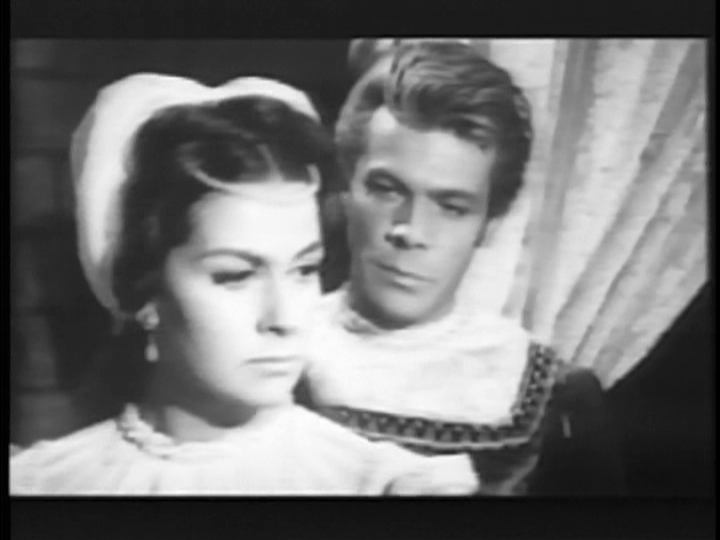
      The Long Hair of Death (1964)

      Grade: D-

      As a wise man once said, "OH, NO! NOT THE BEES! NOT THE BEES! AAAAAHHHHH! OH, THEY'RE IN MY EYES! MY EYES! AAAAHHHHH! AAAAAGGHHH!"


      Or, perhaps more to the point: "BITCHES! YOU BITCHES!"


      Barbara Steele plots and schemes her way through this mediocre Italian gothic tale of murder, revenge, and creepy (though not terribly convincing) medieval dungeons. The film opens on a rather festive note, as an accused witch flails about in the midst of a flaming maze of hay bales and cross-shaped scaffolding. A stylish change from the typical crone-on-a-stick set-up, we thought.


      Meanwhile, upstairs in the castle, the woman’s eldest daughter Helen (Steele) endures the sleazy advances of the local nobleman, who promises to spare mom in exchange for a little rapporto carnale.  It makes no difference, of course: the crispy witch expires, but not before cursing the village and imploring her two daughters to avenge her death.


      Revenge, however, will have to wait. Helen is abruptly offed by the Count in the next scene (to the outrage of Steele fanboys everywhere, we’re sure) and the other daughter, Elizabeth -- just a child, at this point -- is, perversely, entrusted to the Count’s household. Keep your enemies close, we suppose, or pray that Stockholm syndrome does its magic.

      All this is a prelude to the real action, which takes place a decade or so later amid the Black Death or some similar plague. Elizabeth (Halina Zalewska), by now a petulant, sulking sourpuss of a woman, is married, against her will, to the Count’s son Kurt (George Ardisson) -- a boorish Shatner lookalike with a penchant for frilly shirts and pig-headed chauvinism.


      Things aren't going so well for Elizabeth, but soon the requisite dark and stormy night blows in a mysterious figure -- why, if it isn't good ol' Barbara Steele, back from the great beyond! At least, we guessed it was the great beyond. Here is where things got somewhat murky (murkier than the terrible Mill Creek print, if you can believe it). Now Steele claims she's a traveler named Mary, and everyone in the household seems to go along with this fiction (except poor old Count Humboldt, who keeled over from the shock). Not even a flicker of recognition from Kurt, the staff, or, significantly, her own sister.


      Plot hole, or lost in translation? Who knows or cares, because soon the film turns into a long, slow, murky slog to the finish. Kurt, predictably, falls under the spell of the mysterious Mary, who seems to oscillate between wanting it and not (women, right?), and the two of them eventually plan to do away with Elizabeth permanently. There's a ton of gabbing around the dinner table, skulking in dungeons, mooning about the bedroom, and a generous helping of not getting on with things.


      Other reviewers of this film (and there are many) seem to fall into two schools: first are those who agree that, yes, it does get rather dull in the middle -- but that it's not really relevant, because Barbara Steele is just such a talented actress. Then there are those who rabidly insist that no, what you plebes call dragging is actually mood and atmosphere and a building sense of dread.


      As to the latter, all we can say is that we tend to love films where nothing much happens (Idaho Transfer, anyone?), but there's a difference between good atmosphere and pea soup. As to the former? No accounting for taste, we suppose. It is our expert and informed opinion that both sets of reviewers enjoy this movie for precisely one reason. Well, two reasons.


      Inexplicably, nobody else seems to be bothered by the score, which is heavy-handed, mind-numbingly repetitive, and by its presence alone threatened to put this film firmly in "F" territory. We decided on a "D-" simply because we were genuinely curious about how things would all turn out. Though reminding us not unpleasantly of a similar denouement in a more recent film -- and there is something vaguely Summersisle about all the women, it should be said -- ultimately, we were left feeling unsatisfied. Next time the Italians have a zany adventure, we'll make sure they bring a big tomato sauce.