Showing posts with label swamps. Show all posts

Tuesday, February 13, 2018

Can I do it until I need glasses?

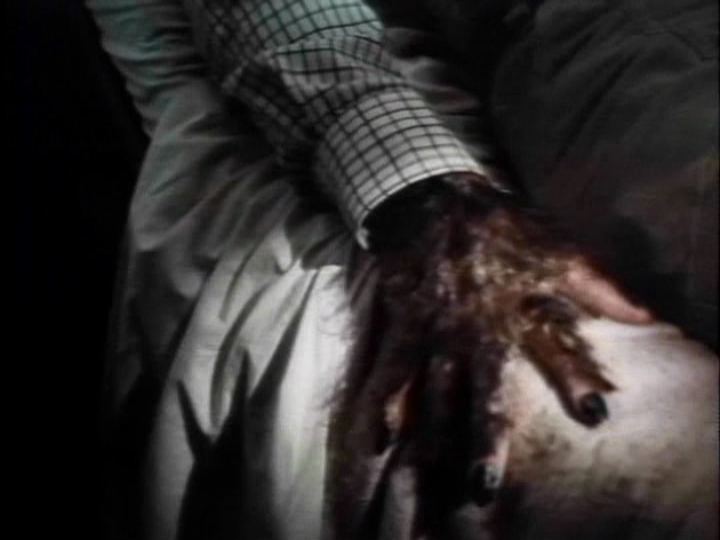
And now, a pair of films where the growing hirsuteness of a character's hands -- and the rest of their body, too -- is a major plot point:


Moon of the Wolf (1972)

Grade: C


Doesn't take long to figure out this one was made for TV -- and if the lack of graphic violence wasn't enough to clue us in, we certainly knew once it started fading to black at regular intervals.

Even so, this slight but amiable look at lycanthropy avoids most of the usual TV-movie traps. It's not too bland, not too pat, and occasionally even has a crisp edge to its dialogue or set pieces.

Moon of the Wolf leans heavily -- maybe too much so -- on atmospheric (i.e. muggy) shots of rural Louisiana, where it was filmed. Then again if the crew had to put up with that miserable-looking weather, more power to them for documenting what they went through. Friends of ours were victims of extortion by that state's infamously corrupt justice system, so we have no urge to visit that neck of the woods to begin with, and Moon of the Wolf did nothing to make a road trip seem more appealing.

Of course the thing about Moon of the Wolf is that the number of whodunit possibilities is really quite small -- two, by our count. It's the kind of movie where you pretty much know the identity of the werewolf from the start, but then you wonder if you aren't being tricked: maybe the whole scene (and it's a good one) with the sulfur and asafetida was a red herring, and it's really that other person.


Sadly, though, the filmmakers chose to go with the less interesting option. On top of that, if you speak French -- or are familiar with certain middling 1970s prog-folk bands -- then the film's suspense takes a hit, since the phrase that le Grandpa Joe keeps mournfully repeating in his sickbed (and other characters mangle as "lou-kah-rouk") is easy enough to break down.


Also, "AWARD"! That's right up there with a giant can that just says "FOOD" on it, or "POISON/SLEEPING TABLETS" for that matter. But after all, this is on the wall of a doctor who gets this gem of a line:

Sheriff: "How come you didn't tell me [she] was pregnant?"
Doctor: "I knew she was pregnant...I was third in my class."

If he'd gone on to recite his SAT scores, we wouldn't have been a bit surprised.


Having seen Moon of the Wolf -- which we actually watched after Queen of the Amazons and before Kong Island, but who's counting -- we've also furthered our progress in the Drive-In Movie Classics box set we plan to take on after the 250-pack. Why? Because it's on that too!

(At least it's not Shock or Snowbeast, which made their way onto both of those box sets plus the Chilling Classics set as well. Bo Svenson and Vincent Price, thrice? Seems Mill Creek likes 'em tall.)

Oh, and these dogs are dead now. Poor dogs; we hope you caught the squirrel at least once, each.


Bride of the Gorilla (1951)

Grade: D

We had to be a bit coy in our review of Moon of the Wolf to avoid spoiling the identity of the werewolf, but there's no doubt here: Raymond Burr is a gorilla.


Or he's a man who becomes a gorilla. Or a man who thinks he becomes a gorilla, à la Nicolas Cage in the wonderful Vampire's Kiss. Whatever, he'll take anything that isn't yet another fat joke or Perry Mason reference.

Burr plays Barney Chavez, a plantation foreman in Brazil who -- as Homer Simpson once observed -- dares to live out the (South) American dream by killing his boss (Paul Cavanagh), marrying his wife, and taking his stuff. In the business, we call that "the triple".

Chavez's perfidy is quietly observed by Al-Long (Gisela Werbisek), a loyal old servant with a witchy side. This gets us curses, dangerous plants -- and Werbisek's astonishingly strong resemblance to Geoffrey Palmer in drag.

(Sorry, old girl, but it had to be said. Please don't curse us.)

In 1951, Burr's star was ascending about as quickly as Lon Chaney Jr.'s was falling, though their respective highs and lows were still five or six years away. Here, the affable old fellow plays a police commissioner who feels pretty sure that Chavez did the deed, but doesn't have quite enough evidence to arrest him.


Chaney's Brazilian cop speaks perfect English, upon which Bride of the Gorilla hangs a lampshade by having him give the following hilarious speech about halfway through:

"I sometimes regret that I went to university, and then returned to this jungle with its superstitions. It only served to confuse me...How could I help being confused? My native mind is filled with these superstitions. My legal mind was developed through books, written by people without emotion."

Coming from a different actor -- say Raul Julia, or Klaus Kinski -- it might almost be plausible, but from Chaney's lips, these lines play like ground beef dropped onto a concrete floor.

The most interesting thing about Bride of the Gorilla is that it somehow feels about five years ahead of its time. Hard to pin down exactly why that is, but we were surprised to remind ourselves that it came out as early as 1951.

It also has a few loopy moments, like when the genteel Dr. Viet (Tom Conway) wants to warn Chavez's coneboobiferous wife Dina about his deterioration. (Dina is played by Barbara Payton, and boy, her life is a cautionary tale if one there ever was.)

Servant girl Larina (Carol Varga) opens the door for Dr. Viet and is hanging around, eavesdropping. But when he asks to speak with Dina alone, she abruptly gets an "Oh, what the fuck!" look on her face, smashes an object on the ground, apologizes -- and leaves, never to be seen again.

Now, we know Larina and Barney had a thing before he threw her over for Dina -- but why would a private conversation between Dina and Dr. Viet make her explode with rage? If anything she might hope that Viet, whose attraction to Dina is obvious (and unrequited), would somehow drive a wedge between them. Oh, well.

Anyway, that's Bride of the Gorilla: yet another "jungle" movie, it's not so goofy as to leave us embarrassed for anyone involved, but not compelling enough to graduate beyond the doldrums. Still, we've certainly seen worse, and Burr has a sort of smoldering, dark-eyed presence that makes him a pretty plausible antihero (even if the only "heroic" thing he does is making time to be nice to goats).

So, welcome to the jungle, Raymond -- but somehow we suspect you've been here before.


Friday, September 20, 2013

Avenging Mom with fire

We didn't plan it this way, but our next two films have a remarkable amount in common:
  • distinctive and intriguing titles;
  • mothers preoccupied by witchy thoughts of revenge, and daughters who get caught up in their schemes;
  • scenes of fire and catharsis, in which the movie's proletariat is at last invited to let loose;
  • murky plots that left us scratching our heads over certain key details;
  • and, courtesy of Mill Creek, terrible transfers with very bad sound, which surely don't do the movies in question any favors.
So in this spirit of ennui and motherhood, let's dive in:


Chloe, Love is Calling You (1934)

Grade: F


As Kelsey Grammer would say, "Oh, dear Lord."

Let's get this out of the way up front: the only saving grace of Chloe, Love is Calling You is the historically significant footage of the Shreveport Home Wreckers. Their performance, though brief, is certainly a highlight.


Otherwise, this atrocious melodrama in the "one drop of black blood" vein manages to be both offensive and boring, which is no small feat. Olive Borden (in her final screen role) is almost plausible as Chloe, a girl who yearns to escape the not-entirely-loving arms of her mother, the voodoo priestess Old Mandy (Georgette Harvey). Old Mandy fled after her husband Sam was lynched many years ago, and now she and Chloe have come back to their old home.


Chloe's decidedly unmelanistic appearance is explained by the fact that she's allegedly "high yella", or mixed-race. And okay, it's not inconceivable that Olive Borden could be mixed-race; she looks more Joyce DeWitt (or Gilda Radner) than Lena Horne, but whatever.  But this guy?


Yes indeed: they chose Philip Ober, best known as "the guy who married Vivian Vance and beat her up", to play Jim Strong, the movie's second mixed-race character. (What kind of person would beat up Vivian Vance, for God's sake?)  Mr. Ober was many things, but a plausible non-Caucasian was not one of them, and even in 1934 one has to imagine his casting must have elicited giggles in the audience.

Jim is utterly besotted with Chloe, and even wrestles dead alligators on her behalf to prove his love:


But she'll have none of it, and instead pines for local plantation foreman Wade Carson (Reed Howes), who returns her affections -- but doesn't realize she's black. (Cue dramatic music here.)

Still, Chloe and Wade fall madly in love, leaving poor Jim out in the cold. A noble soul even so, he saves Wade's life not just once, but twice, and barely gets a thank-you in return.

(He could've at least sent a card. One imagines that the local gift shop in Chloetown would've had "Thanks for saving me from murderous minorities" stocked in both A1 and A7 sizes, since every non-white character in the movie except Chloe and Jim is either servile or treacherously homicidal.)


Now, Wade has recently started working for the genteel Col. Gordon (Francis Joyner). Years ago the Colonel lost a daughter, Betty Ann, under mysterious circumstances: she was presumed to have drowned, but her body was never found.  (You can probably see where this is going.)


The chief roadblock in Chloe's road to happiness (and not-black-ness) is Old Mandy. She holds Col. Gordon responsible for Sam's lynching, which some reviews of the movie seem to take at face value. But racist though Chloe, Love is Calling You is, it's not Birth of a Nation, and as far as we could tell the sequence was actually meant to be:
  • Col. Gordon fires Sam (probably for stealing, since the movie makes a point of showing Wade confronting a pre-existing workplace culture of employee theft);
  • Sam attacks Col. Gordon, knocks him unconscious, and escapes;
  • then an unspecified group of "folks" pursues, catches, and lynches Sam, without the Colonel's knowledge or encouragement.
Not that it made a big difference to Sam, of course, but the bottom line (we suppose) is that Old Mandy is taking revenge on the wrong man. And in fact, there's a little hint of "the cycle of violence ends here" in the movie's closing scenes, when the Colonel pointedly notes that he wants to prevent a second lynching.


At least Chloe, Love is Calling You is short. But it's terrible, and thanks to the poor audio and shaky picture, it's literally hard to watch.  So unless you're interested in black screen presence in early talkies -- or in the Shreveport Home Wreckers -- avert your eyes and ears, and be the happier for it.


The Long Hair of Death (1964)

Grade: D-

As a wise man once said, "OH, NO! NOT THE BEES! NOT THE BEES! AAAAAHHHHH! OH, THEY'RE IN MY EYES! MY EYES! AAAAHHHHH! AAAAAGGHHH!"


Or, perhaps more to the point: "BITCHES! YOU BITCHES!"


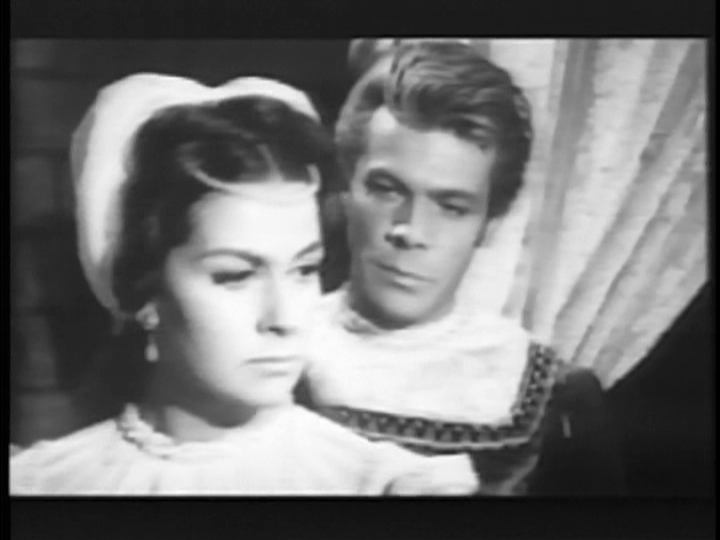
Barbara Steele plots and schemes her way through this mediocre Italian gothic tale of murder, revenge, and creepy (though not terribly convincing) medieval dungeons. The film opens on a rather festive note, as an accused witch flails about in the midst of a flaming maze of hay bales and cross-shaped scaffolding. A stylish change from the typical crone-on-a-stick set-up, we thought.


Meanwhile, upstairs in the castle, the woman’s eldest daughter Helen (Steele) endures the sleazy advances of the local nobleman, who promises to spare mom in exchange for a little rapporto carnale.  It makes no difference, of course: the crispy witch expires, but not before cursing the village and imploring her two daughters to avenge her death.


Revenge, however, will have to wait. Helen is abruptly offed by the Count in the next scene (to the outrage of Steele fanboys everywhere, we’re sure) and the other daughter, Elizabeth -- just a child, at this point -- is, perversely, entrusted to the Count’s household. Keep your enemies close, we suppose, or pray that Stockholm syndrome does its magic.

All this is a prelude to the real action, which takes place a decade or so later amid the Black Death or some similar plague. Elizabeth (Halina Zalewska), by now a petulant, sulking sourpuss of a woman, is married, against her will, to the Count’s son Kurt (George Ardisson) -- a boorish Shatner lookalike with a penchant for frilly shirts and pig-headed chauvinism.


Things aren't going so well for Elizabeth, but soon the requisite dark and stormy night blows in a mysterious figure -- why, if it isn't good ol' Barbara Steele, back from the great beyond! At least, we guessed it was the great beyond. Here is where things got somewhat murky (murkier than the terrible Mill Creek print, if you can believe it). Now Steele claims she's a traveler named Mary, and everyone in the household seems to go along with this fiction (except poor old Count Humboldt, who keeled over from the shock). Not even a flicker of recognition from Kurt, the staff, or, significantly, her own sister.


Plot hole, or lost in translation? Who knows or cares, because soon the film turns into a long, slow, murky slog to the finish. Kurt, predictably, falls under the spell of the mysterious Mary, who seems to oscillate between wanting it and not (women, right?), and the two of them eventually plan to do away with Elizabeth permanently. There's a ton of gabbing around the dinner table, skulking in dungeons, mooning about the bedroom, and a generous helping of not getting on with things.


Other reviewers of this film (and there are many) seem to fall into two schools: first are those who agree that, yes, it does get rather dull in the middle -- but that it's not really relevant, because Barbara Steele is just such a talented actress. Then there are those who rabidly insist that no, what you plebes call dragging is actually mood and atmosphere and a building sense of dread.


As to the latter, all we can say is that we tend to love films where nothing much happens (Idaho Transfer, anyone?), but there's a difference between good atmosphere and pea soup. As to the former? No accounting for taste, we suppose. It is our expert and informed opinion that both sets of reviewers enjoy this movie for precisely one reason. Well, two reasons.


Inexplicably, nobody else seems to be bothered by the score, which is heavy-handed, mind-numbingly repetitive, and by its presence alone threatened to put this film firmly in "F" territory. We decided on a "D-" simply because we were genuinely curious about how things would all turn out. Though reminding us not unpleasantly of a similar denouement in a more recent film -- and there is something vaguely Summersisle about all the women, it should be said -- ultimately, we were left feeling unsatisfied. Next time the Italians have a zany adventure, we'll make sure they bring a big tomato sauce.


Friday, August 9, 2013

Not Lebanese, Blanche! (Part 2)

And, another movie where it's all about the ladyfolk.  But nothing much Sapphic happens in:


Swamp Women (1956)

Grade: C-


Bad "beauties" bust out of brig to bring back buried baubles from bayou, but babes' boat = broken. Bad break for big Bob & Bob's bayou-besotted beloved!

Babes "borrow" boat -- bye-bye beloved (blub-blub-blub).  Babes bicker, bathe, brood, bitch, battle over booty (and Bob).


But, betrayal: brunette babe's bogus -- not a baddie, but a badge babe!  Bob benefits.


Beheld, Swamp Women's brown, blobby, blown-out -- basically, brightness- & brilliance-bereft. (Brief bit's bizarrely #00BB00, because...??)


Bad, Mill Creek, bahut bad!  But, bargain box be bargain box: better buyables = big bucks.


BTW, speaking of Roger Corman, another one we're not going to review is Little Shop of Horrors (1960), since it's been more than amply discussed by many, many other writers.  It's pretty funny, though.