In 1933, Busby Berkeley and Mervyn LeRoy struck gold at the intersection of economic hardship and showgirl opportunism, beginning with that triumphant -- and ironic -- clarion call: "We're in the money!" When times are tough, marry rich, and figure the rest out later. (If that sounds awfully cynical, it probably is -- but hey, it worked out perfectly for one of our grandmothers.)
But though these two films also use Gold Diggers of 1933's secret-millionaire trope, they don't crow about cash at all, whether at the start or the end. Maybe an extra year of Depression-era desperation made the difference, but in this case, the women lucky enough to end up with Mr. Moneybags just seem glad to have found themselves a nice fella.
But though these two films also use Gold Diggers of 1933's secret-millionaire trope, they don't crow about cash at all, whether at the start or the end. Maybe an extra year of Depression-era desperation made the difference, but in this case, the women lucky enough to end up with Mr. Moneybags just seem glad to have found themselves a nice fella.
Grade: C-

This confusing tale of morgues, mayhem, and mistaken identity took us quite a while to unpack, though by the end we'd finally sussed it all out (more or less).
From the opening sequence -- in which the body of a man who allegedly fell asleep at the wheel is deposited at a morgue -- it's clear something sketchy is afoot...

...and if our intuition didn't tell us that, we certainly know it explicitly once Dr. Chandler the undertaker (Warner Richmond) finishes a phone call with his unsuspecting assistant Tommy (Harold Waldridge), turns to his friends, and triumphantly says "They fell for it."
But even though we understood the basic trajectory of the plot, something in the telling of Strangers of the Evening left us very confused as to its mechanics. OK, it's a story of mistaken identity, but how exactly did the swap happen? Were we supposed to infer that certain key items changed hands, or was it depicted in some non-obvious, veiled way?

Similarly, though it may appear Dr. Raymond Everette (Theodore von Eltz) has murdered the father of his fiancée (Miriam Seegar), there's little doubt that all is not as it seems. You're meant to feel clever at moments like those, but instead we had the nagging feeling that we'd missed something -- something that would bring coherence to events themselves, rather than an explication of the underlying scheme (which would obviously be premature at the sub-10-minute mark).

These issues -- and others, like a medical-experimentation subplot that goes nowhere -- are probably down to subpar direction and scriptwriting, in whatever proportions. A second viewing makes things clearer, of course, but that's hardly the standard...or is it? Perhaps some of these films were meant to be seen more than once, by truant schoolchildren and unemployed workers desperate for distraction.

The main selling point for many prospective viewers of Strangers of the Evening was probably the presence of Zasu Pitts -- pronounced "say-zoo", if you didn't know (and we didn't). She's Sybil, the flaky girlfriend of a befuddled amnesiac (Lucien Littlefield) who wanders through the movie in search of his real identity. Pitts does about what you'd expect, and does it as mournfully as ever.

In several details Strangers of the Evening bears an unexpected resemblance to The Midnight Warning, right down to the "dead body rising from a table" and "let us never speak of this again" tropes that shape a significant chunk of its narrative. Maybe it's instructive to compare the two films, since while Strangers of the Evening throws a lot of seemingly unrelated information at the viewer and gradually reveals the underlying structure, we had an easier time following The Midnight Warning's more parsimonious approach, starting with a firm foundation and then introducing new facts one at a time until the picture was complete.

All this probably gives the impression that we didn't like Strangers of the Evening -- which is literally true, but we didn't dislike it either. It's not stupid or irritating, just poorly made in certain respects. (Plus a few flubbed lines here and there, but that's hardly unusual in films from this period.) And we were able to differentiate between at least some of the white guys in hats, which is a nice change of pace.

One can hardly recommend this film, but it's reasonably watchable and not unpleasant -- putting it miles ahead of, say, The Phantom or The Midnight Phantom.
And hey, that's a nice segue into:
Grade: B

There are too damn many films with words like "phantom" and "midnight" in their names, leaving our heads filled with a muskless miasma of monikers: how to differentiate between The Midnight Phantom, The Midnight Shadow, and The Phantom Shadow?
(OK, that last one is actually a Scooby-Doo villain, but you get the point.)
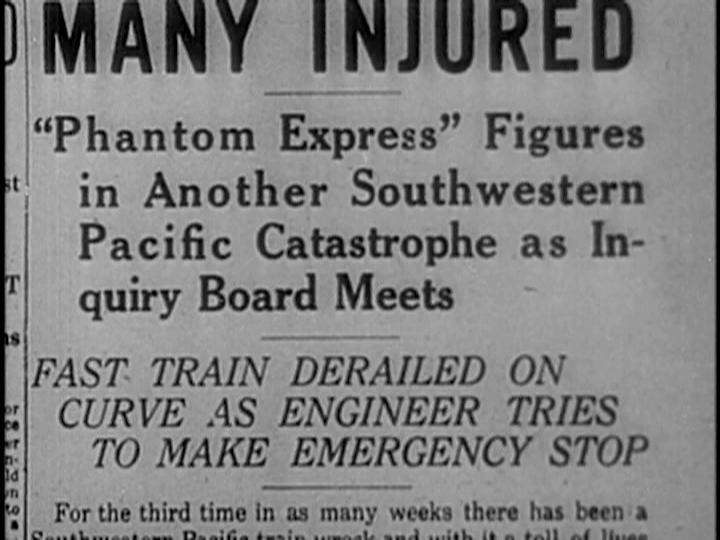
So -- with one foot already in that river of titles untethered to their filmic content -- it's easy to assume The Phantom Express is yet another interchangeable Poverty Row effort, a poorly-acted Sack special, or any number of other been-there done-thats.

That'd be a shame, though, as we were rather charmed by this modest but engaging little movie. True, the plot itself mostly colors inside the lines, and could be summed up like so: a small railroad, plagued with derailments caused by the phenomenon in the film's title, will soon be sold for pennies on the dollar unless the owner's son can solve the mystery.

In all honesty, that mystery isn't terribly hard to unravel, and we guessed its basic outlines well before the final denouement. That said, The Phantom Express doesn't really depend on a whodunit (or a who-conducted-it) to sustain our interest.
Rather, a combination of elements made The Phantom Express a pleasant surprise. One is the skillful cinematography, yielding set-pieces that, for a film of this vintage and budget, are impressively striking.

The biggest factor, though, is the film's unexpected decision not to focus myopically on the hero's quest to save his inheritance. Sure, it's predictably fun to see the boyish Bruce Harrington (William Collier Jr.) go undercover, disguising himself as a grease-blackened railroad worker to find out what's really happening -- and, when the opportunity arises, play a prank on the only person around who knows his true identity.

But instead, The Phantom Express devotes a surprising amount of time to the plight of Smokey (J. Farrell MacDonald), the veteran engineer who's dedicated his life to Southwestern Pacific, only to come under fire when a major derailment happens on his watch. Then as now, loyalty and seniority are no guarantee.
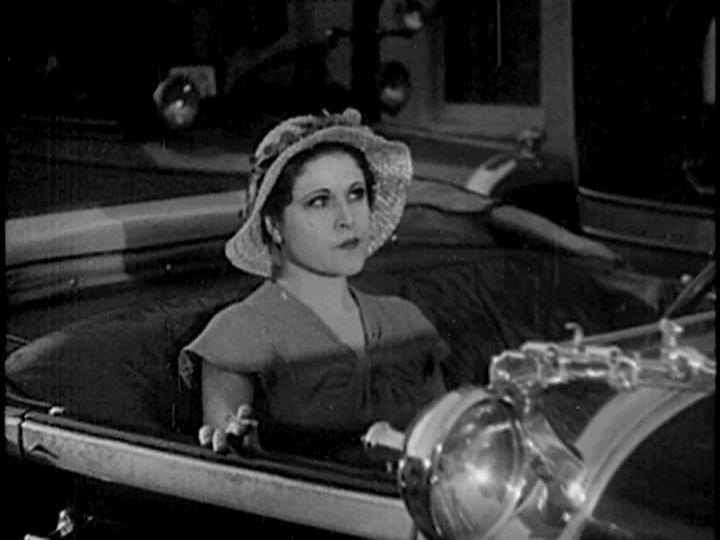
Of course, Smokey's daughter Carolyn (Sally Blane) also turns out to be young Mr. Harrington's love interest (having ditched the heavy-duty RBF you saw a few screenshots ago). Even better for him that he's boarding in their house, for propinquity without iniquity.

Still, The Phantom Express puts Smokey -- and his grief -- front and center for a good portion of its running time. Seldom have we seen a film devote this much care to showing how completely a middle-aged man can be crushed by the loss of his job.
The pathos and intensity here is genuine, and unflinching enough in its depiction that we dreaded -- but half-expected -- the looming prospect of a slow pan and out-of-frame gunshot.

However, a friend in need is a friendly Swede, and none more so than Smokey's irrepressible pal Axel. Played by an actor billed as Axel Axelson (!), with no other credits on IMDb, we have no idea whether we're dealing with a genuine one-shot, or an actor working under a blatant pseudonym for contractual reasons. Either way, Axel's the kind of guy who, if you need him, will show up to help save the day faster than you can say tutenbobels. (Or jazz hands.)

All this means that the closing act of The Phantom Express isn't just a standard boy-solves-crime-and-gets-girl affair, but is as much -- or more so -- about whether Smokey's hopes for redemption will be fulfilled.
Of course, we get the obligatory Scooby Doo action, since these meddling kids still have to solve the crime, unmask the culprit(s), and race against time -- in whatever order. (Bet you thought that "Phantom Shadow" reference was just a one-off!)

But one suspects that, with its frank depiction of a grown man's pain, a film like The Phantom Express may have meant a lot to thousands of aging male moviegoers. With no other socially acceptable way to work through the crushing experience of losing their livelihoods after age 40, at least they could see someone else's grief mirroring their own, while trying to find a way forward in a dark, friendless time.
And sadly, that's still as relevant now as it's ever been.