Showing posts with label my dad's a brilliant scientist. Show all posts

Sunday, October 8, 2023

Polish my Helmut – or, more Cushing for the pushing

Violence -- sexual or otherwise -- has long been cinema's favorite excuse for bare breasts. And these films supply all of the above, plus other pendulous globes! 


Mad Dog (1977) 
[aka Beast with a Gun, etc.]

Grade: C

Oh, Helmut Berger. A cautionary tale of wasted talent, or an example of someone who got the most out of what was predestined to be a limited shelf life? A charismatic chameleon and a born star, or a passaround boy who lucked into the infatuated gaze of fawning directors?

Well, probably the former (in each case). Berger exudes magnetism and danger, like the proverbial caged tiger, and you can't fake that with clever cinematography. He must have been part of what made Visconti's The Damned so striking, though the present writer mostly remembers the Night of the Long Knives scenes.

Such a shame when bad things happen to...people.


Clearly the makers of Mad Dog -- aka Beast with a Gun, The Human Beast, Mad Dog Killer, or La belva col mitra if you want the original Italian -- knew Berger was their star attraction. So they give him just the kind of role in which he shines, as Nanni Vitali, an absolutely ruthless, sexually voracious criminal who escapes from prison and is hell-bent on revenge.

No doubt they had Berger at "ruthless", his forte.


And they give him plenty of screen time, including a protracted shot of his bare backside if you're into that sort of thing, and pretty much all the best lines. More than once it borders on camp, intentionally or not, as when a detective (seemingly) meets his end in a fiery crash:

"That was a nice sight! A well-done dick."

You don't say, Helmut Berger! You don't say.


That detective, one Commissioner Santini (Richard Harrison), has one thing going for him: dude is absolutely jacked. Unlike a lot of policeman protagonists, you get the feeling that this cop could literally overpower the villain. He's got muscles and brains, so what's not to like?

Well, as opposed to (for example) Dirty Harry, Santini is too much of a straight hero to get the good lines. I suppose you could count his Smash Mouth moment about 12 minutes in -- "Vitali's like a mad dog!" -- but that only works on a meta, presentist level.


Actually a bunch of Santini's dialogue hits very strangely in 2023, in that he'll be saying something fairly routine but finishes off with something that sounds like a low-karma Reddit post. See, for example, when he excoriates Vitali for his cowardice:

"You're a filthy hyena. And you have the courage of one. You're only brave as long as you've got that gun, so you can terrorize helpless females."


Oh, hey, I got a work call and have to go home early but it was great meeting you!

Or how about when he, uh, excoriates Vitali for his cowardice again?

"You're a coward. You think you're a genius but you're just a common killer. There's a whole race of people like you, Vitali!"

That's...that sure is a thing you just said, that was said, by you.

On the other hand, we cracked up when a perfectly reasonable request from his Kim Clijsters-looking hostage, Carla (Marina Giordana), got this nasty reply from Vitali:

"I'm thirsty."
"So have a drink, twat!"

Once again, the bad guy gets all the good lines.

Of course this also betrays the fundamentally mean-spirited attitude of Mad Dog. Sure, modern viewers aren't likely to be bothered by its violence -- a bit of which was trimmed out of the Mill Creek print, though the only significant cut we identified actually improves the movie.

(The guy was face-down in a puddle and looked dead as a doornail, so bringing him back to have him cry out in agony? Not a good idea.)

But the "sexy man rapes woman, kills mate to demonstrate alpha status, and may have induced Stockholm Syndrome with his mighty phallus" angle of the film is uncomfortable. Arguably Mad Dog tries to have its cake and eat it too, though we can't communicate how without spoilers, but it's clear the film wants us to think she was ambivalent.

A subtler and more provocative moment comes in the homoerotic subtext between Vitali and the young criminal he picks up (Alberto Squillante). The way Helmut Berger looks at this Bimbo -- no, really, the character's name is Bimbo -- is tough to pass off as merely a kind of paternal affection.

Perhaps Berger put a bit of his authentic self into the role, since it's hard to imagine "Act like you want to bang the delinquent someday" was in the script.


It's also refreshing that Vitali isn't a Criminal Minds-style genius or master karateka, but someone who gets by strictly on his looks, ruthlessness, and cunning. He fumbles an attempted hit on a witness, keeps getting cornered like a rat, and even fails to perform in one fight scene, when a botched swing has him missing the victim entirely: "Bruno! Punch him!" he shouts.

Playing it off was cheaper than a reshoot, I guess.

Oh, and the print looks good enough, but very occasionally something gets cropped to comic effect, like this entrance:


Anyway, Mad Dog has multiple plot holes -- the one at the beginning, involving an unloaded gun, is comically obvious -- and a nasty streak. Even with lines like "I'll be in town...making hamburger out of the motherfucker!", is Helmut Berger enough to carry this one?

It depends on what you want from your hour-and-a-half of entertainment. It was probably bracing in 1977, but hard to predict people's reaction now. Maybe it's got a bit of the "too much of this, not enough of that" syndrome.

Quentin Tarantino seems to like it, prominently featuring the film in Jackie Brown. As for whatever Berger thought, he seems to have given it his all. Or makes us think he did.


Count Dracula and His Vampire Bride (1973)
[aka The Satanic Rites of Dracula]

Grade: D

Count Dracula and His Vampire Bride relies upon the premise that a bunch of high-ranking British muckety-mucks are in a secret society engaging in unspeakable, depraved acts with vulnerable persons. I mean, how gullible did Jimmy Carreras think we are, to toss a vile notion like that at us?


This wasn't quite Christopher Lee's last appearance as Dracula -- there's a horror comedy (shudder) yet to come -- but it's his last with Hammer. To be honest, the only other time we've seen Lee don the cape was in Jess Franco's Dracula (which we're not reviewing, as we'd have nothing interesting to say), so we don't have lots of context for his work as the Count.

This time around, his charisma is undiminished, his accent silly, and he just doesn't get all that much to do.


Meanwhile Peter Cushing is Professor Lorrimer Van Helsing -- one of the many fictional descendants of that fearless vampire hunter, who take to the job like an orphaned beaver that instinctively builds dams. (And they do!)

No marginal old man, Van Helsing holds his own and plays his part -- despite repeatedly engaging in the vice of announcing what you're about to do instead of just doing it. And he even shows off some pendulous globes!


So why is Drac back? Just to frolic with mid-tier extras whose agents convince them going topless will help their careers?


No, he wants to kill everybody with a new strain of bubonic plague that kills "within seconds". Septicemic plague can take less than a day (once symptoms present), but the modern vampire is in a hurry!


If anything Count Dracula and His Vampire Bride seems to think that evil for its own sake is enough of a motivator. Van Helsing tells us it can be "more addictive and more potent than heroin, I assure you, and the end result is just as fatal". Paging Dinky Hocker.

And we get a speech from one Professor Kelsey to that effect -- someone who was apparently "awarded the Nobel Prize for science and humanity" (er, sure), yet now has thrown his lot in with the infernal:

"Evil rules, you know. It really does. Evil and violence are the only two measures that really hold any power."

As we get older, and see more things happen, the temptation to reply "Well...you're not wrong!" grows stronger.

In any event Dracula has two persecutors, as he's also harried (indirectly) by Inspector Murray (Michael Coles), a specialist from Scotland Yard.

Inspector Murray also has the hots for Van Helsing's granddaughter Jessica (Joanna Lumley), for whom we do not have the hots.


Coles has one of those creepy old-young faces (like Brian Jones of the Rolling Stones), a big part of which is the way his haircut inspires cognitive dissonance (also like Brian Jones of the Rolling Stones).

(Not to mention the guy mentioned in red above: seriously, how could the world not twig Jimmy "Jim'll Fix It" Savile as a creep? That weird-haired burly man-child gave us the jibblies the first time we saw him.)


On the other hand, Coles is very good at projecting that "boxer who just took a hard hit to the end but is going to keep on fighting" thing, which is a lot more convincing than the usual impervious action-hero crap.

...speaking of which, Van Helsing (the elder and handsomer one) gets shot in the head, yet they don't bother to explain his immediate recovery or why he's not dead. Would one line about "Somehow, it ricocheted off my skull" really go amiss?


Count Dracula and His Vampire Bride is pretty phoned-in, more so as it goes on. The first 30 minutes or so are moderately entertaining but before long, the plot and pacing are in danger of falling below "Sega CD FMV game" standards. It relies too heavily on people doing stupid things, and needed more pulchritude to keep its audience too titillated to notice its flaws.

(Our understanding is that we're not missing any significant footage vs. the original release under the Satanic Rites of Dracula title, but we could be wrong. Correct us if we are, since a "Well, actually" comment would at least indicate that someone's reading!)

But is it watchable? Sure, it's watchable: what movie with T and/or A isn't, one might ask? (Some entries hence, you'll get an answer to that, courtesy of Ed Wood.)

And some of those action scenes get pretty funny at 4x speed, which is how you play them back if you're reviewing a movie a couple years after you first watched it. As one does.


Obviously, we haven't been able to post much lately. That happens sometimes -- but far be it from us to allow 2023 to pass without an entry.

Perhaps this will mark a renaissance at the Umbrellahead Review, as we catch up on our backlog and start going steady again? We look forward to that day!

Thursday, January 14, 2021

Beat them drums

While Mill Creek now sells a 200-movie box called Tales of Terror, they used to sell a completely different 50-pack of the same name. That older Tales of Terror 50-pack was then incorporated, unchanged, into their Horror Collection 250-pack -- aka our ten-year project completed at the end of 2018.

However, as we've previously noted, an even older version of Tales of Terror had a few interesting movies that were later cut from the set, including a Tod Slaughter film we still haven't seen.

So we sat down to watch two of those films, with no other plan in mind, only to discover they had a huge theme in common. To quote Ice-T, poet of our time:

Way down in New Orleans, yeah
I met this old lady...

If you know what follows that incipit, you know what's coming. And -- wouldn't you know it? -- the first of these movies isn't just set in the Pelican State, it is the Pelican State.


    Drums O' Voodoo (1934)
    [aka Louisiana, aka She Devil] 

    Grade: D-


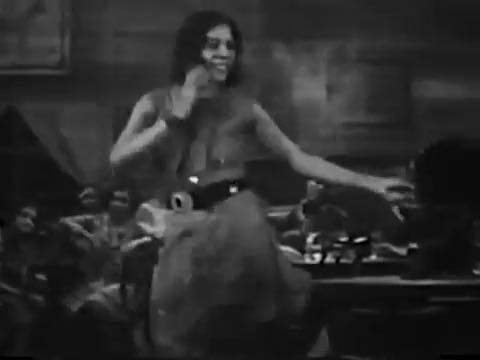
    Well, when we see the Sack emblem, we know a few things about the film to come: it'll be short, and it won't be very good but will at least be interesting.


    That pretty well sums up Drums O' Voodoo, a morality play in the figurative sense, and just about the literal one as well: it was adapted from a stage work, Louisiana, by one J. Augustus Smith, and with a lead antagonist named "Tom Catt" it's clear the brushstrokes will be broad in this one.


    Smith also plays the preacher Amos Berry, also known as (sigh) Elder Berry. His checkered past becomes leverage for Mr. Catt in the latter's quest to bang nubile niece Myrtle (Edna Barr) --


    -- and since Myrtle's already started jookin' in those jook joints, the danger is clear and present. The power of Christ can't compel Tom Catt to back off, but maybe something else can do it? You remember how things ended for Ice-T, don't you?


    Thus enters Aunt Hagar (Laura Bowman, whom we know from Son of Ingagi), whose sonorous voice and foreboding manner -- "Leave everything to me...and the vooooo-dooooo" -- make it clear that this is a woman not to be trifled with. Does trifling ensue? You betcha!


    Another blog, Atom Mudman's A-List, has already covered Drums O' Voodoo with both greater depth and greater sympathy than we can offer, so no need to rehash his good work.

    Though Drums is certainly unusual in many ways (some of which Mr. Mudman details), we unfortunately found most of it excruciating, give or take. As a poorly-preserved document of a poorly-adapted screenplay, what we have here can't really be characterized as "cinematography", but more the equivalent of setting up the camcorder at the back of the auditorium to capture those precious moments of your kid as Tree #3. 


    When you put that together with amateurish acting, a cornball script, and a print in absolutely trash condition, there's not much left. However there's some documentary interest in seeing and, especially, hearing scenes of black American religious life in the early 1930s.

    That part is kind of neat and ought to be known to scholars -- and since apparently Drums O' Voodoo was included in the 2017 UCLA Festival of Preservation (under the She Devil title), maybe there's a copy out there that actually looks decent and includes an intact ending. (This one sure doesn't -- shortly after the film's climax, it unceremoniously Poochies back to its home planet.)


    And hey, Laura Bowman does get a few good lines at the expense of Tom Catt, observing that he's "not as human as the alligator, or gilly monster, 'cause even they don't tackle the females when they ain't willin'!"

    Preach, Aunt Hagar, in your witchy way, and with your one facial expression.


    And speaking of gila monsters:


      I Eat Your Skin (1971, filmed 1964)
      [aka Zombies, aka Voodoo Blood Bath, etc.]

      Grade: F


      Right away we note: yes, after the film sat on the shelf for 7 years, it was retitled I Eat Your Skin so that it could play on a double-bill with I Drink Your Blood. Fine.

      But the new title technically isn't deceptive, as some have claimed, since there is a skin-eating...condition...that plagues some of the characters in this film.


      OK, with that out of the way? Gosh, this movie sucks. Yes, regional filmmaking; yes, seven years on the shelf; yes, all of those things. But this film isn't fun in the way that The Giant Gila Monster or Teenagers from Outer Space is fun, nor in the way that Miami Connection or Troll 2 is fun.

      It's just a stupider, slower, duller version of a half-dozen movies we've seen already -- akin to Teenage Zombies or The Horrors of Spider Island, but not even as good as those. (And yet Mill Creek felt compelled to retain it on the Chilling Classics box set: the world wonders.)

      I Eat Your Skin tries to be funny, isn't; tries to be sexy, isn't; tries to be scary, isn't. This movie just isn't. It has an overarching lack of is-ness, you might say, except in the sense communicated by sentences like:
      • Watching this movie is exactly what I don't want to be doing right now.
      • This film is a dispiriting waste of time and celluloid.
      • Experiencing these 80 minutes is as titillating as a Dixie cup half-full of wet sand.


      Oh, I Eat Your Skin successfully "is" at least one other thing: disconcertingly racist even for a 1964 film, leaving one to wonder how it came off in 1971.

      In this film the black people are the bad people, full stop, while the zombified oafs that lumber around the island are uncomfortably reminiscent of the freakish giants in The Lost City. The whole thing is just icky.


      Watching Mill Creek boxes could easily give the impression that the early 1960s were an awful time for film: smutty and smirking, grotesque and heavy-handed, trashy yet still bound by prior norms and shortcomings, and subjecting viewers to a constant bombardment of sub-Mancini big-band "jazz" clichés.


      I Eat Your Skin does little to undermine that impression. It's the kind of film that pushes screeching people into pools and thinks that's funny -- 


      -- or sets the action in a place called "Voodoo Island" and thinks it's engaging in effective storytelling.


      It's got trombones, and tremolo guitars, and mad scientists, and voodoo ceremonies, and nothing we wanted. We rued its beginning and welcomed its end. We hope you appreciate our sacrifice in watching it.

      Monday, January 11, 2021

      Put our service to the test

      Though neither of these films is a Mill Creek joint, we initially took an interest in them because of their connection to the Horror Collection 250-pack. One features an actress we first met in the earliest days of our site, while the other is ostensibly a sequel to one of our favorite movies on the box.

      However, we didn't foresee that they'd share something else: protagonists who find themselves in the crosshairs of that most terrifying of locations --

      --that most bone-chilling of phrases --

      -- that limitless vein of potential awkwardnesses and unwanted socializations:

      "You can stay in our guest room."


        The Three Weird Sisters (1948)

        Grade: C+

        Ah, Nova Pilbeam. Even if your name weren't so unusual, we'd certainly remember you from your star turn in Counterblast, not to mention your strong resemblance to a former colleague of ours (at least in that colleague's younger days: you wouldn't recognize 'em now).


        And speaking of younger days, it's not clear whether this or Counterblast was Pilbeam's last film role -- though she did make one BBC appearance in 1951 before packing it in for good -- but after a successful career as a child actress, and a reasonable career as a young adult, that was that.

        She lived to age 95 -- when we wrote our Counterblast review, she was still alive! -- but was, from all reports, not interested in discussing the past. (Makes sense when your name is "new".)


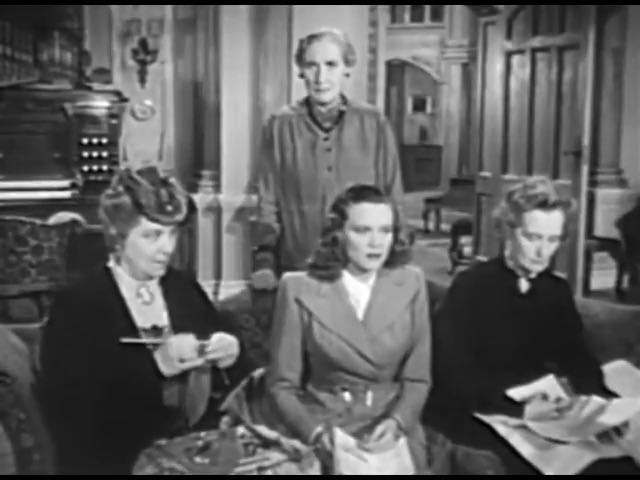
        Anyway, Ms. Pilbeam is Claire (no relation to Emily) Prentiss, a secretary who accompanies her obstreperous boss Owen Morgan-Vaughan (Raymond Lovell) to a Welsh mining village, Cwmglas, where his (ahem) three weird sisters await his arrival at the family home.

        (Technically they're his weird half-sisters, but that wouldn't have the same ring, now would it?)

        One is blind, one deaf, and one has some combination of bad nerves and severe arthritis, resulting in a strange symbiotic interdependency between the three.


        In the film's opening Cwmglas suffers a catastrophic collapse in which several residents die, and survivors opine on the will of God and the suffering of the proletariat.

        While hard to follow on first viewing, a quick review of Dylan Thomas: The Complete Screenplays (which also told us how to spell "Cwmglas") makes the details clear. The Morgan-Vaughans are the local muckety-mucks who made their fortune via the mines, while their cheapskate refusal to fill up unused mineshafts beneath the village caused, or at least contributed to, the collapse.


        For a while, The Three Weird Sisters is poised on a knife-edge of ambiguity: is Owen just a callous bastard who selfishly wants to wash his hands of all responsibility toward the village? (Given that Owen gets a rock flung at him upon arrival, some of the townspeople clearly hold the affirmative.)


        Or is Cwmglas -- the name of which sounds like a "worst of Reddit" thread in the making -- just a decrepit symbol of the corrupt, hopeless old ways? A decaying relic that's undeserving of life support and overdue for destruction? Merely a vessel for a "spent force", one might say?


        With Dylan Thomas on board, some sophistication (moral and otherwise) is to be expected. Ultimately, though, the lines are drawn by the participants' willingness to sacrifice innocent Claire in the crossfire -- and given that one of the sisters describes her as "that horrible painted young woman", one need not be exceedingly wise to infer who the baddies are.


        So what does that leave us? Suspense, atmosphere, intrigue, and barbed dialogue, we suppose, none of which are extraordinary but all of which are at least serviceable. And we get faces, if one likes faces (as we do), ranging from Ms. Pilbeam's ever-popular visage --


        -- to the sisters, especially Gertrude (Nancy Price), whose forbidding countenance somehow intrinsically evokes those stony, mirthless parts of Britain where God's name is perpetually on everyone's lips and yet the old pagan powers feel close at hand.


        Or there's this preacher (Hugh Pryse) in his ridiculous middle-aged makeup:


        And we get amusing vignettes, as when we find the thersitical Mabli (Hugh Griffith) reciting Marxist dogma to, well, dogs:


        Structurally speaking, The Three Weird Sisters is a film-you've-seen-before -- if you understand what we mean -- and offers no great innovation or dramatic uncertainty. So your appreciation of it will likely depend on your affinity for the Welsh coat of paint it's received, and/or your fondness for Dylan Thomas, Welsh terriers, Nova Pilbeam, or handsome older women.

        (No judgment, you do you.)


        Devil Bat's Daughter (1946)

        Grade: D+


        When you expect a film to be a complete piece of crap, it sure is a pleasant surprise when it's not. That's not to say Devil Bat's Daughter even comes close to its predecessor, The Devil Bat, the consensus favorite among Béla Lugosi's Poverty Row efforts (and we agree that it holds up).


        We can't help but be curious why Devil Bat's Daughter was even made. Was a five-year-old film really enough of a success to call for a sequel? That is: if this was a cynical cash-in, what exactly was there to cash in upon in the first place?


        In any event, Devil Bat's Daughter has little to do with the earlier film, though we can't quite call it an "in-name-only" sequel. Instead it runs along similar lines to Shock, with a traumatized young woman, Nina (Rosemary La Planche), guided through recovery by the authoritarian Dr. Clifton Morris (Michael Hale), who may not have her best interests at heart.


        We're not sure whether having a patient living in your home was considered a ridiculous violation of professional boundaries in 1946, though from our vantage point 75 years later, it seems absurd. But living in Dr. Morris's home brings Nina into contact with his saintly wife Ellen (Molly Lamont) and stepson Ted (John James), and guess which one of them falls in love with her?


        ...no, this is 1946, try again. Though we will say that Ms. Lamont, who hasn't necessarily lit up our screen in movies like Scared to Death and Jungle Girl, evinces a degree of angular classical beauty in this film --


        -- while, by contrast, Ms. La Planche's past as a Miss America merely underscores how tastes have changed.


        But better either of them than John James, who unfortunately evokes the irritating Jerry Lester -- plus a dash of Mickey Rooney, a sprinkling of Tim Allen, a dusting of John Heard. Those old-young faces are a tough sell.


        If one acknowledges that the major plot points of Devil Bat's Daughter are foreseeable, there are a few things that deviate from the expected path. One of them is the body count, or more accurately, the body-count-to-emotional-consequence ratio, which is unexpectedly brutal. Not a film for dog lovers, this, though we're always glad to see a movie go for the jugular.


        On the other hand, Devil Bat's Daughter commits an absolutely monstrous act of retconning that, under normal circumstances, should be unforgivable. So instead, we'll forgive it by allowing ourselves to pretend that the literal meaning of the revelation -- which would utterly destroy both this movie and the previous one -- is untrue, and that the character who announces it is mistaken. And frankly, the movie still works if you assume that.


        Still, while our initial impulse was to give this one a C-minus, it really needs to be penalized for that misstep. Otherwise, we were shocked to find that we enjoyed Devil Bat's Daughter. It's a predictable and flawed film, but manages to entertain nonetheless -- if you have very low standards, as we seem to these days.