Showing posts with label scarred for life. Show all posts

Tuesday, August 22, 2017

The 24-hour myth

And now, two films where someone goes to the police for help in finding a vanished lover, but gets turned away for lack of evidence -- at least initially. In one, you already know the plot; in the other, we can hardly say a thing without spoiling it.


The Tell-Tale Heart (1960)

Grade: D+


Well, as we're drawing near the end of the Night Screams subset of the 250-pack (only six left!), it's fair enough to have a film that gives us a real-deal, full-throated night scream.

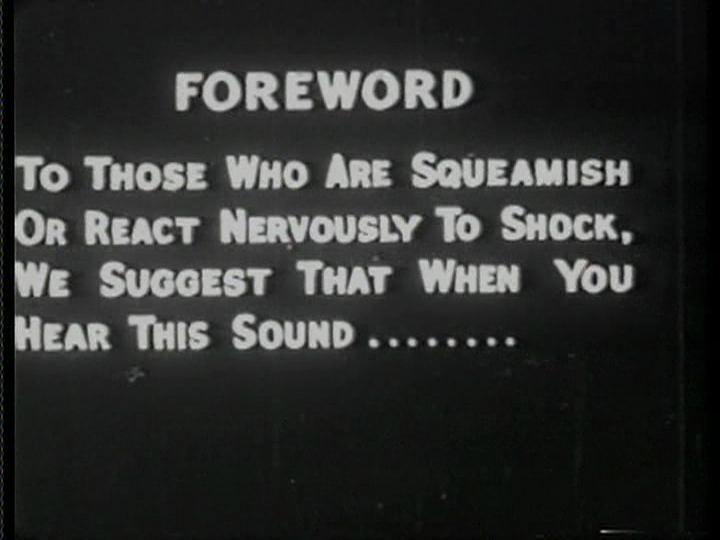
Of course you already know the plot of The Tell-Tale Heart -- and if somehow you don't, then the opening scene's pulsing floorboards and thumping bass drums constitute advance notice (and a literal flash-forward). It even comes with a warning:
So we have Laurence Payne as Edgar (ha ha), the painfully shy librarian, smitten at first sight by the charms of new neighbor Betty (Adrienne Corri) whom he creepily spies on from his window.

For the inside scoop on Betty, Edgar hits up her landlady (Annette Carell), whose fine-featured face somehow took us by surprise, if only for its unexpected unmatronliness. She looks more like an aristocratic German woman in her mid-thirties, or maybe a teacher at a high-end boarding school, than a working-class property manager.

Anyway, Betty agrees to go out with Edgar, and the ensuing date rivals "Ralph Wiggum walks Lisa Simpson home" for sheer awkwardness.

Still, Betty is the very picture of patience and tolerance -- until Edgar abruptly puts the moves on her at her doorstep. It's pretty gross, and while the idea is clearly to keep Edgar from becoming too sympathetic a character, it also exhausts our ability to care that much about his plight.

On the other hand, he has this great friend, Carl. Everyone likes Carl!

From the moment Edgar starts heaping praise on his friend's head, we know where this is inevitably going, the only mystery being whether the ultimate body count is 1, 2, or 3. The real question is, will getting there be half the fun, or not?

Well, the answer in this case is mostly "not". Though atmospheric and competently made, The Tell-Tale Heart is too obvious for its own good, and too emotionally uninvolving to succeed. The score is particularly heavy-handed, with silly "ba-woomp!" timpani glisses that, in trying to evoke some transfigured version of a heartbeat, end up being just a bit too on the nose.

If we already know what's going to happen, where's the tension in watching Edgar's mind unravel? Is sheer expectation meant to be enough here?

The Tell-Tale Heart does attempt a last-minute Hail Mary to solve its central problem, but as with any other work of fiction that tries the same thing, it just leaves the audience feeling baffled and betrayed. What's left is, as so often the case, a passel of interesting faces, like this overly attached barfly/prostitute --

-- and this blink-and-you'll-miss-it appearance by Frank Thornton, aka Captain Peacock from Are You Being Served?, as a barman:


Wanted: Babysitter (1975)
[aka La Baby Sitter, Scar Tissue, etc.]

Grade: C


It's very difficult to know how to talk about Wanted: Babysitter without completely spoiling it. One thing to say upfront is that this was indeed a color production and is available elsewhere in full color, but -- much like Hannah, Queen of the Vampires -- the Mill Creek copy is in black-and-white for some reason.

Then again, when you're talking about one of the most confusing movies we've seen in recent memory, perhaps the black-and-white isn't such a bad thing -- helping the film to seem unmoored and surreal, rather than just muddled. (It also takes the edge off the score's more saccharine moments.)

There's some real star power aboard in Wanted: Babysitter, like:
  • Maria Schneider, whom you know from that movie (and kudos for her witty remark that she only cooks with olive oil now);
  • Vic Morrow, whom you know because he died in that horrible helicopter accident;
  • and Robert Vaughn, whom you know because his picture is in the dictionary next to the word "glower".
As Michelle, a French sculptor living and working in Rome, Schneider seems likely to be the protagonist. But a lot of the film's initial attention goes to Ann (Sydne Rome), a wounded, vengeful actress whose secrets comprise the movie's two titles (more or less).

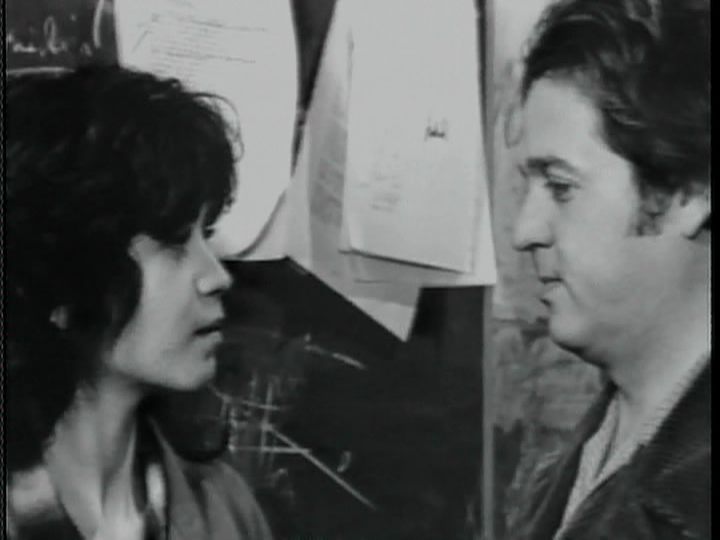
Wanted: Babysitter tanked on release, and was given an especially harsh rating by Leonard Maltin, who dismissed it as a "misfired melodrama" with "non-acting" from Schneider. He also criticizes the "miscasting of chubby Italian comedian Renato Pozzetto" as Michelle's boyfriend, which is a fair cop -- his presence is weird and hard to parse, though it's oddly appealing that the guy in her corner is a schlubby albeit determined goofball. Chubby guys with dad bods can be heroes too, after all.
It's quite obvious that the fragmented narrative in Wanted: Babysitter is a deliberate stylistic choice whose consequences, love 'em or hate 'em, are central to the film's structure.

However, the jury's still out when it comes to the movie's persistent failure to establish a clear sense of place -- by which we mean that we often didn't understand where the hell we were, and worse yet, sometimes thought we were in one place before realizing we'd been in another for a good five minutes.

So, is this an intentional move, a question of style...or a sign of directorial incompetence and/or laziness? (Or maybe it's the black-and-white?)

In the midst of all this, we have bunnies, puppies --

-- and a young boy named Boots, which when written out has about the same resonance as "a homeless girl named Dave" (speaking of Britcoms). The child actor playing Boots even gets his very own "introducing John Whittington" moment in the credits, so naturally he doesn't have any other roles to his credit. Maybe he's an assistant manager at a car wash now.

We can tell you that Wanted: Babysitter is a complex, thoughtful movie of the kind that probably rewards multiple viewings. Even watching just the first few minutes over again, we were able to catch numerous details that eluded us -- no doubt intentionally -- on our first pass. It's always nice to watch a film that assumes its viewers are smart, and gives itself permission to imply a great deal more than it says outright. (Think of the brief exchange in Citizen Kane that lays bare the anti-Semitism of his first wife, even though the word "Jew" is never uttered.)

If the movie does have a fatal flaw, though, it probably is somewhere in that combination of Schneider and Pozzetto, especially the former. In situations where Michelle ought to display a sense of urgency and purpose, she instead seems detached and resigned -- so much so that one ends up rolling one's eyes, swearing at the screen, or simply losing one's suspension of disbelief.

Anyway, here's a funny picture of Robert Vaughn in period costume.

And here's a bunny.

Monday, May 29, 2017

What a doll

We're all about timeliness at the Umbrellahead Review; since today is a holiday (happy Memorial Day, everyone!), let's review two Santa-centric features, each with an adorable little tyke and her beloved dolly. 


Santa Claus (1959)

Grade: F

What else can one really say about one of IMDB's bottom 100 films of all time? Santa Claus is #87 as of this writing -- two spots below The Aztec Mummy Against the Humanoid Robot (1958), another K. Gordon Murray Mexican import redub special.

 
It's a bizarre offering, to be sure. Our man Santa lives in a crystal and gold palace in a galaxy far, far away (though simultaneously directly above the North Pole -- quite the astronomical feat!), and spends his free time playing a magical organ to accompany a flotilla of singing and dancing It's a Small World rejects.

Too racy for Disney, perhaps.
There's no Mrs. Claus in sight (hmm), but he does have a sweaty, hairy, shirtless blacksmith (double hmm) and Merlin the Wizard (yup) in residence to help him out with all the traditional accouterments necessary for Christmas Eve. 

This includes a giant key that opens every door on the planet, sleeping powder for the kiddies, and a massive collection of spy equipment focused squarely on Earth's children. 

This is naturally controlled by giant animatronic body parts.
Santa's particularly fixated on a handful of Mexican niños, among them adorable Lupita, a poor little mite who just wants a dolly for Christmas (plus one more to share with the baby Jesus, because she's just that good and pure).

Lupita really is a cute kid, we say without sarcasm -- we'd love to know what happened to her
Meanwhile, back on Earth (or maybe Pluto or something, since if Toyland is in outer space, why not Hell?), Satan interrupts a demonic dance party to summon his minion Pitch, who's tasked with leading the children of Earth astray (coincidentally, those same Mexican kids!) in order to defeat Santa Claus. 


OK, we'll buy that -- Mexico has its traditional devil-vs-the-shepherds pastorelas, so this modernized, kid-friendly version isn't completely out of left field. What follows is an often strange, yet ultimately harmless baturrillo of devilish trickery, strange ballets, and parents presented in rather coffin-like oversized gift boxes. 

Besides its seemingly interminable length, we count three factors that turn what could have otherwise been a so-bizarre-it's-wonderful surrealistic romp into a ¡dios-mío!-please-let-it-be-over slog.


First is K. Gordon Murray himself, who not only bastardized the original Mexican production (so say some sources -- we're not keen on doing a detailed compare/contrast ourselves), but lent his own voice as the omnipresent narrator, who just goes on and on and ON in that very 1950's false-excited tone, without letting any of the (dubbed) dialogue or action just, you know, speak for itself. 

LET ME TELL YOU ALL ABOUT WHAT IS HAPPENING!
The second is a sort of claustrophobic dinginess that infuses all the scenes, both indoors and out. The Eastmancolor film process probably plays a factor, but no doubt a low budget and poor production values didn't help. 


Even the Toyland scenes, with their over-the-top set pieces and giant key-shaped door openings, have a closed-in, suffocating feeling (bad lighting? poor camera angles?), and this ends up sucking all the brightness and life out of the action.


Finally, the absolute worst thing about the film (in our humble Umbrellahead opinion) is the eye-rolling, ear-gouging, almost physically painful repetition of Jingle Bells -- never a verse, always just the chorus, over and over and over again, whenever a musical cue was deemed necessary (which was often).

 
Whatever its other memorable bits -- I mean, a wizard in a Christmas movie? -- Santa Claus will forever be known to us as "that awful Mexican Jingle Bells thing." Sorry, little Lupita.


Christmas Evil (1980)
(aka You Better Watch Out)

Grade: D


Christmas Evil certainly had the potential for something greater than just seasonally mitigated obscurity. The film stars Harry Stadling (Brandon Maggart), a sad sack middle manager at the Jolly Dream toy factory whose fixation with Christmas stems from a traumatizing moment when he saw his mother in flagrante delicto with his Santa suit-clad father. 

Reminds us of (the later) Don't Open Till Christmas; however, unlike the murderer in that film, the experience doesn't make Harry want to kill Santa -- it makes him want to be Santa. 

Paging Dr. Freud...
From the rooftop of his modest apartment (filled with Santa kitsch -- posters, dolls, the works) Harry spies on the neighborhood children, recording their every act in a custom-embossed pair of leatherbound tomes of, yes, Good Boys & Girls (including little Susy Lovett and her doll -- "just a darling") and the corresponding Bad ones. 

His bookshelf shows volumes labeled '78 through '80 -- where did one have books like that produced in 1980? The local Kinkos? Mail order?
OK, a bit sad and more than a little odd, but so far nothing overtly sinister. What follows is Harry's transition from neighborhood creeper to holiday killer.

Here's why Christmas Evil had potential: its murderer is not, for once, a comprehensively psychotic yet remarkably clever and capable mastermind, able to carefully plan the minutest details of complex crimes and cooly elude capture, all while being completely batshit crazy. 

Hello? Is this every modern crime show on TV?
Rather, this is the slow burn of a sad, unbalanced man being gradually pushed over the edge by the thousand small cuts of an uncivil society: his boorish bullying co-worker; a snotty little boy ogling Penthouse (whose mother happens to be played by Mrs. Tim "The Tool Man" Taylor, Patricia Richardson); the greedy corporate bosses who value profit over charity.

Fed up with the injustice (and unwholesomeness) of it all, Harry focuses on transforming into the jolly elf himself -- the perfectly-padded suit, well-glued facial hair, fancifully painted van-turned-sleigh -- to put right all the perceived wrongs. 

That he goes on to commit murder is only a byproduct of this strange, misguided, rather bumbling quest to restore Christmas cheer to his small slice of the dirty, cruel world.

Where the film fails is not in the premise, but the writing and direction (both by Lewis Jackson). It sort of wants to be a black comedy -- and it probably would have made a great one! -- but is neither black nor comedic enough to pull it off. 

There are a few exceptions.
It really wants to be a slasher flick, but lacks the punch, suspense, and shock factor of even the more mediocre ones (not to mention that the body count is rather low). 


Key scenes are poorly shot and end up murky and hard to follow; the film's timeline isn't well defined (though we figured it out on second viewing), which also adds further confusion. 

It follows a pattern we've often seen in underwhelming films -- an intriguing premise, a middle third that drags, and a rushed finale that doesn't really fulfill the promise of the beginning. Brandon Maggart was well cast and did his best, but ultimately, Christmas Evil belongs on the Bad list.