Showing posts with label cavemen. Show all posts

Monday, December 17, 2018

Poor Mrs. Chickenbottom

Have you ever started a school paper or an essay with one of the following?

"Ever since the dawn of time..."
"Throughout human history..."
"From the earliest days of mankind..."
"In the broad sweep of history..."

To a teacher, sentences like these are the equivalent of Comic Sans at a typography convention. They strike at the heart of even the most seasoned educators, filling them with dread, ennui, and the compulsion to question their life choices.

And sadly, we've all done it at least once, and maybe more than once -- kinda makes you want to track down poor old Mrs. Chickenbottom and buy her a beer, doesn't it? -- until a brave red pen intervened and said "No, and never again" to that hoary cliché.

These two films, though, clearly didn't get the memo. Both of them start out with a narrator -- never a good sign -- who portentously sets the stage by talking about events that predate recorded history.

You know, things that happened at the dawn of time. (Sorry, Mrs. Chickenbottom.)


    Prehistoric Women (1950)

    Grade: F

    Let's just take a moment to consider the opening voiceover in Prehistoric Women:

    "Our knowledge of the prehistoric world, before the first historian sat down to write the story of his people, is vague. It’s founded on the research of archeologists. Their studies of people and dwellings which existed in those times. Existed not only in rocky wastelands, but in the warmer climates, in the plush, prehistoric jungles. Not so very long ago, an explorer in a wild, tropic jungle found evidence which told this story. Nobody knows when these events took place -- maybe ten thousand, maybe a hundred thousand years ago. It’s the story of romance when the world was young.”

    And now, take a moment to reflect on those broken sentences and that tortured syntax. Someone thought to themselves, Yep, this is a good way to start a movie. This is good writing. People will enjoy this.

    With a few exceptions, like these three films, most discs in our Mill Creek 250-pack have been haphazard in their pairings. Follow The Giant Gila Monster with The Fatal Hour? Sure! How about a double-feature of Carnage and Daughter of the Tong? Makes sense!

    However the person who put together 50 Sci-Fi Classics seems more on the ball, because Prehistoric Women is paired with The Wild Women of Wongo on Disc 58, Side B, and that's pretty spot-on.

    Even though it was almost a decade ago, the grinding, interminable experience of watching Wongo is still plenty fresh in our minds. How could it not be, with all those parrots and, uh, wild women?


    Prehistoric Women gave us the same grinding, minutes-are-like-hours feeling we got from Wongo -- but, somehow, it's actually worse. At least Wongo didn't take itself seriously, but Prehistoric Women has loftier ambitions, and that pretty much kills off any chance of enjoyment. It's pure torture.

    If it seems like we're trying to avoid actually talking about Prehistoric Women, well, you've got us. Bottom line, it's basically a really, really stupid version of Quest for Fire -- crossed with Wongo, or One Million B.C., or whatever shitty caveman movie you want to invoke that actually has women in it.

    Of course, these women have immaculate hair, makeup, and teeth, just like in prehistoric times. After all, they're totally paleo.

    And when you have a nearly (or at least temporarily) all-female cast in the 1950s, you know what that means! Good ol' film, substituting violence for the sex it wasn't allowed to show, and inadvertently creating a nation of pervs turned on by the proxy. (No, Mr. Kinsey, I'd rather not borrow your toothbrush, actually.)

    The pompous narrator is present throughout Prehistoric Women, since there's no dialogue except for made-up cave speak, which mostly consists of one or two words at a time. You can imagine how quickly that gets old, at least when done as poorly as it is here.

    And sakes alive, does this print get bad whenever it's dark out:

    Somehow you'd expect Prehistoric Women to be a foreign production, but not only do most of the actors and actresses appear to be American, but many of them actually had substantial careers.

    Given that they spend the entire time grunting and pointing, it's hard to imagine this one was much help to their CVs, but a paycheck's a paycheck.

    And speaking of paychecks...


    Blood Tide (1982)
    [aka Bloodtide]

    Grade: C-

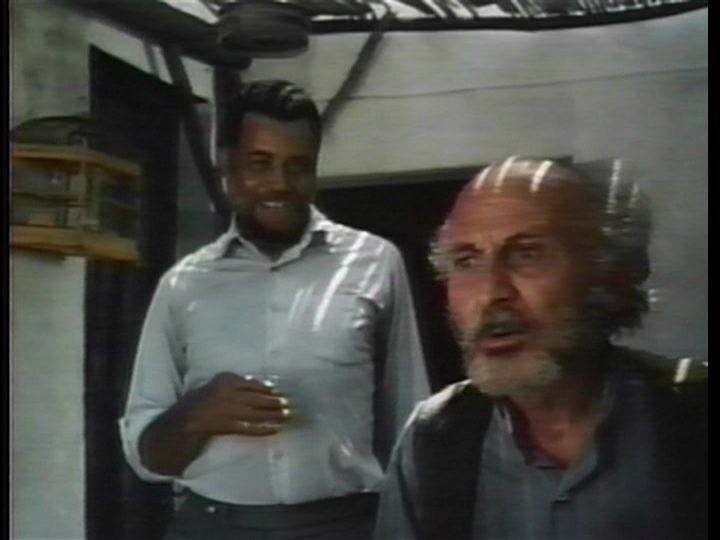
    To paraphrase April O'Neil, "Oh! James Earl Jones! What are you doing here?"

    In the wake of all his Star Wars duties, maybe JEJ just wanted the world to cut him some slack. Sign on the dotted line, and he gets to chill out on a Greek island and pretend he's banging Lydia Cornell, aka the blonde from Too Close for Comfort.

    In Blood Tide she's called Barbara, but she could just as easily be Sara Rush on her first European vacation. And how will Henry handle this news: his daughter with an older man? An older, black man? We see a lot of finger-shaking ahead! Pity poor Muriel -- and poor Cosmic Cow, right?

    But Blood Tide was actually filmed in June 1980, when Too Close for Comfort wasn't even a thing yet (it didn't debut until November 1980), and Empire Strikes Back was just hitting theaters. So maybe the "paycheck factor" was a priority for Jones, and it almost certainly was for Cornell.

    Years and years ago, we here at the Umbrellahead Review were privy to a bit of inside gossip about Mr. Jones -- something that might explain why this illustrious actor has, at times, taken roles that seem beneath him. Let's just say he has more than one thing in common with Sidney Poitier, and respectfully leave it at that. We wouldn't want to anger Darth Vader.

    Foolishly, the makers of Blood Tide didn't have Jones do the opening narration, which runs as follows:

    "Before the dawn of civilization, in the early light of man's existence, life was an eternal struggle between good and evil. The ancients knew the way to placate the beast that lurked beneath the eternal sea, and within the consciousness of man. Sacrifice. Virgin sacrifice. The practice of that bygone age died with the coming of civilization -- but deep in the heart of man, the primeval urge to give new life to an ancient ritual lingers on."

    Maybe JEJ refused to utter the likes of "Before the dawn of civilization", a phrase that comes straight from that high-school essay template. It's still a hell of a lot better than Prehistoric Women, though.

    Mercifully, that's the only narration in the whole film. On the other hand, it pretty much spoils the entire plot.

    And on the third hand, when a movie starts out with a young girl in a boat, voluntarily being sent toward an unseen menace, it's probably part of the plan for viewers to grok that the business about "virgin sacrifice" and "the beast...beneath the eternal sea" ain't metaphorical.
    Neither JEJ nor Cornell are the protagonists of Blood Tide, oddly enough. That honor goes to newlyweds Neil and Sherry Grice (Martin Kove and Mary Louise Weller).

    Kove seems to be doing the Val-Kilmer-as-Jim-Morrison thing in this one, and who can blame him? It's a look that gets the strange, even though we meet him right when the strange can no longer be got. 

    (The usual waiting period is seven years, but we can expedite your application if you demonstrate that you make over $100K per annum.)

    They've sailed to this mysterious Greek island in search of Neil's erratic sister Madeline (Deborah Shelton), but have barely set foot there before they're attacked...

    ...by a flying cat.

    Well, OK, the cat was thrown by a bunch of creepy children, proving once again that the question Who Can Kill A Child? doesn't always deserve to be rhetorical.

    Ere long they run into the island's αρχηγός, Nereus, played by a grim-faced José Ferrer (yes, the producers sprang for two "name" actors). He speaks Greek once or twice in the film and sounds plausible doing it, but how would we know?

    Inevitably Neil and Sherry manage to run afoul of nearly everyone, including Jones's character Frye, a salvage diver whose hobbies include quoting Shakespeare and overreacting.

    Frye also likes to verbally abuse Barbara now and then, just to keep things fresh. In a film well-populated with bizarre moments, his lecture on how to properly eat a watermelon is a highlight. (Apparently, you don't need a knife.)

    But Frye's soliloquies don't require an audience -- he's perfectly happy to speak to an empty, underwater cave before he blows part of it up. Just see for yourself:

    Neil and Sherry quickly track down Madeline, who's staying in a convent and is obsessed with restoring an ancient, multilayered piece of artwork. Madeline is clearly one of those free spirits who drifts in and out of reality, and yearns for some ascetic, pure existence...


    ...which is why her makeup is always so immaculate, of course. Those Greek nuns really know their mascara and lip gloss.

    Deborah Shelton gets the dreaded "introducing" tag here -- often the kiss of death for a young actress's career -- but she actually had over 5 years of TV credits before Blood Tide, and plenty afterwards.

    She also made several appearances in Greek films. Despite her Anglo surname, maybe Shelton spoke the language and could serve as a useful liaison to the crew?

    Sadly, she doesn't get the chance to speak any Greek here -- though it appears that one of her co-stars is fluent in French. (No translator needed.)

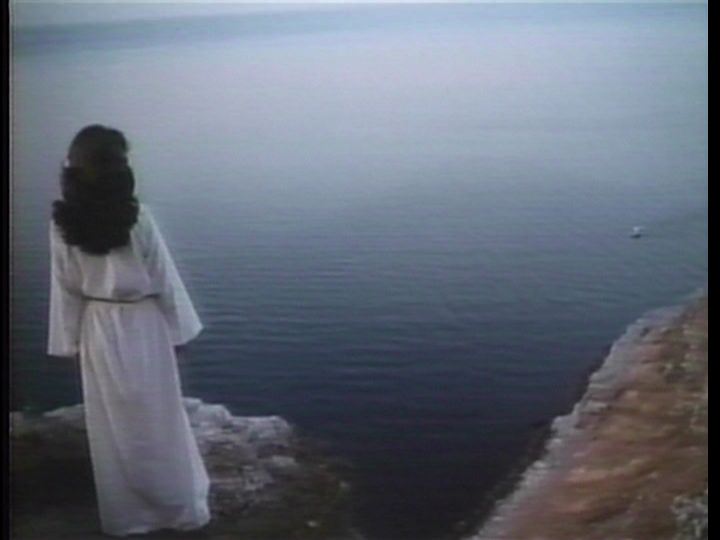
    Madeline sure does wear a lot of white, though. I wonder what that could possibly signify?

    As in Who Can Kill A Child?, we spent a fair amount of the movie's running time yelling at Neil and Sherry to just get the hell out of Dodge. When the ostensible protagonists seem hell-bent on their own destruction -- and are thoroughly overshadowed by the supporting cast -- it's hard to care much about what happens to them.

    Still, Blood Tide was just offbeat enough to hold our interest, even if its climax is abrupt and disappointing. However, the film holds back its weirdest moment for the denouement, when something happens that completely disrupts the narrative -- the kind of thing you'd see in a Channel 101 skit, not a mainstream movie.

    Is it a hail-Mary attempt to rescue a troubled story by simply going completely bonkers at the end? Or is it meant to be thought-provoking?


    Are we meant to re-evaluate a couple characters? Because that would explain why...

    But wait, if that happened, then how could she be...?

    ...oh, yeah, there is that. Yeah. Think about it.


    Or, uh, maybe it's better to forget about it. Here, have a Lydia Cornell leg lift instead.

    Wednesday, December 18, 2013

    Now you see it, now you don't

    Or, really, the other way around.
    (Including this entry, which was written in October but is only making its way to you now...waiting this whole time in our draft box, out of sight.)


    The Phantom of Soho (1964)

    Grade: C


    Seamy and stabby, this Teutonic tale of maritime mayhem and razor-edged revenge is really more of a police procedural than a horror movie. And there's a dash of FPS in there, too.


    A string of murders in Soho, or the mit Sauerkraut version thereof, attracts the attention of Scotland Yard's finest. It would seem in everyone's best interest to crack the case, and the local underworld certainly doesn't welcome the police attention...

    ...but no one's eager to talk.


    The elusive perpetrator -- from whom the film takes its title -- is a cipher to all but a few, who begin to suspect that a crime they committed long ago has come back to haunt them.


    The case also piques the curiosity of Clarinda Smith (Barbara Rütting), an author who specializes in lurid crime novels. The spunky Ms. Smith soon takes a personal interest in the proceedings, aiming to penetrate to the heart of these foul deeds -- as fodder for her next book, naturally.

    It doesn't hurt that she's a very close friend of the head of Scotland Yard (Hans Söhnker), though neither he nor his appointed investigator, Chief Inspector Hugh Patton (Dieter Borsche), are too happy about her preternatural ability to keep one step ahead of them -- and everyone else.


    Whoever put together the English-language script had some fun with it, as the dialogue is uncommonly tight for a dubbed film; no doubt it helped that The Phantom of Soho is based on a book.

    And if you like to see older gentlemen hit on attractive, half-naked 1960s chicks? Well, it's got that too, though their wares will only occupy about half of your screen thanks to Mill Creek's bizarro pseudo-letterboxing.


    But ultimately this Crimi is little more than a glorified Agatha Christie story. There's little to complain about, but little that sticks in the mind afterward. And unlike Christie, here the plot isn't convincing enough to pull off that pleasant suspension of belief that makes a good mystery.

    So instead, it's mainly a matter of pointy things. And also knives.


    The Sound of Horror (1966)

    Grade: D+


    We'd say "A group of treasure hunters gets more than they bargained for", but treasure hunters don't really bargain, do they? I mean, the idea is to find treasure, not to somehow transact for it. You don't make a proposition to the chest, unless you're P.'s high school social studies teacher (who made many such propositions, silently at least).


    Anyway, we're in "Greece", there's a bit of pick-axing and dynamiting, and before you know it our merry band of bargain-hunters is under siege from an invisible foe. If this makes it sound a bit like Predator, well, kind of -- but with less Arnold and more dance scenes.


    A bit of judicious editing would've done The Sound of Horror a world of good, if by "world" one means "significant, but insufficient for salvation". The cast is OK, the concept reasonable, but the movie has an almost suicidal compulsion to bring itself to a screeching halt every 10 minutes or so, with long scenes and extended shots that do nothing to advance the narrative. Examples include:
    • a lengthy, static shot of an empty cavern, during which absolutely nothing happens as far as we could tell (unless something got lost in the crop from widescreen);
    • an extended soliloquy on one character's affection for his car;
    • the aforementioned dance scenes, which at least have a bit of eye candy going on if you're into that sort of thing (we're meh about it);
    • and a lovely sequence, set in the kitchen, wherein the gang's superstitious maidservant fetches water and makes coffee.
    Riveting stuff.


    When the movie permits itself to (ahem) move, it occasionally rises to the level of "mildly engaging schlock", but it's a little too dumb and muddled to really come off, and drops promising plot threads with little fanfare: we were expecting a Monster from a Prehistoric Planet angle, or maybe a Night of the Living Dead standoff, but instead we get a nonsensical mix of hunkerin' down and foolin' around.

    Plus the characters are interchangeable, the score is sub-Bartókian rambling that frequently crosses the line from homage to plagiarism, and the special effects...aren't.


    But of course, that can be part of the charm: "NO EAT I", sayeth the (mildly damaged) Pumpernickel Loaf of Doom. Alas, you can't mindmeld through a fireplace poker, and besides, isn't it time to go gluten-free? Everyone's throwing out their white flour lately.


    Speaking of bodies completely drained of blood, we also caught a couple of Tod Browning flicks on TCM, namely: The Mark of the Vampire, a Dracula clone with Béla Lugosi, clever special effects, and a surprise twist that essentially ruins the movie; and The Devil-Doll, a silly tale of pseudoscience and revenge in France, with Lionel Barrymore as Mrs. Doubtfire.

    No DVR = no screenshots, but we'd give 'em both a shiny D+, given the modest entertainment -- and copious opportunities for weary groaning -- they provided.

    Monday, December 16, 2013

    I've just seen a face

    A distinctive demeanor, a memorable mien, an unforgettable countenance: however you put it, sometimes the silver screen is graced with a visage that -- be it handsome or homely, ugly or beautiful, familiar or exotic -- stops you in your tracks.

    And whatever adjectives may be apropos in this case, the following two films surely feature a face we'll not soon forget. Nor shall we forget the time or place, for the films themselves are quite singular as well, albeit in two very different ways.


    The Sadist (1963)

    Grade: B+


    Nowadays, making a movie about a deranged serial killer is pretty straightforward. Hell, there are multiple TV programs exclusively devoted to the topic, and shows like Criminal Minds bring a steady diet of torture-porn to eager audiences.  Every week they offer a fresh take on man's inhumanity to man, and a new contribution to our extensive vocabulary dedicated to the agonies of -- and violent trespasses upon -- the human body.


    But back in 1963, a film about this subject was a very different proposition. Even as the boundaries of the possible in art began to seem very shaky indeed (or downright arbitrary), there was still a prevailing sense that certain things should not be shown -- that some basic sanctum of human decency and dignity should be preserved, at least within the sphere of public life (of which film is a part).


    Now, given that Nanking, Auschwitz, Katyn, and Hiroshima were within recent memory, that notion -- we suppose the right word would be "decorum", though that's too limiting -- might seem like an obscene indulgence. And that's not to mention the endless array of pre-modern atrocities any historian with a strong stomach could reel off -- and which, taken collectively, put paid to any idea that there's ever been a time when human beings weren't doing terrible things to each other.


    But a real sea change in public discourse hadn't quite happened yet in 1963. The worst televised horrors of the Vietnam War were still a ways off, the communitarian (and socially normative) spirit of the 1950s was still the dominant voice in the United States, feminine hygiene products still resembled medieval chastity devices...in short, many envelopes were just about to be really pushed.


    Or as Philip Larkin once wrote,

    Sexual intercourse began
    In nineteen sixty-three
    (which was rather late for me) –
    Between the end of the "Chatterley" ban
    And The Beatles' first LP.


    And that tension -- between what is and what will be, between what can and can't be shown, between a normative present and a rudderless future -- is probably a big part of why The Sadist is so unexpectedly effective. Sure, on paper it's a thinly veiled cash-in on the Charles Starkweather/Caril Ann Fugate murder spree, with Arch Hall Jr. as "Charlie Tibbs" and Marilyn Manning as the pointedly non-underage "Judy Bradshaw".


    And it's hard to imagine it cost much to make; the plot allows 90% of the film to be set in the same place, the cast barely numbers half-a-dozen and features no "name" actors, and the budget demands for costumes, special effects, and the like were -- one assumes -- minimal.


    But though The Sadist is hardly perfect, it's not the cynical, half-assed exploitation film one might expect; instead, we get an uncommonly tense and well-crafted little film that easily overcomes its few missteps. Central to this achievement is Arch Hall Jr., whose performance is something we don't often see in these films: genuinely and unexpectedly frightening.


    Much like the real Starkweather, his Charlie Tibbs is a bizarre combination of boyish preening and damaged Neanderthal coarseness, with dull, hateful eyes glaring out from beneath a beetle brow and carefully coiffed pompadour. Nothing good can come of a face like that, you'd think, and you'd be right. He veers between detached, giggling sociopathy and sudden fits of rage -- the latter usually prompted by his sense that the other characters look down at him or think he's stupid.

    And to be fair, he's usually correct. The other characters underestimate his intelligence and pay a price for it, for Tibbs is crafty indeed.


    But not too crafty, for The Sadist is mercifully free of a common trope.  Too many serial killers in film and TV are made out to be omniscient, omnipotent geniuses, capable of meticulous, watertight planning and able to foresee every move their prey might make. Not Tibbs; he's dangerously sharp, and his insecurity and paranoia give him a realistic ability to sniff out trickery -- but he still has limitations (both mental and physical, though the latter disappears and reappears at random) and blind spots.


    We can't however, say that we much enjoyed watching The Sadist -- the subject matter is too deeply and unremittingly unpleasant for that -- nor do we have any real urge to watch it again. It's the cinematic equivalent of a certain type of short story where, in essence, one thing happens, and the drive towards that thing is the fabric of the story.  And in The Sadist, that one thing is the systematic psychological torture of a group of people.

    As such it's a complete success, and has all the elements of a good dramatic arc, but there's no layering, no cinematic polyphony, no secondary narrative: in other words, there's nothing here that would reward repeat viewing. It's a highly effective and straightforward film with a short half-life, and there's nothing wrong with that.

    But seen from the present day, The Sadist looks like the harbinger of things to come. And while we admire its unflinching approach to the subject matter, it's one step down a path that's since been well-traveled indeed -- and we're not sure walking that road has been good for us, or anyone.


    Eegah (1962)

    Objective Grade: D-
    Tasty Shaving Cream Bonus: B+

    ... and then, there's Eegah.


    ("The name written in blood!")

    Primitive love-starved caveman encounters modern culture; a bizarre mixture of hijinks, ho-hum, and holy cow, wtf? ensues.


    Many folks on the bad movie circuit will know this one from its treatment on MST3K, or else for keeping company with The Beast of Yucca Flats and From Justin to Kelly on IMDB's Bottom 100. It was P. who organized our back-to-back Arch-a-thon, and K, not knowing what was coming, fully expected that he of the Cro-Magnon face would be the titular cave dweller.

    Instead, we're treated to a handsome-ish young Richard Kiel, in the days before he rose to (relative) stardom in the James Bond franchise as the steel-mawed villain Jaws.


    What, then, for Hall? In a complete reversal of his role in The Sadist, Arch plays the clean-cut, gee-whiz, wow-zee-wow-wow* teenager Tom Nelson, a gas station attendant with a swell dune buggy and sweet electric guitar -- both of which receive more than their fair share of screen time.

    *actual quote


    Unfortunately for Hall, the only thing flatter than his generic smart alecky lines is the crooning he foists upon us during the film's musical breaks (complete with phantom back-up singers!) The action (as it were) screeches to a warbly halt as we're treated to songs about "Vickie" ...


    ("Vickie! Oh-oo-whoa Vickie! / I'm so alooone...")

    ... and "Valerie" ...


    ("If I had a thousand paintings / in a marble gallery / every single picture / would be of" ... you know who!)

    ... but not, conspicuously, about his girlfriend Roxy Miller (Marilyn Manning). Frankly, we don't blame him -- thanks to some very unflattering hairdos, Manning could easily be mistaken for the mother of Judy Bradshaw, the gum-smacking 14 18 year old she goes on to play a year later in The Sadist.


    Eegah's not so picky about his ladies though, which leads to one of the more bizarre hostage situations we've yet encountered. There's a master's thesis worth of material in what goes on in that cave among Eegah, Roxy, Roxy's wounded pith-helmeted father, his shaving kit, a bubbling sulfurous cauldron, and the corpses of Eegah's dead relatives. Trying to explain all the nuances here wouldn't do the film any justice -- it's one of those times where you've just gotta experience it for yourself.


    (He even shows her his etchings!)

    It's notable that our supposed hero, he-of-the-face, is entirely absent from all that wacky cave action. Instead, Arch Hall Jr.'s father could think of nothing better for Tom to do during the middle 1/3 than wander ineffectually around the surrounding desert landscape. (Oh, did we forget to mention that it was Arch Hall Sr. who directed this ... thing ... and played Roxy's dad? Ah, the pungent smell of nepotism!)


    Despite this being essentially a vehicle for the younger Hall and his musical career (as it were), Richard Kiel ends up stealing the show with his youthful Schwarzenegger visage, ludicrous false beard, and community theater animal skin costume. However, credit for our favorite moment in the film goes to the random chef who, in the midst of Eegah's rampage, casually offers up a forkful of meat as through the caveman were just one more bored buffet patron.


    ("Wait, don't tell me...rare, right?")

    Despite this and other chunks of meaty goodness, Eegah is still, at its heart, a bad, bad movie. Bad dialogue, bad lighting, and lots of pointless scenes of driving, singing, swimming, hiking, and otherwise not getting back to the real action. Plus, don't forget about the stock footage!


    (Hump?)

    But unlike The Sadist, which is far and away the better of the two films, this movie is much more amenable to repeat viewing, if only to catch all those little wtf moments that might have gone unnoticed the first time around.  While we've probably had more than our fill of the scrunched up, scowl-faced, punchably pompadoured "hero" and his off-key serenades, we'd be more than eegah to pay a visit to our new favorite gentle giant and his fabulous facial hair.


    (Seriously?)