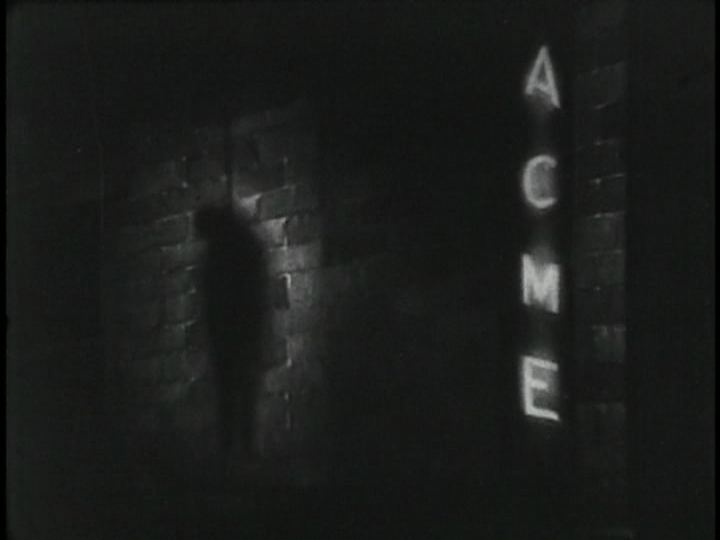
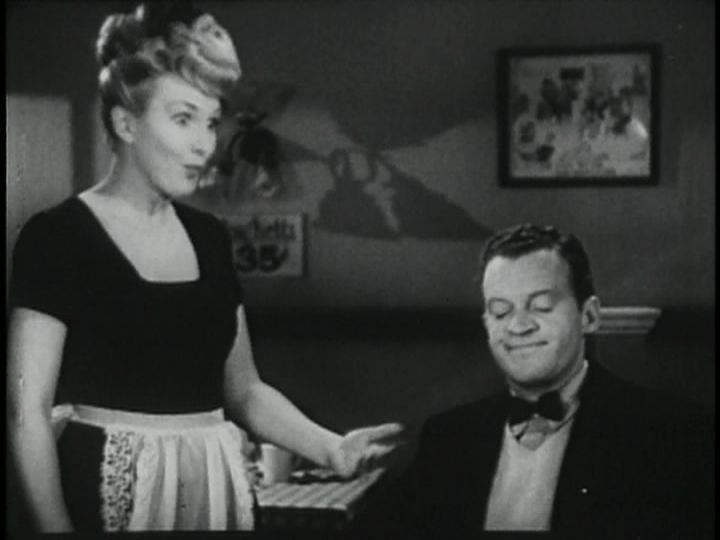
Easy enough to find a theme for these next two, as they apparently shared a double bill back in 1961. That's not all they share, though, as both films have a bunch of other things weirdly in common:
- spaceships with supply lines that get cut or disconnected;
- astronauts endangered by fast-moving meteoroids while on a space walk;
- mutually-hostile male characters who find themselves on opposite sides of a love triangle, only to later join forces;
- and, above all, major characters with incongruously bleached hair.
[aka Space Men]
Grade: C+

There are some things we expect in the opening moments of a science-fiction film from 1960. For instance, an assortment of goofy meters, as seen above. Or maybe, if the film gets to the action right away, you'll have people in spacesuits.

One thing we didn't expect, though, was this:

Unless you count some earlier shots of the back of a person's head, the first character onscreen in Assignment: Outer Space is ace pilot Al, played by Archie Savage. Now, between Savage's bizarre platinum dye job, the print's faded colors, and sheer disbelief, it took us a moment to process that a film of this vintage had a black man not just as a prominent character, but in the leadoff spot.
He's not the protagonist, mind you; that role falls to spunky reporter Ray Peterson (Rik Van Nutter), whom Ray wakes from hibernation in the opening sequence. But, still.

And do you know what the other characters say about Al's race? Absolutely nothing. It's literally never once remarked upon, or even alluded to in the vaguest way. He's just a crack pilot and an affable (but heroic) guy, and a key member of their team.

Of course, the folks aboard spaceship BZ-88 (and space station ZX-34) don't mince words, and even genial Al has no hesitation about referring to Peterson as a "parasite". Fair enough since, while Ray does supply the film's narration, he's not of much use otherwise. He even screws up an important refueling operation --

-- much to the displeasure of station commander George (David Montresor), a melancholy and put-upon soul who kinda looks like the drug dealer in Day of the Panther.

Otherwise Peterson has little to offer beyond the repeated, extreme close-ups we get of his star-struck gaze -- which we're guessing is actually the same shot recycled over and over again. Its first appearance is when Al unceremoniously kicks him out into the "terrifying void" of space, spawning this exchange:
Ray: "A chilly sense of...emptiness. D'you understand me, Al?"
Al: "Sure I understand. Every baptism has its mystery, even out here in space."
Ray: "I've never felt so lonely."

If you're familiar with 2001: A Space Odyssey, some bells might already be ringing. Crew members waking from hibernation? Close-ups of awestruck eyes? And what if we were to tell you that there's even a computer gone wrong that has to be deactivated, while the body of a crewman who died in hibernation lies silently nearby?

In fact it seems to be more or less established that Stanley Kubrick was well aware of Assignment: Outer Space, specifically took inspiration from it, and even tried to hire director Antonio Margheriti to handle the visual effects for 2001.
It's not difficult to see why, as Assignment: Outer Space captures the heaviness, isolation, and coldness of space travel, much as in Kubrick's opus. Characters move in a measured, self-conscious way, carefully proceeding through rooms (or the exteriors of spaceships) as though they really were navigating an altered environment, while high-G maneuvers in flight put visible strain on the actors.
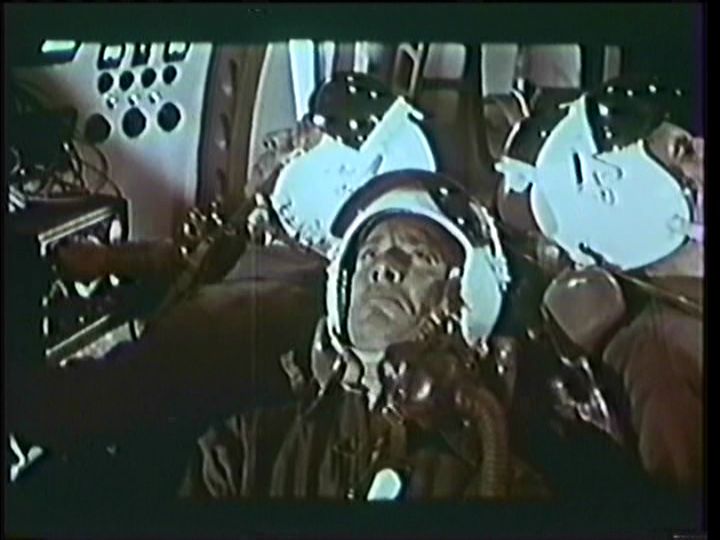
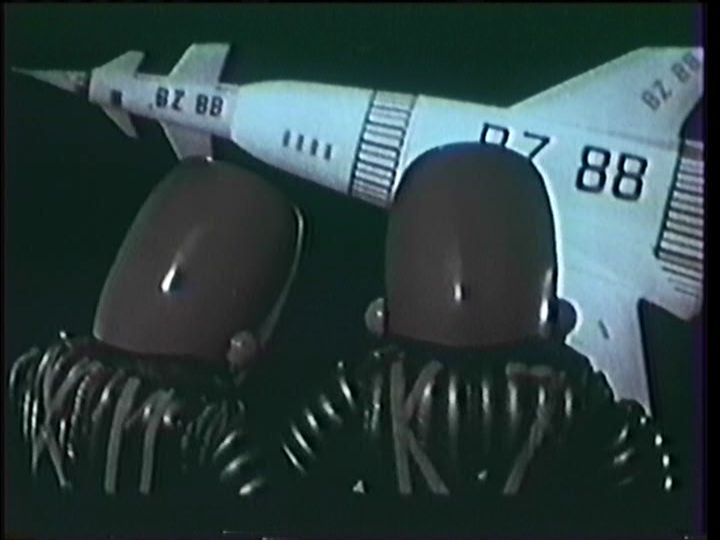
And while others have poked fun at the special effects in Assignment, the film's ships and rockets at least have the solidity and weight of real objects, and there's something disarmingly ingenious about them. Someone who can do this kind of work with a budget of essentially nil? That's the kind of guy you want to hire, because he won't go overbudget when you give him more to play with.
There is one moment where any sense of disbelief comes to a bizarre, screeching halt, as a crew of redshirts meet their death in a fiery crash on Phobos. The pilot desperately tries to regain control, his voice echoes in terror, and then we get this:

That's...a street, and power lines, and a car (we're told it's a Chevy). Once we were done laughing, we had to wonder: what gives?
Well, apparently this shot wasn't in the original Italian film, nor is it to be found in the English dub seen here (with much better color quality than the Mill Creek print). In those prints, though we zoom in on the Martian moon's surface, the ship's impact isn't shown.
So we can only assume some American distributor felt the moment wasn't sufficiently "impactful" (ugh) and decided to add an explosion, any explosion that was available. And now poor Margheriti (whom we already knew from Battle of the Worlds and The Long Hair of Death) gets the rap for it! Does that seem fair to you, Ray?
Anyway, none of this is to say that Assignment: Outer Space is a masterful work of cinema, because it certainly isn't. It's talky, the plot is often too opaque for its own good, and the romantic subplot with navigator Lucy (Gaby Farinon) is hardly convincing -- even if it's amusing to watch the camera zoom closer and closer in on the duo, as the sexual tension mounts...

...until Ray suddenly brings up Christmas out of the blue and the score starts playing "Deck the Halls", to utterly bizarre effect. (At least it's not "Jingle Bells".)
Still, Assignment: Outer Space is a work of hard SF that never relies on woo-woo physics or deus ex machina to justify its plot points, and we have a lot of respect for that. The ships go a bit fast at times (though well under the speed of light), but otherwise everything that happens is entirely within the realm of practical human achievement, and is explained in those terms.
And it feels real, in a way that so many slicker productions don't -- but 2001 did. For those reasons, and for its remarkably forward-looking racial politics, Assignment: Outer Space deserves more credit than it's gotten in most quarters.

Grade: D

The opening minutes of The Phantom Planet bear more than a slight resemblance to various elements from Assignment: Outer Space. For instance, we've got redshirts who are scarcely introduced before they promptly crash into a celestial object.

We've got valuable, pressurized fluid spurting into the void thanks to a cable issue -- and no, we're not talking about the scrambled Playboy Channel.

And of course, we've got a skilled pilot with weirdly tinted hair:

For his role as Capt. Frank Chapman, Dean Fredericks apparently decided to keep the bleached-blonde look he'd picked up when playing Steve Canyon for NBC, even though that TV series had ended a year or two before The Phantom Planet started filming. Though not nearly as disconcerting as Archie Savage's snow-white mane, it still doesn't look right on Fredericks.
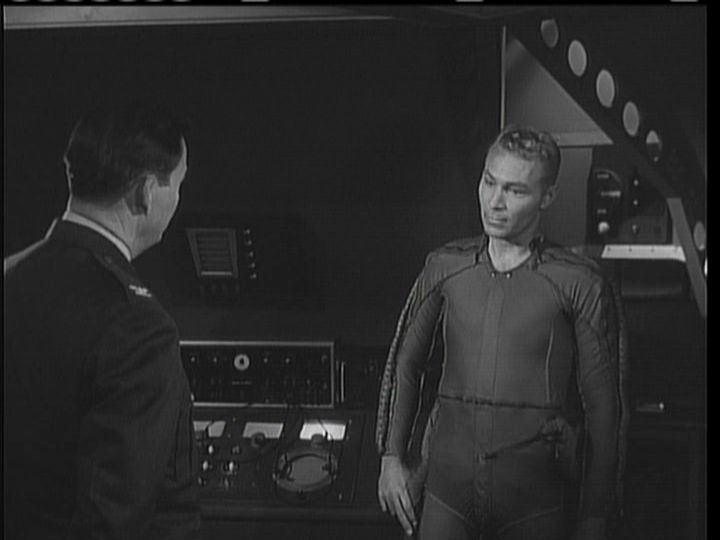
Anyway, Capt. Chapman is sent out by the Air Force brass to check out what happened to those redshirts, and for a while it looks like we're going to get another hard SF tale with a plot heavily shaped by military hierarchy, orders that are followed or not followed, and so on.
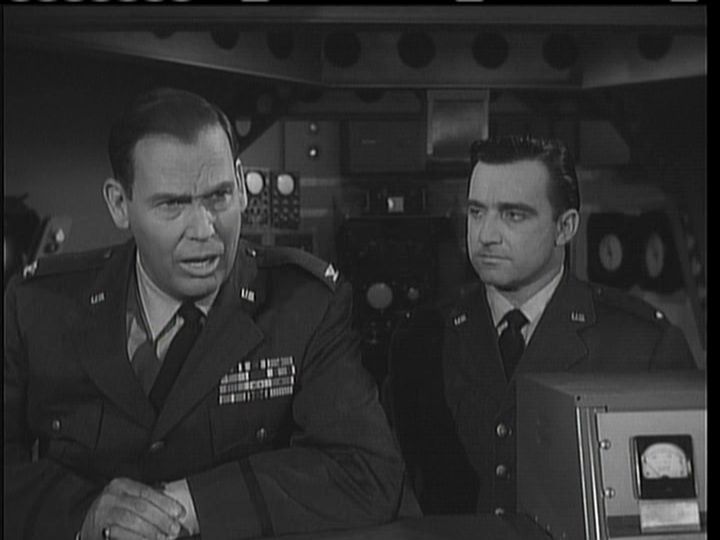
Chapman and his philosophical co-pilot Lt. Makonnen (Richard Weber) have a refreshingly honest conversation about the stresses of taking off in a giant exploding space dildo:
"That does it, Captain. We can relax a bit now."
"Takeoff's always the same...my heart pounded like a sledgehammer."
"Yeah, mine too."
It's nice to see a film where space travel isn't treated as something absolutely routine.

Soon, in another echo of 2001, they're called to exit the craft to deal with a technical issue, whereupon things go very wrong.

Given that the film's title and MacGuffin are one and the same, it's no surprise that their rocket soon crash-lands onto the large asteroid seen in the first screenshot above -- a prop picked up on some holiday trip to the Great Barrier Reef, no doubt.
But then things take a turn for the weird:

Like, really weird:

From this point on, the touchstone that comes to mind for The Phantom Planet isn't 2001, but The Twilight Zone, as we leave hard SF behind and are instead handed a premise that'd be more at home in the presto-change-o, ain't-life-strange-o vistas of Rod Serling's brainchild.
At least they mumble some technobabble about the space between electrons being decreased on this asteroid -- known as Rheton -- and, unlike "Rascals" on Star Trek: TNG, Chapman's outfit doesn't change size too. Fortunately, the mysteriously humanoid, English-speaking inhabitants of Rheton have no trouble finding something for him to wear.

Actually, much as there is something Twilight Zone-ish about the direction, it's probably Star Trek -- the original, we mean -- that's the better touchstone. One example: when Chapman is immediately put on trial for roughing up a member of the welcoming committee, the jury for this dashing spaceman is made up entirely of nubile young women, including two real-life Playboy Playmates of the Month (!).

Speaking of the Shat, one of those women is (blink and you'll miss her) Allyson Ames, aka Kia from Incubus. Bucking the trend she appears here as a brunette, i.e. without the bleach job she had in the Esperanto epic.

Other name actors include Richard Kiel (we'll get to him later) and Francis X. Bushman as Sessom, the kindly elder who runs Rheton. Hard to imagine what was going through his head when he was asked to play an imaginary theremin while delivering lines like "This planet is slowly using up the energy that holds the atomic particles together", but he never seems to think himself above the material.

The rest of The Phantom Planet plays out a bit like a mediocre episode of TOS, and is largely dedicated to Chapman's efforts to answer common Captain Kirk questions like:
"How can I escape this cult-like society, which has me imprisoned in subterranean caverns and unable to communicate with my allies?"

"How shall I use these women's obvious attraction to me to my advantage?"

"How should I handle this ritualized fight to the death against a hotheaded, competing male?"

"How might I best defeat this hilariously goofy-looking alien in physical combat?" (Enter Richard Kiel.)

"How should I handle my own star-crossed attraction for a woman who, now that I think of it, bears an odd resemblance to Elizabeth Taylor?"

"And how should I address the obvious sexual tension between that Japanese-American crew member and their commanding officer -- if at all?"

"Eh, never mind. I think we're done. How about some end credits?"

"...Let's get the hell out of here."