Having watched so much of Tod Slaughter's filmography, it will come as no surprise that the Umbrellahead Review felt compelled to "polish him off" and watch the rest of his available films.
To group these in one entry, we depart from strict viewing order in terms of our movie-watching in general, but at least they're presented in the order in which we saw them. And most were watched just this year, in a string of Slaughter showings -- except the first, which we screened way back in 2020:
Grade: C-

The idea of a "poor man's Sherlock Holmes" is so commonplace now -- paging House M.D. among others -- that it's hard to imagine a time when it was, let's say, an alternative born of necessity. In other words, people are eager for Sherlock Holmes, but there's only just so much to go around, so let's give them Herlock Sholmes or what-have-you.

Thus, Sexton Blake seems like the store-brand cereal, the not-quite Chuck Taylors, the thing you get instead of the thing you wanted. But then again some of us preferred the Gobots to the Transformers (raises hand), so who's to say? Maybe some English boys loved their off-brand sleuth, the way their grandchildren would love their "zed-eks" Spectrums.

And if George Curzon is the tenant of 221C (so to speak) then, as Michael Larron, Tod Slaughter is our ersatz Moriarty, a stamp-collecting, hood-wearing fiend who will stop at nothing to do whatever it is he does.

It's the usual, in other words, though with one refreshing change: when Sexton Blake gets himself into some serious hot water, it's femme fatale Mademoiselle Julie (Greta Gynt) who saves his bacon -- not through feminine wiles but simply by dragging his incompetent ass out of danger. A woman's work, etc.

Also, television, in 1938. We know it was a thing, but it still feels weird that it was a thing!

Grade: B

Now this is something else. Song of the Road is, we're told, one of John Baxter's "quota quickies". It comes to us on DVD as part of a double bill with Baxter's 1934 film Say It With Flowers, a kind of love letter to the dwindling music hall tradition.
(Say It With Flowers also stars Mary Clare, whom we immediately recognized as one of the titular Three Weird Sisters.)

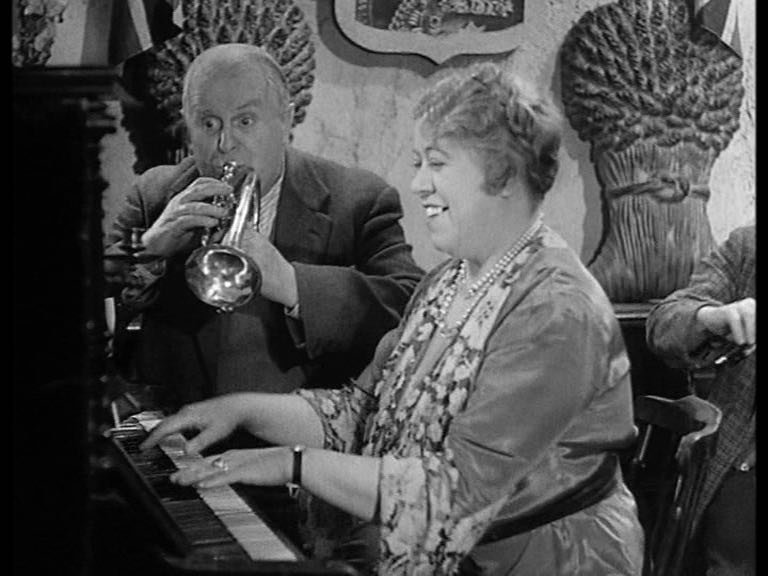
Likewise, Song of the Road is an effort to capture a dying art -- two of them, really -- on film. The protagonist, Old Bill (Bransby Williams), is one of the drivers who lose their livelihood when the local council opts to replace their horse-drawn carts with motorcars. Progress, gentlemen, progress!

Unlike his colleagues, Bill isn't willing to adapt to the "newfangled ideas" and learn to drive a motorcar. Instead, he scrapes together just enough money to buy his beloved 'orse (Polly) and hits the road, trusting that something will somehow turn up.

Nice touch in this segment: the pawnbroker Solomon (Fred Schwartz) -- who's so clearly coded as Jewish that if they had him break into "Hava Nagila" it'd hardly make a difference -- is kindhearted and helps Old Bill. That's quite the contrast from Melter Moss.

Soon enough we came to see Song of the Road as a close cousin to Beartooh [sic], since Baxter dedicates considerable stretches to panoramas of nature, with long shots of trees, rolling hills, and farmland. One gets the impression he was trying to document it all while it was still around to be documented.
And there's also horsebutt, if you're into that. We don't judge.

After a few lean days, the wheel of fortune turns, and eventually old Bill runs into sideshow huckster Dr. Dando (Percy Parsons) and his wife (Peggy Novak). The Dandos may be a group of pill-pushers --

-- but they're good people and, wouldn't-cha-know-it, need the help of a man and his horse. And who's there but good ol' Tod Slaughter, doing what he always does?

However, Tod's role is relatively minor, and when he gets his inevitable comeuppance -- which is hardly a spoiler: when did Tod Slaughter play a role and not get a comeuppance? -- he swiftly departs, not to be seen again.

The other "dying art" documented by Song of the Road is the array of pre-industrial, horse-driven farming techniques that were, apparently, still used in parts of England come 1937.

That said, the film's message is unambiguous and oddly unsentimental: the old ways are about to go away for good, and if you want to survive you'd better modernize. With war on the horizon, that proposition was about to become deadly serious -- and Song of the Road clearly realizes this.

Don't be deceived, then, by Song of the Road's sweet-natured tone: there's more truth here than one might expect.
And if its charms are largely documentary -- more of a time capsule than a testament to particularly skillful storytelling -- then what of it? Simply being in the right place at the right time has always been a part of making worthwhile art.
Grade: D-




Sweeney Todd: The Demon Barber of Fleet Street (1936)

The Greed of William Hart was Tod's last feature film (not counting the Inspector Morley edits), and has a good reputation. Also known as Horror Maniacs, it's essentially an embellished retelling of the story of Burke and Hare, a pair of Scottish graverobbers who added murder to their skill set.

However, basing the film on a true story led to a massive last-minute crisis, as some anxious soul insisted that the entire film be redubbed to change the characters' names from Burke and Hare to Moore and Hart (wink, wink).
Some have complained about this but, honestly, we didn't notice. What we did notice, however, was the near-incomprehensibility of much of the dialogue to our American ears. Like Song of the Road, we watched The Greed of William Hart courtesy of a DVD from Renown Pictures, but they unfortunately didn't see fit to include subtitles on this one. And boy, could we have used them.

Some very literate people, folks we respect, see The Greed of William Hart as a high point in Tod's film career and a fitting sendoff. So why did we find it so utterly excruciating, laborious, and tedious?

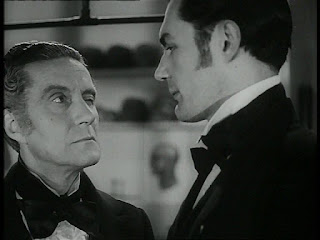
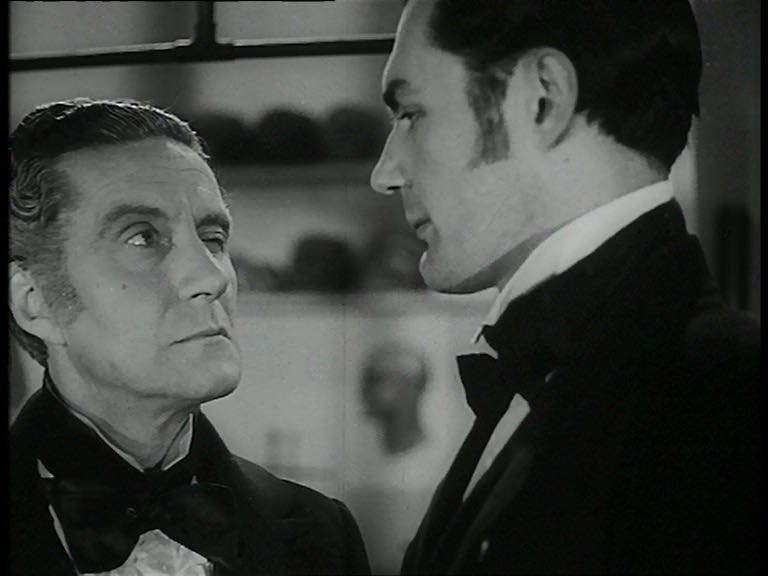
One reason is easy to pinpoint: the manchild Jamie (Aubrey Woods), a simpleton with vaguely pre-Raphaelite looks, who seems to be in every damned scene.

He hangs out with the good guys:

He hangs out with the bad guys:

And his third-person "Aye, Jamie is afeared of the peerie fairies, ye ken?" routine wears out faster than the knees on a pair of Jos. A. Bank pants. For God's sake, Cookie Monster would blush at that crap.
He pops up everywhere and never shuts up. He's Poochie in tartan, he's the guy that wants to crash on your couch, and if you don't find yourself wishing he'd peace out posthaste, you're made of stronger stuff than us.

Even if it weren't for the knob with the wool hat, The Greed of William Hart just lacks something. It's hard to pinpoint since it's not as though we can't handle weedy sets, strange editing, a near-total absence of music, or a slow pace.
Put those things together, though, and watching this film feels a lot like trying to clean your rugs with a cheap, half-broken canister vacuum.

There's a feeling of drudgery about The Greed of William Hart, in other words, and we found it to be a largely joyless affair. Bad direction? A bad script? Too much reliance on Scottish "charm" from a distinctly English perspective?
All of these things and more, perhaps. But it doesn't even strike us as a film that's hard to watch but somehow worth the effort, like a work of art from a bygone generation. For us, there was no "there" there, no heart to Hart as it were. It was just a slog. Sorry, Tod.

Grade: C

Well, here we are at Tod Slaughter's signature role. Unfortunately we don't have a proper DVD of this one -- after all, it was cut from the Tales of Terror set -- so we've made do with whatever we could find on YouTube and/or Archive.org.
(The YouTube copy is a TV print that was cut for content, so the Archive source is for choice, despite the abrasive sound quality and green line up the side.)

How is it? Oh, fine, we suppose. Tod Slaughter at his ripest, no doubt, "polishing off" his targets with straight razor, weaponized chair, or whatever it takes.

And he also does that other thing he does. Score another one for the Tumblr.

Speaking of Tumblr, Sweeney Todd also has a racist subplot, complete with spear-flinging natives ululating in a language that clearly isn't one ("La-la-la-la-la-la"). If that sort of thing bums you out, you'll get bummed out by that part of Sweeney Todd.

Do you notice we're just not feeling this one? We can't shake a sense of been-there-done-that, even if that's illogical (and vaguely unfair) in chronological terms, since Sweeney Todd was only his second film.
It may be Slaughter's signature role, but to us, he was more interesting as the Spinebreaker or the False Sir Percival Glyde. Those villains are formidable, bold, and clever, whereas Sweeney Todd is more of a cunning brute who has to rely on subterfuge. He even backs down from a direct confrontation with his fence (which is a nice touch that was cut from the YouTube print).

Oh, it's also got crossdressing (twice over!), if you're into that sort of thing. And a framing story.

Anyway, meat pies, pearls, cut throats, trick chairs, homely second-string love interests, and a building on fire (paging Brian Eno). Does that cover it? Can we move on now?

Grade: C-


Also known as Stranglers' Morgue for whatever reason, The Curse of the Wraydons is often cited as Tod Slaughter's worst film. Going into it we expected sheer tedium at best, and especially after our difficulties with The Greed of William Hart, we could only dread the torture awaiting us.

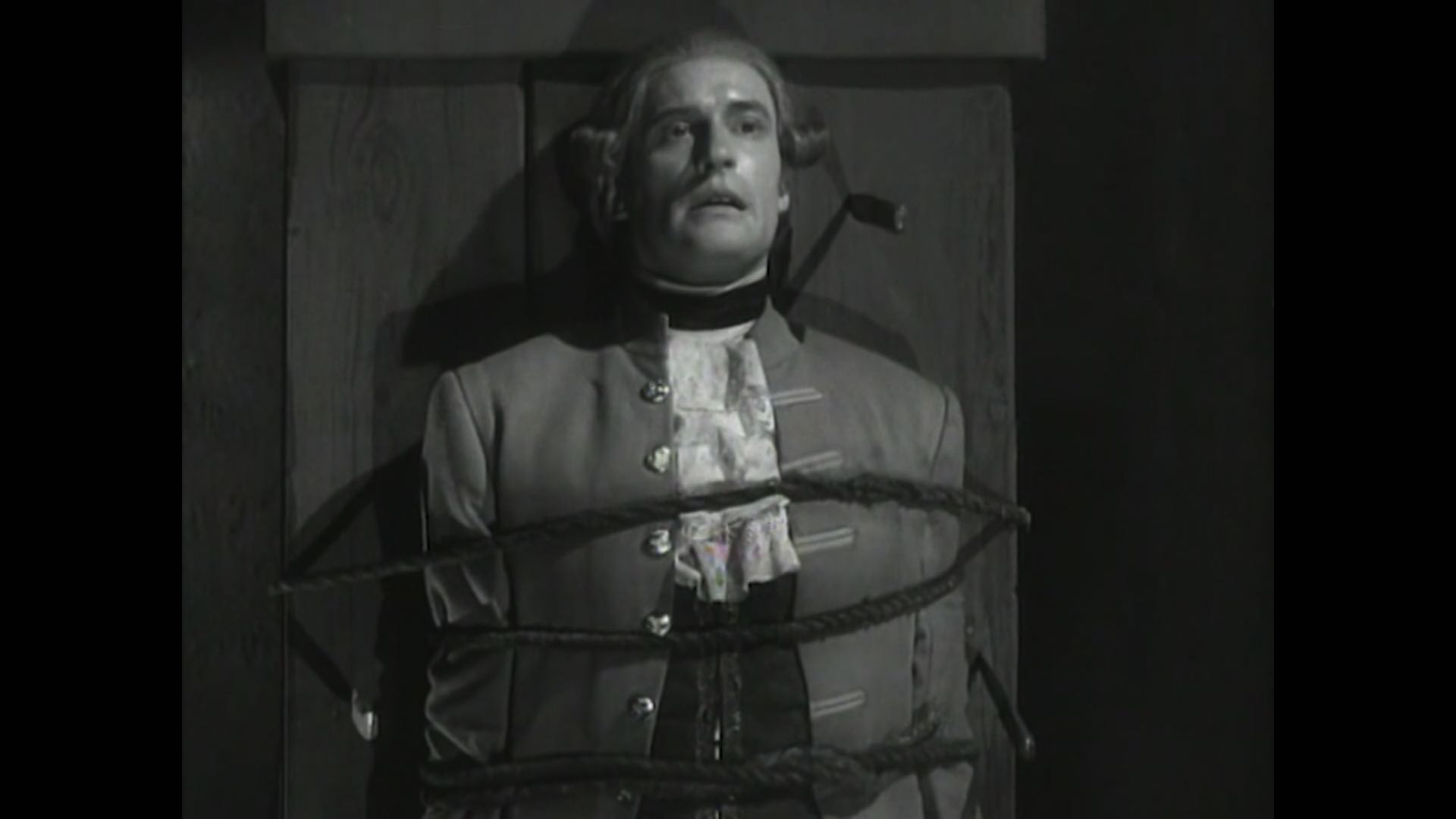
To our pleasant surprise, however, Wraydons really isn't too bad at all. Of course it's talky, threadbare, and suffers badly from the miscasting of Bruce Seton as Captain Jack Wraydon. Seton just doesn't have that "dashing young captain" thing going on; he was only in his late thirties at the time of filming, but something about his face just screams "older man playing young".


The other thing, of course, is that if a character's ability to (ahem) spring from his heels is going to be a major plot point, one would expect some Peter Pan action on the silver screen. This we don't get, though at least there's fencing. (Not much, though.)


There aren't any real surprises -- Slaughter slaughters, henchmen hench, women are made uncomfortable -- but there's a lot to be said for making it through 92 minutes without regrets.


But otherwise Wraydons is fine, in the sense that while we watched it, it didn't make us wish we weren't watching it. We paid two bucks to stream it (hence the weird cropping on our screenshots), and no refunds were requested.

There aren't any real surprises -- Slaughter slaughters, henchmen hench, women are made uncomfortable -- but there's a lot to be said for making it through 92 minutes without regrets.
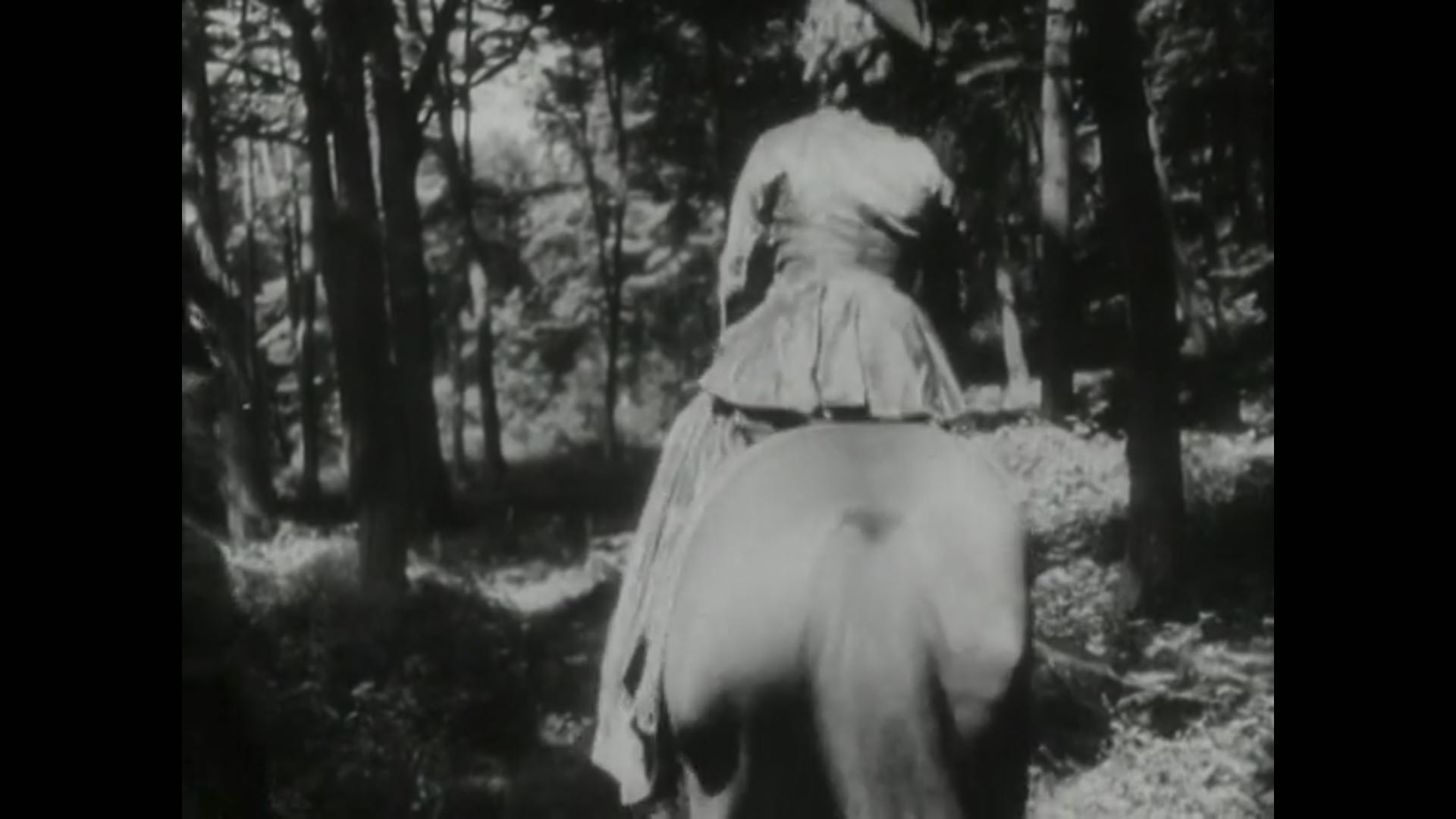
And if you wait long enough, you get horsebutt.
Meanwhile, we picked up the Kino Lorber DVD of The Face at the Window, which longtime readers may remember as one of the movies on Disc 46, and the worst affected of the bunch to boot (since we had to pull it from a particularly poor copy on YouTube).
While we don't really have anything new to say about the film, we did enjoy our second (or third?) viewing more. No doubt it has no small amount to do with the difference between this:
While we don't really have anything new to say about the film, we did enjoy our second (or third?) viewing more. No doubt it has no small amount to do with the difference between this:

And this:


When a film looks better, it's easier to understand and enjoy. Imagine that! Amusing to realize that The Face at the Window reuses the title music from Sexton Blake and the Hooded Terror, by the way -- we knew it sounded familiar.
In recent months we've also seen some other Slaughter ephemera, including additional episodes of Inspector Morley Late of Scotland Yard that have been posted to YouTube. Shall we comment on those, or on Tod's brief but classy reunion with Bruce Seton on "Moral Murder" from Fabian at the Yard?
Or shall we dissect his two Pathé newsreels, also available on YouTube? Or his brief reprise of Sweeney Todd ("Britain's most fruity drama", quoth the narrator) for the bizarre but amusing short film Bothered by a Beard, with Tod in a most unconvincing wig, and his Tobias about five times older than he ought to be?
In recent months we've also seen some other Slaughter ephemera, including additional episodes of Inspector Morley Late of Scotland Yard that have been posted to YouTube. Shall we comment on those, or on Tod's brief but classy reunion with Bruce Seton on "Moral Murder" from Fabian at the Yard?
Or shall we dissect his two Pathé newsreels, also available on YouTube? Or his brief reprise of Sweeney Todd ("Britain's most fruity drama", quoth the narrator) for the bizarre but amusing short film Bothered by a Beard, with Tod in a most unconvincing wig, and his Tobias about five times older than he ought to be?

We think not -- though of the bunch we'd recommend "Pots of Plots", viewable here, as a rare chance to see Slaughter as Captain Francis Levinson from East Lynne, one of his best-known and most popular stage roles.
Otherwise, though, we seem to be done with Norman Carter Slaughter, which both pleases and saddens us. Unless Darby and Joan surfaces -- or we seek out a better print of Maria Marten with the missing 10 minutes -- we've more or less exhausted his filmic output, save a couple of brief appearances on quiz shows, clip shows, and the like. Other than that, there simply isn't any more to see.
The first film of his we watched, Crimes at the Dark House, is still the best. But even if none of the others could reach its dizzying heights, we're glad to have gotten to know the rest. Godspeed, Mr. Murder; we haven't forgotten you.
Otherwise, though, we seem to be done with Norman Carter Slaughter, which both pleases and saddens us. Unless Darby and Joan surfaces -- or we seek out a better print of Maria Marten with the missing 10 minutes -- we've more or less exhausted his filmic output, save a couple of brief appearances on quiz shows, clip shows, and the like. Other than that, there simply isn't any more to see.
The first film of his we watched, Crimes at the Dark House, is still the best. But even if none of the others could reach its dizzying heights, we're glad to have gotten to know the rest. Godspeed, Mr. Murder; we haven't forgotten you.


