Showing posts with label amateur detectives. Show all posts

Monday, January 11, 2021

Put our service to the test

Though neither of these films is a Mill Creek joint, we initially took an interest in them because of their connection to the Horror Collection 250-pack. One features an actress we first met in the earliest days of our site, while the other is ostensibly a sequel to one of our favorite movies on the box.

However, we didn't foresee that they'd share something else: protagonists who find themselves in the crosshairs of that most terrifying of locations --

--that most bone-chilling of phrases --

-- that limitless vein of potential awkwardnesses and unwanted socializations:

"You can stay in our guest room."


    The Three Weird Sisters (1948)

    Grade: C+

    Ah, Nova Pilbeam. Even if your name weren't so unusual, we'd certainly remember you from your star turn in Counterblast, not to mention your strong resemblance to a former colleague of ours (at least in that colleague's younger days: you wouldn't recognize 'em now).


    And speaking of younger days, it's not clear whether this or Counterblast was Pilbeam's last film role -- though she did make one BBC appearance in 1951 before packing it in for good -- but after a successful career as a child actress, and a reasonable career as a young adult, that was that.

    She lived to age 95 -- when we wrote our Counterblast review, she was still alive! -- but was, from all reports, not interested in discussing the past. (Makes sense when your name is "new".)


    Anyway, Ms. Pilbeam is Claire (no relation to Emily) Prentiss, a secretary who accompanies her obstreperous boss Owen Morgan-Vaughan (Raymond Lovell) to a Welsh mining village, Cwmglas, where his (ahem) three weird sisters await his arrival at the family home.

    (Technically they're his weird half-sisters, but that wouldn't have the same ring, now would it?)

    One is blind, one deaf, and one has some combination of bad nerves and severe arthritis, resulting in a strange symbiotic interdependency between the three.


    In the film's opening Cwmglas suffers a catastrophic collapse in which several residents die, and survivors opine on the will of God and the suffering of the proletariat.

    While hard to follow on first viewing, a quick review of Dylan Thomas: The Complete Screenplays (which also told us how to spell "Cwmglas") makes the details clear. The Morgan-Vaughans are the local muckety-mucks who made their fortune via the mines, while their cheapskate refusal to fill up unused mineshafts beneath the village caused, or at least contributed to, the collapse.


    For a while, The Three Weird Sisters is poised on a knife-edge of ambiguity: is Owen just a callous bastard who selfishly wants to wash his hands of all responsibility toward the village? (Given that Owen gets a rock flung at him upon arrival, some of the townspeople clearly hold the affirmative.)


    Or is Cwmglas -- the name of which sounds like a "worst of Reddit" thread in the making -- just a decrepit symbol of the corrupt, hopeless old ways? A decaying relic that's undeserving of life support and overdue for destruction? Merely a vessel for a "spent force", one might say?


    With Dylan Thomas on board, some sophistication (moral and otherwise) is to be expected. Ultimately, though, the lines are drawn by the participants' willingness to sacrifice innocent Claire in the crossfire -- and given that one of the sisters describes her as "that horrible painted young woman", one need not be exceedingly wise to infer who the baddies are.


    So what does that leave us? Suspense, atmosphere, intrigue, and barbed dialogue, we suppose, none of which are extraordinary but all of which are at least serviceable. And we get faces, if one likes faces (as we do), ranging from Ms. Pilbeam's ever-popular visage --


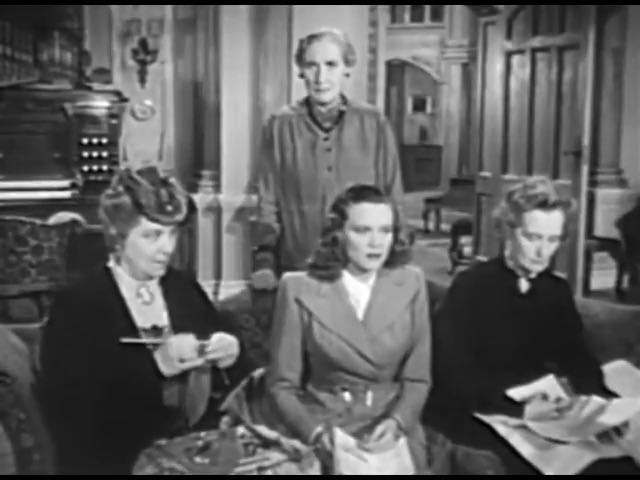
    -- to the sisters, especially Gertrude (Nancy Price), whose forbidding countenance somehow intrinsically evokes those stony, mirthless parts of Britain where God's name is perpetually on everyone's lips and yet the old pagan powers feel close at hand.


    Or there's this preacher (Hugh Pryse) in his ridiculous middle-aged makeup:


    And we get amusing vignettes, as when we find the thersitical Mabli (Hugh Griffith) reciting Marxist dogma to, well, dogs:


    Structurally speaking, The Three Weird Sisters is a film-you've-seen-before -- if you understand what we mean -- and offers no great innovation or dramatic uncertainty. So your appreciation of it will likely depend on your affinity for the Welsh coat of paint it's received, and/or your fondness for Dylan Thomas, Welsh terriers, Nova Pilbeam, or handsome older women.

    (No judgment, you do you.)


    Devil Bat's Daughter (1946)

    Grade: D+


    When you expect a film to be a complete piece of crap, it sure is a pleasant surprise when it's not. That's not to say Devil Bat's Daughter even comes close to its predecessor, The Devil Bat, the consensus favorite among Béla Lugosi's Poverty Row efforts (and we agree that it holds up).


    We can't help but be curious why Devil Bat's Daughter was even made. Was a five-year-old film really enough of a success to call for a sequel? That is: if this was a cynical cash-in, what exactly was there to cash in upon in the first place?


    In any event, Devil Bat's Daughter has little to do with the earlier film, though we can't quite call it an "in-name-only" sequel. Instead it runs along similar lines to Shock, with a traumatized young woman, Nina (Rosemary La Planche), guided through recovery by the authoritarian Dr. Clifton Morris (Michael Hale), who may not have her best interests at heart.


    We're not sure whether having a patient living in your home was considered a ridiculous violation of professional boundaries in 1946, though from our vantage point 75 years later, it seems absurd. But living in Dr. Morris's home brings Nina into contact with his saintly wife Ellen (Molly Lamont) and stepson Ted (John James), and guess which one of them falls in love with her?


    ...no, this is 1946, try again. Though we will say that Ms. Lamont, who hasn't necessarily lit up our screen in movies like Scared to Death and Jungle Girl, evinces a degree of angular classical beauty in this film --
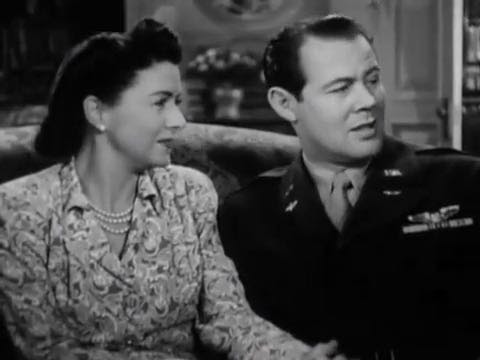

    -- while, by contrast, Ms. La Planche's past as a Miss America merely underscores how tastes have changed.


    But better either of them than John James, who unfortunately evokes the irritating Jerry Lester -- plus a dash of Mickey Rooney, a sprinkling of Tim Allen, a dusting of John Heard. Those old-young faces are a tough sell.


    If one acknowledges that the major plot points of Devil Bat's Daughter are foreseeable, there are a few things that deviate from the expected path. One of them is the body count, or more accurately, the body-count-to-emotional-consequence ratio, which is unexpectedly brutal. Not a film for dog lovers, this, though we're always glad to see a movie go for the jugular.


    On the other hand, Devil Bat's Daughter commits an absolutely monstrous act of retconning that, under normal circumstances, should be unforgivable. So instead, we'll forgive it by allowing ourselves to pretend that the literal meaning of the revelation -- which would utterly destroy both this movie and the previous one -- is untrue, and that the character who announces it is mistaken. And frankly, the movie still works if you assume that.


    Still, while our initial impulse was to give this one a C-minus, it really needs to be penalized for that misstep. Otherwise, we were shocked to find that we enjoyed Devil Bat's Daughter. It's a predictable and flawed film, but manages to entertain nonetheless -- if you have very low standards, as we seem to these days.


    Sunday, October 15, 2017

    Paging Dr. Cuddy

    No bonus points for guessing the theme: someone at Mill Creek no doubt felt very clever when they noted all three of these films' titles have Hugh Laurie in a genitive construction, and so grouped them together on a single DVD side (Disc 48, Side B, if you're keeping count).

    That DVD side also represents a milestone, since it marks the end of Night Screams -- or at least the Horror Collection 250-pack's incorporation thereof -- which means we only have one subset left to review, 50 Sci-Fi Classics.

    (Of course, a good 25% of those "sci-fi classics" are actually peplum, but we'll cross that bridge...)

    Anyway, on to the Houses!


    House of Danger (1934)

    Grade: C+


    In a nutshell, House of Danger is basically House Dark the at Crimes -- that is, Crimes at the Dark House in reverse.

    Instead of an evil-minded, mustachioed impersonator seeking to usurp the place of a man he murdered while working thousands of miles from home, we have a benevolent, mustachioed impersonator (Onslow Stevens) desperately trying to avoid usurping the place of the man whose life he saved (James Bush).

    And it's not as if House of Danger is coy about any of this; as another reviewer points out, this is a crime story, not a mystery story. But House of Danger is also a romance, as -- unlike The False Sir Percival Glyde -- the false Ralph Nelson most certainly inspires the passion of Sylvia (Janet Chandler), the woman who's been waiting for "him" ever since they made a half-serious promise of engagement a decade ago.

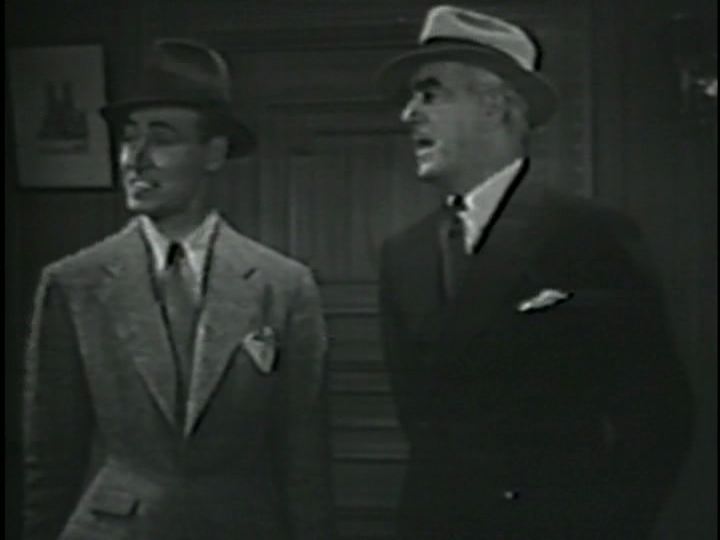
    Now, this requires some serious suspension of disbelief, since Onslow Stevens and James Bush don't resemble one another to any meaningful degree. Here's Stevens:

    And here's Bush:

    So it's hard enough to believe that Sylvia is fooled, let alone all of Nelson's family and friends. But to the film's credit, one person immediately smells a rat:

    As Mr. Weatherby, Nelson's uncle (by marriage) and attorney, Howard Lang is one of the film's jewels. Clever and droll, he reminds us a tiny bit of the intrepid Captain McVeigh from City of Missing Girls, though Lang never has occasion to be as spry as H.B. Warner. But he gets off a few good one-liners of the I-guess-you-had-to-be-there variety, as when the two leading men inevitably bicker over Sylvia and he intervenes:

    "Well, why not let the girl decide what she wants to do? She will anyway! Bet you hadn't thought of that."

    When paired with a chagrined look on both men's faces and a perfectly timed fade to black, it got a big chuckle from us. (Shades of Vernon, Florida too.)

    The crime in House of Danger is offscreen, and is also the engine that sets the plot in motion: Nelson's father recently fell off a cliff, and Mr. Weatherby thinks it was murder. Again, it's not as if there's any doubt about who did it; the question is just how to prove it.

    There's a certain amount of cleverness in how this unfolds, but the ensuing narrative isn't exactly taut with suspense -- and the ultimate resolution turns out to be something of a deus ex machina.

    You may have detected a whiff of stock footage in a couple of these screenshots, and that's one of House of Danger's flaws, though a very minor one. More jarring is the set-piece in which Sylvia serenades a gathering, with strange, dubbed contralto vocals and obviously-pantomimed piano playing that make the sequence teeter dangerously into the realm of the ridiculous. Perhaps we ought to praise the scene for its modest realism, but since Ms. Chandler is already treading in DT territory as it is, it's too big a risk.

    Still, House of Danger is -- by our steadily-lowering standards -- a likable little film that neither insults our intelligence nor wastes our time. Tightly plotted and thoughtfully directed, it's two minutes longer than the next movie in this post, yet seemed to go by twice as fast. It's just a pity the image is so dark and unstable, leaving some scenes almost unintelligible, while others teeter on the edge.


    House of Mystery (1934)

    Grade: F


    Graze through reviews of House of Mystery and you'll find the usual stock lines: "Fans of the old dark house genre will certainly enjoy this one" says one reviewer, while another dubs it a "definite recommendation for all Poverty Row fans", and a third opines that "the screenplay is rather good". We just need someone to call it a "fun romp" and it'd make for a complete set of received opinions.


    All this reminds us of our observation a few entries back -- that many people watching 1930s movies don't actually seem to see the actual movie in front of them, but instead the signifier that it represents: old-dark-house-ness, or old-timey-ness, or (less charitably) when-men-were-men-and-minorities-were-servants-ness. Whatever it is.

    You see, House of Mystery is utter garbage -- a loveless, mirthless exercise in the laziest sort of filmmaking. It's cynical enough to pull the worst kind of bait-and-switch, opening with a pair of scenes in an Indian dive bar and temple that lead us to believe we're in for a "Hindoo" adventure. And to be fair, these sequences, whatever their flaws, are not unatmospheric.


    But the script endeavors to lie, to tease the viewer. (See what I didn't not do there?)

    For, after the first 10 minutes, House of Mystery reveals itself to be the worst sort of old dark house movie -- with thick servings of talky exposition, thoroughly unlikable characters devoid of humanity, pointless hints at backstory that never get fulfilled, and "comic" relief that leaves us staring at the screen in shell-shocked dismay, wondering how something so joyless and empty ever got made.

    Oh, and it's got gorillas.

    The most aggravating thing about House of Mystery is probably its tone-deaf stupidity, particularly when it comes to other cultures. Look, we're hardly the sort of people to be quick on the trigger with Tumblr denunciations, but would it have killed them to find out the name of the Hindu goddess of death isn't pronounced "Kay-lie" -- as though Elmer Fudd, having just completed his speech therapy class, decided to buy some lube and overcorrected?

    Worst of all is the séance scene that repeatedly invokes the spirit of...Pocahontas. No, we're not kidding! Strangely the offensive absurdity and over-the-top stupidity of this seems to have escaped almost everyone who's written about House of Mystery, with the only exception being the one reviewer who writes:

    "Pocahontas? The Native American princess? Well, apparently one type of “Indian” is the same as the other back in the 1930s."

    (Unfortunately that reviewer's credibility is a bit shot by his next sentence -- "Yet, silly as it sounds, the picture is complex and suspenseful". Err....)

    And wait, holy shit, is that the exact same crystal ball from the screenshot we linked earlier? Too funny.

    Anyway, you'd really have to stretch to find something to enjoy in House of Mystery. We suppose the cinematography isn't too bad, with a couple nice shots here and there; shame this print looks so much better than House of Danger, though a few early sections are ripped to shreds with little cuts.

    And as the ill-used dancer/servant Chanda, Joyzelle Joyner does what she can with a thankless part. If her heaving shoulders and flashing eyes are more indicative of "acting" than acting, well...at least she's trying.

    Otherwise, though -- wait, did we mention it's got gorillas? Two gorillas, for reals.


    The House of Secrets (1936)

    Grade: C


    When it comes to this Anglo-American tale of conspiracy and hidden treasure, full enjoyment probably depends on one's ability to tolerate that creakiest of plot devices, the remarkable coincidence.

    Two big coincidences feature in The House of Secrets, and it's quite upfront about the first. When toothy traveler Barry Wilding (Leslie Fenton) rescues a beautiful woman (Muriel Evans) from an awkward situation on a boat, she's appreciative but pointedly refuses to give her name before she departs, leaving him lovelorn and at a loss.

    So isn't it remarkable --

    -- that she turns out to be Julie Kenmore, a tenant in the spooky old English house he's just inherited? What a curious incident!


    But this appears to have been standard practice for the author of the source material, Sydney Horler, who's unfamiliar to us but from all reports was a "nasty little man", racist and anti-Semitic and generally unpleasant.

    (By the way, that link claims that Wilding rescued Kenmore from a "masher", but that's not quite true -- close attention to the dialogue reveals the man's interest had something to do with drugs.)

    The House of Secrets uses another trope we recently encountered in The Midnight Warning -- namely, the close friend of the protagonist who also happens to be ace detective Tom Starr (Sidney Blackmer).

    This kind of thing can be disastrous for a story -- the equivalent of dropping a Level 10 ranger into your entry-level D&D campaign -- but to its credit, The House of Secrets mostly keeps Starr out of the action, leaving Wilding to unpack things on his own.

    It's hard to say much more about The House of Secrets without spoiling it, though quite frankly the basic outlines of the plot are pretty obvious before long: with early references to drugs, the sound of maniacal laughter, and portentous warnings from every corner about how Wilding can't possibly be allowed to know what's going on in the house he just inherited and really ought to sell it posthaste? Not too hard to put the basics together.

    For most of its 70-minute running time, The House of Secrets is remarkably brisk -- so much so that at some point we looked at each other and were astonished by just how much had happened over the course of the movie: the film felt long in a good way, i.e. from its own cohesion and propulsion. OK, perhaps it has one too many IWGIHs, but the margin of excess is slim.

    However, by the 45-50 minute mark, our destination had become obvious enough that other characters' endless evasions and deferrals started to get irritating: yes, we know all will be made clear in the final scene, but maybe it's better to put some pieces in place first, so it's more satisfying when those last few are snapped in.

    We also can't claim the ultimate conclusion really grabbed us. Once again, we could tell a Midnight Warning-style denouement was more or less inevitable -- was there a vogue at one time for "So now you see, we had our reasons" plots? -- but everything's a bit too pat, with one-time adversaries turned newfound friends with no time to catch our breath. Can you really make fast friends with someone who recently held you at gunpoint?

    Well, The Phantom thought so, and I guess The House of Secrets does too: must have been a 1930s thing.


    Anyway, The House of Secrets is a fine way to wind up the Night Screams set -- not least because it actually has some night-time screaming, which is always nice. (It also has a fuzzy, VHS-dubbed print that makes some of the darker scenes more or less inscrutable in their details, but such is Mill Creek life.)

    By the standards of this box, it's an above-average suspense tale that kept us more or less engaged throughout its running time -- even if our laughs at the end owed more to resigned incredulity than to real satisfaction.


    And to our pleasure and astonishment, that brings us to the end of Night Screams. 12 months ago it seemed inconceivable that we'd ever work through our backlog, whereas now we're spoiled for choice:

    Do we immediately continue on to 50 Sci-Fi Classics? (From which we've already reviewed 5-6 movies anyway, mind.)

    Or take a detour into one of our other, shorter box sets, like Grit 'n' Perseverance from whence our beloved Beartooh [sic] hailed?

    Or wrap up some unfinished business from the Nightmare Worlds subset that begins the 250-pack, and with which this whole project started out -- in more ways than one?

    Dunno. But first we have an awards ceremony to convene!