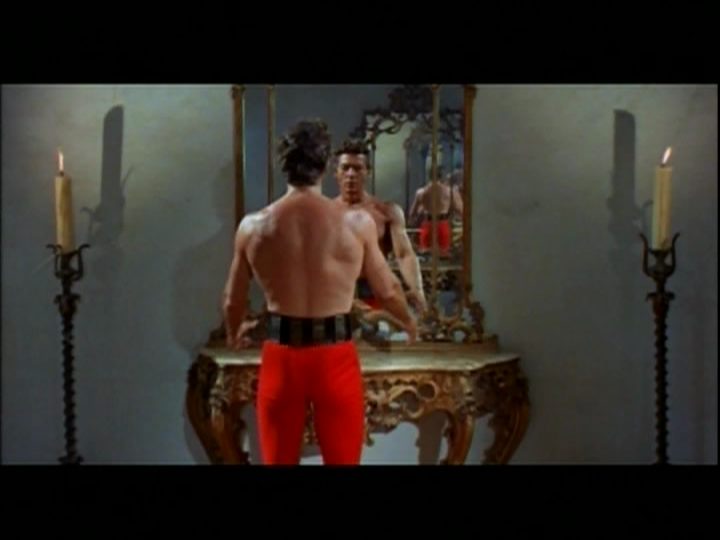
Up next are two* more Tod Slaughter movies from the Night Screams subset of the Mill Creek box set.*
Plus, as a bonus, we review a feature film* of his that hadn't been seen for decades, until it resurfaced last year.
(*Well, sort of -- on all counts! -- see below.)
Plus, as a bonus, we review a feature film* of his that hadn't been seen for decades, until it resurfaced last year.
(*Well, sort of -- on all counts! -- see below.)
Grade: B-

Traffic in human depravity though he may, there's something oddly comforting about knowing you're about to watch a Tod Slaughter film. Partly it's the familiarity of seeing the same faces over and over again, until they blend together in a pleasantly delirious haze, wherein names become less important than structural functions.

So it doesn't matter that Marjorie Taylor is called "May Edwards" in this particular film, because it's just another instantiation of her archetypical role as "the woman Tod Slaughter wants to sleep with, thereby making her very uncomfortable".
(Someone should start a Tumblr called "Tod Slaughter making women very uncomfortable.")

This film (The Ticket of Leave Man) and the next (The Face at the Window) blend together even more than most, since they both involve a lot of the same plot points. There's a mysterious criminal named for a dangerous animal, who hides in plain sight by masquerading as an affluent and upstanding citizen. There's a beautiful woman whose charms attract the unwanted attention of said murderer.

And there's an honest young man (John Edwards) employed at a bank -- and in love with said young woman -- who runs afoul of the law when he's falsely accused of one or more heinous crimes.
In this case, the honest young man even gets thrown in prison, though he's paroled before too terribly long. This makes him the titular "ticket of leave man", a phrase totally unfamiliar to us before this film.

To help us differentiate it from other Slaughter films, The Ticket of Leave Man has some striking secondary characters, like this creepy, cigar-smoking child-man...

...or this unambiguously anti-Semitic caricature:

We're hardly the sort to grasp at straws in the name of self-righteousness, but it's not as if there's a scintilla of doubt when it comes to Frank Cochran's portrayal of counterfeiter Melter Moss, or what stereotype it's meant to evoke. Given that he only had three IMDb credits -- one of them for the role of "Ho Tang", we kid you not -- we're guessing Cochran may have been mainly a stage actor, who apparently specialized in ethnoculturally insensitive roles.

The Ticket of Leave Man is a close cousin to It's Never Too Late to Mend, and probably a notch better than that preachier effort. And we get Slaughter with and without mustache, which is always a plus. But we're docking a few points for Melter Moss: OK, we don't know from 1930s Britain, but we want they should do better than that, no?

Grade: C-
So, when we pulled out Disc 46 of our 250-movie box set to watch The Face at the Window, we were greeted by this:

And this:

Yes, it seems that instead of giving us Disc 46 of the Horror Collection, Mill Creek accidentally gave us Disc 46 of the Western Legends Movie Pack. Oh, well.
Fortunately, all four films on Disc 46 are available for viewing on YouTube and other sites -- which means that, for our next few posts, the screenshots you see won't be from the Mill Creek box. Unfortunately our downloaded source for The Face at the Window is by far the worst of the four, yielding blurry, artifacted results like this:

It was still watchable (barely), but the poor video quality probably detracted from our enjoyment of The Face at the Window -- though, don't get us wrong, we're grateful to the uploader nonetheless.
Another demerit is the supernatural element in this tale, first hinted at in the opening text crawl:

Then, later, we get a bunch of flasks and beakers, and you know what that means. That's right: science.

Somehow, the inclusion of lycanthropy (sort of) and galvanism dampens the fun -- perhaps because the necessary pseudo-scientific handwaving undermines the classical purity, if you will, of Slaughter's Grand Guignol act.
Or then again, maybe it's that the protagonists too often act like blithering idiots, repeatedly contriving to make the stupidest possible choice in order to serve the needs of the plot? That made it hard to care much about their fates.

But hey, at least we have another entry for our Tumblr.

Grade: C+

This "movie" is actually an edited compilation of the first three episodes of a British TV series, Inspector Morley Investigates -- aka Inspector Morley (Late of Scotland Yard) Investigates, depending on whom you ask.
However, Inspector Morley was never actually broadcast in Britain: though a full run of 13 episodes was wrapped, the producers were apparently unable to sell the show to the BBC.

Instead, they sold it to the American market -- where it was apparently broadcast for at least one run -- but also took six of the episodes they'd filmed and combined them into two features, King of the Underworld and Murder at Scotland Yard, which were shown in the U.K. (Confused yet?)
The latter feature, and the majority of the episodes, remain lost as of this writing -- but may yet lurk in someone's vault or collection.

You can find more information about the series, including the three other surviving episodes, here. In any event it was a very pleasant surprise when King of the Underworld was unexpectedly shown last year on a British TV station, and we're very grateful to the colleague who was kind enough to provide us with a DVD of the broadcast.

Slaughter plays Terence Reilly, an irrepressibly evil criminal mastermind, and it's nice to see that age hasn't robbed him of his panache or physical presence. Though Inspector Morley solves a fresh case in each episode, some aspect of the crime will inevitably reveal Reilly's sinister fingerprints.
And unlike Slaughter's other characters, Reilly doesn't generally let his wang overrule his brain -- making him far more dangerous.

Opposing Reilly's schemes are Inspector John Morley (Patrick Barr), naturally, as well as his crackerjack assistant Eileen Trotter (Tucker McGuire). Quick-witted and sharp-tongued, Eileen bears no small resemblance to Harriet Sansom Harris (best known for her recurring role on Frasier as Machiavellian agent Bebe Glazer).

In actuality, King of the Underworld doesn't "read" as a feature film at all. The edits (and voiceover narration) that combine the three episodes aren't crude, but certainly aren't seamless, and even contemporary audiences unaware of the film's origins could hardly have been fooled. Still, Slaughter's presence -- he was in every episode of Inspector Morley -- provides enough continuity to forge a reasonably plausible Holmes vs. Moriarty storyline.

That said, the quality of the writing isn't great, and leans too heavily on a handful of gimmicks -- especially disguises -- whose plausibility stretches thin with reuse. Also, Morley himself isn't really as clever as he ought to be, sometimes letting slip information that can only harm him or his colleagues: after Eileen successfully tricks Reilly, why on earth would the Inspector then reveal her identity to him? What purpose does it serve, except perhaps to gloat?

We've seen the other, later episodes of Inspector Morley Investigates that survive, and we're sorry to say that in those, Eileen is woefully underused and dumbed-down. Here, though, she's a real firecracker. Independent-minded, and (ahem) oddly sexy, she's arguably a better foil to Slaughter than Morley himself. Certainly, she's almost as responsible for solving their cases as Morley is.
So naturally, the writers ensure that Eileen eventually gets into deep trouble and has to be rescued. Così fan tutte.

Tod Slaughter fans will be this film's main audience, but Tucker McGuire's fun portrayal means there are two good reasons to seek out King of the Underworld. Otherwise it's largely a standard affair and a period piece -- but as fresh documentation of a great actor's career, it's like rediscovering a home movie you'd forgotten about.