Showing posts with label his daughter finds out. Show all posts

Sunday, July 25, 2021

Unilateral disarmament: the pros and cons

(A cheap and obvious pun, but it had to be made.)

In a slight departure from strict chronology, The Umbrellahead Review once again turns its attention to films found on some versions of Mill Creek's box sets, but not others. In this case, we're looking at the Nightmare Worlds release -- specifically the version included as part of our 250-pack box set -- which omits two movies we had to seek out from other sources.

One of these films was cut before we got our box set; one seems to have been added afterward. One was removed in favor of The Disappearance of Flight 412, that shaggy-dog story of a TV movie; the other replaced The Return of Dr. Mabuse, that unmemorable slice of early-1960s German murk.

Both films are superior to their respective swapmates -- if that's not a word, it should be -- and one of them is about to get the first grade of its kind on The Umbrellahead Review.


    The War Game (1965)

    Grade: A


    The simplest way to describe The War Game would be "sobering". We downloaded our copy -- split, it seems, into two individually-digitized reels -- from Archive.org. Normally when we watch movies we don't talk much, but we might chat or complain a little.

    But by the time we got halfway through the first reel of The War Game, not a peep was to be heard hereabouts.


    Produced, written, and directed by Peter Watkins, The War Game was filmed in preparation for a 1965 showing on the BBC, but after seeing its depiction of the effects of nuclear war on Britain, the bigwigs at the Beeb deemed it too traumatizing for broadcast. Subsequently it was shown at film festivals, ultimately winning the Academy Award for Best Documentary Feature in 1967.


    But The War Game didn't reach British television until 1985, airing just before the 40th anniversary of the Hiroshima bombing in 1945 -- and nearly a year after the premiere of Threads, which did indeed traumatize millions of British people, adults and children alike.

    Along with 1983's Testament and The Day After -- both of which did their parts to traumatize American families -- Threads is the most obvious point of comparison for The War Game. All these films were made for TV, and all of them offer a relentlessly downbeat vision of life after atomic war.


    One crucial difference is that The War Game is not narrative fiction, but a documentary of sorts. It makes little attempt to tell the stories of specific people, but instead assembles a collage of scripted and unscripted interviews, recitations of quotes by prominent British public figures (most of them hopelessly fatuous, naive, or jingoistic), and enactments of what one might expect to be "typical" scenes in post-apocalyptic England.

    You know, looters getting shot, injuries without doctors to treat them, utter and total loss of hope, that sort of thing.


    The War Game is far less graphic than Threads, but in some ways is even more effective as a result. Watkins does a masterful job of weaving together individual heartbreak with collective destruction, not by creating characters for us to follow, but through the synecdoche of letting each person's words, facial expressions, and movements inevitably imply the whole.


    If you retain any affection for the inhabitants of Great Britain and their ways -- and, please, don't let's conflate the British people with any misdeeds done in their name or the name of Empire -- then it's profoundly disturbing to see the total breakdown of those ways, sometimes referred to as "society". (You know, that thing Maggie said didn't exist.) 


    We know that The Day After had a profoundly sobering effect (there's that word again) on Ronald Reagan, who wrote in his diary that it was "very effective and left me greatly depressed...My own reaction was one of our having to do all we can to have a deterrent and to see there is never a nuclear war."

    Guess it takes Hollywood to reach Hollywood -- but The Day After also reached a massive percentage of the American public. The War Game was denied that opportunity, reaching only a handful of cinematic elites until its time had passed.

    Impossible to say now what effect it would have had since -- in this timeline at least -- we miraculously made it through the remainder of the 20th century, and the first two decades of the 21st, without turning ourselves into glass souvenirs for curious aliens.


    Anyone who's seen "The City on the Edge of Forever" knows better than to meddle with the past. So, who knows: had The War Game been shown, maybe it would have inspired a huge British anti-war movement that would, in turn, have inspired a countermovement that led to catastrophe. Push a pendulum, get hit in the face.


    Better then to forfeit one's moment in the sun -- and an Academy Award sure as hell ain't bad -- than to reap "Two Suns in the Sunset". Nonetheless The War Game is more available than ever and, sadly, just as relevant as ever.

    It retains its power to leave an audience in stunned silence -- and if that audience is unlikely to want to watch it again, that would seem to be a measure of its success.


    The Severed Arm (1973)

    Grade: C

    After The War Game, the gore and goofiness of The Severed Arm come as a relief. True, it has ambitions of being something more than a standard-issue slasher/revenge film; in some details, it does elevate itself above that mean.

    But when you come down to it, The Severed Arm is one of those movies whose relationship to the consumer is mainly defined by the one-to-one correspondence between its title and its contents: it does what it says on the can. For those who like freshly amputated upper extremities, it's not going out on a limb (ahem) to say, this is the sort of thing they'll like. It delivers.


    Here's a really weird trope that we see a lot in films and TV: the idea that, in the face of a potentially lethal event -- poison gas, radiation, starvation -- you can precisely calculate the amount of time left. If you're able to finish a task or find salvation when you're below that number, you're golden; if not, you're inevitably dead meat.


    Now, sometimes this kind of exactitude makes narrative sense, like in a scuba diving movie. But if you're wondering how and why an amputatable gets amputated in The Severed Arm, the main reason is that six bros get together, something goes terribly wrong...


    ...and before long, "Some of us...maybe all of us...can't make it through tomorrow" if they don't get to sawin'. (Chop chop.)


    One might quote Dave Chappelle's sage observation -- "You were in on the heist, you just didn't like your cut" -- but, naturally, that holds little sway with the hack-ee. So when the other five bros begin losing limbs left and right...


    ...well, really more like left or right...


    ...the question doesn't really seem like "Whodunit?" so much as "Whatcha gonna do when they [in the 'third-person singular of unspecified gender' sense] come for you?"

    Hard to say more without spoilers galore, though the presence of Deborah Wiley as Teddy -- daughter to don't-mind-'im-'e's-'armless -- complicates matters beyond the routine.

    Is she a possible love interest with a disarming smile? Just an indignant and/or concerned family member? Something else? Only time will tell.


    One of us recalls reading some pretty negative comments about The Severed Arm that implied it was in the same league as Manos or Eegah. Consequently, as we watched (hi, Ray!), the film defied expectations simply by being of ordinary quality.

    That doesn't mean it was especially well-acted or well-written, mind you -- the script even invokes the old cliché about how the calls are coming from inside your house! -- but it never got worse than passable.


    Of course it helps that, instead of our usual PD fare, we were watching a gorgeous widescreen transfer from Vinegar Syndrome, with intense colors and a beautifully crisp image. Between that, Phillan Bishop's moody analog synth score, and the lavish supply of marvelous 1970s aesthetics, the film is a feast for the senses.


    By the way, some people who own DVDs of The Severed Arm have wondered if it ends prematurely. It's possible that sketchy releases truncate the credits to obfuscate copyright, but Vinegar Syndrome's release makes it very clear that the film's rather abrupt ending is intentional, and the final freeze-frame doesn't change during the credit roll.

    If you see a still shot with two happy people, and one with a blank expression, you've seen the end.

    (But the screenshot below isn't it -- just a chance to show off some cardigans and fancy prints.)


    Monday, April 3, 2017

    Get on with it!

    Had we not already been the patient folks we are, trekking through the 250 movies of the Mill Creek Horror Collection would surely have taught us that virtue which is seldom found in humans (and never in a duck).

    But these next two films stretched our virtue to its limit (leaving it, no doubt, slacker for the experience). For both make it pretty clear where they're going from the outset, and yet still take most of their running time to get there -- leaving us long minutes in which to await the incoming inevitability.


    Nabonga (1944)

    Grade: D-


    It's been a while since we first watched Nabonga, but we'd imagine that some minutes in, we turned to each other with a quizzical look: "What the...Haven't we seen this one before?"

    And in fact Nabonga has a lot in common with The White Gorilla, that godawful piece of Crash trash that made our worst list a few entries back. Both involve primates (obviously), stock footage of African wildlife (hardly a surprise), Corrigan himself (in a gorilla suit, natch)...

    ...and white women worshipped and/or feared by credulous, stereotyped natives. Yep, that's a delightful panino of racism served up from Nabonga's grill, though it could be worse.


    Of the two, Nabonga is clearly the better film (not that that's saying much). There's a pleasant edge to its MacGuffin -- a tale of stolen riches, a plane crash, and a crooked father (Herbert Rawlinson) willing to kill to protect himself, his daughter Doreen, and his ill-gotten gains (in whatever order). He may be a murderer and a fiduciary traitor, but at least he loves his kid, right?

    You've probably already guessed most of the rest, like the noble explorer Ray Gorman (Buster Crabbe) who goes in search of a mysterious "house with wings" that fell from the sky, or the native Tobo (Prince Modupe) who bravely escorts him, despite his trepidations about the "white witch" living in the jungle.

    (Poor Tobo: you behaved with honor and courage, but -- while facing your fears is always a good move -- in this case, sadly, you'll regret that decision.)

    Naturally, there's also a cunning rival (Barton MacLane), a morally ambiguous femme fatale (Fifi D'Orsay) -- who wears Mexican peasant blouses, for some reason, and flowers that look like dollar signs --

    -- and of course Doreen (Julie London), who's all growed up now and has swapped out her paternal protector for something a bit more...hirsute.

    And if you've guessed that it's love at first sight for her and Buster, the answer is a resounding "Yes!"...

    ...uh, more or less, anyway.

    All well and good, but did we really need 60+ minutes to chew on this meager plot before we get to anything resembling real action? Gorilla suits, smiling ladies, and fake crocodile fights aren't remotely enough to sustain Nabonga, which doesn't come close to fulfilling the promise of its initial hook. Some conflict between Gorman and Doreen's father would have given some teeth to proceedings, but as things stand, Nabonga's only real selling point is that it's not The White Gorilla.


    Midnight Phantom (1935)

    Grade: F


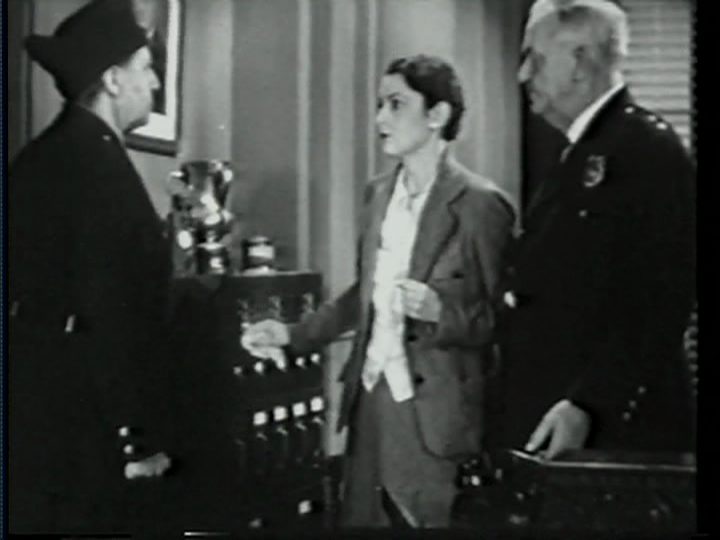
    As anyone who's ever watched Adam-12 can tell you, it's hard being a police chief (Jim Farley). You've got to be tough but fair, keep your integrity integrated and your wits about you, and hold the men around you to the highest ethical standards while living up to them yourself.


    Oh, and occasionally you have to show off your nipples. There's that, too. (It's a union thing.)

    "OK, I've had all I can take -- cover 'em up, Chief."
    It's even harder, though, when you know you've got a lot of people who want to kill you -- and Midnight Phantom spends a good three-quarters of its running time making damn sure we know just how many people want to kill Chief Sullivan.

    Some highlights from this long list include his own men, tired of getting one too many dressings-down. Several of them make not-so-veiled threats against him -- a serious thing in a tough town where "I'll get you!" isn't an invitation to carpool.

    Or there's the sad case of his secretary Kathleen (Barbara Bedford), an attractive woman in the early stages of spinsterhood, who quietly harbors a flame of passion for her middle-aged boss.

    Her formidable mother (Mary Foy), mistaking propinquity for iniquity, then proceeds to rain down holy hellfire on the poor chief's head.

    We can't find it at the moment, but one site described Foy as "spectacularly butch" or something along those lines, and that's about right. One part Nona Gaprindashvili and one part Lawrence Dane, she's the sort of woman who says "You'll pay for that!" and leaves you no doubt that it will be so.

    And then there's Lieut. Dan Burke (Lloyd Hughes), who's passionately in love with the chief's daughter, Diana (Claudia Dell). The chief even gives his blessing to their marriage, so it seems like blue skies for love, right?

    Well, not so fast: there is the minor matter of Burke's criminal brother -- whose existence, once revealed, flits across the plot of Midnight Phantom like that bird what got hit by a baseball that one time. Which is to say, he goes splat, and that's his sole function in the film...

    ...except, of course, that the whole thing hits the newspapers, and gets poor Lt. Burke the Ted Knight treatment from the chief. Motive for murder? Maaaaaybe.

    And then there are all the random criminals who get paraded through the screen at one point -- all so that the famed criminologist Professor David Graham (Reginald Denny, looking rather Scanavino-esque) can do the equivalent of a psychic's "cold reading" on them and suss out their particular brand of lawbreaking. Maybe one of them has manslaughter on the mind?

    But one person it can't be is Prof. Graham, no way, no how. Nope. He's such a nice man, and so criminological, you know?

    Why, he goes to great lengths to make it clear how OK he is with Diana's imminent marriage, even though he's in love with her! And when given an easy opportunity to undermine Lt. Burke, he doesn't take it, but instead supports Diana! Confronted by a wavering beauty who seeks permission to return to the arms of her beloved, he could've said "What are you, nuts?" but instead, he affirms their love. What a guy.


    Anyway, with all these potential foes lurking around, you'd expect the Chief to think to himself "I'm dead meat!", and take appropriate precautions. Or maybe the film would bump him off about halfway through, and we'd have an elaborate series of revelations and counterrevelations to unravel. Right?

    Well, no: Midnight Phantom just kinda putzes around for 45 minutes and then, like a college student who procrastinates on a paper until 2:00 a.m. the night before it's due, spends the last 12 minutes hurriedly trying to cobble together some sort of denouement.

    Consequently, while any consecutive few minutes of the film are reasonable enough, Midnight Phantom is a complete trainwreck on a structural level, because its fundamental design is disastrously misguided. Its thesis statement is untouched until page 18 of 20; its bungee cord of salvation turns out to be a rubber band.

    Such is the mark of a failed film. (It also has a stupid name: every time we've gone through the list of films in our backlog, we've looked at the title and said "Midnight Phantom? What was that?")

    So if Midnight Phantom is the booby prize, it seems we are the winners. (Sigh.) But hey, at least it's got soul:

    (I know, I know, I know...and now, you supply the other 23! See ya.)

    Monday, February 20, 2017

    Passion killer, you're too much

    By no means is this next pair of reviews our first foray into the Night Screams (sing it, Neil!) subset of the 250-pack. We've covered six of those films so far, ranging from the Sapphic musings of Kiss Me, Kill Me to the bottomless battles of Killers of the Sea (as opposed to the topless titillations of Devil Monster, with which we sometimes confuse it).

    But these two films share another trait besides being part of Night Screams, since they both prominently feature pretty ladies gettin' photographed (and then offed -- not much of a spoiler, that). And yet, both are also dominated by a charismatic male actor whom we found more memorable than any of the XXs on display.


    Bloody Pit of Horror (1966)

    Grade: D+

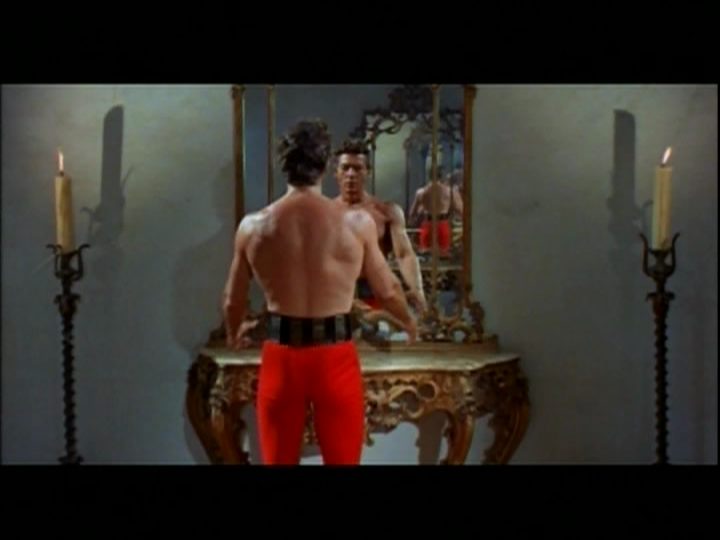
    Silly robes aside, there's a solid case to be made that Mickey Hargitay was actually the most attractive member of his family. We've never thought Jayne Mansfield was much of a looker, and Mariska clearly takes after her; meanwhile, though we knew Mickey was jacked, we didn't realize how pretty he was.

    Somehow a mental image of one of those circus strongmen with a big mustache crept into the "Mickey Hargitay" filing drawer of our brains, but he's not Karnov- or Zangief-esque at all; if anything he looks and moves more like a dancer. His screen presence is a bit off-kilter, but no less palpable.

    However, Mickey Hargitay certainly wasn't the best actor in his family -- his daughter deserves that title (even if these days SVU has reduced her to trotting out rote expressions of pained sympathy and righteous indignation, in whatever sequence is necessary to fill that episode's quota).

    He gives Bloody Pit of Horror his best shot, but -- like a washed-up actor doing porn to make money -- his efforts feel out of place and, at times, faintly embarrassing.

    And of course, Bloody Pit of Horror basically is porn -- torture porn, to be precise, that's allegedly adapted from the writings of de Sade. Oh, there's a framing story about a group of models and photographers who foolishly blunder upon a haunted castle and ignore numerous warning signs telling them to get the hell out.

    With their blasé attitude and loose morals, they ultimately offend Hargitay -- who (now that we think about it) plays a washed-up actor, so there you go -- and thereby seal their fate. Throw in a medieval legend about the "Crimson Executioner", an obsession with bodily purity, and a handful of underlings who all wear striped shirts for some reason, and you've got a movie.

    But, to vaguely evoke that famous line from 1984, the torture is the point of Bloody Pit of Horror -- not a means to an end, but an end in itself. And, well, if you're into seeing women tormented to the tune of looping Italian lounge music, then we suppose this here is your jam. It's got skewerings, slashings, burnings, an iron maiden, death by crossbow, and an elaborate setpiece involving a web of wires and the goofiest-looking spider this side of Martha's Orphanage.

    As demonstrated by the persistence of shows like SVU and Criminal Minds (not to mention the recent U.S. election), virulent sexual sadism is rather fashionable these days. But while Bloody Pit of Horror is too distasteful to be laughed off, the years have dulled its edge, and -- despite some impressive sets and a fairly attractive cast -- ultimately it left us bored and disinterested.


    City of Missing Girls (1941)

    Grade: C+


    This crisp little effort from Poverty Row manages to be a film about prostitution that never actually uses the word, nor any of its synonyms. But that's clearly the subtext -- here couched in euphemisms about "out-of-town jobs" to which the titular girls are assigned, never to return.


    Swooping in to save the day is James Horton, an ambitious young A.D.A. (played by John Archer, whom we recently saw in Bowery at Midnight, and rather reminds us of Robert Sean Leonard in this appearance).

    He's flanked by a philosophical old police captain (H.B. Warner) and -- could there be any doubt? -- a young, spunky female reporter, Nora Page (Astrid Allwyn). She's good-naturedly amoral in her search for front-page news, though like all spunky female reporters, she eventually sees the error of her ways.

    She's also in for a grim discovery, as her father is an investor in the "Crescent School of Fine Arts" -- a talent agency that's more or less a front for the film's sex trafficking operations. So the deeper she digs, the closer she unwittingly gets to dear old Dad.

    (Don't you see? This is what always happens to -- ugh -- career women. Hence why no spunky female reporter's career outlives the runtime of the film she's in, not to mention the conspicuous lack of middle-aged spunky female reporters in these movies.)

    One thing that's refreshing about City of Missing Girls is the unexpected civility of the cast. Officers of the law and criminals have actual conversations, and treat each other with a degree of respect, even when hinting at the gravest of threats. And this paradoxically makes the villain King Peterson (Philip Van Zandt) seem more menacing, since like a big dog that doesn't bark, he has no need to boast to prove his power.

    If you enjoy the fashionable absurdities of past decades (as opposed to the fashionable inhumanity of the present era), then City of Missing Girls offers a pleasant smorgasbord of preposterous peacockery. We get silly hats (obligatory in any film with a SFR), silly outfits, and silly dances galore.

    But the real star is H.B. Warner, who's the kind of old fella we'd all love to have in our corner, and steals every scene he's in. (We suppose that's no surprise coming from a guy famous for his portrayal of Jesus -- which he pulled off the age of fifty-two!)

    As Captain McVeigh, he's warm, witty, patient, sharp as a tack -- and astonishingly spry when the moment calls for it.

    By our lights, McVeigh is the film's real protagonist. He's the first onscreen and last to leave, and gets most of the best lines:

    Horton: "If you were a gangster and you wanted to frame somebody --"
    McVeigh: "Yeah, well, I'm not a gangster, and I don't want to frame anybody. I want to go to sleep!"
    Horton: "Mac, this is important!"
    McVeigh: "All right, I am a gangster, I do want to frame somebody, and I don't want to go to sleep."
    Horton: "All right, now who would you get to take a picture like this?"
    McVeigh: "A photographer."

    At heart City of Missing Girls is a formula piece, with a plot whose twists and turns hardly qualify as such. But it's still an enjoyable one, and if you don't agree, may H.B. Warner haunt you with his Duck Face of Disappointment.