Showing posts with label sea creatures. Show all posts

Monday, December 17, 2018

Poor Mrs. Chickenbottom

Have you ever started a school paper or an essay with one of the following?

"Ever since the dawn of time..."
"Throughout human history..."
"From the earliest days of mankind..."
"In the broad sweep of history..."

To a teacher, sentences like these are the equivalent of Comic Sans at a typography convention. They strike at the heart of even the most seasoned educators, filling them with dread, ennui, and the compulsion to question their life choices.

And sadly, we've all done it at least once, and maybe more than once -- kinda makes you want to track down poor old Mrs. Chickenbottom and buy her a beer, doesn't it? -- until a brave red pen intervened and said "No, and never again" to that hoary cliché.

These two films, though, clearly didn't get the memo. Both of them start out with a narrator -- never a good sign -- who portentously sets the stage by talking about events that predate recorded history.

You know, things that happened at the dawn of time. (Sorry, Mrs. Chickenbottom.)


    Prehistoric Women (1950)

    Grade: F

    Let's just take a moment to consider the opening voiceover in Prehistoric Women:

    "Our knowledge of the prehistoric world, before the first historian sat down to write the story of his people, is vague. It’s founded on the research of archeologists. Their studies of people and dwellings which existed in those times. Existed not only in rocky wastelands, but in the warmer climates, in the plush, prehistoric jungles. Not so very long ago, an explorer in a wild, tropic jungle found evidence which told this story. Nobody knows when these events took place -- maybe ten thousand, maybe a hundred thousand years ago. It’s the story of romance when the world was young.”

    And now, take a moment to reflect on those broken sentences and that tortured syntax. Someone thought to themselves, Yep, this is a good way to start a movie. This is good writing. People will enjoy this.

    With a few exceptions, like these three films, most discs in our Mill Creek 250-pack have been haphazard in their pairings. Follow The Giant Gila Monster with The Fatal Hour? Sure! How about a double-feature of Carnage and Daughter of the Tong? Makes sense!

    However the person who put together 50 Sci-Fi Classics seems more on the ball, because Prehistoric Women is paired with The Wild Women of Wongo on Disc 58, Side B, and that's pretty spot-on.

    Even though it was almost a decade ago, the grinding, interminable experience of watching Wongo is still plenty fresh in our minds. How could it not be, with all those parrots and, uh, wild women?


    Prehistoric Women gave us the same grinding, minutes-are-like-hours feeling we got from Wongo -- but, somehow, it's actually worse. At least Wongo didn't take itself seriously, but Prehistoric Women has loftier ambitions, and that pretty much kills off any chance of enjoyment. It's pure torture.

    If it seems like we're trying to avoid actually talking about Prehistoric Women, well, you've got us. Bottom line, it's basically a really, really stupid version of Quest for Fire -- crossed with Wongo, or One Million B.C., or whatever shitty caveman movie you want to invoke that actually has women in it.

    Of course, these women have immaculate hair, makeup, and teeth, just like in prehistoric times. After all, they're totally paleo.

    And when you have a nearly (or at least temporarily) all-female cast in the 1950s, you know what that means! Good ol' film, substituting violence for the sex it wasn't allowed to show, and inadvertently creating a nation of pervs turned on by the proxy. (No, Mr. Kinsey, I'd rather not borrow your toothbrush, actually.)

    The pompous narrator is present throughout Prehistoric Women, since there's no dialogue except for made-up cave speak, which mostly consists of one or two words at a time. You can imagine how quickly that gets old, at least when done as poorly as it is here.

    And sakes alive, does this print get bad whenever it's dark out:

    Somehow you'd expect Prehistoric Women to be a foreign production, but not only do most of the actors and actresses appear to be American, but many of them actually had substantial careers.

    Given that they spend the entire time grunting and pointing, it's hard to imagine this one was much help to their CVs, but a paycheck's a paycheck.

    And speaking of paychecks...


    Blood Tide (1982)
    [aka Bloodtide]

    Grade: C-

    To paraphrase April O'Neil, "Oh! James Earl Jones! What are you doing here?"

    In the wake of all his Star Wars duties, maybe JEJ just wanted the world to cut him some slack. Sign on the dotted line, and he gets to chill out on a Greek island and pretend he's banging Lydia Cornell, aka the blonde from Too Close for Comfort.

    In Blood Tide she's called Barbara, but she could just as easily be Sara Rush on her first European vacation. And how will Henry handle this news: his daughter with an older man? An older, black man? We see a lot of finger-shaking ahead! Pity poor Muriel -- and poor Cosmic Cow, right?

    But Blood Tide was actually filmed in June 1980, when Too Close for Comfort wasn't even a thing yet (it didn't debut until November 1980), and Empire Strikes Back was just hitting theaters. So maybe the "paycheck factor" was a priority for Jones, and it almost certainly was for Cornell.

    Years and years ago, we here at the Umbrellahead Review were privy to a bit of inside gossip about Mr. Jones -- something that might explain why this illustrious actor has, at times, taken roles that seem beneath him. Let's just say he has more than one thing in common with Sidney Poitier, and respectfully leave it at that. We wouldn't want to anger Darth Vader.

    Foolishly, the makers of Blood Tide didn't have Jones do the opening narration, which runs as follows:

    "Before the dawn of civilization, in the early light of man's existence, life was an eternal struggle between good and evil. The ancients knew the way to placate the beast that lurked beneath the eternal sea, and within the consciousness of man. Sacrifice. Virgin sacrifice. The practice of that bygone age died with the coming of civilization -- but deep in the heart of man, the primeval urge to give new life to an ancient ritual lingers on."

    Maybe JEJ refused to utter the likes of "Before the dawn of civilization", a phrase that comes straight from that high-school essay template. It's still a hell of a lot better than Prehistoric Women, though.

    Mercifully, that's the only narration in the whole film. On the other hand, it pretty much spoils the entire plot.

    And on the third hand, when a movie starts out with a young girl in a boat, voluntarily being sent toward an unseen menace, it's probably part of the plan for viewers to grok that the business about "virgin sacrifice" and "the beast...beneath the eternal sea" ain't metaphorical.
    Neither JEJ nor Cornell are the protagonists of Blood Tide, oddly enough. That honor goes to newlyweds Neil and Sherry Grice (Martin Kove and Mary Louise Weller).

    Kove seems to be doing the Val-Kilmer-as-Jim-Morrison thing in this one, and who can blame him? It's a look that gets the strange, even though we meet him right when the strange can no longer be got. 

    (The usual waiting period is seven years, but we can expedite your application if you demonstrate that you make over $100K per annum.)

    They've sailed to this mysterious Greek island in search of Neil's erratic sister Madeline (Deborah Shelton), but have barely set foot there before they're attacked...

    ...by a flying cat.

    Well, OK, the cat was thrown by a bunch of creepy children, proving once again that the question Who Can Kill A Child? doesn't always deserve to be rhetorical.

    Ere long they run into the island's αρχηγός, Nereus, played by a grim-faced José Ferrer (yes, the producers sprang for two "name" actors). He speaks Greek once or twice in the film and sounds plausible doing it, but how would we know?

    Inevitably Neil and Sherry manage to run afoul of nearly everyone, including Jones's character Frye, a salvage diver whose hobbies include quoting Shakespeare and overreacting.

    Frye also likes to verbally abuse Barbara now and then, just to keep things fresh. In a film well-populated with bizarre moments, his lecture on how to properly eat a watermelon is a highlight. (Apparently, you don't need a knife.)

    But Frye's soliloquies don't require an audience -- he's perfectly happy to speak to an empty, underwater cave before he blows part of it up. Just see for yourself:

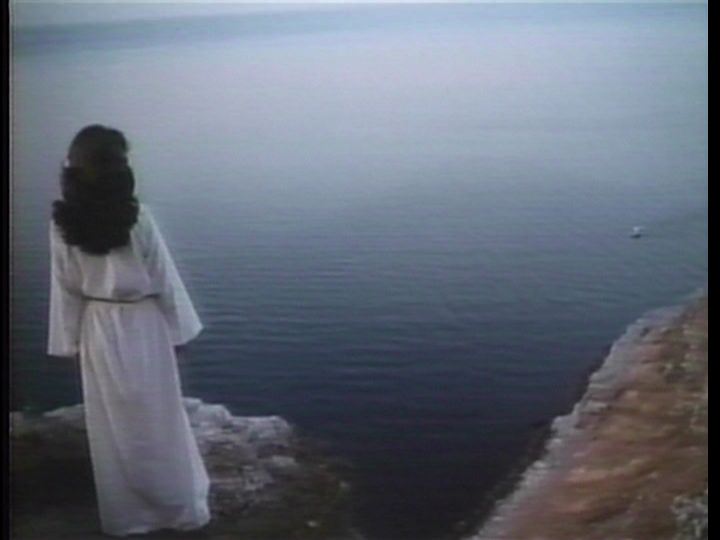
    Neil and Sherry quickly track down Madeline, who's staying in a convent and is obsessed with restoring an ancient, multilayered piece of artwork. Madeline is clearly one of those free spirits who drifts in and out of reality, and yearns for some ascetic, pure existence...


    ...which is why her makeup is always so immaculate, of course. Those Greek nuns really know their mascara and lip gloss.

    Deborah Shelton gets the dreaded "introducing" tag here -- often the kiss of death for a young actress's career -- but she actually had over 5 years of TV credits before Blood Tide, and plenty afterwards.

    She also made several appearances in Greek films. Despite her Anglo surname, maybe Shelton spoke the language and could serve as a useful liaison to the crew?

    Sadly, she doesn't get the chance to speak any Greek here -- though it appears that one of her co-stars is fluent in French. (No translator needed.)

    Madeline sure does wear a lot of white, though. I wonder what that could possibly signify?

    As in Who Can Kill A Child?, we spent a fair amount of the movie's running time yelling at Neil and Sherry to just get the hell out of Dodge. When the ostensible protagonists seem hell-bent on their own destruction -- and are thoroughly overshadowed by the supporting cast -- it's hard to care much about what happens to them.

    Still, Blood Tide was just offbeat enough to hold our interest, even if its climax is abrupt and disappointing. However, the film holds back its weirdest moment for the denouement, when something happens that completely disrupts the narrative -- the kind of thing you'd see in a Channel 101 skit, not a mainstream movie.

    Is it a hail-Mary attempt to rescue a troubled story by simply going completely bonkers at the end? Or is it meant to be thought-provoking?


    Are we meant to re-evaluate a couple characters? Because that would explain why...
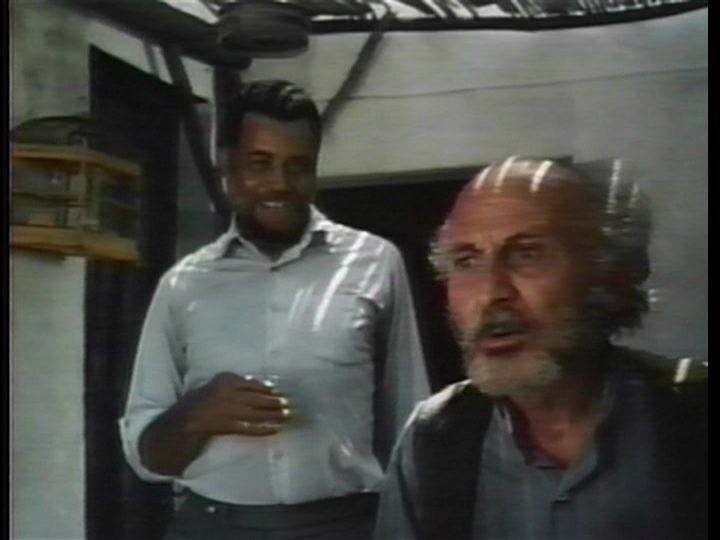

    But wait, if that happened, then how could she be...?

    ...oh, yeah, there is that. Yeah. Think about it.


    Or, uh, maybe it's better to forget about it. Here, have a Lydia Cornell leg lift instead.

    Monday, October 8, 2018

    Masha, Marsha, MARSHA

    We're doing a bit of sequence-breaking here, since the next film we watched after The Phantom Planet was actually Killers from Space (to be featured in our next post). Here's the story:

    Back around September 2008, while we waited for our Mill Creek 250-pack to arrive in the mail, we went ahead and watched a couple movies we knew were on the box, using copies downloaded from the Internet Archive. (Hey, we were impatient.)

    Of those two motion pictures, one is among those reviewed below. The other was actually from Nightmare Worlds, and we're saving it for our very last review from the 250-pack (unless we go back and watch the box set's crappy prints of Metropolis or Night of the Living Dead for some reason).

    Thus, there's a logic to going out of order for these three films: in a way, this review isn't early, but is instead (gulp) over ten years overdue!

    ...wait, did we say three films? Well, that's a complicated question, thanks to Roger Corman, Peter Bogdanovich, and the magic of editing.


    Planet of Storms (1962)
    [aka Planeta Bur, Планета Бурь]

    Grade: B-


    Voyage to the Prehistoric Planet (1965)

    Grade: C-


    Voyage to the Planet of Prehistoric Women (1968)

    Grade: D


    What exactly should one call this cinematic set of Soviet space sagas? It's certainly not a trilogy in the usual sense of the word, so that's out. Is it, in effect, a single film -- call it Voyage to the Prehistoric Planet of Prehistoric Women and Also Storms -- that should be treated as such?


    Maybe that's the best fit, since if you watch all three back-to-back, it starts to feel like a single text in which you get three different perspectives on the same events. We're not talking Rashomon here, but the effect is still palpable: will it ever again be possible for us to watch Planet of Storms without imagining that, somewhere off-camera, Mamie van Doren is wearing a chef's hat and controlling the weather and seismology from afar?


    Either way we'll use the original, i.e. Planet of Storms, as our source for all screenshots of the Soviet material -- not that it won't be obvious from the subtitles, which are generally well-done but sometimes get a bit goofy.


    Planet of Storms supplies the basic story that runs through all three films: expedition goes to Venus, brings a robot. Two teams land in different spots, spend the bulk of the film trying to reunite. Along the way, weird animals, natural disasters, and haunting vocalises abound.


    One could easily dub Planet of Storms the "planet of dank analog synths", since we get some seriously spacy, Louis and Bebe Barron-esque effects once the crew lands on Venus. Other music includes an orchestral cue that gets repeated three or four times, and a patriotic song of triumph and thanksgiving that pops up toward the end of the film to hilarious effect.


    Otherwise Planet of Storms is appealingly sparse in its soundtrack and, overall, is more understated than we might have expected. Then again, we don't have a lot of touchstones for Iron Curtain cinema beyond "propaganda piece" and "weird Czech animation" -- and, now that we mention it, some of the set design could easily have been repurposed as the background for a stop-motion film out of Prague.


    For a film that's ostensibly about a bunch of manly men doing exploratory things, it's interesting how much Planet of Storms is dominated by characters who fall outside that definition. One example is Robot John, whom we already knew from our 2008 viewing of Voyage to the Prehistoric Planet.


    For a being that speaks only in an electronic monotone, he takes on a surprising number of dramatic roles: savior, unwitting villain, comic relief. Tears are even shed for him when he falls (hardly a spoiler since the film foreshadows the hell out of it).


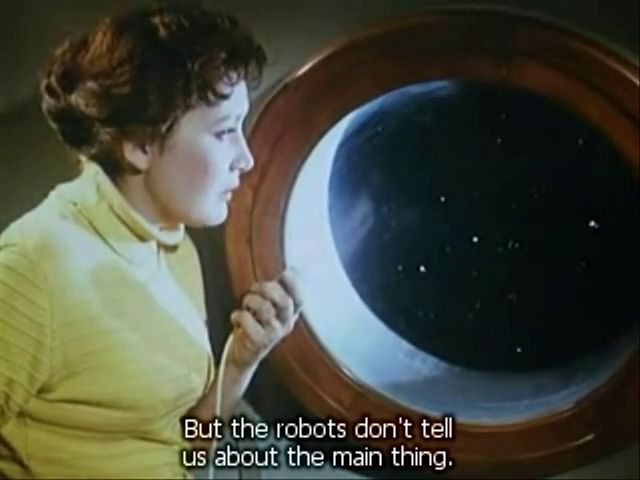
    And then there's Masha (Kyunna Ignatova), who -- like so many women before her -- has to stay home while the boys go out to play.


    Left alone aboard the Vega in orbit around Venus, it's her job to mind the store, maintain contact with Earth, and worry herself sick.


    Despite her frumpy Soviet outfits -- or perhaps because of them? -- there's something quite magnetic about Ms. Ignatova. In both appearance and demeanor, she reminded us of a reality show contestant from a few years back, who had much the same mournful air...and paradoxical allure.


    Even though she never gets to do much except emote, we suppose Masha's inclusion as part of the crew speaks well of Planet of Storms. Then again, when her colleagues think she's messed up a big decision (spoiler alert: she didn't), they don't exactly mince words:


    That's Planet of Storms, an imperfect but engaging little film. So what did Voyage to the Prehistoric Planet add to it? Well, one thing is obvious from the get-go:


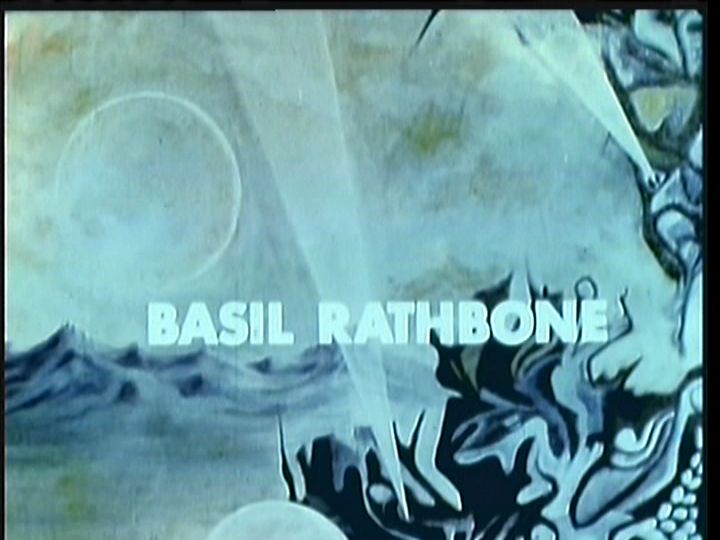
    If you're going to rip off someone else's work -- we assume Corman didn't pay a licensing fee to the Soviets -- then there's nothing like hiring a semi-washed-up "name" actor to add a veneer of respectability to your project. Here Rathbone plays Professor Hartman, supervising the Venerian expedition from a lunar base the filmmakers expected us to build by 2020 (sigh).


    Though he gets top billing, the added scenes with Rathbone are even briefer than we remembered: maybe 5-6 minutes, tops? He does little but expostulate, bark at his subordinates to repair things, and perch awkwardly on chairs.


    The other big change is the complete excision of Masha -- why, Roger Corman, why? -- in favor of Faith Domergue as Marsha, the new communications officer or whatever she is.

    If you're a big Carey Lowell fan -- and you know what we mean (moo) -- then you might prefer Ms. Domergue (whose surname is pronounced "bouquet", we're quite sure). For us, the swap was a real downgrade, and felt totally unnecessary.


    On top of that, the character herself gets downgraded: whereas Masha came to the correct decision on her own, Marsha has to be told by the Professor. And when she recounts that to the crew, her tone is that of a submissive Stepford Wife who's been reminded of her place:

    "He ordered me to wait no matter how I felt. He made me realize my responsibility...I'm very grateful to him now."

    Ah yes, happiness is slavery. On the other hand, at least one of her colleagues reminds the Professor: "Didn't anyone ever tell you ladies are tougher than men?" So, mixed messages, we guess.


    Otherwise the main thing Voyage brings to Planet of Storms is of course the English dub, which is reasonably faithful: other than purging the Soviet references, it sticks pretty closely to the facts of the original script. True, the characters are more petulant at times, and a bit less philosophical overall; true, there are some awkward turns of phrase dictated by the mouth movements in the original.

    But it was still neat to see that many of the film's little quirks -- like the way Robot John played music while they crossed the rope bridge -- were actually in the original. When we watched Voyage in 2008, we almost certainly assumed the dubbers were taking liberties in that scene, but it's legit.


    That said, there's a subtle thread of dark humor throughout Planet of Storms, and the Voyage dub loses a lot of that. The most striking difference is in the scene where Robot John gives antibiotics to two crew members: in the original, it's essentially silent, and John's blundering attempts to help the desperately ill Dr. Kern (Georgiy Teykh) are grimly funny.


    In the dub, though, John gets play-by-play instructions over the radio that walk him through the whole thing, right down to being told to pour water all over Dr. Kern's face. It completely changes the meaning of the sequence, and pretty much ruins it -- though you wouldn't know what you were missing unless you'd seen the original.


    On the plus side, John gets a nicer and more emotionally complex send-off in Voyage with the addition of a key line that wasn't in the original. Kern, his creator, quietly weeps when John is lost, and maybe it's not a coincidence that we only noticed that when watching the Voyage dub.


    Finally, there's Voyage to the Planet of Prehistoric Women, a project for which Peter Bogdanovich wisely used a pseudonym. (Joke's on you, Peter, since now we have IMDb.)

    He handles most of the narration, though he's not the deep-voiced narrator of the opening segment, which splices in meaningless footage of various prototype spacecraft --


    -- as well as scenes "borrowed" from another Soviet film, The Sky Calls, which is apparently about the race to Mars.


    As a side note, isn't it felicitous that all the Cyrillic letters in this next shot are also present in the Latin alphabet? Even casual viewers probably raised an eyebrow at the "СИРИУС" and "ВЕГА" visible in exterior shots of the rockets, but this one works out seamlessly.


    Speaking of viewers, it bears mentioning that both Voyage to the Prehistoric Planet and Voyage to the Planet of Prehistoric Women were done for TV, though Women appears to have had a theatrical run at some point. Women is derived from Prehistoric Planet, and uses the same dub, though a significant amount of it is edited, lost under voiceover, or otherwise removed. It also moves the timeline up to 1998, which is even more depressing, especially if you work for NASA.

    And the biggest change of all? No more Masha or Marsha!


    Instead, Bogdanovich blandly informs us that "The code name for Earth Control was MARSHA", and that's that. We capitalize this because it's begging for a bacronym -- something like, I don't know, Mission and Rocketry Space Headquarters America? -- not that Bogdanovich sees fit to bother.

    In fact all the added footage from Prehistoric Planet is gone: no Rathbone, no Domergue. Was it for cost reasons (i.e. no residuals)? To make it easier to trick TV stations into buying a film 85% identical to one they'd already run? Or, with a strict length requirement no doubt in effect, was it because they wanted to be sure to insert as much of this sort of thing as possible?


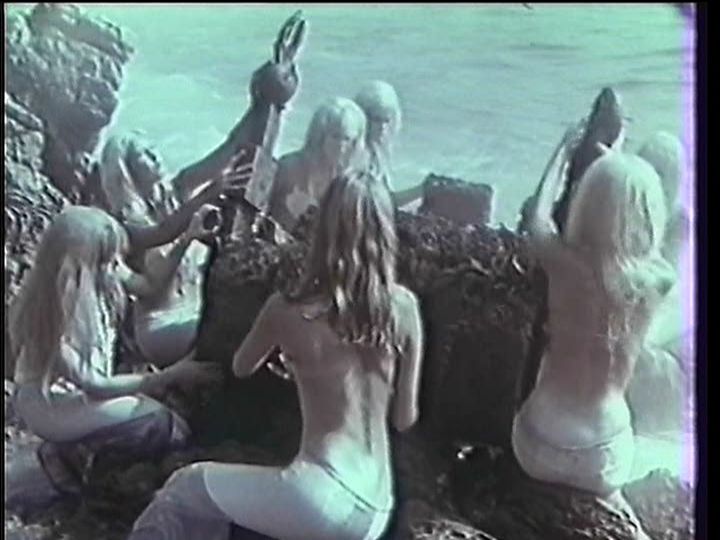
    In truth there's something sort of clever about the way Voyage to the Planet of Prehistoric Women integrates the new footage -- if you can call anything about long sequences of telepathic beach bunnies clad in seashell bikinis "clever", that is.


    Between their outfits and the way they swim, the Venerians are clearly meant to be something like mermaids with legs, which most of us call "women". And in case their bleached hair and total silence aren't enough to communicate their otherworldliness, we're clued in when one takes a big bite out of what appears to be a whole, ungutted, raw fish. Yummy.


    All the prehistoric women's dialogue is in voiceover, which would normally lead us to assume that many of the actresses were Europeans hired more for their waist-to-hip ratios than their English-language skills. But the names given in IMDb are pretty much Anglo all the way around, and very few of them have more than one acting credit, so who knows: chances are, they were just models who needed a paycheck.


    Anyway, the basic conceit of Prehistoric Women is that the women worship the pterodactyl-like creature that, at one point, attacks the characters in Planet of Storms. (Cue a not-altogether-convincing rubber replica, presumably made by Bogdanovich's team, that the women carry around reverently to comic effect.)


    Once their god is slain (which happens offscreen and is unique to Prehistoric Women), they summon natural disasters to punish the invading cosmonauts, but fail to kill them. Soon, they realize they've been worshipping a false god, and guess who shows up to replace him?


    Watching Voyage to the Planet of Prehistoric Women is sort of like reading Harry Potter fan fiction. Everything feels messed-up and askew, but there's more sex -- and if you really want to spend extra time in that universe, it offers the illusion of a fresh perspective or alternate narrative.

    Even so, if you're the kind of person who'd far rather have a Masha on your screen than nine sub-Daryl Hannah simpletons, Voyage to the Planet of Prehistoric Women has few rewards -- and certainly isn't a patch on the source material. It's a garbled, mangled version of a pretty good film, and the traces of the original's quality are beginning to fade at this point.

    But, OK, this one was kind of cute:


    By the way, did we mention there was a brontosaurus in this movie? To paraphrase Gordon Sumner, we're sure there's a lesson for us.