True, we haven't seen much of her work, but films like The Nightmare Never Ends and Savage Journey are the epitome of why we love to watch movies "from the wrong side of the tracks", so to speak. And her marriage to screenwriter Philip Yordan, why, how felicitous that it offered recurring opportunities to practice her craft!
Now, we find ourselves here once more, summoned back to her warm and apple-cheeked embrace. And -- speaking of tracks -- it's all thanks to that steamiest form of transportation, the locomotive.
Grade: C+

It's a lazy cliché to point it out, but lazy clichés are often true: the presence of actors like Christopher Lee and Peter Cushing pretty much ensures this tale of glowing eyes, smooth brains, and hairy hands will be at least watchable.

In fact, the equation cuts both ways: having those two legends on board probably encouraged the film's screenwriters to make an extra effort beyond just saying "Hey, let's put a monster on a train!"
The extra drafts were worth it, as from the beginning, the script is noticeably more crisp and intelligent than your average, brainless horror fodder.

True, there are occasional dud lines, as when the striking Countess Petrovska (Silvia Tortosa) greets Lee's character, Prof. Saxton, by reeling off a series of banalities about his home country:
"Ah, yes, England. Queen Victoria, crumpets, Shakespeare."
And Shakespeare this ain't.

On the other hand, take the scene where Dr. Wells (Cushing) is enjoying the dining car's services with the mysterious Natasha (Helga Liné), who looks a bit too much like the Countess for the film's own good.
(Things got confusing as hell when one of them got killed off: only then did we realize they were two separate characters. Isn't it a casting director's job to foresee this kind of thing?)

When his pleasant meal is interrupted by a request for his medical services, he asks his colleague and assistant Miss Jones (Alice Reinheart) for help, and she gets off a nice one-liner at his expense:
Wells: "Miss Jones, I shall need your assistance."
Jones (glances at Natasha, then smirks): "Yes, well, at your age I'm not surprised."
Wells (indignantly): "With an autopsy!"
Jones: "Oh, well, that's different."

That said, at least one review of Horror Express describes the first half as banal, the second as riveting. We found it rather the other way around: the first half was intriguing, but after the all-important halfway point, the film's plot began to get mired in silliness.

The second half is also marred by the abrupt arrival of a character who gets shoehorned in, hogging the spotlight for several minutes while adding little to the proceedings...

...but we don't mean Faith Clift! She does make her first appearance in the second half, true, as an American traveler. However she only gets a few lines of dialogue over the course of a few scattered scenes, and her delivery of those lines is -- dare we say it? -- utterly unremarkable. Competent, even.
The only odd thing about Ms. Clift's performance is that she blinks so frequently that it's hard to get a screenshot that doesn't look like she's drugged, or half-asleep.
Then again, in one of her scenes, she actually is asleep -- which is a very effective way to minimize awkward line readings.

No, the unwelcome interloper is Telly Savalas as Captain Kazan -- an irreverent, sadistic martinet who spends most of his limited screen time chewing the scenery. Some reviewers seem to have thought highly of Savalas's work in Horror Express, but from our point of view, he's an annoyance whose boorish screen presence breaks the movie's spell.

And -- speaking of irreverence -- Horror Express continues the trope, seemingly inevitable in Yordan-related films, of featuring a conflict between science/atheism and piety/religion. Our spokesperson for the latter group is mad monk Father Pujardov (Alberto de Mendoza), who bears a vague resemblance to the perennially put-upon Spanish tennis ace, David Ferrer.

For further background on Horror Express, and all things Yordan, we warmly recommend Bernard Gordon's book Hollywood Exile: or How I Learned to Love the Blacklist. Many of the stories Gordon tells are illuminating or funny, but at least one is rather sad: apparently this was Peter Cushing's first film after the death of his wife Helen. Cushing always struggled with nerves right up until the start of shooting (after which he was fine), but in this case his depression was so crushing that he was determined to back out at the last minute.
Some clever tactics from Christopher Lee rescued the situation, and shooting began the next day as scheduled. Still, one hopes that Cushing -- who outlived his wife by two decades, but once said that "the heart, quite simply, [had] gone out of everything" after Helen's death -- took some comfort, or at least found temporary relief, in his work and the company of his colleagues.

Oh, and a word to the wise: if sharp things going into eyes make you uncomfortable, you might want to skip this one.
You also might want to avoid ordering the whole fish, just in case the knife slips. (Pop!)

Night Train to Terror (1985)
Grade: F
Variety Is the Spice of Life Bonus: D-

And now the Class-O-Meter takes a precipitous dive -- which (once again) could be foreseen if you knew in advance that Night Train to Terror is essentially a salvage job. It takes two movies that had already been released, plus one unfinished project sitting on the shelf, and mashes them all together into a 90-minute anthology film.

And how does it accomplish this? Why, with that freshest of devices, the wraparound story -- though at first it seems like a wraparound song, since Night Train to Terror starts proceedings by offering up this troupe of fresh-faced youngsters:

You see, this is a family affair in more ways than one: young Byron Yordan (front and center above), son of Philip and Faith, is the leader of the "rock band" riding Night Train to Terror's titular locomotive.
The band pops up again after each segment, gamely dancing and lip-synching their way in piecemeal fashion -- one verse at a time -- through the only song they know how to play, "Everybody But You".

This number, a kind of 1950s throwback using 1980s instruments, deserves to have its lyrics documented in full somewhere on the Internet:
Daddy's in the dining room, sorting through the news
Mama's at the shopping mall, buying new shoes
Everybody's got something to do -- everybody but you!
Come on and dance with me, dance with me, dance with me, dance with me [x2]
Everybody's got something to do -- everybody but you!
Sister's on the telephone, gossiping again
Junior's at the arcade, smoking with his friends
Everybody's got something to do -- everybody but you!
(chorus)
Johnny's been a bad boy, staying after school
Principal is working hard, making new rules
Everybody's got something to do -- everybody but you!
(chorus)
It pretty much defines "incessant repetition". And splitting it up into a total of four discrete appearances over the course of the film? Not such a clever idea.
His costuming may have zero continuity, but at least Byron Yordan is handsome enough in a clean-cut way -- and a passable enough breakdancer -- that he doesn't make an ass of himself.

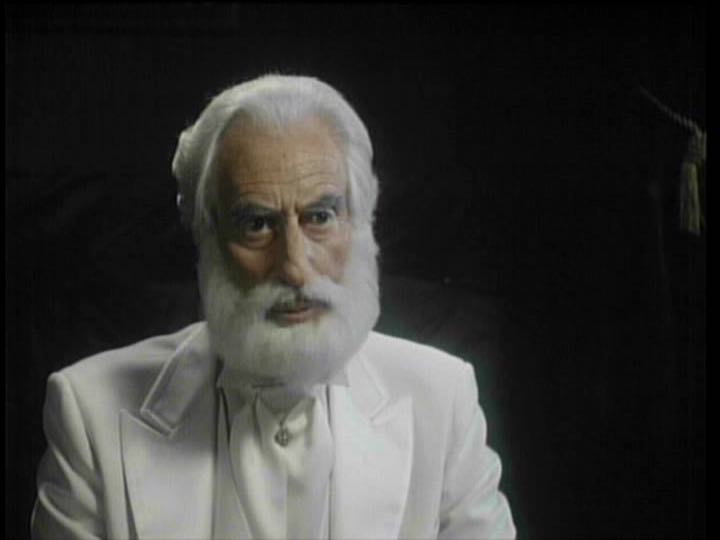
Anyway, the VIPs on this train ride are God and Satan, credited as "Himself" and "Lu Sifer" onscreen, but actually played by Ferdy Mayne and Tony Giorgio, respectively. They spend the ride arguing over the characters in the recycled segments, and whether their souls should go to Heaven, Hell, or Purgatory.
All setup for an "As I watched..." routine, naturally.

We've read that Mayne was, justifiably, embarrassed when he saw the finished film. No word on whether it was because the script required him to describe the band's music as "quite touching".
We also get a serenely imperturbable and impeccably polite black conductor (Gabriel Whitehouse), which vaguely feels like a lazy racist trope, though it's hard to pin down exactly why.

Then again, given that the only other black character in Night Train to Terror is named "Prince Flubutu" (Mark E. Ridley), maybe it's not that hard to figure out.
He shows up in the second segment -- adapted from the 1984 film Gretta aka The Death Wish Club, which pretty much tells you the plot of that one -- and they don't even get his exit line right: "Excuse me while I smoke!" should clearly have been "I hope you don't mind if I smoke!", don't you agree?

Some of the decisions that went into compiling Night Train to Terror go well beyond the bizarre. One of them is the inclusion of two different segments in which Richard Moll (here billed as "Charles") is a major character. Did they think we wouldn't notice that the murderous orderly in the first segment --

-- is the same, incredibly distinctive-looking man who plays a strident atheist in The Nightmare Never Ends?
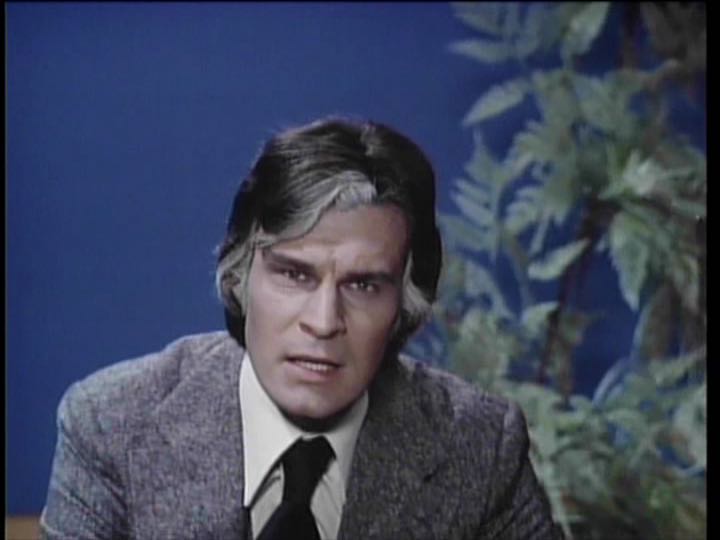
Yes, we're blissfully reunited with that watershed film, though here it gets hacked down to about a third of its original length -- which still gives it a higher percentage of Night Train's running time than any other segment.
As a result, the Nightmare narrative is largely undamaged, with all our favorite Papini moments intact. (Brigham Young sure is looking rough these days.)

In fact, we get bonus content of a sort, as The Nightmare Never Ends has now been augmented by some seriously off-the-wall claymation sequences. They showed up earlier in Gretta, and we don't know if that film already had 'em, though it's hard to imagine how the scene with the killer fly played out otherwise.

But they sure do add an odd twist to Nightmare -- even if the net effect is to make us expect a California Raisins cameo.

The other weird thing about Nightmare is that several characters' lines have clearly been overdubbed by a different voice actor. Once again, this had already happened in Gretta, as whenever the loony Mr. Schmidt (William Charles) speaks, it's with a thick pseudo-Russian accent and a totally different acoustic from the other characters.

But things strike much closer to home, for -- brace yourselves -- Faith Clift has had all her lines replaced by another actress! We were wondering why her performance seemed so un-cervine and cortically intact.
Given that a few tweaks were made to the Nightmare plot, maybe it was necessary for continuity purposes. But still, is there no justice? Is there no exemption for family?

Comfort her, "Charles". Comfort your apple-cheeked truelove.


