Showing posts with label love polygon. Show all posts

Monday, August 13, 2018

Throat coat

Next up in our amble toward the end of 50 Sci-Fi Classics, we have two films from 1960 that already have a bunch of things in common, like extensive portfolios of feminine pulchritude. (Or attempts thereunto, since de gustibus etc.)

The thing that really grabbed us, though, is that in both movies -- à la Homer Simpson's tragic, recurring physical abuse of his son Bart -- one or more characters show off a yen for wrapping their hands around other people's necks.


Horrors of Spider Island (1960)
[aka Body in the Web / Ein Toter hing im Netz]

Objective Grade: D-
Fräulein Furtherance: C-

Was it possible to make a full-on sexploitation romp in 1960? Not sure, but whether necessity or caution is at work, this trashy Teutonic venture tries to hedge its bets. Half horror movie, half T&A exhibition, it succeeds in neither, with amusing results.

In fairness, about 10 minutes of nudity has been chopped out of this print, with just a few distant shots of skinny-dipping fräuleins remaining in the mix.


Those who wish to perv, then, are left with "scantily-clad" as their only option -- though, to the film's credit, it includes a larger variety of body types than we'd see in most other productions, then or now.

"So wait, why are these women scantily clad?", asked no one. Well, we spend the first 10 minutes of Horrors of Spider Island putting together a troupe of "dancers" for a trip to Singapore. After some leg-ogling --


-- and male-gazing --

-- plus a hilariously deflating rejection of an actual classically-trained dancer, we're off. But, surprise! Somewhere out past Honolulu, their plane catches fire and crashes headfirst into the ocean.

Somehow, all the models survive ("Wait, didn't you say 'headfirst'?"), along with their manager, and they make their way to an island whose secret they soon discover. If only they'd known the English-language title of this film.


However, if you're expecting Arachnophobia with sturdy thighs, things don't really play out that way. Instead we get some sort of spider, man, who roams the island and occasionally pops up to strangle lone wanderers --


-- or even just pays them a visit at home. How convenient!


Soon enough two strapping young men show up -- one stolid, the other devil-may-care -- and their presence sows discord among the ladies. Add a couple additional murders, a romantic plot, some torches and quicksand, and you can probably guess the rest.

We seem to remember enjoying Horrors of Spider Island though now, months after watching it, it's hard to recall exactly why. Maybe it was the comically lazy ending, or the array of stock characters -- the seductress, the innocent, etc. -- that populates the troupe of dancers.

Maybe it was the adorable model -- that is, the adorable spider model.

Or maybe we were amused by the goofy dialogue, the incessant catfights, and the laughable Southern accent used for one character's dubbed voice (Ann, played by Helga Neuner). Or maybe it's all the sexy-sax music, who knows?


Goliath and the Dragon (1960)

Objective Grade: C-
Shattered Dreams Surplus: B-


Aaaand it's back to peplum, and Mark Forest as Goliath, hero of Thebes. Poor guy, he just wants to go back to his home and family, and chill out. But as the movie begins, he's in the final stages of a mission to retrieve a "blood diamond" stolen by the evil tyrant Eurystheus (Broderick Crawford) of Ocalia.


The introductory narration sets the scene:

"Legend has it that Goliath served the God of Vengeance, and the Goddess of the Four Winds. In return for his devotion, he was said to be favored with immortality: he would never know death at the hands of any mortal man."

That last bit robs the narrative of some of its drama, no?


But we get an interesting twist along the way, as somewhere in the process of "fighting a three-headed fire-breathing dog, a giant bat, a centaur and finally a dragon" (to quote the DVD sleeve, which makes the movie sound like a boss rush), Goliath forsakes the gods in frustration. Not only does he end up smashing the very statue to which he returned the blood diamond, he actually causes a solar eclipse with his rage. Dude.

How do things go so wrong? Well, it all starts with family conflict: Goliath's brother Illus (Sandro Moretti) is in love with Thea (Federica Ranchi). Her parents once ruled Ocalia, but were poisoned by Eurystheus, who now holds Thea captive (and intends to marry her against her will). Illus sneaks into Ocalia to see her, though Goliath has explicitly forbidden it --


-- but he gets himself caught on the way out.

Rather than execute Illus on the spot as he'd prefer, though, King Eurystheus heeds the counsel of his Machiavellian advisor, Tindar (Giancarlo Sbragia). This is despite the latter's penchant for describing him as "only a mass of fat and muscle, full of violence and brutality".

Most of us don't take advice from people who insult us, but eh, you do you, Eurystheus.

Tindar observes that Illus could be more useful if they let him escape -- after convincing him that Goliath secretly wants Thea for his own. And hey, beautiful slave Alcinoe (Wandisa Guida) can help with that part, since it goes along nicely with her own schemes -- though sleeping with Tindar (who has the hots for her) isn't one of them.

Cue drama! Illus shares the fake news with Goliath's wife Dejanira, who's assembling a huge feast for Goliath's return, and is hardly pleased to learn her husband wants to bed her brother-in-law's fiancée (even though he doesn't). And when Goliath informs Dejanira mid-massage that he'll kill Illus if he sees Thea, that doesn't help matters. (Apparently her father killed his parents, hence the hostility.)
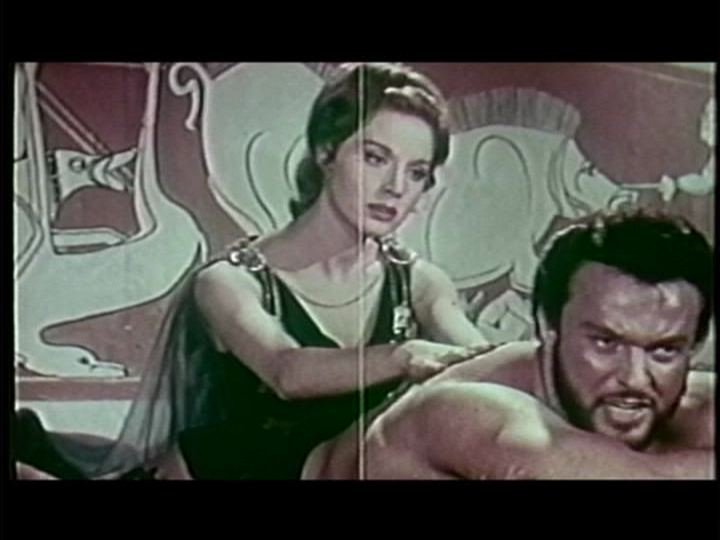

Meanwhile, Goliath heads out to meet some friends and bumps into Alcinoe, who's on her way to deliver a vial of poison for Illus to give his brother at the feast (using a cover story, concocted by Tindar, that it'll just make Goliath "come to his senses" and stop wanting Thea). Alcinoe gets thrown from her horse --


-- and attacked by a hilariously bumbly bear (overlooked in the Mill Creek boss rush recap), whom Goliath dispatches.


Naturally, she immediately falls for her rescuer -- but disappears shortly afterward, leaving Goliath bewildered.


Goliath gets home and, since Illus refuses to stop seeing Thea, he humiliatingly ties him to a tree --


-- whereupon a slave girl of Ocalia arrives to drop off the vial Alcinoe failed to deliver. Will Illus kill his brother? Well, that depends on whether Alcinoe and Thea can join forces to send out a psychic warning. That's what people did before cell phones, you know.


Soon we get an execution by elephant head-crushing (a real thing back in the day!) --


-- and a disturbing prophecy from the Goddess of the Four Winds: "In time your brother shall reign in Ocalia, Goliath -- but it will cost the life of the woman who loves you!"


Now, we guessed what this really means, and you probably have too. But Goliath is unfamiliar with concepts like "dramatic irony", so with his vision of domestic tranquility destroyed, he wrecks the temple of the gods and unleashes one of the great lines of dubbed Italian peplum cinema:

"Collapse like my shattered dreams!"


If all this seems a mite convoluted, well, it is -- and the last act comes together in about the way you'd expect. But at least the production values are decent, and the women good-looking, so this peplum wasn't too much of a pain in the neck to soldier through.


That said Broderick Crawford isn't especially believable as a warlord -- as someone on another site noted, his persona reads "gangster", not "warrior" -- though the gnarly scar helps a little.


We mustn't forget to mention the rapey centaur, Polymorphus:


Or this wonderful dragon head:

And we simply have to include a screenshot of the (ahem) "giant bat" in defeat, which looks suspiciously like an Ewok gone Brian Peppers or something:


Wednesday, July 12, 2017

Racism al fresco

The customer says: "We'd like a table outdoors, some heterosexual banter as an appetizer, and then at least one ethnic stereotype as our entrée." And do these two films deliver!


A Scream in the Night (1935)

Grade: D


If your old man is famous and you're in the same line of work, it's not an easy hand to play: just ask the Bach kids, Miloslav Mečíř Jr., or any number of other examples. Lon Chaney Jr. seemed to want to pick up where his chameleonic dad left off, and that's fine -- his prerogative.

But front-load a film to this extent (as seen in the above screenshot), and not only are you putting a lot of pressure on the son, you're already funneling the viewer into too narrow a causeway: instead of responding to the movie's events as they unfold, we're responding to our expectations of Chaney's double casting.

(Also, "Butch Curtain"? What is that, something Charles Nelson Reilly's interior decorator picked out for him?)

Anyway, we've got a huge ruby, owned by the father (John Ince) of Edith (Sheila Terry), the woman sitting with Chaney-as-Jack-Wilson in the screenshot above. Wilson's on the trail of Johnny Fly (Manuel López), nogoodnik criminal --


-- and virtuosic lasso-tosser:

As we soon discover, Fly's favorite hangout is Butch Curtain's bar. He may be a dim-witted thug with a wonky eye (shades of Manfish!), but he's a sure shot with darts and knives.

His bar is also a magnet for attractive birds of one sort --

-- or another:

(P. thinks this uncredited extra shows strong indicators of foxiness, K. disagrees. Either way it'd be interesting to find out who she was: anybody know?)

So isn't it a wild coincidence that Jack looks a lot like Butch, and can even talk like him? And wouldn't it be the funniest thing if that turned out to play a role in the plot? To invoke a double positive, "Yeah, yeah."

Along the way to the inevitable, we get policeman Wu Ting (Philip Ahn), whose clan presumably ain't nuthing ta f' wit. He speaks normally at the start of the movie, but lays it on thick when he goes undercover:

"Me velly solly. Excuse, please. Oh, me just want a dlink. You can do, please? Whiskey, please. You bossy man here? Maybe you do me hon-ah, have dlink with me."

The 1930s: not the greatest time to be an Asian actor.

There's a reason A Scream in the Night apparently sat on the shelf for almost a decade before it was released. Even with a plot this simple, some details are fumbled: ultimately Wilson-as-Curtain gets his cover blown, thanks to Fly's combative girlfriend Mora (Zarah Tazil), but how exactly it happened we have no idea.

Anyway, Chaney is passable here, but not enough to carry the film. Sorry, Lon. Now could we get the number of that foxy extra?


Jungle Man (1941)
[aka Drums of Africa] 

Grade: D-

OK, so let's get this out of the way upfront: Jungle Man -- called Drums of Africa on our copy, but as we understand it that's an anomaly -- is basically a marginally better version of The White Gorilla. That means it has:
  • copious use of stock footage of animals
  • characters who don't really interact with the above-mentioned animals
  • events recounted through flashback for no particular reason
  • repurposed footage from a silent film (not 100% sure about this one, but we think so)
  • racist depictions of African natives and Africa itself
  • pompous lectures about the jungle and its dangers
So if we found The White Gorilla so terrible that we dubbed one of the worst movies we've ever seen -- after all, we regularly quote "As I watched..." as a kind of metonym for a particular type of bad movie-making -- then how the heck does Jungle Man scrape a D-minus? Well, here's one reason:


That's right, no Crash Corrigan. His "ass-faced voyeurism" (cruel phrase, but fair) is instead replaced here by Buster Crabbe, who's easier on the eyes and a far more charismatic screen presence.

Of course, if you like boot-fa-chays, the movie has some of those too.


You see, we're meant to think this woman will want to marry that guy --

-- but, well, see what happens when she meets this guy:

That's one thing that's refreshing about Jungle Man, actually: from the moment she meets Crabbe as Dr. Robert Hammond, Betty is thoroughly and more-or-less unrepentantly smitten. It's so obvious that when she embraces her fiancé Bruce (Weldon Heyburn) as he's about to leave on an expedition to the mythical City of the Dead, he pauses and looks at her dubiously:

Bruce: You do want me to come back, don't you?
Betty: Oh, of course! W-why shouldn't I?
Bruce: I don't know, I -- I've just had the strangest feeling ever since we've been here.
Betty: Silly.

In the midst of this we cut away to Crabbe and Bruce's pal Andy (Robert Carson), who shoot each other a look, and boy, do their facial expressions tell a story:

So you see, Jungle Man isn't completely stupid. It's got a couple of marginally amusing one-liners -- "But I'm from Missouri, you'll have to show me" is one, if that gives you the idea of the league we're talking about -- and also has at least one other great cutaway, in which Betty's father William (Paul Scott) and his brother Jim the priest (Charles Middleton) have this exchange after Betty announces her intent to join Hammond on a trip to a dangerous village:

Jim: Oh, William, you must stop her!
William: Stop her? You don't know Betty. I didn't want to come to Africa! But I'm here!
Jim: Perhaps it's just as well I turned to this -- I never did understand women.

And the reaction shot:

We surely don't want to give the impression that Jungle Man's few moments of liveliness outweigh the crushing contrivance of its storytelling, though. It's hard to find the right word for the way a movie like this makes us feel, but unconvincing is the closest we've found, though that hardly does it justice. It's not the performers' fault -- they're fine -- but the production itself that feels awkward and cynical and heavy-handed, like it's always playing to the dumbest people in the cheapest seats.

For instance, let's take the sound effects. That "constant jungle chatter" in certain scenes is some sort of squeaky bird call, made by rubbing two dry cylinders together, that sounds like a misaligned fan belt or malfunctioning air conditioner. It's not pleasant. Or there's the lion's roar that sounds like a Superball being rubbed against an oil drum: couldn't they do better in 1941?

Then there are the historical inaccuracies, anachronisms, or whatever you care to call them. First of all, the tiger --

-- which they hang a lampshade on by explaining how Jim "picked him up in one of the Malay states". OK, fine, whatever you say. Clearly they had a tiger available and needed an excuse to use him, and after all he's the only animal that actually interacts with any of the cast:

Oh, and the tiger's name is Satan, which gives us the odd spectacle of hearing a priest say "Thank you, Satan" after the cat defends him from an attacker. Yup.

Meanwhile, this is the famed City of the Dead, in darkest Africa:

Or here's another angle:

If you looked at these shots and said "wat" to yourself like that old lady in the meme, you're exactly right: this is Angkor Wat, in that well-known African country, Cambodia. Yup again.

Really, the African-ness of this movie is solely a product of stock footage, costume design...and hiring a bunch of black actors to demean themselves by shouting "Booga booga booga" and waving spears in the air. ("They're just like children," opines Jim the priest, in an aggression none too micro.)

If at this point you're foolish enough to watch Jungle Man -- and you can't say you haven't been warned -- then, as the kids say these days, you do you. Just don't watch The White Gorilla, for the love of Vlad, unless you really want to dive into despair and question your life choices.