We can muster enough suspension of disbelief to get through most movies, no matter how thoroughly science may have refuted their premises. No one will be walking around on Venus anytime soon; wasps don't make royal jelly; there isn't an island where tigers and lions coexist; you can't freeze a turtle in ice and bring it back to...
...uh, never mind on that one.
Still, these next two films -- which also happen to be the last two black-and-white movies we watched in 50 Sci-Fi Classics -- really pushed our limits by setting their action in places that literally, paradigmatically don't exist. (At least you can land on Venus.)
...uh, never mind on that one.
Still, these next two films -- which also happen to be the last two black-and-white movies we watched in 50 Sci-Fi Classics -- really pushed our limits by setting their action in places that literally, paradigmatically don't exist. (At least you can land on Venus.)
Grade: D+

Planet Outlaws isn't just the last of the B&Ws, it's also the last example on the 250-movie pack of that beloved format, the edited serial. Sigh.
At least it's not coy about its origins:

Someday we'll learn to keep Buck Rogers and Flash Gordon straight -- and it doesn't help that Buster Crabbe played both roles, of course.
At least now we've got the basics down, and know that Buck was the one who got hit with knockout gas in the 20th century and woke up in the 25th: hence Duck Dodgers.

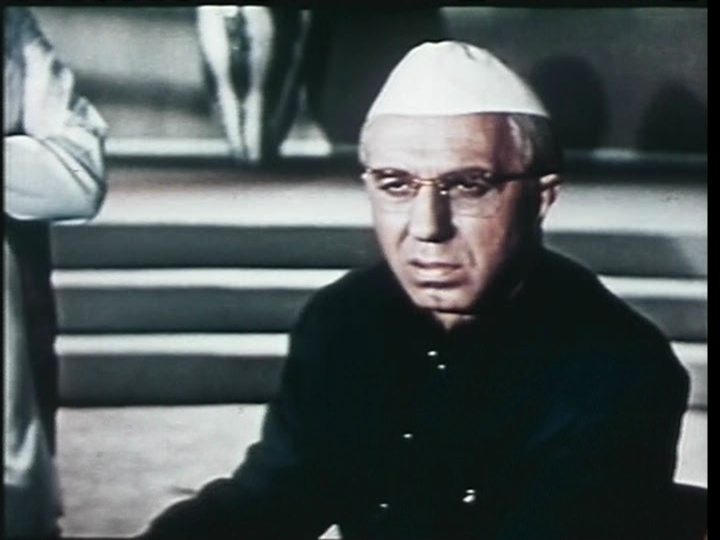
We first encountered Sherman S. Krellberg when he brought us The Lost City via his company "Super-Serials", which now sounds like a line from an episode of South Park but whatever. To freshen up this 14-year-old release, Krellberg decided that a wraparound narration would be just the thing -- isn't it always? -- and that he was just the guy to do it.
(IMDb doesn't make it 100% clear that it was him, but here's a picture of Krellberg with, we kid you not, Budd Rogers. Looks like the same guy to us.)
So there he sits, intoning banalities about UFOs, Jules Verne, da Vinci, and atomic power on the way in, while wrapping things up with a rousing "God bless America!" at feature's end. Heavy duty.

It's not really fair to judge a serial that's been hacked down from nearly 4 hours to 71 minutes -- and "hacked" really is the word: Planet Outlaws moves along at a pace so blistering that transitions are sometimes botched completely, as if the film were skipping forward (but it's not).
End of a music cue from the previous scene left in? Dialogue chopped out mid-sentence? No problem!

Even in this chopped-down form, though, it's evident that the original Buck Rogers serial had one hell of a lot of repetition. Some of that is inherent in the format (since people need to catch up), while some was no doubt done to save money.
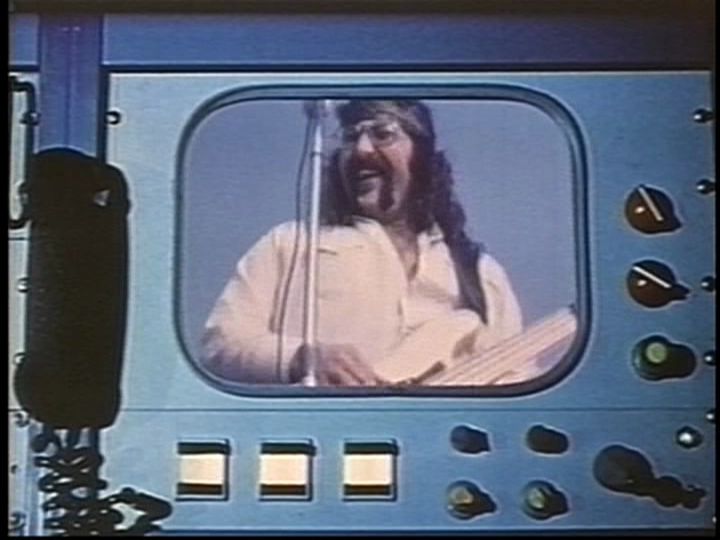
The most amusing sign of the film's economizing ways: we don't just get scenes where actors watch previously filmed material on a screen, as recently seen in The Lucifer Complex. We get scenes where actors watch screens that show actors watching other actors on screens.
Yes, it's literally a case of "As I watched 'as I watched'..." -- which we don't envy Google Translate in its attempt to render for our non-English-speaking visitors.

In Planet Outlaws, Buck's main task is to broker an alliance with the Saturnians, in hopes that they'll help the beleaguered forces of the Hidden City to defeat evil dictator and "super-racketeer" Killer Kane (Anthony Warde).

Among Kane's many crimes, perhaps his most heinous is placing his enemies under permanent mind control, using specially designed helmets to turn them into "living robots, men robbed of all willpower". He pronounces it ro-bits, natch.

So Buck flies to Saturn, dodging blockades and security forces along the way...

...and then, later, he flies back to Earth...

...and that's pretty much how this thing goes. Back and forth, back and forth, back and forth, with every trip bringing a new stratagem to evade Kane's goons -- except the stratagem is usually just "steal a ship and hope they let you through the perimeter".

If we were ten years old in 1938, and seeing Buck Rogers in its original format, this might be exciting. Compressed down to a little over an hour and seen in one sitting, the formula becomes painfully repetitive, like one of those video games where you spend 75% of your time backtracking through landscapes you already know well.

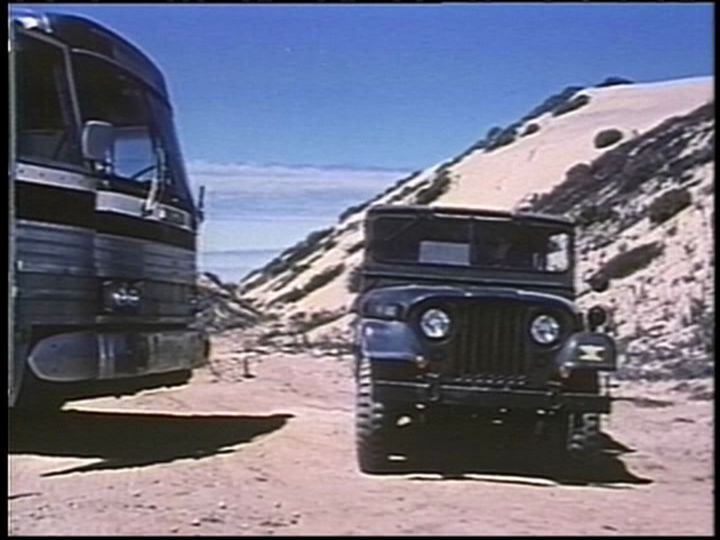
Speaking of landscapes, apparently Saturn has a surface that looks a lot like a California state park, and you can live and breathe there without protection. Who knew?

In fairness, we're not sure when it became clear that Saturn was a gas giant, or that there was no solid surface to stand upon. Were these things known in 1938? We don't know. (This book, though interesting, doesn't help much.)

On the other hand, the Saturnian Prince Tallen doesn't carry any ethnic stereotype baggage, even though he's portrayed by Korean-American actor Philson Ahn. He's just a good guy from another planet. So in that way, Planet Outlaws is refreshingly not of its time, whether you define that time as 1939 or 1953.

Even knowing this version is hopelessly compromised, we can't say we're too excited by what the Buck Rogers serial appears to have offered. We probably shoulda just played it on the Co-lee-co, but we were too busy with a certain boy and his pancake. $500 and it's yours.

Grade: D

Look, we know Unknown World means well. We're sure it does. But before committing this particular journey to the center of the earth (ahem) to the screen, couldn't you people have talked to a geologist -- or a coal miner?
Even if the screenshot above were referring to 2500 meters below sea level (and it ain't), we'd be talking about one hell of a temperature increase. The TauTona mine goes to about that depth (from a starting point of 1500 meters above sea level), and it's over 130°F down there without air conditioning.
So, Dr. Morley (Victor Kilian), if your mission is to find a place where people can live and thrive while a nuclear holocaust goes on somewhere over their heads --

-- then 2500 meters underground isn't the place to do it. And 2500 miles underground certainly isn't the place to do it, not even if you're a Horta.
Funding denied! There'll be no saving civilization for you!

The end!

...well, except it's not, since Unknown World uses the Citizen Kane trick of starting out with a lengthy newsreel item about its own characters.
So when the cash runs out, who do you turn to?

Why, everyone's favorite, of course: the good-looking, dissipated heir with a heart of gold (Bruce Kellogg). Always up for a lark, millionaire playboy Wright Thompson Jr. sponsors Morley's expedition -- as long as he gets to come with. He's got a buck or two to spare, and after all, having adventures is exactly what the buck is for, right?

So it's off to the fictional Mt. Neleh, which is apparently near Mt. Lefat...and the cryptic crossword solver in us immediately wonders: did screenwriter Millard Kaufman have a crush on a woman named Helen Tafel?
There seem to have been a number of Helen Tafels out there, and we found at least one obituary with an age-appropriate birth year attached. So maybe she was the one: ah, lost love!

Even though we're sympathetic to tales of subterranean exploration, we don't feel especially inclined to recap the slow, dull journey that Morley's team makes as they progress from the chilly surface -- see, it's windy --

-- into the bowels of the earth. Spoilers would be inevitable, you see, and we'd prefer to evit them.
At least their vehicle is a wacky combination of tunnel-boring machine (bet you wish you had that Horta now, huh?) and submarine -- though it looks more like someone hybridized a kitchen implement with a particularly baroque sex toy.

The tedium is alleviated here and there by a few decent scenes -- like when the contamination of the team's water supply makes them exceedingly grateful for some drippy stalactites.

By the way, the actor playing Dr. Morley is uncredited thanks to the blacklist, making it NO KILIAN I for him.

Nuclear wars that have no victor, and blacklists that assuredly did have a Victor: these were some of the threats facing the American 1950s, when everything so often seemed to be hanging by a thread.

Isn't it nice that we've moved past those days of political persecution and pointless saber-rattling?
Haven't we?

...oh, James Seay, did you do it again?