In these films the hero has a long way to go (such a long way to go). Heck, he even uses air currents to get there.
However -- unlike Christopher Cross's beloved anthem -- he "rides like the wind" not to ditch the girl and "be free again", but to win her heart and loins.
However -- unlike Christopher Cross's beloved anthem -- he "rides like the wind" not to ditch the girl and "be free again", but to win her heart and loins.
Grade: D+


Yes, The Lost Jungle is an entry in that niche genre, "animal trainer as action hero". Have we seen more of these in the box? It feels like we must have, but 220+ movies later it's hard to be sure.

We don't know too much about Clyde Beatty, whose act seems to have become the template for all lion tamers and big cat performers. (He didn't originate the whole chair-as-defensive-weapon thing, but it became indelibly associated with him.)
Onscreen he's portrayed as a decent sort by the standards of the time. For one, he's a fervent supporter of animal welfare, willing to use fisticuffs against anyone who brutalizes his performers -- as we learn right away: when evil trainer Sharkey (Warner Richmond) brandishes a 2x4 and tells a tiger "Don't you start with me or I'll knock every tooth out of your head!", Beatty reminds him of the categorical imperative.

Beatty gets close-up shots, White Zombie-style, to signify the mesmeric power (animal magnetism?) that lurks in his eyes...

...though these days, it draws more attention to his hairstyle, whose meaning as a signifier has seen some changes in the last 85 years or so, from "manly man" (we guess) to "skate punk" to "Tom Villard". At least it keeps this jolly good Obergefella from being another IWGIH.

So soon enough we get the MacGuffin, in the form of Beatty's girlfriend Ruth (Cecilia Parker). The two of them clearly love each other, no doubt bonding over their shared admiration for comically wide men's belts.

Even so Ruth, despairing of his obsession with the animals and failure to propose, decides to go on an expedition to the "South Seas" with her father (Edward LeSaint), a sea captain, and Professor Livingston (Crauford Kent). This expedition is in search of Kamor, a lost island that's allegedly the "real cradle of civilization" -- and the Professor will know it's the right place when he finds, we kid you not, "an island bearing the fauna of both Africa and Asia".

In other words: lions and tigers, in the same place. How conve-e-e-enient, as the Church Lady would say. That ol' lampshade got a real workout back then.

Back in the States, a heartbroken Clyde throws his all into a new, high-risk act that adds Ursidae to the mix. This gets his publicist pal Larry (Syd Saylor) a bit twitchy --

-- but despite Sharkey's meddling, things work out: this is a family film, after all, and could hardly bear a grisly ending for Clyde.
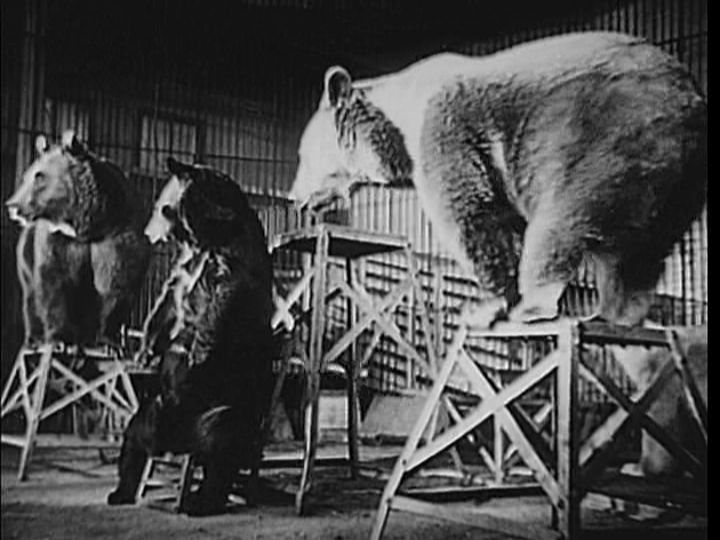
Condensing 12 chapters and four hours of footage into a single feature film isn't an easy task, and truth be told, the editors did a pretty good job of it. But there are inevitably weird corners in the narrative, threads that get dropped abruptly, and set-pieces that seem to have had a disproportionate amount of attention lavished upon them --

-- like Clyde's journey by dirigible in search of Ruth et al., who by this point have disappeared. Needle in a haystack, sure: but you'll never believe where he crash-lands!

Ultimately everything in The Lost Jungle is a pretext for Beatty's big-cat routines -- though apparently a couple chapters involved gorillas in some way, and we're not sorry to see those get left on the cutting-room floor.
While it doesn't end up making much sense, and the film suffers from a certain lack of charisma across the board, it has more than enough content to keep us from groaning too much as we watched.

[aka La regina delle Amazzoni]
Grade: D-

Oh, great, just what the world needed: a "funny" peplum. Right from the start, the soundtrack makes it clear that something is askew in this one. A fumbled fanfare in the opening scene sets the tone:

Next comes a massive stadium fight, set to a hyperactive big-band jazz accompaniment, wherein Glaucus (Ed Fury) emerges as the last man standing.

Alas, his victory doesn't last, as his friend Pirro (Rod Taylor) sells him out to a couple visiting merchants. They offer to pay handsomely if he can convince Glaucus to join them aboard their ship full of strong men -- a task Pirro accomplishes by clocking him on the head (we guess, since it's not shown) in the aftermath of a massive, chicken-related bar fight.

Once Glaucus regains consciousness, he raises hell again, before Pirro sabotages the boat to convince him to calm down and go with the flow. Along the way Glaucus meets Sofo, the Egyptian, with whom he hits it off -- though Sofo clearly knows something he doesn't.

When the ship lands, the men's mission is revealed: to guard a huge cache of treasure against pirates, in exchange for a share of said treasure (allegedly obtained from natives ignorant of the value of gold). First, though, let's have some food and wine!


For these first fifteen minutes, Colossus and the Amazon Queen seems like a typical peplum at heart. Sure, the gods are absent and the tone is pointedly lighthearted (how could it not be with tubas and xylophones on the soundtrack?).
Still, we expected the usual fare -- even after the arrival of that most unwelcome of filmic abominations, an overdubbed talking parrot, who chides Glaucus as he wakes from his stupor: "Shameful! Athletes taking dope these days!"

Instead, though, we get a tired role-reversal sex comedy, as Glaucus et al. find themselves in the clutches of the Amazons, a society where women are warriors and men are worriers. Do you like tall skinny dudes in drag, chirping in effete voices about how they "just can't understand [why] I never seem to get my wash as dazzling as yours"? Does that prospect make you laugh your sides out? If so, this is the film for you.

For the rest of us, Colossus and the Amazon Queen doesn't really have a reason to exist. It's certain to offend some, and won't amuse the others, so who's left? People who like to watch sexually frustrated queens lounge around and drink wine? We suppose it's cheaper than doing the same thing at a Caribbean resort.

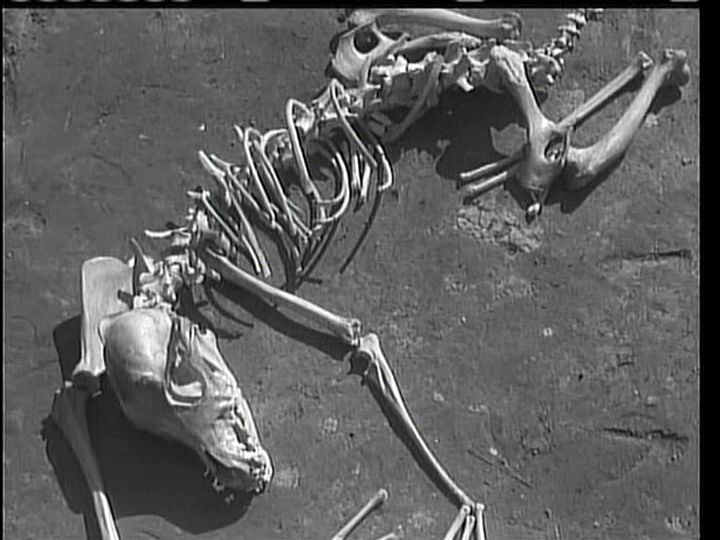
And now, since you're not depressed enough, have a screenshot of a couple of starved-looking bears tied up outside a cave. Score one for Mr. Beatty, who would never tolerate this.

But hey, at least the parrot almost gets it. Almost.

Grade: C-
OK, first of all, check out this title card, which couldn't be more of its time if it tried. We only wish we could show you the way it "lasers" onto the screen.

Setting aside the question of how the hell a film from 1989 ended up on a Mill Creek set -- is it licensed? Public domain? Was it even possible to screw up your copyright in 1989? -- the first thing that caught our eye about Laser Mission was the presence of Brandon Lee.
Thanks to some combination of half-remembered advertising for The Crow and a couple viewings of his father's films, we had the impression Brandon was some sort of 1990s emo kid, perennially brooding and fey, like Edward Scissorhands meets Robert Smith meets that international student who dresses like an anime character.
Well, not exactly:

There is a dash of Depp in there, sure, as well as his father who (how did we not know this?) had a significant amount of European ancestry. But we were reminded above all of the strong-jawed presence of Evil Dead star Bruce Campbell -- maybe with a dash of Hwil Hweaton in there too, especially around the eyes (and certain line readings). Plus, of course, dude is jacked.

Laser Mission is quintessential late-1980s straight-to-video trash, and Lee is determined to have a hell of a lot of fun making it. Unfortunately, he doesn't get much in the way of good lines: when he falls through a ceiling and lands on someone's dinner table, he notes how he "just dropped in to say bon appetit!", if that gives you a sense of the caliber of writing we're dealing with here.

The other "name" actor is Ernest Borgnine, who sports a threadbare Russian accent, doesn't get much screen time, and seems happy just to be there. That said, if you'd told us there was also a cameo by Michael J. Fox --

-- we might have believed you.
The makers of Laser Mission seem to have taken "cheap name recognition" as their watchword, as they hired David Knopfler -- the other Dire Strait -- to compose the music, but apparently didn't pay him for more than one song.
So if you somehow fail to pick up on what Lee's character Michael Gold does for a living, the soundtrack is happy to fill you in, as almost anytime there's music in Laser Mission, you've got Knopfler's strained, Señor Cardgage-esque voice, chuntering away:
He's a mercenary man
Mercenary man
Mercenary man
Yeah, mercenary man
It's another earworm, but only through sheer repetition, from opening credits to ending credits. We even hear the little, faux-flamenco nylon-string guitar interlude multiple times.

The MacGuffin in Laser Mission is a huge diamond that can be used to build a superweapon, and if your brain hasn't been taken over by "Mercenary man..." you can probably guess why Borgnine has a Russian accent, and why Gold's pursuing him. Like many MMs, Gold is a master of disguise, transforming himself into Latin American stereotypes on a moment's notice:

He soon joins forces with Alissa (Debi Monahan), an animal sanctuary worker who's unexpectedly competent with firearms and vehicles -- a fact not lost on Gold, who asks the natural question: "You carry a gun and you're not afraid to use it. You can outdrive the best of them...Who are you and who are you working for?"

The response he gets -- "I'm hot, I'm tired, I'm hungry and I'm thirsty and I'm walking around in these high heels all day and I have blisters on my feet!" -- is petulant and defensive. Hardly the reply of a secret agent, right? (Right?)
But the bad feelings don't last, and their brief love scene later on (oh, c'mon, that's hardly a spoiler) is, blessedly, one of the few times we hear music other than "Mercenary Man" in this film.

Gold's merry chase takes him to Cuba -- where he nearly gets guillotined -- and ultimately to the fictional African country of Kabango, which we presume to be a stand-in for Angola. Logically enough most of Laser Mission was filmed right next door, in Namibia and South Africa. This leads to some absurd scenes in which Michael and Alissa get dumped in (we're guessing) the Namib desert without food or water --

-- and somehow manage to amble their way to safety. One can only imagine the smell, especially since, as we assume you've noticed, Alissa wears the same blue dress from start to finish.

Comic relief is provided by a wacky pair of conscripts, Manuel (Pierre Knoesen) and Roberta (Maureen Lahoud), who stay on Gold's trail throughout the film but never quite seem to want to pull the trigger. Roberta also has a seriously revealing wet T-shirt scene, leaving us to wonder whether Monahan refused and Lahoud was drafted to fulfill the first half of the T&A requirement.


It's all what you'd expect, doesn't make that much sense, and we can only hope Brandon Lee had a great time in Namibia, since he didn't get much time to begin with. Who would've thought Ernest Borgnine would outlive him by nearly two decades?