Monday, January 16, 2017

Warning! Attention! Achtung!

Before watching the next three films -- all of which, as it happens, revolve around criminal schemes that run afoul of the law -- be warned: each harbors a serious issue that, in the case of one of these films, can damage your television or even your health. (No, we're not kidding.)


Bowery at Midnight (1942)

Grade: C+

To see Béla Lugosi onscreen in a starring role is, alas, to know you've already spotted the villain. But for the first few minutes of Bowery at Midnight, Béla puts up a good front as Karl Wagner, the kindly operator of a soup kitchen/flophouse. Wagner doesn't ask a lot of questions, or try to save anyone's soul...

...because his is already long gone. Wagner leads a double life, you see, as the mastermind behind a series of particularly brutal robberies -- and his associates have a nasty habit of ending up dead.

And that goes double if they get the bright idea of talking smack about him while he watches on his secret TV (which, to our great pleasure, Bowery at Midnight makes no attempt whatsoever to explain).

Did we say Wagner leads a double life? Well, it's really more of a triple life --

-- for, by day, he's Professor Brenner, noted criminologist and devoted husband. While his criminal associates know that Wagner has a dark side, no one knows that Brenner is Wagner -- and he means to keep it that way.
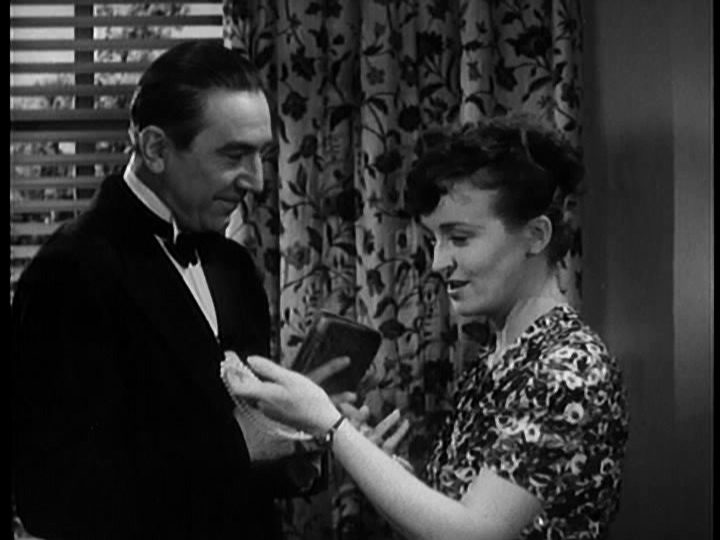
Wagner/Brenner makes for a refreshingly evil character, and a part tailor-made for Lugosi. He has no compunction about killing anyone, and we mean anyone, who gets in his way. The movie's body count is impressively high, and as another site notes, it quickly establishes that any character can die at any time -- something that puts us in a completely different headspace, so to speak, from the usual "everything's OK in the end and only the bad guys get it" fare.

Of course there has to be an infusion of spunk somewhere along the line, right? And Bowery is no exception, though it distributes its moxie more or less evenly between Wagner's assistant Judy (Wanda McKay), a nurse who knows nothing of her boss's dark side --

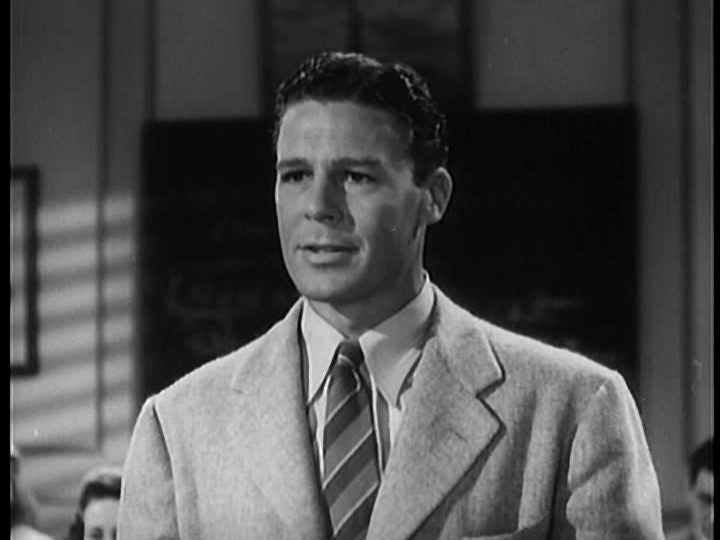
-- and her wealthy boyfriend Richard (John Archer), who -- quelle coincidence! -- is taking Brenner's criminology class. Annoyed and offended by Judy's long nights in the Bowery, Richard decides to scope things out for himself. This is not one of his better ideas.
Bowery suffers from a mild case of One Subplot Too Many, though other writers have overlooked one possible motivation for its bizarrely tacked-on zombie theme. Let's put it this way: if zombification is fully reversible, you can off as many people as you want without violating the Hays code.

Now, a very important warning: at approximately 55:41 into Mill Creek's print of Bowery at Midnight, the viewer is hit out of nowhere with an ear-splittingly loud noise (probably feedback of some kind) in one channel.

It's far louder than the surrounding audio, sounds like a cross between a siren and a Slinky from hell, and is more than capable of blowing out your speaker if you've got the volume turned up (and who doesn't when trying to make out the dialogue on these Mill Creek DVDs?). If you're listening on headphones, it could certainly cause hearing damage.

It also made us jump about 10 feet even though we had a vague idea it was coming (thanks to a warning on another site, and we're grateful for the solid), marking the first genuinely scary moment we've had on this box. And when we watched Bowery again for this review, K. spent the entire time cringing in apprehension.

So how will you know when it's coming, short of watching the counter on your DVD player? Well, watch out for this scene in which Judy is asking one of the flophouse residents to run an errand for her, and hands him some money:

Right after that, she leaves and walks into the next room, and that's when the noise happens. Turn down your volume in advance! You'll know you're clear when she begins to speak with this man, "Doc" Brooks:

If all this sounds overwrought, believe us, it's no joke. Consider yourself warned!


Midnight Shadow (1939)

Grade: F

Another Sack film with an all-black cast, Midnight Shadow poses the question: how do you stretch 25 minutes' worth of film into a 50+ minute featurette?

Why, with "comic relief", of course -- if you can use that term to describe the asinine and joyless antics of the two wannabe detectives who mug their way through this film. We remembered Midnight Shadow as one of the worst films we'd seen on this box, but for the first 15 minutes or so, we found ourselves questioning this assessment: did this silly but inoffensive murder-mystery really deserve that much opprobrium?

But once Buck Woods and Richard Bates show up onscreen, look out. It's not merely that they're unfunny, or that there's something embarrassing and painful about watching them carry on. They're just flat-out obnoxious, so insultingly stupid that it moves us to anger.

And it doesn't help that Richard Bates has a creepy, young-old face that makes his role as "Junior" somehow disturbing -- a bit like John Hurt's early scenes in Heaven's Gate, we suppose, but much, much worse. Ostensibly a young man, he certainly doesn't look much younger (if at all) than his onscreen parents.

So be warned: the presence of these two pretty much tanks any chance for Midnight Shadow to be what it could have been, i.e. a threadbare but mildly entertaining romp whose rough edges and incoherent script are almost forgivable in light of its brevity and circumstances.

Instead, it's just a big steaming pile of anhedonia. Sorry, Sack.


Torture Ship (1939)

Grade: C-


Let's get the warning out of the way upfront this time: Mill Creek's print of Torture Ship is missing the first 9-10 minutes of the film, give or take. And while you can infer the gist of the missing material pretty quickly -- these people are criminals on a boat, this person's a scientist conducting experiments on them, etc. -- it still has a major impact on the film's coherence and enjoyability.

It turns out that neither YouTube nor Archive.org can supply the missing beginning to the film, so we digitally "rented" a copy of Sinister Cinema's version, which seems to be the only place to get those opening minutes. The Sinister print is certainly better than Mill Creek's copy, but much as with The Ghost Walks several entries back, it also has some unexpected flaws. Among these are a scene that's been mysteriously replaced by an exact repetition of a later scene (which is confusing as hell), and a couple skips and audio dropouts that aren't present in the Mill Creek version.

If you choose to watch the Mill Creek version of Torture Ship (from which all of these screenshots are taken), you'll be a bit lost for a while, but you'll still be able to enjoy the film's wealth of interesting faces. And it sure has a lot of them, though there's a clear winner in the bespectacled fellow pictured at the very start of this review, Skelton Knaggs, a man who -- as you can see -- looks exactly like his name.

Our female protagonist, Joan, is played by Julie Bishop -- who, speaking of fah-chays, looks a bit like the young Arlene Francis (a cutie in her youth, if you didn't know that: certainly worth a Google, no need for a Bing).

An innocent secretary unwittingly mixed up in a murderous racket, her only lifeline is heroic Lt. Bob Bennett (the ever-redoubtable Lyle Talbot), nephew to the scientist we mentioned a while back. And boy, does she give him bedroom eyes when he saves her bacon.

And speaking of women of a certain age who work in quartets, the comic relief in Torture Ship is supplied by Ole Olson (Eddie Holden), a stereotyped Swede and spiritual grandfather of Sven Lindström. Cowardly but sweet-natured -- and full of gratuitous transformations of palato-alveolar affricates into palatal approximants, naturally -- he gets the film's best line, or at least its strangest:

"If a gun was even two feet in front of me, it would run like 'Hail, Columbia'."

In its Mill Creek-ified form, Torture Ship is a murky and unsatisfying affair; with the opening restored, it's a marginal but reasonably entertaining hour of plots and counterplots, with a little woo-woo science for added spice, and at least one unforgettable face.

If you're reading this and decide to assemble the best parts of the Mill Creek and Sinister prints into some sort of restoration project, drop us a line with the download link -- we'd love to see your new cut!

Sunday, January 15, 2017

She's still the boss

In many films, the women are pretty while the men are clever. In our next three, it's the opposite: sure, the male leads are hunky and charismatic, but when it comes to cunning leadership, it's the ladies who own the day.


Shock (1946)

Grade: C


On the eve of reuniting with her long-lost husband, a woman (Anabel Shaw) witnesses a psychiatrist (Vincent Price) murder his wife, and is so traumatized that she falls into a catatonic state. And guess who ends up supervising her care?

Though competently made, Shock isn't long on suspense, thrills, or grim noirish atmosphere -- in other words, the things that help make a film like this great. What it does have is Price, genteel and faintly sinister (as always), whose indisputable stage presence and imposing frame help him to easily take command of every scene he's in (as always).

He's well-paired here with Lynn Bari as a scheming nurse who, Lady Macbeth-like, goads him into compounding his sins. She's a fully believable love interest for the brooding psychiatrist, and has enough physical presence of her own to stand up to Price.

Less impressive is Anabel Shaw, whose performance somehow doesn't connect. She reminded us very much of Cathy O'Donnell from The Amazing Mr. X (also starring Lynn Bari!), but while O'Donnell's innate warmth encouraged us to care about her character's travails, Shaw just comes off as overwrought and hapless.


We also might have enjoyed Shock more were it not for the terrible audio quality of Mill Creek's print. Distorted and muffled, it's hard to understand without aggressive EQ, and even after filtering it's still a tough listen.

But we did get a bit of a "shock" ourselves, when this popped up in a montage:

(And yes, no need to Google it if you don't remember -- it was a Tuesday.)


Teenage Zombies (1959)

Grade: D-


Oh, Don Sullivan. We'll always love you for "The Mushroom Song", but your boyish charm isn't enough to elevate Teenage Zombies to respectability. When the film you're in compares unfavorably with freakin' Bloodlust, that's a bad sign.


Fact is, Teenage Zombies is only one or two standard deviations above the likes of Manos: The Hands of Fate. It's not as flagrantly incompetent as Manos, but its hulking manservant -- and long pointless travel shots -- are surely cut from the same cloth.

A few touches, e.g. having a female mad scientist for a change, keep Teenage Zombies from occupying the very bottom of the trash heap. But it lacks the charm of a Giant Gila Monster, without which its dull stretches and atrocious line readings are much harder to forgive -- and boy, is that canned soundtrack overbearing.

But don't worry, Don. Teenage Zombies may have made us sad little mushrooms for a while, but we can still summon laughter -- "ah-wonderful" laughter -- at least where chicken-wire "jail cells" are concerned.


Colossus and the Headhunters (Maciste contro i cacciatori di teste) (1963)

Grade: F


Eh, truth be told, our heart's not much in this famously bad Maciste flick either. The print looks like ass, the production values are half-assed but not endearingly so, and none of the principals command much attention, not even the big guy himself (Kirk Morris).

So what's left? Well, a strong queen, who fights, wears funny hats -- 

-- and naturally falls in love with Maciste, thanks either to his chiseled physique or his ability to walk off serious arrow wounds.

Or maybe it's his uncanny ability to find neatly mowed grasslands through which to lead his party of displaced persons? Who knows.

Anyway, evil brother, imprisoned father, blah blah blah, badly choreographed swordfights, blah blah. Oh, and an interminable dance scene, speaking of bad choreography.

Should we write any more? Let's ask this guy, who's doing Thorgrim-goes-Hawaiian cosplay or something:

Naah, we've done enough. We don't need to log every detail of a movie like this.

Monday, January 2, 2017

Breath, advocate, food cake

If you're confused by this post's theme, then go to hell -- since that's where all three of these films can be found, at least in the genitive case.


Devil's Partner (1958/1961)

Grade: C-


For a film that opens with an old man sacrificing a goat and selling his soul to Satan, there's something awfully coy about Devil's Partner. For example, why does he draw a hexagon, rather than the usual pentagram? Why is the term of the agreement two years?

And why does the Devil apparently sign under the name "Jezzer Hora"? Is that his MC name or something?

It's never really clear what either party is getting out of this arrangement. In his new guise as "Nick Richards", Jenson's actions seem haphazard and self-serving, and it's hard to see how managing a gas station in Furnace Flats, NM (pop. 1505) will serve an infernal agenda. He doesn't work to corrupt anyone's soul or cause widespread mayhem; he just wants to win a pretty girl's heart, keep people from sniffing around his origins, and make devilish references to his true nature.


From all appearances, the scriptwriters simply couldn't decide whether the Richards character should be the Devil in Jenson's newly rejuvenated body, or just a mean old man who uses his second lease on life to try to screw his neighbor's daughter. He clearly has some demonic powers, but -- like a cat hoarder's interactions with the outside world -- they mostly seem to revolve around animal control.

At one point he says outright "Well, I'm really the Devil," but none of his other actions corroborate that. And if Jenson/Richards is merely an aide to Asmodeus, this still seems like a pretty terrible business arrangement for the Evil One.

Without a coherent plot, Devil's Partner is left to depend on the charisma of its lead -- which, in truth, is considerable: Ed Nelson has a brooding, smirking intensity that makes it easy to believe he'd both attract and unsettle the residents of Furnace Flats.

But a movie needs more than charisma and a handful of effective set-pieces to succeed, and ultimately Devil's Partner is undone by its reluctance to commit to a clear vision of its own plot. One can only guess that the screenwriters were afraid of alienating Bible Belt audiences by explicitly using Satan as a protagonist, and so hedged their bets, substituting hexagons for pentagrams and "Jezzer Hora" for "Beelzy Bubba".

If you're willing to sacrifice goats in your film, though, why settle for half-measures?


The Devil's Daughter [aka Pocomania] (1939)

Grade: C-

If it's a "SACK" attraction, you know it must be good, right?

But sadly, The Devil's Daughter really isn't a good film. Stiffly acted and scripted, and saddled with a hackneyed plot about love triangles, sibling rivalry, and obeah, it's a movie whose theatrical merits wouldn't pass muster at a regional summer stock production. To give it a free pass for these things, simply because it has an all-black cast, would strike us as condescending at best.

That said, The Devil's Daughter has multiple saving graces -- namely that it's short (clocking in at well under an hour), entertaining, and full of engaging imagery and sounds.

(These things are hardly a given: soon enough in the Umbrellahead Review, we'll see an example of an early African-American film with none of those redeeming qualities.)

It's by no means an unpleasant film to watch, and the corny performances are, if anything, a source of amusement.

The one actor who comes off well here is Hamtree Harrington, an experienced vaudevillian who serves as the film's comic relief. He's broad, but relatively polished, and it's interesting to see how a character of this type is portrayed in a film intended for black audiences.


It also doesn't hurt that his love interest, Elvira (Willa Mae Lane), is kinda foxy -- certainly more so than the two female leads, anyway. (The male leads aren't any great shakes either.)

Ms. Lane also acquits herself well in the acting department, but doesn't appear to have had any other roles; too bad.


The Devil's Daughter is no masterpiece, but it's no Chloe, Love is Calling You either. With appropriately modest expectations, it's worth experiencing both as a time capsule and as 50 minutes of light entertainment. Believe us, it could be much worse -- and it'll help you remember "obeah" during those tight Boggle matches.


The Devil's Messenger (1961)

Grade: D


At this stage of his career, it's hard not to feel faintly embarrassed for Lon Chaney, Jr., no matter what role he's in. Still, playing the Lord of the Underworld would seem a perfect fit for the veteran actor -- but turns out to be an unexpected bit of miscasting.

With Rolodex in hand and smiles aplenty, LCJ's Satan is neither saturnine nor diabolical. Instead, he comes off more like a kindly uncle, or at worst, like the washed-up alcoholic who holds court daily at your local bar, telling tall tales of his past, ever-genial but clearly beyond redemption.

...and hey, that's pretty much what he was. Zing!


Anyway, Chaney's role in The Devil's Messenger is simply to provide a framing story for three episodes of a Swedish TV series, 13 Demon Street, a horror anthology that seems to have basically been Der Tvilight Zøn in all but name. It's a recycle job, in other words, like Alien Zone and other "movies" we've seen through the years.

And the frame is pretty horrific in its stupidity, revolving around a young suicide named "Satanya" (no, we're not kidding) who delivers cursed objects to unsuspecting Earthlings, somehow justifying the set's title. Even by our steadily lowering standards, it's stupid and half-assed. 

Fortunately 13 Demon Street seems to have been a serviceable if uninspired affair, and the three featured stories are no worse than a third-rate episode of Rod Serling's brainchild.

The first, involving a brutish photographer with a guilty conscience, is probably the least rewarding of the bunch, since the plot is utterly predictable and the protagonist impossible to care about.

The second segment, telling the tale of a scientist who falls in love with a woman preserved in glacial ice, is actually dumber. But at least we were distracted by trying to figure out who the lead actor reminded us of, beyond a vague hint of Abe Vigoda. (Maybe it was just the Pakistani guy that P. went to college with?)

It was no strain to "place" the protagonist of the next story, though, given his striking resemblance to René Auberjonois (of Benson and Deep Space Nine fame) -- maybe with a dash of Bashar al-Assad thrown in there too.

This third and final tale was by far the best, depicting the inexorable meeting of a man haunted by a recurring dream and a fortuneteller who serenely conveys the will of fate. Predictable, but capably acted and directed, its plot and story arc wouldn't have been at all out of place on TZ, though the last five minutes dragged a bit.

Unfortunately, this segment is also the only one that gets shoehorned back into the framing story, squandering whatever goodwill it had earned. It turns out that our protagonist is also Satanya's ex-boyfriend, and so when he dies...yeah, it's stupid.

Never fear, though, as the Lord of the Files [sic!] comes through with a last-minute turn to the bizarre: Satanya's next mission is to deliver a formula that will allow humanity to build a 500-megaton nuclear weapon! I see we're ramping things up a bit, Mr. Lucifer -- that's 10 times larger than the biggest detonation in history. 

Gratuitously super-sized nukes aside, The Devil's Messenger has no real attraction beyond the unexpected competency of its third act. The audio quality of Mill Creek's print is quite horrific, by the way, with the kind of distortion that sounds more like a bad connection than an overmodulated signal.

Oh, and at one point, this happened:

Admittedly, it was only for a split second, but still: way to go, Mill Creek Quality Control! (That's a phrase right up there with "The Lance Armstrong Sportsmanship Award" and "The Buddy Rich School of Diplomacy".)

If you're trapped in ice for thousands of years with nothing else to do, you can watch The Devil's Messenger, I suppose. Just don't blame us if, thanks to propinquity, you end up getting a crush on the glacier girl. And hey, you could do worse: we hear she's a real doll.