Friday, May 12, 2017

In like a lion, out like a trout

Two of these movies feature apples, throats getting slashed, and unconvincing loops of barking dogs in the background. One...does not. Oh, well.

But all three do share this in common, at least: after an intriguing and attention-getting start, they swiftly go downhill.


Carnage (1984)

Grade: D+

Whatever faults Carnage may have, its opening sequence is undeniably striking. As we hear the strains of an old record, a young bride and groom murmur words of love, embrace one another...


...whereupon he proceeds to blow her brains out with a pistol, seemingly consensually, before turning the gun on himself. OK, not our kink, but still a hell of a MacGuffin, right?

And when, in the next sequence, we see another young couple in love move into that very same home, we're obviously meant to fear that history will somehow repeat itself.

What follows is more or less within the spectrum of films like The Amityville Horror, Poltergeist, and so on; it's just a heck of a lot more half-assed. Naturally, the ante gradually gets upped, from hand-stabbings...

...to throat-slashings:

And from limb-severings...

...to full-on decapitations:

And naturally, no matter how many signs of trouble pile up -- not to mention all the mysteriously overlooked corpses that eventually litter their property -- neither she (Leslie den Dooven) nor he (Michael Chiodo) can get it together to leave this haunted house. Instead they just sulk, bicker, and invite people over.

When a film's principals act so stupidly as to beggar belief, it's inevitably a hard sell. Ergo, the biggest flaw in Carnage isn't its amateurish production or acting, but simply that -- through repeated abuse of the audience's engagement -- the film ultimately loses its spark.
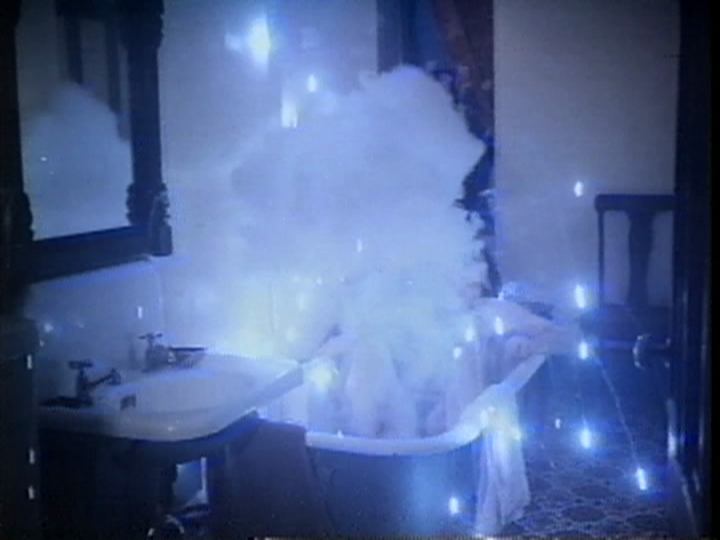
On the other hand, Miss den Dooven does have a certain charm -- at least if you're in the market for something full-figured, blonde-maned, and every bit as Dutch as her name would suggest. She'd make a fine ex-girlfriend.

...though, when it comes to marriage material, you could do worse.


Frankenstein 80 (1972)

Grade: D-


The stylish, pervy opening sequence of Frankenstein 80 leaves no doubt as to the seediness of the film to come. A woman is struck down, her armload of apples tumbling down the stairs like a flotilla of Potemkin baby carriages.


A sinister hand removes the victim's clothing and briefly fondles her body, lingering over the naughty bits, before cutting her open and removing one of her organs. Who would do such a thing? Maybe it was one of these people, if only we could read their names:

Ah, Mill Creek, keep creekin' on.

Anyway, Frankenstein 80 is what happened when Italian cinema decided to ask the question "Hey, what if the Monster were a rapist?" And here's the delightful answer:

OK, in fairness, that's probably the most unflattering shot in the film -- making him look like some stray member of Foghat getting frog-marched out of a trashed hotel room by his long-suffering agent (who'll take care of the dead hooker, again).

This one has a bit more impact, no?

Or perhaps you prefer the version where the monster -- aka Mosaic -- beats a woman to death with a beef bone?
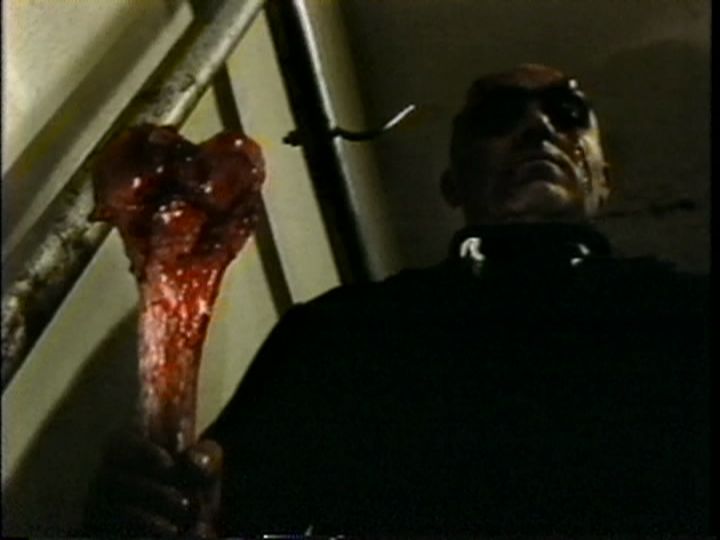
Anyway, Frankenstein 80 makes some silly pretense at a plot, with a missing serum, a dead patient and, of course, a megalomaniacal doctor whose last name rings no alarm bells whatsoever at the hospital where he works.

We're ostensibly meant to root for the de rigueur hero and his love interest, each of whom is about as compelling as the cotton stuffed in bottles of ibuprofen.

But the film's main hook is undoubtedly the steady trickle of T&A elicited by the rampaging Mosaic. In 1972, that might have been titillating; now, nearly five decades later, Frankenstein 80 has nothing much to offer, and no real basis on which to expect your attention.

Unless you're a Mill Creek completist (or a Frankenrape buff, and God help you if you are), don't bother watching this one.


Death Warmed Up (1984)
[aka Death Warmed Over]

Grade: D+

We wanted to like Death Warmed Up. After all, it's from New Zealand, dates from the first half of the 1980s, and -- much as we later saw from Peter Jackson -- has no qualms about going completely over the top when necessary.

A few reviewers convinced themselves this was an effective and appealing film; it's easy to see how. The opening sequence is by turns taut, sexy, enigmatic, and violent, backed up by flashy cinematography that makes the most of each shot.

Even something as simple as an exterior shot of a building is handled with a bit of verve:

And the paroxysm of parricide (with a dash of, uh, fluorocide) that climaxes the first act? It still has some punch, even decades later.

But then Death Warmed Up takes a left turn and decides it wants to be Mad Max, with revenge and vehicles and blond dye-jobs...

...and some guy with no eyebrows (David Letch)...

...and a chase sequence in a tunnel. Mel Gibson's flick didn't have that, huh? Looks damn good, doesn't it?

Or wait, maybe we should make a high-concept zombie movie. Could we do both? Let's get some surgery going.

And a meaningless oscilloscope-type readout that looks like a butthole: can you do one of those up for a few hundred bucks?

And how about an exploding head or two?

Ooh, let's throw in an Indian stereotype (Jonathan Hardy). It's like A Face in the Fog, but ethnic!

For all the visual style and (potentially) glorious excess of Death Warmed Up, its complete failure to deliver any kind of narrative cohesion or character motivation pretty much spoils the fun. One of many questions left unanswered: why exactly does protagonist Michael (Michael Hurst) drag his friends with him on his revenge mission?

As the old saying goes, Death Warmed Up can't bedazzle us with brilliance, so it tries to befuddle us with bullshit. But not only do the film's visual fireworks fail to compensate for the lack of a coherent plot or script, it may well be that they actively contribute to the stunned, apathetic feeling that came over us about 45-50 minutes in.


With a distinctive cast and ambitious production values, it's a pity that Death Warmed Up burns its bridges so completely. But burn them it does, and the slapdash result is -- for the most part -- an unrewarding chaos of meaninglessness.

Wednesday, April 19, 2017

A ____ in the _____

No points for guessing our theme this time around -- but, on the other hand, you'll get quite a few points if you can follow the plots of these two convoluted murder-mysteries on first viewing. (We sure couldn't.)

And what else do they have in common besides the structure of their titles? Well, how about --
  • unusual projectiles,
  • piquant discussions of the human neck,
  • amateur detectives,
  • and truly horrific prints?
Yeah, that's about right.


A Face in the Fog (1936)

Grade: F

"Numb from the neck both ways": that's how spunky female reporter Jean Monroe (June Collyer) describes herself early on in A Face in the Fog. The exact gist of this idiom is obscure to us -- its only appearances on the Internet are an IMDb review of this very film, and a dead link on a message board for ex-Mormons -- but watching A Face in the Fog gave us a feeling that can't be too far removed from, well, whatever it means.

The film's plot seems like standard stuff: a mysterious, hunchbacked fiend is committing murder after murder, all centered on the Alden Theater, where a new production is soon to debut.

Cue our spunky female reporter, who nearly gets offed in the opening scenes (and whose ridiculous cries for help bear a remarkable resemblance to the arcade game King & Balloon, if you can dig that). She seems like our protagonist, but in reality, most of the legwork is done by her spunky male colleague Frank Gordon (Lloyd Hughes) and bumbling photographer Elmer (Al St. John).

Together, they hope to unravel the mystery -- and, apparently, claim a $2000 reward, though as far as we can tell that's never explicitly mentioned in the film. (Whoops!)

Of course, odds are that the reward was mentioned, but got lost in one of the many, many cuts and skips that plague this copy of A Face in the Fog. It's hard to give the film a fair shake when it's represented by a print this damaged. While the sound quality is tolerable, the picture is often blurry and hard to make out, and several key scenes are so badly hacked to bits that we literally had to watch the film three times to fully piece together what was going on -- and there are still several things, like the reward, that remain unclear to us.

But even if the print were intact, we'd probably still be confused by A Face in the Fog. First and foremost, it suffers acutely from a common 1930s affliction: a severe excess of interchangeable white guys in hats. We struggled mightily to differentiate between the many fellows in chapeaus, and eventually resorted to making notes in a text file just to keep track of them all.

Second, A Face in the Fog doesn't make any sense -- a diplomatic way of saying that, basically speaking, it's dumb as hell. For instance, we learn very early on that the Fiend's weapon of choice is a large projectile, and yet "there hasn't been a mark of any kind" on the victims. As Kittka from the Specialists would say, eet's not poss-ee-bull -- and it's not the only law of physics that gets violated by the murder weapon.

And speaking of the victims, as they expire, they take the time to say "His name is..." and then collapse, instead of just blurting out the name of the murderer like any human being would.

Meanwhile, key moments in the plot, including the film's climax, are shaped not by the protagonists, but by minor characters. Halfway through, a man we've never seen before is introduced -- some rando who's yet another guy in a hat, basically -- and he immediately becomes the prime suspect. This is not good storytelling (especially since, let's face it, it's completely obvious whodunit by the halfway point of the film, if not sooner).


With a better and more complete print, A Face in the Fog might be marginally more coherent. But it's not as if that would help with the stupidities of its plot, the inane and repetitive dialogue, the unfunny comic relief, the stiff performance of June Collyer (and her lack of chemistry with Hughes), or any of the film's many other turnoffs.


A Shot in the Dark (1935)

Grade: D


The protagonist of A Shot in the Dark, a college boy named Kenneth Harris, is played by one Charles Starrett. Tell us that was a pseudonym for John de Lancie, Sr., and we'd surely believe you -- so strong is his resemblance to the actor who played perennial irritant Q on Star Trek: TNG.

The movies we watch seldom come to the attention of the major press, but back in 1935, Andre Sennwald at the New York Times wrote a review of A Shot in the Dark that's pretty much on point. To quote one of his choicer lines (with a spoiler redacted):
"A Shot in the Dark," which pictures a trilogy of murders on a rural college campus, telegraphs its punches in a way that...is as good as a confession to us amateur gumshoes. All you must do is single out the kindly ____, who obviously has nothing to do with the case, and then observe how the camera contemplates him for a moody second or two as he stares into the fire or drapes himself in the background with an air of furiously transparent innocence.
Pretty accurate, really, then and now.


To tell the truth, the cues were so obvious that we found ourselves wondering whether we were deliberately being misled. In such a case, one's suspicions turn to other characters, idly and musingly, in hopes that the scriptwriter had a curveball in store.

It's like the difference between being genuinely gullible, and consciously allowing oneself to half-believe a farfetched proposition simply because it would make life more interesting. One is foolishness; the other is a way to sustain a vague thread of hope in the face of disappointment. "Maybe something cool will happen," we tell ourselves, even knowing it probably won't.


But, as Sennwald writes, "There is a lot more to it, routinely told, and the trail leads relentlessly to the man who couldn't possibly have done the deed." Quite so. And if you've already ID'd the culprit in a murder-mystery, what's left to enjoy?

Well, the sound quality of A Shot in the Dark is horrendously muffled, and even with major EQ and other intervention, several lines of dialogue escaped us completely. But at least the picture isn't bad, letting us appreciate a few choice shots -- like this one, where a hanged man's dangling feet cast a macabre shadow:

And even with the damaged soundtrack, there are a few wonderful voices to be had in A Shot in the Dark, like the unexpected basso profundo of Professor Brand (John Davidson) --

-- or the affable growl of Robert McKenzie, evoking the quintessential country sheriff, and a few Sesame Street characters besides.

But the twists and turns in A Shot in the Dark -- and there are a few -- just don't have that feeling of inevitability that can keep a mystery interesting even after you've guessed all the guessables. OK, fine, here's a long-lost love, and a long-lost sibling, and a "You look just like ____!", and an unexpected bit of collateral damage: but who cares? It all feels arbitrary and piled-on, filler for a fundamentally thin plot, a way to keep us hung up for just a bit longer.

Not only do both films have a surfeit of minor characters (mercifully more distinguishable here, at least), but the victims in A Shot in the Dark also suffer from the same folly as those in A Face in the Fog: "It was --", they begin, and before they finish their sentence, it's curtains.

So, a memo to all witnesses everywhere: lead with the name, save the deets for later. The alternative just drags things out and makes everyone miserable, especially those of us who have to watch this stuff.

Friday, April 14, 2017

Four of a perfect pair

Some genres offer bodies of work so self-similar that, naturally, we sometimes confuse one film with another, or get the details mixed up in our minds. Take, for instance, the archetype of the spunky female reporter, saved from grisly death by (poison flowers/murderous lunatics/toxic gas/hired goons) thanks to the well-timed intervention of her love interest, a (policeman/ADA/reporter/detective), whom she marries at the end of the film. Can you fill in those blanks for a movie like A Shriek in the Night or The Fatal Hour without Googling? We sure can't.

It gets weirder, though, when we find ourselves confronted with pairs of unrelated films that don't have much in common with each other but, when considered as a duo, bear a striking resemblance to another couple of films.

Such is the case with these two flicks. There's very little connection between The Dungeon of Harrow and The Devil's Sleep, except that they're both on Disc 39, Side B of the Mill Creek 250-pack, and so we watched them consecutively. But as a pair, they have a freakishly large amount in common with the two films we wrote about here, Bloody Pit of Horror and City of Missing Girls. Some examples:
  • Brooding nobleman in isolated castle engages in sadistic behavior towards visitors while living under the shadow of a lethal, disfiguring plague? Well, that's The Dungeon of Harrow and Bloody Pit of Horror.
  • Hoodlum, threatened with prosecution for leading young folk into iniquity, engineers compromising photograph in order to blackmail high-ranking officer of the court into resigning? And then, girlfriend of court officer goes sexily undercover to thwart blackmail plot, but has cover immediately blown? Why, that's City of Missing Girls and The Devil's Sleep.
  • Film prominently features famous real-life strongman as major character? Huzzah, it's Bloody Pit of Horror and The Devil's Sleep.
  • How about a captain -- played by a well-known "name" actor whose fame exceeds that of anyone else in the cast -- who offers a much-needed voice of sanity and competence in the midst of chaos, and treats his junior partner with kind respect? Look no further than The Dungeon of Harrow and City of Missing Girls.
Clearly, these four have their cross to share: what a perfect mess! But let's pull out our torch, wooden sword, and superfluous apostrophes for our descent into:


The Dungeon of Harrow (1962)

Grade: D


What on earth to make of this moody, messy affair? How do you parse a movie that clearly plans to live or die by the virtues of its dialogue, but is chock full of line readings stiff enough to make Faith Clift blush?

How, exactly, to take a movie seriously that mispronounces the name of its own antagonist? (Yes, the bad guy is "duh Sayd", it seems, and Donatien Alphonse François is spinning in his grave.)


Or that thinks you can turn an ordinary middle-aged man into a convincing facsimile of the devil, simply by inverting the colors of the shot?


And yet there's something vaguely endearing about The Dungeon of Harrow, whose flaws aren't, one imagines, the product of mercenary cynicism or Woodian half-assery. For such an obviously cheap film, it manages to conjure an impressive degree of atmosphere; even when the props and costumes look to be borrowed from the local summer stock theater -- or simply made from whatever the 1962 equivalent of the local dollar store had on hand -- it's somehow forgivable.


We're guessing this was a labor of love for Pat Boyette, who wrote and directed the film, serves as its narrator, and even gets credit for the soundtrack (though from the sound of it, we'd guess he was just bringing up the faders on various snatches of library music). He was also a well-known comic book artist, though a claim on IMDb that he was associated with Howard the Duck appears to be completely false.

Thing is, The Dungeon of Harrow isn't stupid, just amateurish. And it's got a real edge to it too, with whips, chains, décolletage that reveals a bit more than usual for 1962, graphic deaths at the hands of piercingly-thrown swords, and -- hey, speaking of piercings -- female characters who'll never again have the chance to say "Hey, Mom, look what I did!" 

Also, we can't overlook Matches -- de Sade's towering (and fiercely loyal) black servant -- whose bizarre getup and platinum blond dye job evoke nothing so much as a Santa Claus/Dennis Rodman mashup (as one site aptly noted). Somehow Maurice Harris brings a certain dignity to a part that, let's face it, is only one or two notches above the likes of The Lost City on the racism-o-meter.

What else can we say? It's The Dungeon of Harrow. It's low-budget, ham-fisted regional filmmaking. It's ponderous voice-over narration. It's "Oh my God, no!" said with an inflection more suitable to discovering that you put the wrong mustard on your turkey sandwich, and you really wanted the Dijon but I guess you'll have to live with the yellow because it's not as if you're going to clean that off, I mean you could but it's a hassle and a waste and why didn't you pay more attention? Now your sandwich isn't good and it's the only sandwich you get to have today, so there.

It's a print that looks like ass (go for the Vinegar Syndrome release, we figure, if you want to see this one at its best). And it's...well, it's pretty decent makeup, actually! Good job, Henry (or is it Enrique?) Garcia.


The Devil's Sleep (1949)

Grade: D+

"Mr. America, walk on by / Your supermarket dream"?

"Mr. America, walk on by / The liquor store supreme"?

"Mr. America, try to hide / The product of your savage pride"?

But -- sorry, Frank -- Mr. America, aka George Eiferman, doesn't do any of those things. He's scrupulously honest and humble, hides nothing, and is entirely drug- and alcohol-free. And naturally, he only gets about ten minutes of screen time, which is all well and good since he can't act his way out of a paper bag. (Dude sure was jacked, though.)

No, The Devil's Sleep may talk a big game when it comes to its featured celebrity, but the vast preponderance of the film is devoted to the naive teens, pill-pushing hoods, and upstanding citizens affected one and all by the scourge of prescription drug abuse: mainly uppers, but some downers too.

It even casts a shadow over The Honorable Rosalind Ballantine (Lita Grey), who's refreshingly portrayed as a judge first, woman second. And when she has a come-to-Jesus moment late in the film, wondering if she hasn't erred by putting her career before her maternal duties, her daughter Margie (Tracy Lynne) shuts her right down, and there's no more said about that. Nice!

Ballentine is one of several public servants who, alarmed by growing episodes of drug-fueled juvenile delinquency, decide to take the fight to local hood Umberto Scalli (Timothy Farrell). Naturally, Scalli -- who, as villains go, is nearly interchangeable with King Peterson from City of Missing Girls -- won't take this lying down. He's not nearly as genteel about it as Peterson, but then again he doesn't seem to murder people routinely, so that's a plus in his column.

Then there's Sergeant Dave Kerrigan (William Thomason), whose girlfriend is Margie's boyfriend's sister. (We literally stopped the DVD to work this out.) And he does the things these guys do in all these movies: do you really need us to tell you what?

Especially for a 1949 film, The Devil's Sleep has a surprising amount of T&A. Some of this revolves around the reducing clinic that's one of Scalli's rackets, where plump aspirants are fed dangerous stimulants to get the pounds dropping off (but don't tell Mr. America!). Cue sideboob, natch, and even more beneath the frosted glass.

The plumpest of those aspirants is Tessie T. Tesse (Mildred Davis). Her considerable girth doesn't go unremarked upon, but the expected jokes have an unexpected lack of nastiness. They wouldn't pass muster on Tumblr -- and what does, really, except the self-righteous spleen-venting of bourgeois brats whose entitled whining so materially and categorically contributed to the election of the unelectable that one might reasonably think them agents provocateurs? -- but (ahem, don't mind us) it's still remarkably gentle for the time, or for such a lightweight movie (no pun intended).

Davis's ownership of her own size -- and witticisms at her own expense -- are the poised responses of a seasoned comedienne. But with no other IMDb credits, her experience must have been on the vaudeville circuit. Too bad; she's pretty good, and could've shined in bit parts on I Love Lucy and so forth.

On a different note, creeped out by Gary Crosby on Adam-12? Well, here's a prototype:

Short, jacked men with domestic violence haircuts and fetal alcohol faces: they just feel like snakes in-a-gadda-da-vita, somehow. So, guess that means Stan Freed is well cast as Hal Holmes, Scalli's liaison to the hungry mouths of teens who just want to loosen up a little.

Holmes is also instrumental in getting Margie in trouble, yielding even more teh und ah in photographic form:

Anyway, to get to the point, The Devil's Sleep is inoffensive but preachy mediocrity, with several scenes that could plausibly have been co-written by Ed Wood if the timeline allowed for it. Then again, amphetamines are scary stuff -- so a bit of moral panic is, for once, hard to fault. After all, you could end up like this guy: